
The U.S. bond and equity markets are telling two distinctly different stories.
The U.S. bond market and equity market are telling two distinctly different stories.
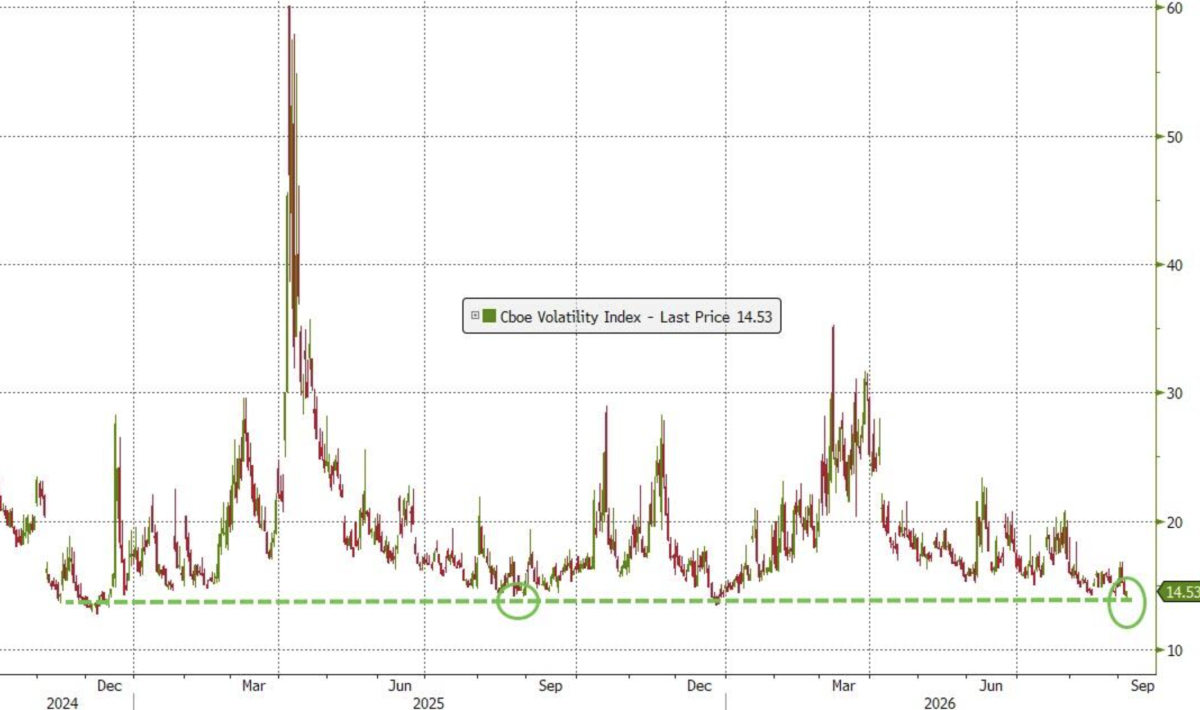
During the Labor Day holiday, global bond markets remained under pressure: Japan’s 10-year government bond yield rose to its highest level since 1996, while the UK’s 30-year gilt yield touched highs last seen in 1998. Duration assets in developed markets faced sustained selling throughout the summer. Meanwhile, the VIX index, a gauge of fear in the U.S. equity market, fell to its lowest level since Trump’s second term (excluding the Christmas holiday period). The MSCI World Index has gained 13% year-to-date, standing less than 1% below its historical peak.
 This divergence is the core contradiction highlighted by Goldman Sachs partner Mark Wilson in his latest "Weekly Mash" newsletter. He points out that the narrative of equity market "resilience" masks a quietly unfolding reality: valuation multiples have been contracting under the pressure of rising yields, yet the market has not fully priced in changes to discount rates. As students return to school and the market shifts out of its summer mode, Wilson outlines the current landscape of opportunities and risks around four key themes.
Federal Reserve Governor Waller has explicitly signaled that the upcoming CPI and PPI data releases are critical. Before these inflation figures are released, the "cognitive split" between bond and equity markets may continue to test investors’ judgment.
Paradox One: Momentum factors have been halved, but the market narrative remains unchanged
This summer, the internal structure of the market has undergone profound changes, yet this shift has not received the attention it deserves.
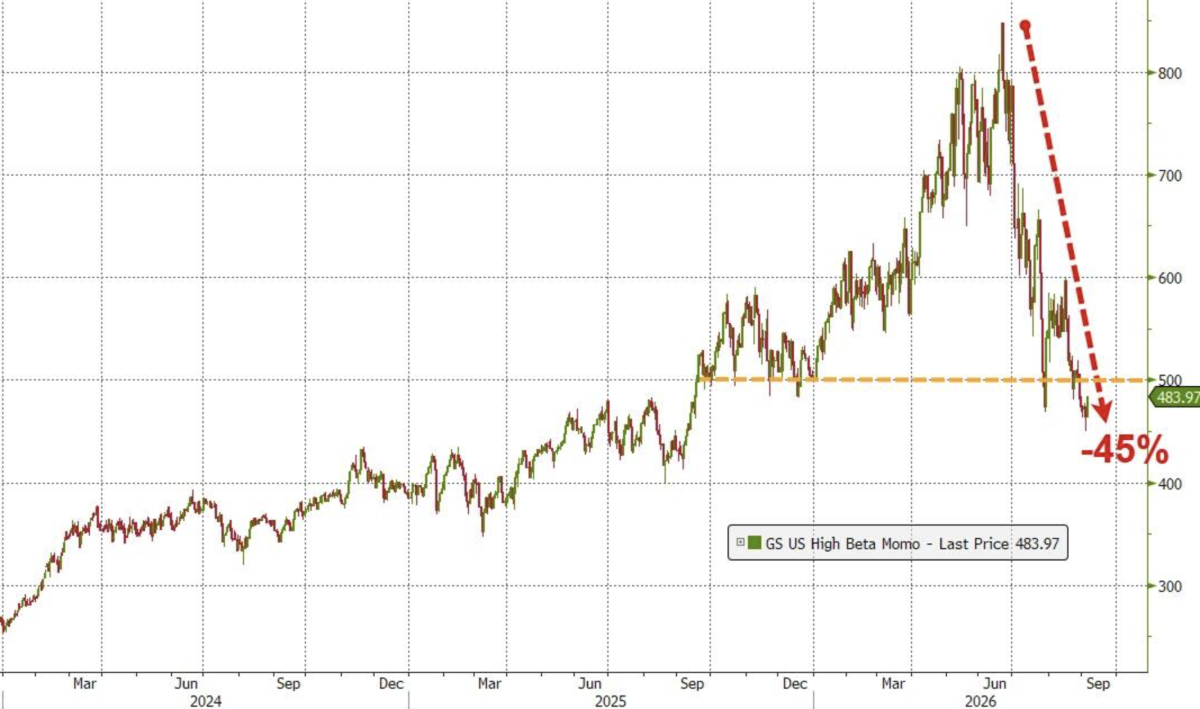
Wilson notes that the "High Beta Momentum" portfolio tracked by Goldman Sachs has retraced nearly 50% from its late-June highs, turning its year-to-date cumulative returns negative. While the rotation in July was widely discussed, the second wave of declines in August barely attracted sufficient attention. He argues that the risk transfer and digestion pressures stemming from July’s events weighed on price action in August, which should come as no surprise.
Of greater concern is the change in the composition within momentum factors: software stocks have moved to the long side on a three-month horizon but remain on the short side on a twelve-month horizon. Wilson clearly states that one should not expect the leading sectors of the first half to reassert dominance in the second half.
Paradox Two: Yields hit generational highs, while valuations bleed beneath the equity market’s "resilience"
The continued rise in global yields is one of the most underestimated risks of the current market cycle.
Wilson acknowledged that equity markets have demonstrated considerable resilience in the face of a sharp rise in global yields; however, he also pointed out that valuation multiples have actually contracted during this "period of resilience," and the market has not fully rewarded the "remarkably consistent" strong earnings performance seen year-to-date.
He attributed the current pressure in the bond market to two independent main themes: first, the geopolitical risk premium resurfaced in August, with conflicts in the Persian Gulf and escalating tensions between Russia and Ukraine driving a repricing of oil and gas prices; second, the AI investment wave has delivered a dual shock—large technology companies have begun financing capital expenditures through debt, intensifying competition for capital while also creating price pressures in specific economic sectors.
Wilson’s conclusion is direct and clear: "Once the fixed-income sell-off stops and yields stabilize, it will be an unconditional positive for equities. And this is precisely the clearest signal at present—because the sell-off has not yet ceased."
Paradox Three: Geopolitical risks are heating up, yet European defense stocks have underperformed their fundamentals for a full year
Logically, rising geopolitical risk should be a direct tailwind for the defense sector, but the actual market trend has been precisely the opposite.
Wilson noted that over the past 12 months, there has been a 25% divergence between the stock price performance and earnings trends of European defense stocks—earnings have remained robust, while share prices have consistently lagged. Current positioning in the sector is at a two-year low, with Goldman Sachs Prime Brokerage data showing that the long-short ratio has just begun to recover from local lows.
He partially attributed the initial valuation discount to the substitution effect of "new tech" replacing "old tech," but pointed out that this explanation no longer holds as both segments are now under pressure.
Regarding the political calendar, Wilson advised investors to monitor the recent regional elections in Saxony, the Swedish elections, and the increasing probability of Marine Le Pen winning next year's French presidential election. He explicitly stated a preference for increasing exposure to European defense stocks at current levels.
Paradox Four: The AI narrative is shifting from "shovel sellers" to "shovel users," with CyberCab potentially being the most undervalued signal
The AI investment theme is undergoing a significant narrative shift.
Wilson pointed out that the market is shifting from beneficiaries of AI capital expenditure (i.e., the infrastructure layer) to beneficiaries of AI application scenarios—a rotation trend expected to continue, moving from Salesforce to Snowflake and then to Tesla. The fundamental evidence he cited includes: NVIDIA’s results significantly exceeding expectations with raised guidance, Dell conveying similar signals, positive reception of OpenAI’s Astra model, and the pattern of parallel development in open and closed ecosystems revealed by NVIDIA’s acquisition of Hugging Face.
Wilson specifically highlighted the progress of Tesla’s CyberCab, describing it as one of the most impressive yet least discussed pieces of evidence for a leap in AI capabilities. Citing data, he noted that cumulative mileage for CyberCab stood at 380,000 miles as of Tesla’s earnings call on July 22, but rapidly surpassed 1 million miles thereafter.
On a longer-term horizon, Wilson mentioned that Goldman Sachs has increased its 2030 shipment forecast for humanoid robots sixfold and has begun assessing their operational impact. For example, automation is projected to generate approximately $72 billion in cost savings for Amazon, along with a 240 basis point improvement in EBIT margins.
Overall, Wilson’s core judgment is that after a summer of "narrative indigestion" in the first half of the year, the market has completed its rotation, undergone valuation compression, and begun seeking a new narrative that can remain self-consistent in a high-yield environment. However, he warned that Japanese and UK government bond yields at generational highs are not merely an ignorable "atmosphere," but rather reflect higher discount rates, intensified capital competition driven by AI debt financing, and the reality that "resilient growth" and "perfect pricing" can coexist—until they suddenly cannot. The low level of the VIX may simply indicate that the market has not yet found sufficient reason to panic, rather than that risks have dissipated.
Source: Wall Street News; Author: Zhao Ying; Zhitong Finance Editor: Wang Qiujia