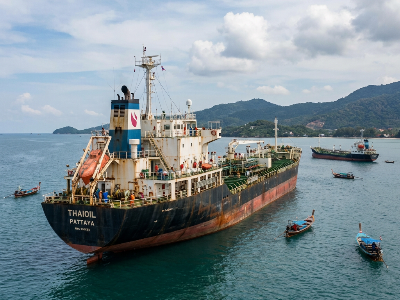
The nature of the military conflict between the United States and Iran underwent a significant shift this week. As U.S. military strikes targeted crude oil tankers in transit for the first time, moving beyond coastal military facilities, this marks a formal escalation from "targeting production capacity and infrastructure" to "disrupting transportation corridors." Consequently, market focus has shifted from "the extent of Iran's production cuts" to "whether the U.S. military intends to systematically sever Iran's crude oil supply chains," prompting a reassessment of global crude oil pricing logic.
The nature of the US-Iran military conflict underwent a significant shift this week, as US strikes targeted crude oil tankers underway for the first time, moving away from coastal military facilities and infrastructure. Consequently, the risk of supply disruptions in the Strait of Hormuz has moved from theoretical expectation to imminent reality, prompting a reassessment of global crude oil pricing logic.
According to CCTV International News, US Central Command (CENTCOM) issued a statement on September 5 stating that "US forces struck three Iranian crude oil transport vessels after the Islamic Revolutionary Guard Corps (IRGC) fired ballistic missiles at two US Navy ships patrolling regional waters." CENTCOM subsequently released a strongly worded statement: "We will not hesitate to defend US forces and, if necessary, will destroy Iran's limited and exposed oil tanker fleet."
 This marks the first time since the conflict erupted in February that the US military has included crude oil tankers underway in its strike targets, signaling a formal escalation of US-Iran confrontations from "targeting production capacity and facilities" to "targeting transportation corridors." Market focus has thus shifted from "the extent of Iran's production cuts" to "the safety of passage through the strait," placing both oil prices and shipping insurance pricing frameworks under pressure for revaluation.
Earlier on the same day, Iranian media reported that an oil tanker near Kharg Island was allegedly hit by a US missile; evacuation efforts are underway, with no casualties reported so far. The day before, Tehran was reportedly said to have fired anti-ship missiles at vessels in the Strait of Hormuz. These intensive actions targeting maritime traffic lanes continue to drive up the region's shipping risk premium, subjecting the Strait of Hormuz to its most severe security test since the outbreak of the conflict.
Qualitative Shift in Strike Targets: From Destroying Facilities to Targeting Oil Tankers
Over the past week, US military strikes have focused on the Islamic Revolutionary Guard Corps' (IRGC) air defense positions, mine-laying facilities, radar systems, maritime assets, communication sites, and ground facilities at key oil export hubs such as Larak Island and Kharg Island. On Sunday, CENTCOM conducted "limited and precise operations" against Iranian mine-laying units in the strait, followed by another round of strikes on Tuesday targeting IRGC air defense positions and mine-laying facilities.
The direct strike on three crude oil tankers underway expands the target scope from static military assets to dynamic transportation vehicles. The US stated that the trigger was Iran's firing of ballistic missiles at two US Navy warships. CENTCOM's public warning that it would "destroy Iran's oil tanker fleet if necessary" further indicates Washington's intent to include Iran's energy export capability itself within the scope of strikes. Compared to previous damage to infrastructure, direct attacks on transport vessels have a more immediate and direct impact on Iran's crude oil export capacity.
Shipping Disruption Becomes Reality: Safety of Passage Through the Strait Emerges as Core Variable
The Strait of Hormuz handles approximately 20% of global crude oil shipments, serving as the most critical chokepoint for global energy supply. Previously, market pricing of the conflict mainly revolved around potential losses in Iran's production capacity and facility damage. Now, direct attacks on oil tankers have extended the risk to the passage itself, making shipping disruption no longer a hypothetical scenario.
According to a report by Iran's Fars News Agency on the 5th, multiple explosions were heard in the waters near Kharg Island, and an Iranian oil tanker was reportedly hit by a US missile. Crew evacuation is underway, with no casualties reported so far. The previous day, Tehran was allegedly said to have fired anti-ship missiles at vessels in the Strait of Hormuz. While Iranian media and the US military differ in their accounts regarding the number of tankers and specific locations, both sides point to the core fact that "oil tankers were attacked."
Iran responded promptly. According to a report by the Islamic Republic News Agency (IRNA) on the 6th, the Public Relations Department of the Islamic Revolutionary Guard Corps (IRGC) announced that the IRGC Air Force had launched multiple ballistic missiles, striking a U.S. aircraft carrier and a destroyer. The statement claimed that both U.S. naval vessels were "forced to withdraw from the conflict zone after sustaining damage." The intense exchange of fire targeting maritime supply lines marks the most severe security challenge the Strait of Hormuz has faced since the outbreak of this round of conflict.
Shift in Crude Oil Pricing Logic: Can the Geopolitical Premium Persist?
For the crude oil market, the core issue is no longer "how much oil Iran can produce," but rather "whether this oil can be exported." If attacks on oil tankers further spill over to affect international commercial fleets, shipping insurance pricing will face sustained upward pressure, thereby influencing shipowners' route choices and overall logistics costs.
Amid escalating tensions, oil prices were already at elevated levels: WTI crude stabilized near $91 per barrel after accumulating a roughly 9% gain over three consecutive days, while Brent crude settled below $96. Market analysts noted that the latest escalation may continue to support oil prices, but whether a window for negotiations exists for both the U.S. and Iran to de-escalate will determine the sustainability of the geopolitical risk premium.
Key factors to monitor going forward include whether the U.S. military systematically expands its strikes against Iranian oil tankers, and whether there are substantive changes in transit arrangements for international commercial tankers in the Strait of Hormuz as well as in shipping insurance rates.