
Source: China Securities Co., Ltd. (CSC)
By Hu Yuwei, Zhou Zhihan
Executive Summary
On September 6, ICBC,$ABC (01288.HK)$respectively disclosed plans for private placements of A-shares to specific investors, aiming to raise no more than RMB 100 billion and RMB 160 billion. The Ministry of Finance intends to subscribe for RMB 70 billion and RMB 130 billion respectively, with participation from China National Tobacco Corporation and its subsidiaries, among others. The net proceeds, after deducting issuance expenses, will be used entirely to replenish Core Tier 1 capital. The issue price shall not be lower than the average trading price of the shares over the 20 trading days preceding the first day of the issuance period, and the subscribed shares will be subject to a five-year lock-up period.
On the same day,$The People's Insurance (601319.SH)$disclosed a plan for a private placement of up to RMB 15 billion to the Ministry of Finance; China Re disclosed a plan to issue domestic shares worth RMB 3 billion to the Ministry of Finance (issue price: RMB 1.33/share, issued at a premium);$CHINA LIFE (02628.HK)$Group,$CHINA TAIPING (00966.HK)$, the Export-Import Bank of China, and China Export & Credit Insurance Corporation announced on the same day that they had received capital injections of RMB 35 billion, RMB 7 billion, RMB 30 billion, and RMB 10 billion from the Ministry of Finance.
 The private placements by ICBC,$Agricultural Bank Of China (601288.SH)$mark the launch of the second round of capital replenishment for state-owned large banks, with all six major state-owned banks having entered or completed this round of capital replenishment. Both rounds of capital injection were deployed under the Government Work Report of the respective years, funded by special sovereign bonds, totaling RMB 800 billion.
The Ministry of Finance's total capital injection in this round amounts to RMB 300 billion, fully aligning with the special sovereign bond quota outlined in this year's Government Work Report. The scope of support has expanded from commercial banks to include insurance and policy financial institutions, with all central state-owned insurance enterprises included, reflecting a systematic approach. The issuance is priced at full market value; China Re issued at a premium with a five-year lock-up period, highlighting its long-term capital nature and exerting a positive impact on the secondary market. Within one week of the disclosure of the initial capital injection plans, four banks recorded significant price increases and excess returns, demonstrating notable resilience during extreme market conditions.
Capital replenishment will enhance credit extension and risk coverage capabilities. Capital injections into policy-oriented institutions will also improve their ability to supply funds for serving the real economy and supporting opening-up, sending positive signals for stabilizing growth and expectations.
Main Text
I. Event Overview
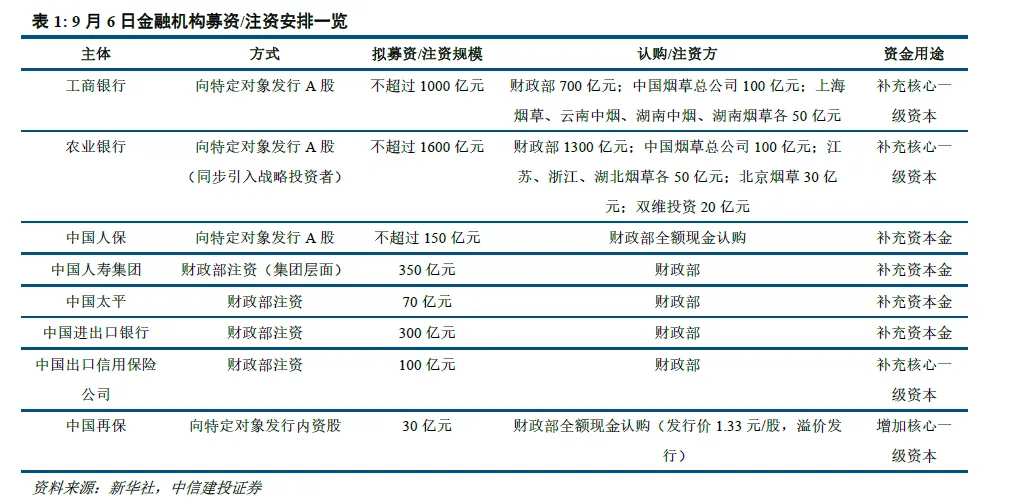
On September 6, ICBC, Agricultural Bank of China, PICC, China Re,$China Life Insurance (601628.SH)$Group, China Taiping, Export-Import Bank of China, and China Export & Credit Insurance Corporation, among eight central financial enterprises, announced capital increase plans on the same day. The Ministry of Finance will inject a total of RMB 300 billion into these eight institutions, marking the formal implementation of concentrated capital replenishment within the state-owned financial system.
Specifically, ICBC and Agricultural Bank of China held board meetings to approve plans for issuing A-shares to specific investors. ICBC plans to raise no more than RMB 100 billion, with the Ministry of Finance subscribing to RMB 70 billion, China National Tobacco Corporation to RMB 100 billion, and Shanghai Tobacco, Yunnan China Tobacco, Hunan China Tobacco, and Hunan Tobacco each subscribing to RMB 50 billion. Agricultural Bank of China plans to raise no more than RMB 160 billion, with the Ministry of Finance subscribing to RMB 130 billion, China National Tobacco Corporation to RMB 100 billion, Jiangsu Tobacco, Zhejiang Tobacco, and Hubei Tobacco each subscribing to RMB 50 billion, Beijing Tobacco subscribing to RMB 30 billion, and Shuangwei Investment subscribing to RMB 20 billion. Agricultural Bank of China will simultaneously introduce China National Tobacco Corporation and its relevant subsidiaries as strategic investors. The issue price for both banks shall not be lower than the average trading price of A-shares over the 20 trading days preceding the first day of the issuance period. Subscribers will pay in cash, and the subscribed shares will be subject to a five-year lock-up period. After deducting issuance expenses, the raised funds will be entirely used to replenish Core Tier 1 capital.
On the same day, PICC disclosed a plan for a private placement of up to RMB 15 billion in A-shares to the Ministry of Finance, which will subscribe in full with cash, with the proceeds used to replenish capital. China Re disclosed a plan to issue domestic shares to the Ministry of Finance, aiming to raise RMB 3 billion to increase Core Tier 1 capital. The issue price is RMB 1.33 per share, representing a premium over its H-share secondary market price, and subscribers have committed to long-term holding.
China Life Insurance Group, China Taiping, Export-Import Bank of China, and China Export & Credit Insurance Corporation announced on the same day that they would receive capital injections from the Ministry of Finance in the amounts of RMB 35 billion, RMB 7 billion, RMB 30 billion, and RMB 10 billion, respectively. These funds are intended to support these institutions in replenishing capital and enhancing their capacity to serve the real economy and fulfill policy-oriented functions.
II. Launch of the Second Round of Capital Replenishment for Large State-Owned Banks, with Full Implementation of the "Phased and Batched" Deployment
The disclosure of the private placement plans by ICBC and Agricultural Bank of China marks the official launch of the second round of capital replenishment for large state-owned commercial banks. This follows the 2025 completion of capital replenishment by Bank of China,$China Construction Bank Corporation (601939.SH)$、$BANKCOMM (03328.HK)$、$PSBC (01658.HK)$and represents the second round of capital increases initiated by large state-owned commercial banks.
From a policy perspective, this round of capital replenishment has been steadily advancing for over a year. In September 2024, financial regulators explicitly stated their intention to increase the Core Tier 1 capital of six large commercial banks, implementing the plan in an orderly manner based on the principle of "coordinated promotion, phased implementation, and bank-specific strategies." Subsequently, both rounds of replenishment were first deployed in the Government Work Report of the respective year, with the Ministry of Finance issuing special sovereign bonds to provide funding. The 2025 report specified the issuance of RMB 500 billion in special sovereign bonds, after which four major banks launched private placements, aiming to raise no more than RMB 165 billion, RMB 105 billion, RMB 120 billion, and RMB 130 billion respectively, totaling RMB 520 billion. Of this amount, the Ministry of Finance subscribed to RMB 500 billion, with the remainder subscribed by China National Tobacco Corporation,$CHINA MOBILE (00941.HK)$、$China CSSC (600150.SH)$and other investors. In March of this year, the Government Work Report further proposed the "planned issuance of RMB 300 billion in special sovereign bonds to support capital replenishment for large state-owned commercial banks." The issuance schedule announced by the Ministry of Finance indicates that the relevant "Special Sovereign Bonds for Capital Injection into Central Financial Institutions" will be issued in May and June of this year, with annual interest payments.
With the formal disclosure of the private placement plans by ICBC and Agricultural Bank of China, the phased replenishment of Core Tier 1 capital for large state-owned commercial banks has been further implemented. All six large state-owned banks have either entered into or completed their capital replenishment arrangements for this round. The cumulative allocation of special sovereign bonds by the Ministry of Finance across both rounds amounts to RMB 800 billion, systematically strengthening the capital base of state-owned financial capital.
Following the full implementation of this round of replenishment, the capital safety cushion for large state-owned banks will be further thickened. On one hand, this helps alleviate pressure on endogenous capital replenishment against the backdrop of narrowing net interest margins, thereby maintaining the stability and sustainability of credit extension. On the other hand, it enhances their capacity to supply funds to key areas and weak links such as technological innovation, green and low-carbon development, and inclusive finance for small and micro enterprises, better fulfilling their role as the main force in serving the real economy and as the ballast stone for maintaining financial stability.
III. Expansion of Support Scope to Include Central State-Owned Insurance Enterprises and Policy Financial Institutions, Systematizing the Capital Injection Framework
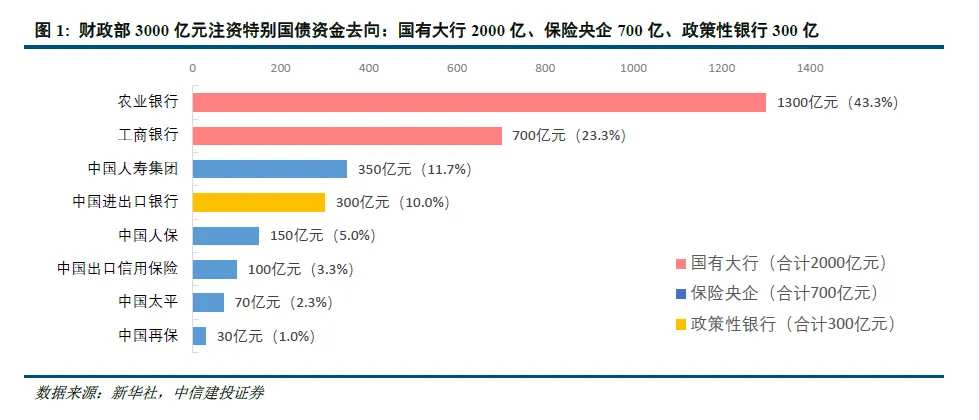
Unlike the first round of capital injection in 2025, which covered only state-owned commercial banks, this round further extends support to central state-owned insurance enterprises and policy financial institutions. This is not only a significant measure to enhance the capital strength and solvency adequacy ratios of insurance institutions and strengthen the financial system's risk resilience, but also achieves full coverage of the RMB 300 billion in special sovereign bond funds across three types of central financial enterprises: large state-owned banks, central state-owned insurance enterprises, and policy financial institutions.
At the State Council Information Office press conference on August 21, Vice Minister of Finance Liao Min stated, when introducing the relevant arrangements, that RMB 300 billion in special sovereign bonds would be issued to support capital replenishment for relevant central financial enterprises. The name of the bond itself, "Special Sovereign Bonds for Capital Injection into Central Financial Institutions," also reserves space for covering financial institutions beyond commercial banks.
PICC has disclosed its private placement plan. The Ministry of Finance has injected capital into China Life Insurance Group, China Taiping, China Export & Credit Insurance Corporation (Sinosure), and China Reinsurance. With this move, the four major state-owned insurance enterprises and China Reinsurance are all included in this round of capital replenishment. Additionally, the Export-Import Bank of China received a capital injection, further extending the scope of this capital replenishment to cover policy banks.
The Ministry of Finance's total capital injection in this round amounts to RMB 300 billion. This includes subscribing to RMB 70 billion of ICBC shares, RMB 130 billion of Agricultural Bank of China shares, RMB 15 billion of PICC shares, and RMB 3 billion of China Reinsurance shares; as well as injecting RMB 35 billion into China Life Insurance Group, RMB 7 billion into China Taiping, RMB 30 billion into the Export-Import Bank of China, and RMB 10 billion into Sinosure. The total amount aligns exactly with the RMB 300 billion quota for special sovereign bonds issued for capital injection, creating a complete closed loop between the use of funds and bond issuance.
For insurance institutions, this round of capital injection is a significant measure to enhance capital strength and solvency adequacy ratios, thereby strengthening their risk resilience. This will help them better serve as economic shock absorbers and social stabilizers. For the Export-Import Bank of China, the capital injection will bolster its credit supply capacity, providing better support for stabilizing foreign trade and foreign investment, and promoting high-level opening-up.
The capital bases of commercial banks, insurance institutions, and policy financial institutions have been simultaneously strengthened, thereby further enhancing the overall capability of the state-owned financial system to serve the real economy and withstand risks.
4. Issuance pricing is fully market-oriented, with distinct characteristics of long-term capital.
The private placements by ICBC and the Agricultural Bank of China, as well as the domestic share issuance by China Reinsurance, were all priced through market-oriented mechanisms. Subscribers such as the Ministry of Finance have committed to long-term holdings. The issuance arrangements exhibit a high degree of market orientation, clearly reflecting the attributes of long-term funds and patient capital.
Specifically, the issuance price is no lower than the average trading price of the shares over the 20 trading days preceding the first day of the issuance period, with no discount applied. The pricing level fully reflects the fair value in the secondary market, resulting in limited dilution of existing shareholders' equity. The lock-up period for shares subscribed by investors is up to five years. Subscribers such as the Ministry of Finance and the tobacco industry system enter as providers of long-term funds and patient capital, marking a clear distinction from short-term arbitrage-driven financing.
The Agricultural Bank of China also signed a strategic cooperation agreement with the tobacco industry system on the same day, introducing business synergies beyond capital ties. The subscription structure balances fiscal dominance with diversified participation by industrial capital, demonstrating a comprehensive design.
The plan disclosed by China Reinsurance on the same day further confirms this pricing orientation: the price for domestic shares issued to the Ministry of Finance was RMB 1.33 per share, representing a premium over its H-share market price in the secondary market, and the subscribers have committed to long-term holdings.
By subscribing at market prices or even at a premium, the Ministry of Finance, as a subscriber, not only demonstrates recognition of the long-term value of financial institutions but also fully protects the interests of minority shareholders and supports market confidence.
V. Strengthening the Capital Base to Enhance Financial Services for the Real Economy and Opening-Up
Following the completion of this round of capital injections, state-owned financial institutions will see simultaneous enhancements in their capital safety margins, risk resilience, and capacity to provide funding to the real economy.
Currently, the operations of major state-owned banks remain overall stable, with capital levels within a healthy range. According to Wind data, as of the end of June 2026, the Core Tier 1 capital adequacy ratios of the six major banks—ICBC, Agricultural Bank of China, Bank of China, China Construction Bank, Bank of Communications, and Postal Savings Bank of China—were 13.21%, 10.80%, 12.04%, 14.24%, 11.25%, and 10.04%, respectively, all significantly exceeding regulatory requirements. Asset quality also remained sound, with non-performing loan (NPL) ratios for the six major banks ranging between 1.00% and 1.30% during the same period; notably, the NPL ratios for ICBC, Agricultural Bank of China, Bank of China, China Construction Bank, and Bank of Communications all declined to varying degrees compared to the end of 2023.
However, net interest margins (NIMs) in the banking sector have continued to narrow. The NIM for commercial banks decreased from 2.08% at the end of 2021 to 1.41% in the first half of 2026, while the NIMs for the six major banks ranged from 1.23% to 1.63%. As the support provided by retained earnings for endogenous capital replenishment weakens, utilizing special sovereign bonds for exogenous capital injection represents a forward-looking arrangement to proactively strengthen risk resilience during a window of stable operations and improving asset quality.
An increase in capital adequacy will directly enhance the credit and asset allocation capabilities of major state-owned banks, thereby better supporting key areas such as technological innovation, green transition, and inclusive finance. For insurance institutions, capital replenishment helps improve solvency and risk protection capabilities, allowing them to better function as economic shock absorbers and social stabilizers, while also introducing more long-term, stable capital into the capital markets.
At the level of policy-oriented financial institutions, capital injections into the Export-Import Bank of China and China Export & Credit Insurance Corporation will help enhance their capacity to provide funding for the real economy and opening-up, as well as their resilience in risk prevention and control. This supports their effective fulfillment of policy-oriented financial responsibilities and service to major national strategies, holding positive significance for stabilizing foreign trade and foreign investment, and promoting high-level opening-up.
Overall, this round of capital injection arrangements balances the goals of stabilizing growth and preventing risks, playing a positive role in stabilizing market expectations and boosting market confidence.
VI. Lessons from History: Positive Secondary Market Response Following Disclosure of the Initial Capital Injection Plan
Following the disclosure of the initial capital injection plan, the banking sector rose against the market trend, delivering significant excess returns. This round of capital injections is expected to sustain this positive feedback, further boosting market confidence.
A review of the market performance following the disclosure of private placement plans by four major banks on March 30, 2025, shows that during the first trading week after the announcement (March 31 to April 3), Bank of China, China Construction Bank,$Bank Of Communications (601328.SH)$、$Postal Savings Bank Of China (601658.SH)$Share prices rose by 2.91%, 4.69%, 4.21%, and 0.38% respectively during the same period,$CSI 300 Index (800122.HK)$fell by 1.37%. The relative excess returns of the four banks against the index were approximately 4.28%, 6.07%, 5.58%, and 1.76% respectively; even amid the extreme market conditions on April 7, when external tariff shocks caused the$CSI 300 Index (399300.SZ)$The index's excess returns were approximately 4.28%, 6.07%, 5.58%, and 1.76%, respectively; even amid the external tariff shock on April 7,$CSI 300 Index (000300.SH)$to drop 7.05% in a single day, the capitalized banks as a group still demonstrated significant resilience to declines. By April 8, the cumulative excess returns of the four banks relative to the CSI 300 Index further expanded to 6.21%, 12.04%, 6.48%, and 5.21%.
Experience from the first round indicates that the capital injection arrangement, under which the Ministry of Finance fully subscribed at market prices with a five-year share lock-up period, received positive feedback from the secondary market. By strengthening the capital base and stabilizing operational expectations, it enhanced the allocation value of the banking sector. The terms of the current plan are consistent with the first round. Moreover, China Reinsurance Group's premium issuance and the Ministry of Finance's voluntary concession to the secondary market further signal a commitment to supporting the market and sharing long-term value with investors. This helps boost investor confidence, improve market risk appetite, and support the stable and healthy development of the capital market.
Risk Disclosure
(1) The implementation effects of existing policies and the progress of subsequent incremental policy introductions fall short of expectations; local governments have an incomplete understanding of central policies and inadequate implementation. (2) Economic growth is slowing, macroeconomic fundamentals are deteriorating, and uncertainty in economic operations is intensifying. (3) The real estate market has been volatile recently, with the potential for further deterioration in market sentiment; risk contagion from international capital markets may also trigger turbulence in domestic capital markets. (4) A sharp decline in land transfer revenue has led to a rapid expansion of local government debt scales, raising the risk of default. (5) Risks of escalating geopolitical confrontations persist, with the ongoing Russia-Ukraine conflict keeping the international situation tense.
Editor/Rocky