
Li Auto invested RMB 2.65 billion in Sunwoda Power, accelerating the switch to self-developed batteries across its entire lineup, a move directly aimed at "de-CATL-ization." HIMA, Xiaomi, XPeng, and others are also intensively introducing secondary and multiple suppliers, reshaping battery pricing and supply chain influence; however, CATL's market share remains above 50%, and its dominant position has not yet been shaken.
The power dynamics within the power battery industry are being quietly reshaped. Li Auto invested RMB 2.65 billion in Sunwoda Power and simultaneously announced a switch to self-developed batteries for its entire vehicle lineup, moving the concept of "de-CATL-ization" from slogan to substantive action.
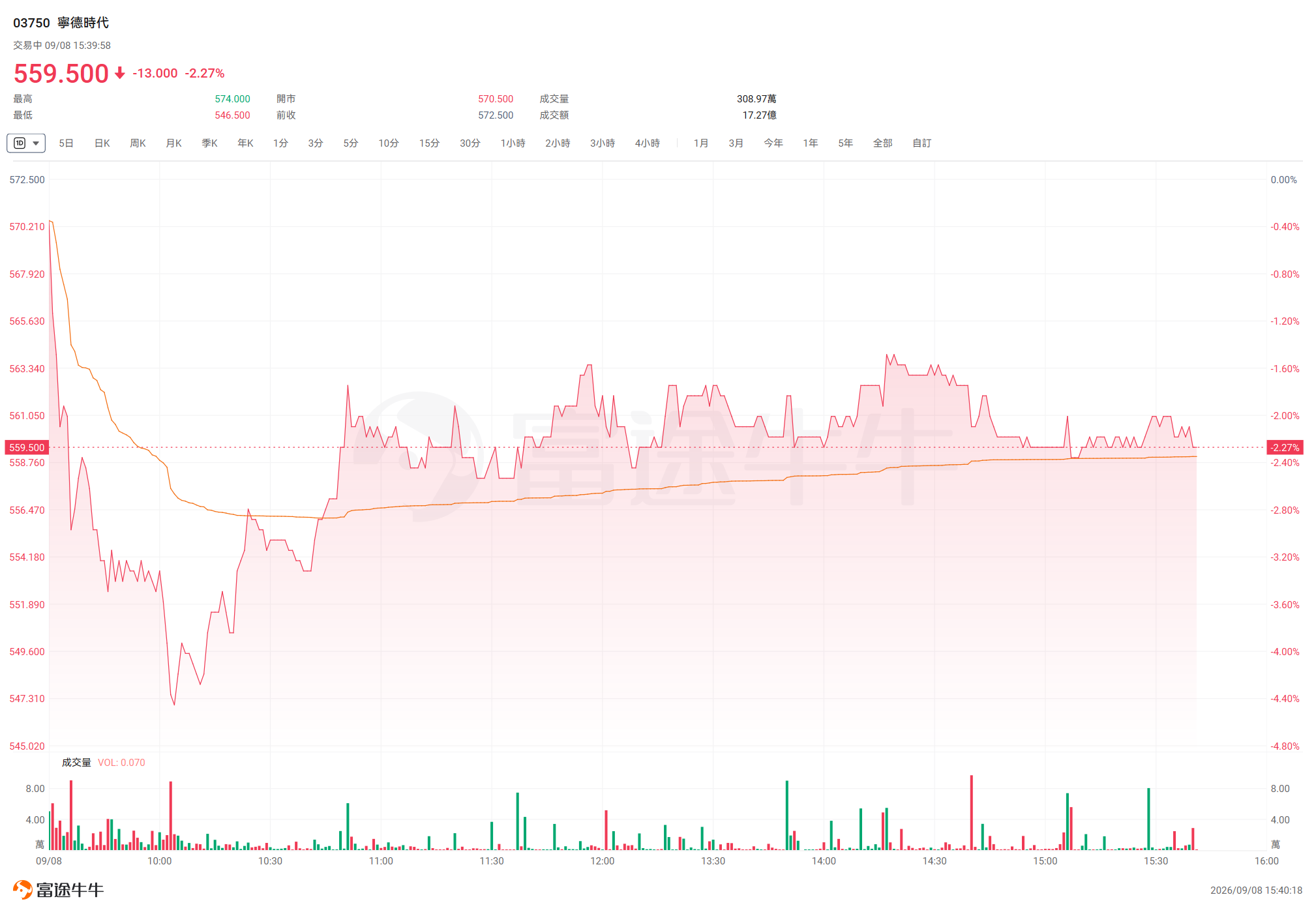
On September 8, CATL's stock price fell sharply, with A-shares$Contemporary Amperex Technology (300750.SZ)$dropping more than 3% at one point, and H-shares$CATL (03750.HK)$dropping more than 4% at one point; since pulling back from the high on August 6, the cumulative decline in A-shares has exceeded 18%. In terms of news flow, lithium carbonate futures have fallen by more than 11% since September, dropping from around RMB 160,000/ton to near RMB 140,000/ton, further suppressing market sentiment. Meanwhile, from HIMA to Xiaomi, and from Li Auto to XPeng, the moves by several mainstream automakers to intensively introduce "secondary" or even "multiple" battery suppliers have come to light one after another, suddenly heating up external discussions about CATL's core status as the "Battery King."
 Li Auto's latest strategic layout is particularly noteworthy. On September 4, Sunwoda announced,$LI AUTO-W (02015.HK)$its plan to subscribe for an 8.79% stake in its subsidiary, Sunwoda Power. Upon completion of the transaction, it will indirectly hold an 11.17% stake, becoming the second-largest shareholder. On September 7, Li Auto further announced that its self-developed batteries have been installed in models such as the L8, L6, and i8, and will subsequently cover the entire lineup. Flagship products like the MEGA and i9 will also gradually switch from CATL to self-developed solutions. With these two parallel steps, Li Auto's strategic intent in the battery supply chain is undisguised.
RMB 2.6 Billion Investment in Sunwoda: A Transaction of "Mutual Benefit"
According to Sunwoda's announcement on the evening of September 4,$LI AUTO-W (02015.HK)$it plans to invest RMB 2.65 billion to subscribe for approximately RMB 1.4 billion in new registered capital of Sunwoda Power, corresponding to an 8.79% stake after the capital increase. Combined with the equity previously held through Chongqing Chezhiyuan, Leading Ideal HK Limited, under entities related to Li Auto, will indirectly hold a total of 11.17% of Sunwoda Power, becoming the second-largest shareholder after the Sunwoda Group.
For Sunwoda Power, this capital injection is driven by deeper strategic logic.
In May this year, Sunwoda Power completed its Series C financing, bringing in 13 investors and raising RMB 1.68 billion; in July,$Sungrow Power Supply (300274.SZ)$and$TIANQI LITHIUM (09696.HK)$its subsidiary Shehong Tianqi invested a total of RMB 805 million to complete the Series C+ round. The frequent introduction of endorsements from industry leaders has been widely interpreted by outsiders as preliminary groundwork for Sunwoda Power's renewed IPO plans. As early as 2023, Sunwoda Power had announced its intention to spin off and list on the ChiNext board of the Shenzhen Stock Exchange, signing an advisory agreement with CITIC Securities, but was forced to suspend the plan due to continued losses at the subsidiary level.
Financial data shows that Sunwoda Power recorded revenue of RMB 20.093 billion and a loss of RMB 3.169 billion in 2025; in the first half of 2026, revenue reached RMB 15.529 billion, with the loss narrowing to RMB 324 million. Although the losses have not been fundamentally reversed, the narrowing trend may support expectations for a relisted offering.
For Li Auto, the strategic significance of this investment is equally clear: securing a battery supply partner with stronger bargaining power and lower dependency, thereby providing dual guarantees in capacity and technology to completely break away from reliance on CATL.
Li Auto's "De-CATLization": From Deepened Cooperation to In-House Substitution
$LI AUTO-W (02015.HK)$The relationship with Sunwoda Power dates back to 2017. At that time, Li Auto had not yet mass-produced any vehicle models but had already included Sunwoda in its supplier system. Both parties were in non-mainstream positions within their respective sectors, forming a motive to "band together for mutual survival."
In 2022, as Li Auto rose to the forefront of sales among new energy vehicle manufacturers thanks to its "family SUV" positioning, the company began accelerating supply chain diversification. During Sunwoda Power's Pre-A financing round that year, Li Auto led the investment with RMB 400 million, becoming the largest single investor. In February 2023, Li Auto officially announced its collaboration with Sunwoda, with the latter establishing dedicated production lines to provide battery packs for the L8 Air and L7 Air models. In September 2025, the two parties further upgraded their cooperation by jointly establishing Shandong Li Auto Battery Co., Ltd., each holding a 50% stake.
However, public data as of September 2025 shows that Li Auto has cumulatively delivered approximately 1.4 million vehicles, of which about 1 million still use CATL batteries, while Sunwoda's supply volume accounts for approximately 400,000 units. The dependence on CATL remains relatively high. It is precisely this reality that makes Li Auto's "De-CATLization" process more urgent.
On September 7, Li Auto announced an acceleration in the full-scale deployment of its self-developed batteries: the initial deliveries of the MEGA will switch from CATL's 5C ternary lithium batteries to Li Auto's in-house solution, with the i9 and the 2026 model of the i6 to follow. Li Auto stated that it initiated independent cell research and development in 2020, with core technologies covering a complete system including 5C cells, pack assembly, and Battery Management Systems (BMS). The company affirmed its strategic commitment to "keeping future core technological barriers under its own control."
Automakers are collectively adopting multi-supplier strategies, bringing bargaining power dynamics to the forefront.
Li Auto's move is not an isolated case. Recent new vehicle announcements by the Ministry of Industry and Information Technology show that the new all-electric version of the AITO M6 has already been equipped with$Gotion High-Tech (002074.SZ)$lithium iron phosphate batteries produced by its Yichun Gotion subsidiary, officially ending CATL's exclusive supply arrangement for AITO. According to informed sources, except for Zunjie, whose current scale does not yet support the introduction of a second supplier, other brands under HIMA (Harmony Intelligent Mobility Alliance) plan to introduce diversified battery suppliers,$CALB (03931.HK)$, Gotion High-Tech,$Sunwoda Electronic (300207.SZ)$will all enter the relevant supply chains.
Xiaomi EV's third model, "Xuntian," has also brought in CALB. The battery sourcing for this model was finalized in early 2024, with Sunwoda as the primary supplier and CALB as the secondary supplier, at an approximate allocation ratio of 60% to 40%. Previously, both the SU7 and YU7 models used$CATL (03750.HK)$and$BYD COMPANY (01211.HK)$battery solutions.
According to incomplete statistics, mainstream automakers such as Harmony Intelligent Mobility Alliance (HIMA),$XIAOMI-W (01810.HK)$、$LI AUTO-W (02015.HK)$、$XPENG-W (09868.HK)$、$LEAPMOTOR (09863.HK)$and GAC Aion have already$CATL (03750.HK)$introduced second or even multiple suppliers in addition to their primary ones.
Zhang Xiang, Secretary-General of the International Association for Intelligent Connected Vehicle Technology, pointed out that power batteries account for more than 30% of the total cost of electric vehicles. The bargaining power in this segment has long been held by single suppliers, leaving automakers in a passive position regarding supply chain negotiations, delivery cycles, and capacity allocation.
Industry insiders estimate that$CALB (03931.HK)$Gotion High-Tech, and Sunwoda offer lithium iron phosphate (LFP) battery packs at prices 3% to 10% lower than CATL. Taking an 81 kWh battery pack as an example, a 3% price difference translates to a cost gap of nearly RMB 2,000. For vehicle models with annual sales exceeding 100,000 units, this implies potential cost savings in the hundreds of millions of yuan.
Zhang Xiang stated: "'De-CATL-ization' is not about one party replacing another, but rather an inevitable step toward industry maturity. When too much bargaining power is concentrated in one segment, the industry will inevitably seek to restore balance. The era when a single battery manufacturer held dominant sway and automakers queued up to secure battery supplies is indeed gone."
CATL: Dominant Position Remains Unshaken
Market data shows that$CATL (03750.HK)$its dominant position in the power battery market remains unshaken. According to data from the China Passenger Car Association (CPCA), CATL's domestic market share of power batteries for new energy passenger vehicles rebounded to 50.1% in the first quarter of 2026, reclaiming "half the market" for the first time in five years. However, over the past four years, its market share stood at 47.2%, 43.5%, 45.3%, and 43.8% respectively, fluctuating within the 43% to 48% range.
Meanwhile, second-tier players are accelerating their breakthroughs. According to CPCA data, Gotion High-Tech ranked third in the industry with a 6.1% market share in the first quarter of 2026, hitting a record high;$CALB (03931.HK)$at 5.1%,$Eve Energy Co.,Ltd. (300014.SZ)$at 5.0%;$Sunwoda Electronic (300207.SZ)$、$REPT BATTERO (00666.HK)$, Svolt, and other companies all held market shares in the 2% to 3% range.
Editor/melody