
Morgan Stanley estimates that return on capital across different AI business models is attractive: providing API services with proprietary computing power can reach up to 46%, cloud providers leasing GPUs achieve approximately 31%, and those relying on third-party computing power see returns of around 25%. Meanwhile, after the capital expenditures of the four major cloud providers are projected to rise to $1.47 trillion in 2027, their growth rate is expected to decline to approximately 12% in 2028. AI investment is shifting from a focus on computing capacity to commercialization.
How is the return on investment for this round of AI "cash burn" by tech giants? Morgan Stanley offers a non-pessimistic outlook: model companies providing API services using their own computing power can achieve a Return on Invested Capital (ROIC) of up to 46%; hyperscale cloud providers renting out GPUs see an ROIC of approximately 31%; and even model companies relying on third-party infrastructure maintain an ROIC of around 25%. From the perspective of capital returns, this trillion-dollar AI arms race is not merely "burning cash."
More importantly, AI investments are gradually becoming self-sustaining. Morgan Stanley projects that the combined operating cash flow of the four major giants—Amazon, Google, Microsoft, and Meta—will rise from $739 billion in 2026 to $1.23 trillion in 2028, while new debt financing needs during the same period will decline from $238 billion to $90 billion. By 2028, new debt requirements for these giants will amount to only about 7% of their operating cash flow, indicating that financial pressure has not worsened in tandem with the expansion of capital expenditure.
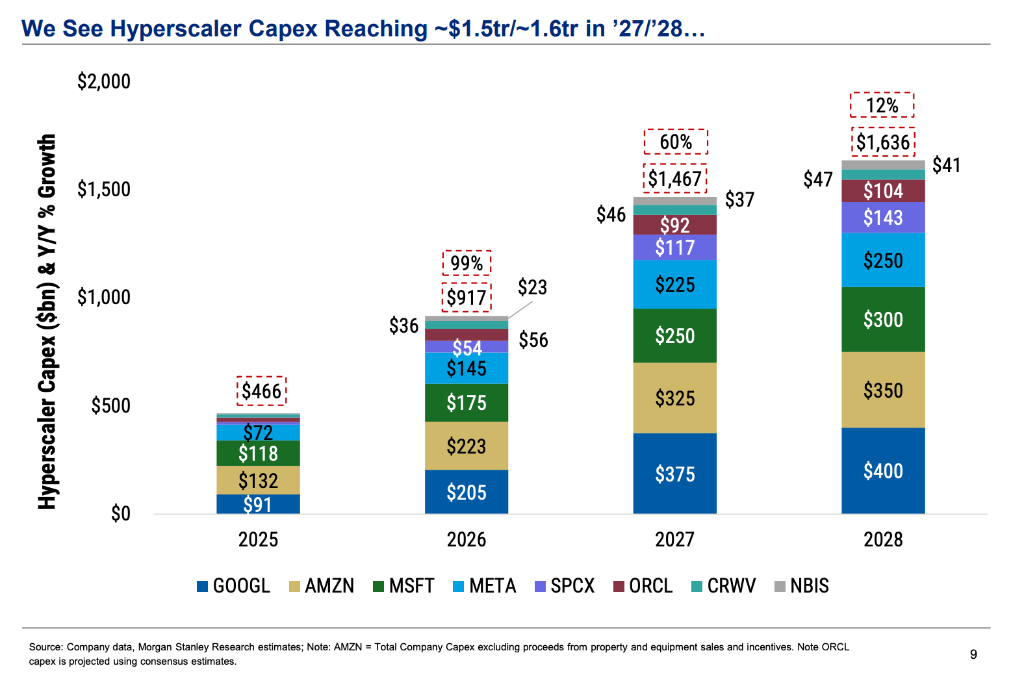
 However, the frenetic growth in capital expenditure may be approaching a阶段性 end. Capital expenditure for data centers by the four major hyperscale cloud providers is expected to rise from $917 billion in 2026 to $1.47 trillion in 2027, a year-on-year increase of approximately 60%, but growth will slow to just about 12% in 2028. This implies that the market's focus in the next phase will shift from who can build more data centers to who can convert existing computing power into revenue and profits.
This is precisely where Morgan Stanley sees the most potential: as the growth rate of capital expenditure slows and AI application penetration increases, capital may gradually shift from hardware, semiconductors, and memory to models, cloud platforms, and software applications. The "return on investment test" for AI investments is transitioning from the stage of building computing capacity to the stage of commercial monetization.
Capital Expenditure: Peaking in 2027, with a significant slowdown in 2028
Morgan Stanley expects data center capital expenditure by hyperscale cloud providers to increase from approximately $466 billion in 2025 to about $917 billion in 2026, further rising to approximately $1.47 trillion in 2027, and reaching about $1.64 trillion in 2028. However, the growth rate of capital expenditure will drop sharply from approximately 60% in 2027 to about 12% in 2028.
Among them, Google’s expansion is the most aggressive, with data center capital expenditure expected to grow by 83% year-on-year in 2027; Amazon, Meta, and Microsoft are projected to see growth rates of approximately 50%, 55%, and 43%, respectively, though all will slow significantly by 2028.
Morgan Stanley believes that practical constraints such as chips, server racks, land, electricity, and labor are limiting further expansion. Meanwhile, the giants have already engaged in substantial "pre-building" of data centers to meet demand from 2027 to 2029, leaving limited room for further front-loading of capital expenditure.
Therefore, the key change in 2028 is not that AI demand has peaked, but that infrastructure investment is entering a digestion phase after a period of rapid expansion.
Computing Capacity: Nearly Quadrupling in Three Years
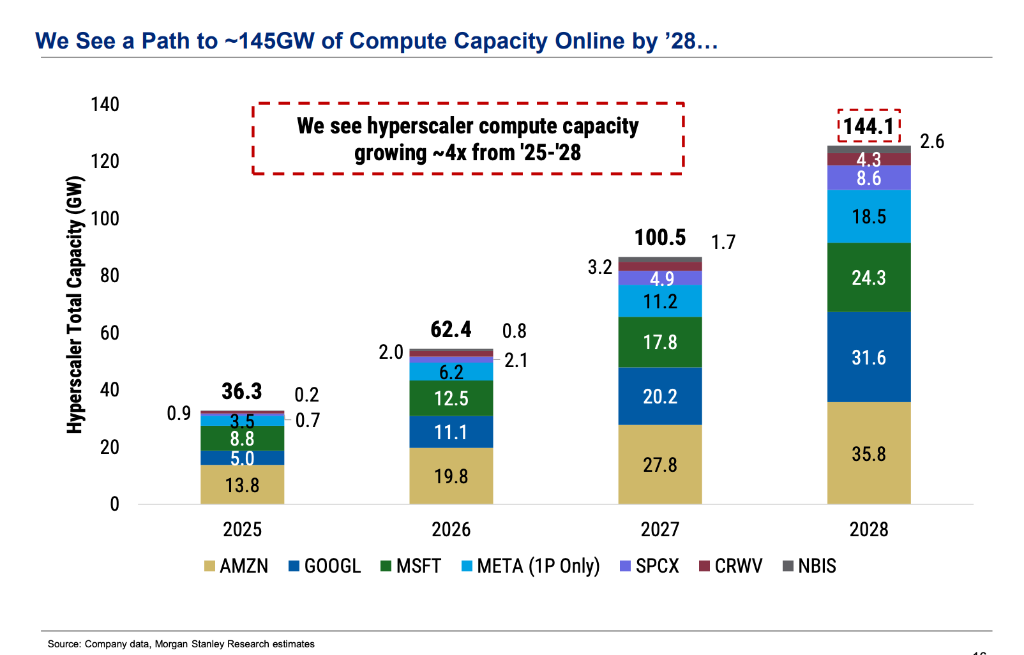
Despite the slowdown in capital expenditure growth, computing capacity will continue to expand. Morgan Stanley projects that the total computing capacity of the four major hyperscale cloud providers will increase from approximately 36 GW in 2025 to around 144 GW in 2028, nearly a fourfold expansion.
Among them, Google is expected to be one of the companies adding the most new capacity, with approximately 9 GW and 11 GW added in 2027 and 2028, respectively. This expansion is primarily intended for training Gemini, driving GCP growth, and supporting generative AI features in Search and YouTube.
Meanwhile, the structure of computing power is also evolving. Morgan Stanley expects the share of custom ASICs in newly added computing capacity to rise from 34% in 2025 to 66% in 2028, with Google TPU and Amazon Trainium serving as the primary drivers.
In other words, while demand for AI computing power continues to grow, the industry is shifting from a "rush for GPUs" to "enhancing per-unit computing efficiency." NVIDIA remains at the core, but the importance of cloud providers' self-developed chips is steadily rising.
AI Return on Investment: Proprietary Infrastructure and Model Layers Are the Most Profitable
Morgan Stanley calculated the return on invested capital (ROIC) for three GenAI business models. Under the IaaS model where hyperscale cloud providers rent out GPUs, using the GB300 as a benchmark, each GW corresponds to approximately $23 billion in revenue, with an ROIC of about 31%.
Model companies utilizing proprietary infrastructure to provide API services achieve the highest returns, generating approximately $30.4 billion in revenue per GW and about $17.9 billion in after-tax operating profit, corresponding to an ROIC of roughly 46%. If relying on third-party infrastructure to provide APIs, although revenue per GW reaches approximately $40.5 billion, the ROIC is only about 25% after deducting computing lease costs.
This implies that the most attractive segment of the AI value chain is not necessarily the simple leasing of computing power, but rather companies that possess model capabilities, infrastructure, and commercialization strengths. Morgan Stanley believes that Meta and Google are representative of this model.
Market Size: AI Commercialization Is Key to the Next Phase
Morgan Stanley estimates that the total addressable market (TAM) for global GenAI will reach $50 trillion to $60 trillion, with the knowledge work market accounting for approximately $20 trillion to $30 trillion and the consumer market for about $30 trillion.
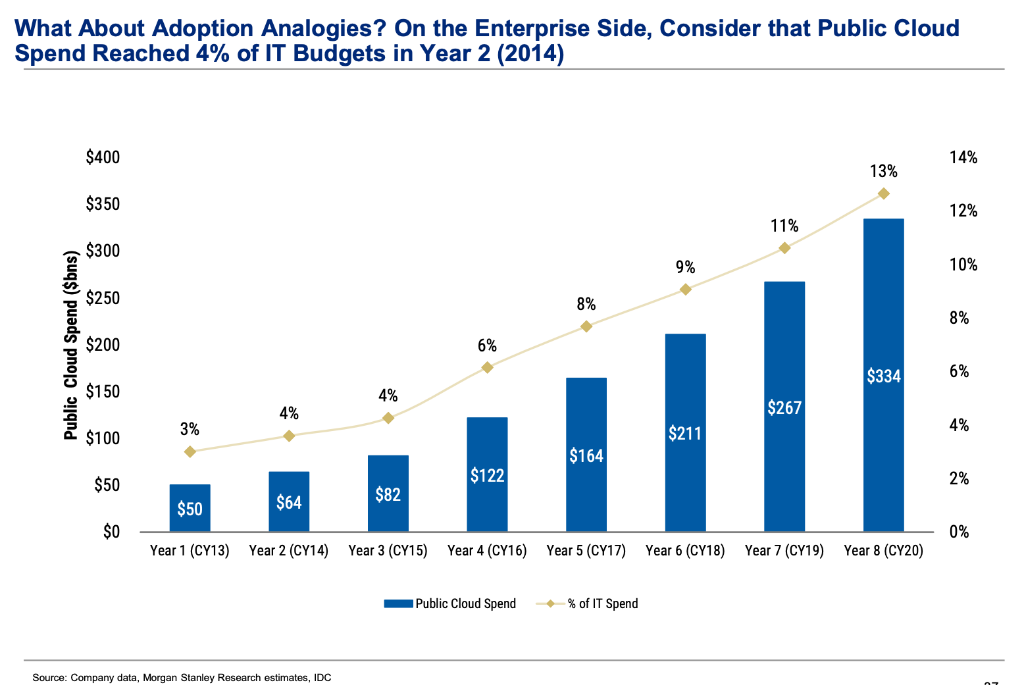
Drawing an analogy to the public cloud adoption curve, enterprise AI spending is projected to reach approximately $812 billion by 2027, equivalent to a penetration rate of about 4% of the total addressable market (TAM) for knowledge work. Morgan Stanley believes that AI diffusion may proceed faster than that of public cloud, as enterprises do not need to undertake large-scale infrastructure migrations, and AI can deliver quantifiable productivity gains more rapidly.
More importantly, tangible signs of commercialization for AI are already emerging. By the second quarter of 2026, approximately 25% of S&P 500 constituent companies were able to quantify the revenue generated by Generative AI (GenAI), a significant increase from 14% a year earlier.
This indicates that AI investment is gradually shifting from a "build first, wait for demand" model to a virtuous cycle of "compute investment – application growth – revenue realization." Whether the application layer can sustainably contribute to revenue and profits will become the core determinant of valuations in the next phase.
Edited by Deng