
SpaceX's stock has recently been trading within a narrow range, but a new wave of buying interest may emerge soon.
$SpaceX (SPCX.US)$ The stock has recently been trading in a narrow range, but a fresh wave of buying pressure may soon emerge as the Nasdaq-100 Index undergoes its quarterly weight rebalancing later this month.
The key lies in a little-known provision within the methodology of this technology-heavy benchmark index, which, combined with staggered lock-up expirations facing shareholders of Elon Musk’s satellite and space exploration company, jointly restricts the number of shares available for trading.
 When determining a company’s weight in the index, Nasdaq Inc. calculates market capitalization based on the lower of either total shares outstanding or three times the free float. This means that for stocks with a smaller free float (excluding shares held by insiders or subject to lock-up periods), the full market capitalization is not used in the weight calculation.
Due to lock-up restrictions, SpaceX’s free float is relatively small, resulting in a weight of only 1.25% in the Nasdaq-100 Index, ranking it 19th, despite its market capitalization exceeding $2 trillion, which places it sixth highest in the index.
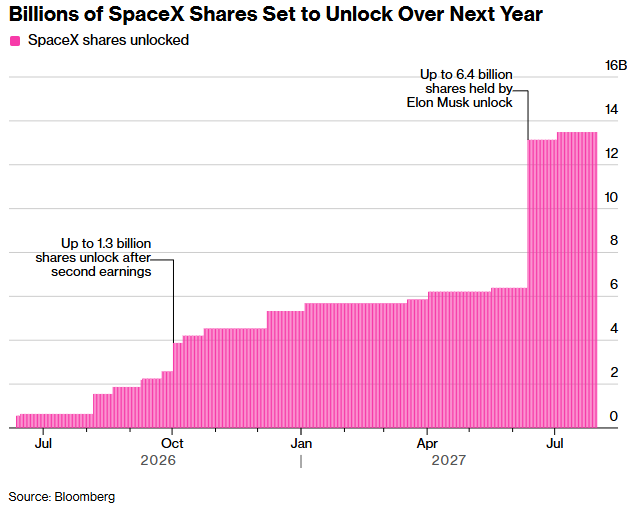
However, following the next weight rebalancing of the index, this weighting is expected to rise. The results of the rebalancing are scheduled to be announced after Friday’s market close and will take effect on September 21. This is partly because more than 1 billion shares have already been released from lock-up restrictions, increasing SpaceX’s free float as a percentage of its total shares outstanding from less than 10% immediately after its IPO to nearly 30%.
According to estimates by a team of strategists at Morgan Stanley Securities led by Min Moon, SpaceX’s weight could reach 2.25% after the rebalancing, forcing index funds and ETFs to generate $15.5 billion in passive net buying. According to Nasdaq data, approximately $1.7 trillion in assets were tracking the Nasdaq-100 Index as of the end of the second quarter, including the Invesco QQQ Trust Series 1 exchange-traded fund, better known by its ticker symbol QQQ.
As more SpaceX shares are released from lock-up restrictions over the coming year, the company’s free float will continue to increase, implying that its weight in the Nasdaq-100 Index could rise further.
"To some extent, market prices here will be pushed up by forced buying," said Ed O’Gorman, CEO of River Wealth Advisors. "I think it will take some time before you can truly see the market’s genuine view on this stock."
Following the sensational, record-breaking IPO in June that triggered weeks of intense volatility, SpaceX’s share price has stabilized. Over the past four weeks, the stock has traded sideways within a range of $133 to $150, hovering just above its $135 IPO offer price. In the absence of near-term fundamental catalysts, a rebalancing of index weights could provide the necessary momentum for a breakout.
Steve Sosnick, Chief Strategist at Interactive Brokers, stated, “Either newly unlocked shares will be absorbed by anticipated buying interest, or a significant surge in demand from index funds will drive the price higher.” He added, “It should see increased demand from QQQ and similar funds.”
Nasdaq is not the only index provider that calculates weights in this manner. S&P Dow Jones Indices, which manages the S&P 500 Index, also uses free-float-adjusted market capitalization to determine weights for certain indices. Two years ago, when Berkshire Hathaway significantly reduced its stake in Apple, it increased the free-float value of Apple’s shares. Analysts at Piper Sandler estimated at the time that this would trigger $40 billion in buying from passive funds.
Although SpaceX was included in the Russell 1000 Index in June, S&P 500 rules require stocks to have at least one year of trading history prior to inclusion. Consequently, it will not be eligible for inclusion until at least mid-2027.
SpaceX’s first lock-up expiration in August coincided with its inaugural earnings release, sparking market concerns about a massive sell-off based on the theory that a sudden increase in share supply would overwhelm demand. However, no such sell-off materialized after the second unlock occurred one week later, as insiders largely retained their equity stakes, bolstering investor confidence and supporting the share price.
More than 1 billion shares are set to become unrestricted by the end of October, and an additional 1.3 billion shares will become tradable after the company reports its third-quarter results in mid-November.
O’Gorman from River Wealth noted, “The more significant event—the one that truly matters—will occur in November when the earnings report triggers the release of lock-up restrictions, flooding the market with a large volume of shares.”