Following reports of attacks on Iranian oil tankers, the intraday gain in U.S. crude oil prices widened again to over 2%. U.S. officials disclosed that the U.S. military struck Iranian targets near Kharg Island. The Iranian military warned that tankers docked at ports in Kuwait and Bahrain would become targets of attack and urged crew members to evacuate immediately. Kharg Island is Iran's primary hub for oil exports, with approximately 90% of Iran's crude oil previously exported through this location. Earlier on Tuesday, the Iranian military claimed to have captured an advanced U.S. unmanned submarine.
Military conflict between the United States and Iran has once again extended to areas near Iran's core oil export facilities, with Iran warning that it will target tankers belonging to U.S. allies in the Middle East.
On the evening of Tuesday, September 8 (local time), CCTV News cited Iranian sources reporting that an Iranian oil tanker was struck by U.S. missiles approximately four miles off Kharg Island, Iran. Local sources stated that there were no casualties, the crew was evacuating, and relevant authorities were investigating the incident. Subsequently, CCTV cited warnings from the Iranian military stating that tankers at ports in Kuwait and Bahrain would be targeted, urging crews to evacuate immediately.
 According to a report by the Iranian media outlet Tasnim, a small Iranian oil tanker was hit by projectiles fired by U.S. forces about four nautical miles from Kharg Island, within the island's anchorage area. There were no reported casualties, and the tanker's crew is currently evacuating.
During Tuesday's midday trading session for U.S. stocks, news emerged regarding attacks on Iranian oil tankers near Kharg Island, causing international crude oil futures to surge. The intraday gain for U.S. WTI crude oil widened again to over 2%, briefly approaching $94 per barrel, while Brent crude oil rose more than 1% intraday, briefly nearing $99 per barrel.
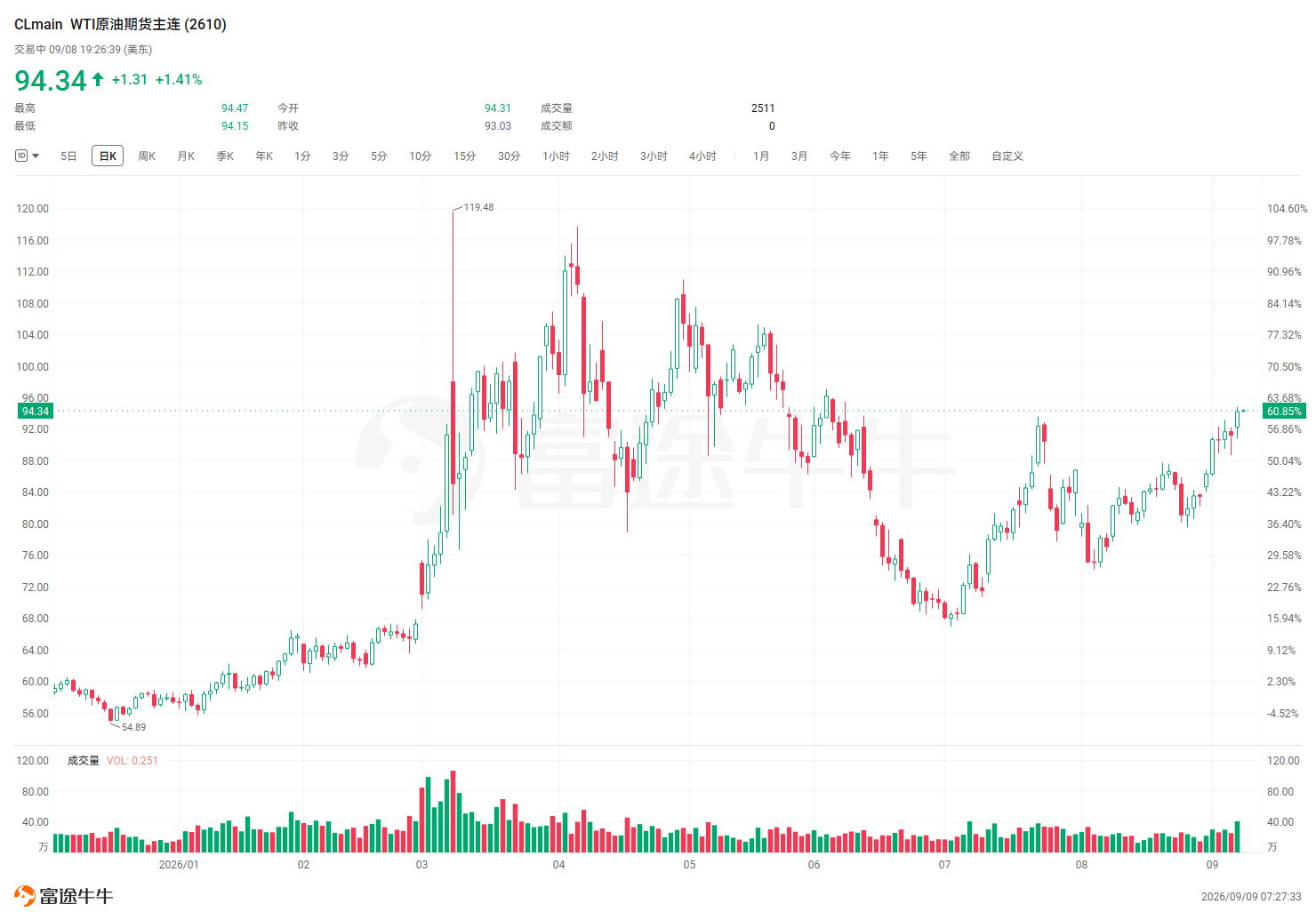
Amid escalating conflicts in the Middle East and disruptions to shipping in the Strait of Hormuz, oil prices have hovered near multi-week highs. During European trading on Tuesday, U.S. crude surpassed $94.70 per barrel, marking a three-month intraday high, while Brent crude exceeded $99.40 per barrel, reaching its highest level in over three months.
Iranian Military: Oil Tankers at Kuwaiti and Bahraini Ports Will Become Targets of Attacks
After Iran stated that U.S. missiles had attacked an oil tanker near Kharg Island, the Iranian military issued threats to attack oil tankers at ports in the Gulf region.
According to CCTV News, on the evening of the 8th (local time), the Islamic Revolutionary Guard Corps (IRGC) of Iran issued an urgent warning regarding the U.S. attack on Iranian oil tankers. The IRGC warned that, in light of the U.S. military's culpable actions in attacking multiple Iranian tankers, all crew members aboard tankers docked at ports in Kuwait and Bahrain should evacuate immediately, as these vessels will become targets for attacks given that these ports harbor U.S. forces. This applies regardless of whether the tankers are anchored or berthed in port.
As Kharg Island is one of Iran's most critical hubs for crude oil exports, the attack on a tanker nearby has drawn market attention not only to the damage sustained by the single vessel but also to whether the military conflict between the U.S. and Iran further threatens Iran's crude oil export capacity.
Iranian media reported that the attacked tankers were located within the anchorage area of Kharg Island. U.S. media outlet Fox News stated that the U.S. military struck multiple targets around Iran's Kharg Island, with several Iranian oil tankers listed as targets. Citing U.S. sources, CCTV reported that the U.S. military struck targets near Kharg Island and the port city of Jask in Iran, noting that anonymous senior U.S. officials indicated that Iranian oil tankers were among the targets.
This development aligns with the military conflicts that have occurred around Kharg Island in recent days.
Reports on Saturday, September 5, indicated that explosions had previously been heard near Kharg Island. The U.S. Central Command subsequently stated that U.S. forces had attacked three Iranian oil tankers, including one located near Kharg Island. The U.S. side claimed that the Islamic Revolutionary Guard Corps (IRGC) of Iran had previously launched missile attacks against two U.S. Navy vessels.
According to reports, the U.S. military also accused the three targeted Iranian oil tankers of providing funding to the IRGC and its regional proxies.
Therefore, if Iran's latest claims regarding the attack are further confirmed, it would indicate that the military confrontation between the two sides over Iranian oil transportation and shipping in the Strait of Hormuz is ongoing.
The Iranian military claimed on Tuesday to have captured an advanced U.S. unmanned submarine.
Just before news of the tanker attacks emerged, Iran released another announcement with significant military implications.
According to CCTV News, on September 8, the Navy of the Islamic Revolutionary Guard Corps issued a statement claiming that its forces successfully captured an advanced intelligent unmanned submarine belonging to the U.S. military at dawn that day near the entrance to the Strait of Hormuz through a "complex intelligence and operational action." The statement added that relevant images would be released within the next few hours.
Iranian media subsequently continued to report on this development.
However, the U.S. side offered a different description of Iran's alleged "capture." Citing information from the U.S. Central Command, some U.S. media outlets reported that the vessel under Iranian control was a malfunctioning, non-classified unmanned underwater device, rather than the advanced military submarine described by Iran.
This indicates that as the tanker attacks and the unmanned underwater vehicle incident unfold in succession, the military standoff between the U.S. and Iran in the Strait of Hormuz and its surrounding waters is escalating further.
Khark Island has become a focal point of the US-Iran conflict.
Khark Island has drawn heightened market attention not only because it is a key oil export hub for Iran, but also because it serves as a critical node for assessing whether Iranian crude can continue to reach international markets.
Previous reports indicated that Khark Island is Iran’s primary oil export hub, handling approximately 90% of the country’s crude oil exports. However, Iranian oil exports have faced significant disruptions amid US maritime blockades and shipping constraints in the Strait of Hormuz.
In recent days, market concerns over whether the conflict will further impact Iran’s oil export infrastructure have intensified markedly.
Although Middle Eastern oil supplies have been severely disrupted, Brent crude had not previously breached the $100 mark. This was due to continued oil shipments through the Strait of Hormuz at a certain scale, Gulf producers utilizing alternative export routes, and increased output from non-OPEC producers such as the United States, Canada, and Guyana.
However, if US-Iran military actions directly affect tankers, terminals, or crude export facilities around Khark Island, market pricing logic could shift—from concerns over supply disruption risks to fears of an actual decline in export capacity.
Brent crude is within striking distance of $100.
Against this backdrop, oil prices have shown heightened sensitivity to any military developments involving Iranian tankers and Khark Island.
Driven by factors including the deteriorating situation in the Middle East, WTI and Brent crude prices rose above $94.70 and $99.40, respectively, during European trading hours on Tuesday, with Brent just one step away from the psychological barrier of $100.
If further confirmation emerges regarding attacks on tankers near Khark Island, the core question for markets will be whether the US-Iran conflict will escalate from strikes against military targets to sustained assaults on Iran’s oil export system.
This will also determine whether the surge in oil prices is merely a short-term spike or if it opens up further room for prices to move above $100.
Editor/Stephen