
Traders are concentrating derivative positions within shorter time horizons and becoming more selective, shifting from broad derivative exposures to specific instruments. Traders are reviewing their portfolios and offloading unwanted risk assets, resulting in insufficient market liquidity, particularly for long-dated contracts.
According to Zhitong Finance APP, traders focused on oil-linked commodities are becoming increasingly cautious about holding long-term positions, as ongoing conflicts in Iran and Ukraine continue to drive energy price volatility and render geopolitical developments unpredictable. Traders are concentrating their derivative positions within shorter timeframes and becoming more selective, shifting from broad derivative exposures to specific instruments. They are actively reviewing their commodity portfolios and divesting unwanted risk assets, resulting in insufficient liquidity in the oil trading market, particularly for long-term contracts.
Conflict is simultaneously threatening Persian Gulf export routes and alternative passages through the Red Sea, pushing oil prices above $100 per barrel. The U.S. stated it had destroyed five Iranian oil tankers, prompting Iran to announce retaliatory measures. Meanwhile, Houthi forces backed by Iran launched deep-strike attacks within Saudi territory, igniting energy facilities and once again raising concerns about the security of exports via the Red Sea. As of September 9, crude oilFutures Tradingmarket statistics show that the international benchmark—Brent crude futures—rose 2.2% to $100.07 per barrel, breaking through the $100 threshold. This marks the first time since July this year that Brent crude has surpassed the $100 integer mark. WTI crude prices rose 1.83% to $94.73 per barrel. Year-to-date, Brent crude has accumulated a gain of over 60%.
 Navigational constraints remain severe for two critical global energy shipping lanes: the Strait of Hormuz and the Bab el-Mandeb Strait. Preliminary data from Kpler shows that only six cargo vessels passed through the Strait of Hormuz on September 8, down from nine the previous day and below the recent 10-day average of 12. Traffic through the Bab el-Mandeb Strait stood at 25 vessels on the same day, slightly below the recent daily average of 27. While the level of disruption differs between the two straits, the threat of attacks in the Bab el-Mandeb is increasing pressure on tankers transporting oil from Saudi Red Sea ports to Asia to undertake further detours.
The cost of detours can now be quantified by specific voyage metrics. Taking the route from Yanbu, Saudi Arabia, to Taiwan, China, as calculated in July reports: the normal transit via the Bab el-Mandeb Strait takes approximately 19 days. Rerouting north through the Suez Canal, across the Mediterranean Sea and Gibraltar, and around the Cape of Good Hope to Asia takes approximately 48 days, an increase of 29 days. Fuel costs rise from $1.26 million to $2.87 million, an increase of approximately 127.8%, with an additional Suez Canal fee of about $1 million. Based on these rounded figures, the incremental fuel cost and new canal fees total approximately $2.61 million, strongly illustrating that even if land-based pipelines bypass the Strait of Hormuz, maritime transport may still incur high hedging costs.
Morgan Stanley: Oil traders plagued by war avoid long-term bets
As conflicts in Iran and Ukraine cast a shadow over market prospects for the coming months, traders in the oil futures market are becoming increasingly cautious regarding longer-term positions.
Brendan Ross, Co-Head of Global Oil Trading at Morgan Stanley, stated that traders are concentrating their derivative positions within shorter timeframes and approaching risk with greater "calm prudence." He added that as geopolitical risks rise, traders' actual operational choices are becoming more stringent, shifting from holding broad derivative risk exposures to selecting specific instruments.
"People are managing risk with greater precision," Ross said Wednesday at the Asia Pacific Oil Conference in Singapore. "They have clearly identified which risks they truly wish to assume and which could lead to unexpected, sustained losses."
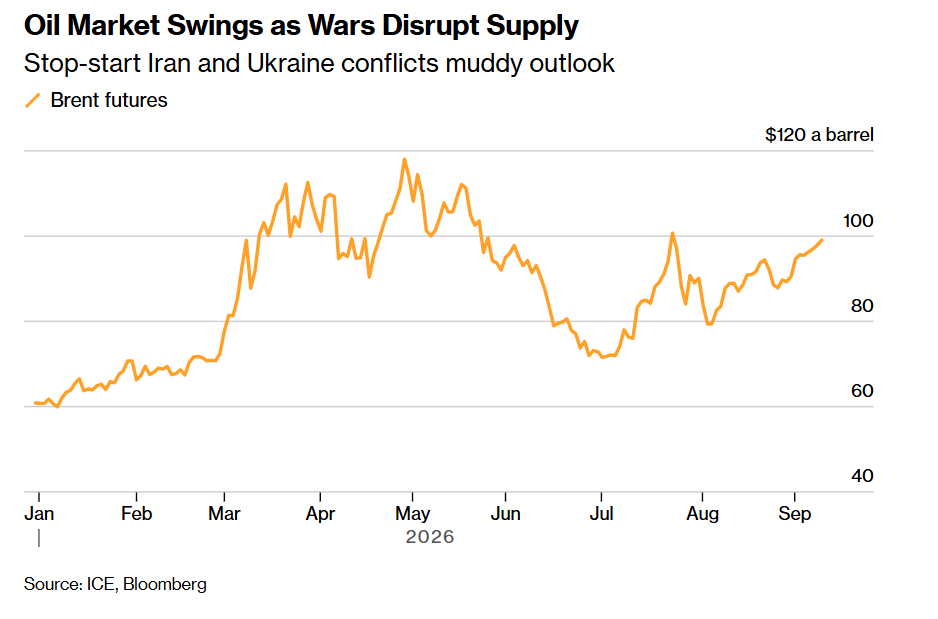
As shown in the chart above, global geopolitical conflicts are disrupting supply and causing turbulence in the oil market. Intermittent conflicts between Iran and Ukraine have blurred the outlook for energy commodity trading.
The rapidly changing situation between the U.S. and Iran, combined with ongoing hostilities between Russia and Ukraine, has caused repeated and severe volatility in the oil market. Intermittent negotiations between Washington and Tehran, along with repeated Ukrainian attacks on Russian energy infrastructure, have exacerbated volatility across the entire energy market. Since the beginning of the year, Brent crude prices have fluctuated between approximately $60 and $126 per barrel, while refined product prices have experienced even more剧烈 volatility.
In the interview, Ross emphasized that traders are reviewing their portfolios to eliminate risks they are not truly willing to bear, leading to insufficient liquidity across markets, particularly in longer-dated contracts.
"People are essentially trading only near-term contracts covering the next three to six months, while illiquidity in longer-dated contracts further exacerbates the overall lack of liquidity," he stated in the interview.
Refined petroleum products have been hit hardest by the conflict, as disruptions to production and trade have tightened global supplies. U.S. retail diesel prices hit a record high last week, while fuel costs surged significantly across Europe amid worsening global shortages.
"Regarding the disconnect between physical and financial markets, it is clear that this is primarily occurring in the refined products market," Ross said.
"Tight nearby supply and cold distant months" implies that the market places a stronger premium on the scarcity of immediately deliverable oil, while pricing for forward dates lacks trading depth. Disruptions to crude oil supply and transportation support spot and near-month prices, making it easier to form or widen a backwardation structure where near-month prices exceed far-month prices. If refinery shutdowns further constrain the supply of refined products such as diesel, price increases for refined products may outpace those for crude oil, pushing up crack spreads and widening regional price differentials.
Meanwhile, reduced participation in far-month contracts weakens price discovery and widens bid-ask spreads, meaning even smaller orders can trigger significant volatility. For refiners, traders, and fuel users, hedging solely with crude oil futures makes it more difficult to cover risks arising from refined product shortages, regional price differentials, and changes in transportation costs.
After large Middle Eastern oil tankers became targets: From supply shocks to repricing in equity and bond markets
A comparison of pre-war and post-war benchmarks for the same tanker routes more直观ly illustrates the impact on freight rates and Middle Eastern energy supplies. The Baltic Exchange's weekly report on February 27 showed that the TD3C route, transporting 270,000 tons of crude oil from the Persian Gulf to China, had a freight rate of WS216.89, with an equivalent time charter earnings rate for standard Very Large Crude Carriers (VLCCs) of $209,550 per day. The corresponding levels listed in the September 4 weekly report had risen to WS677.22 and nearly $704,000 per day.
According to the above calculations, the Worldscale (WS) freight rate index rose by approximately 212.2% compared to pre-war levels, while daily earnings increased by about 236.0%. The former reflects changes in freight rates on the same route, while the latter represents daily earnings after deducting voyage costs. Together, these two indicators show that severe constraints on energy supplies, transportation risks, and tight effective capacity have significantly pushed up the economic costs of tanker transport.
Attacks on tankers near Kharg Island, Iranian threats to strike tankers at ports in Kuwait and Bahrain, and Houthi attacks on Saudi energy facilities are expanding risks across three segments: export loading, route security, and refining production. In particular, the combination of refinery shutdowns and disruptions to refined product transportation means that even if some crude oil can be exported via alternative routes, fuels such as diesel may remain in short supply. This explains why Ross emphasized that the disconnect between physical and financial markets is concentrated mainly in refined products: simply betting on the rise or fall of Brent crude may not adequately cover the actual risks posed by diesel shortages in specific regions, delivery delays, and rising freight costs.
Oil price assessments by Wall Street financial institutions are increasingly contingent on the duration and severity of conflicts. Bank of America forecasts that if minor conflicts constraining oil flows persist until year-end, Brent crude could trade in the range of $95–$120 per barrel; should the conflict escalate and cause significant damage to major energy infrastructure, there is a risk of prices surging to $150 per barrel. These two scenarios correspond to varying degrees of supply disruption. Morgan Stanley’s observation of trading concentration over a three-to-six-month horizon indicates that traders are shortening their forecast horizons, as the oscillation between ceasefire negotiations and military escalation makes long-term supply and demand projections more difficult to execute. A decline in participation in far-month contracts would significantly raise the costs of adjusting positions and exiting trades.
For U.S. equities, the impact depends on how long high oil prices persist and the intensity of their transmission to inflation, corporate profits, and interest rates. On September 8, the yield on the 10-year U.S. Treasury note rose to 4.805%, while the S&P 500 Index fell by approximately 0.6%; meanwhile, the energy sector’s year-to-date gain has exceeded 40%. Energy producers benefit from price support, whereas consumer and industrial companies face pressures from declining purchasing power and rising input costs. If long-end yields continue to rise, financing and valuations for highly valued companies will also come under pressure. The resulting investment theme across equities and bonds is that scarcity in energy supply creates localized profit opportunities, while high oil prices and liquidity contraction increase the cost of risk-taking across the broader market.
Edited by Deng