
U.S. tech stocks are experiencing a rare divergence between fundamentals and macroeconomic signals: while demand for AI remains robust, pressures from the yen's appreciation, rising interest rates, and widening CDS spreads persist, yet the Nasdaq 100 remains resilient. Rich Privorotsky, head of trading at Goldman Sachs, is bullish on the leap in AI capabilities driven by Astra, whereas analyst Garrett warns that extremely low correlation and compressed volatility may signal that the market is brewing more intense turbulence.
U.S. technology stocks are currently in a rare state of "long-short divergence": AI fundamentals continue to strengthen, but macroeconomic pressures from yen appreciation, rising interest rates, and widening credit spreads persist.$NASDAQ 100 Index (.NDX.US)$Yet the sector has consistently refused to break down.
The real risk for tech stocks right now lies not in AI demand, but in the potential for rapid market repricing should the macroeconomic environment and systemic leverage suddenly shift.
 Rich Privorotsky, head of trading at Goldman Sachs, noted that frontier AI models continue to push the boundaries of capability, while demand for Google Cloud and AI servers remains robust.$Broadcom (AVGO.US)$He even suggested that actual demand has already surpassed the $115 billion forecast for fiscal year 2027. However, the strengthening yen, widening CDS spreads for tech stocks, and rising U.S. Treasury yields all point to tightening financial conditions.
When fundamentals continue to improve while macro signals weaken, and prices refuse to confirm either trend, the market is often building momentum for a more dramatic directional choice. The volatility market is sending similar signals: the six-month realized correlation of the S&P 500 has dropped to 11, and SPX straddle prices are near their yearly lows, indicating that the market is still underpricing the potential for significant future volatility.
The bullish logic for AI remains unchanged; the true risk stems from macroeconomic factors.
AI fundamentals continue to strengthen. Privorotsky pointed out that frontier models are breaking through previously intractable mathematical and scientific problems, including solutions to the Navier-Stokes equations proposed by OpenAI. The new generation model, Astra, has been trained on over 100,000 GPUs, with peak power consumption reaching 70 to 100 megawatts, demonstrating capabilities significantly superior to previous generations.
Demand shows no signs of cooling. Google Cloud’s single AI orders exceeding $100 million have more than doubled both month-over-month and year-over-year; the payback period for AI server investments has compressed to under two years, shortening to approximately one year when using self-developed chips.
Broadcom stated that actual AI demand has already surpassed its fiscal 2027 outlook of $115 billion. The constraints on industry expansion are shifting from insufficient demand to issues such as power supply, data center site selection, and supply chain capacity.
Therefore, if tech stocks decline from current levels, the primary concern should not be a sudden collapse in AI demand, but rather the simultaneous pressure from interest rates, the yen, and leverage.
Yen strength poses hidden risks to carry trades.
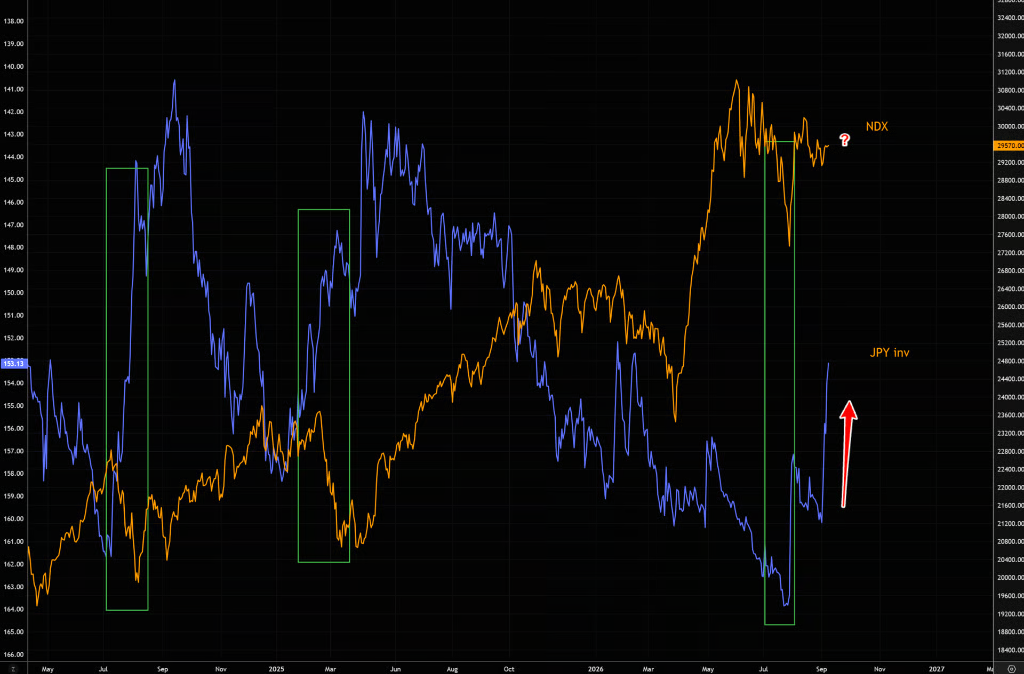
The appreciation of the Japanese yen is becoming one of the most closely watched macroeconomic variables in the market.
As the market continues to price in further policy tightening by the Bank of Japan and the repatriation of Japanese capital, the yen has been strengthening. U.S. Treasury Secretary Bessent recently struck a tough tone, stating, “I am the house now... you can bet against me all you want.” However, this has not altered the yen’s upward trajectory.
The real cause for concern is the unwinding of yen-funded carry trades. Should Japanese capital repatriation accelerate, Japanese bonds and equities could absorb more liquidity, simultaneously forcing deleveraging in U.S. markets.
Historically, yen strength has correlated with declining risk appetite and rising volatility. However, during this cycle, the Nasdaq 100 Index has demonstrated greater resilience to yen appreciation. Whether this indicates sufficient robustness in technology stocks or suggests that macroeconomic pressures have yet to fully transmit remains to be confirmed by the market.
CDS spreads are widening, yet equity markets refuse to confirm the signal
The credit market has issued clearer warnings.
Since mid-August, CDS spreads for technology stocks have continued to widen. When CDS spreads expanded rapidly in July, the Nasdaq 100 Index experienced a notable correction; however, as credit spreads widen again in this current phase, the equity market has shown little reaction.
The credit market is sounding alarms, while the equity market refuses to validate them.
Similar signals are emerging in the interest rate market. The persistent rise in U.S. Treasury yields should theoretically exert further downward pressure on high-valuation technology stocks, yet large-cap tech stocks remain resilient. In the short term, this reflects strong market absorption capacity; however, if yields continue to climb, the pressures currently priced in could be released in a concentrated manner.
Volatility is extremely compressed; the next breakout may be more violent
Rather than attempting to predict market direction, the more pertinent focus at present may be the extent to which volatility has been compressed.
$S&P 500 Index (.SPX.US)$The six-month realized correlation has dropped to 11. In the past 25 years, similar levels were seen only in February 2007 and January 2018, with the latter followed by the "Volmageddon" episode. Analyst Garrett pointed out that such extreme low-correlation states have historically been unsustainable over the long term, often ending with a rapid reversion in index volatility and convexity.
Meanwhile, SPX straddle prices remain near their year-to-date lows, indicating that the market continues to underprice the potential for significant future volatility.
The current market presents a rare combination: strengthening AI fundamentals, warning signals from macroeconomic and credit markets, a directionless Nasdaq 100 Index, and volatility suppressed at low levels. Once prices eventually break out, the move is likely to be accompanied by a swift rebound in volatility, resulting in sharp unidirectional trends.
Editor/melody