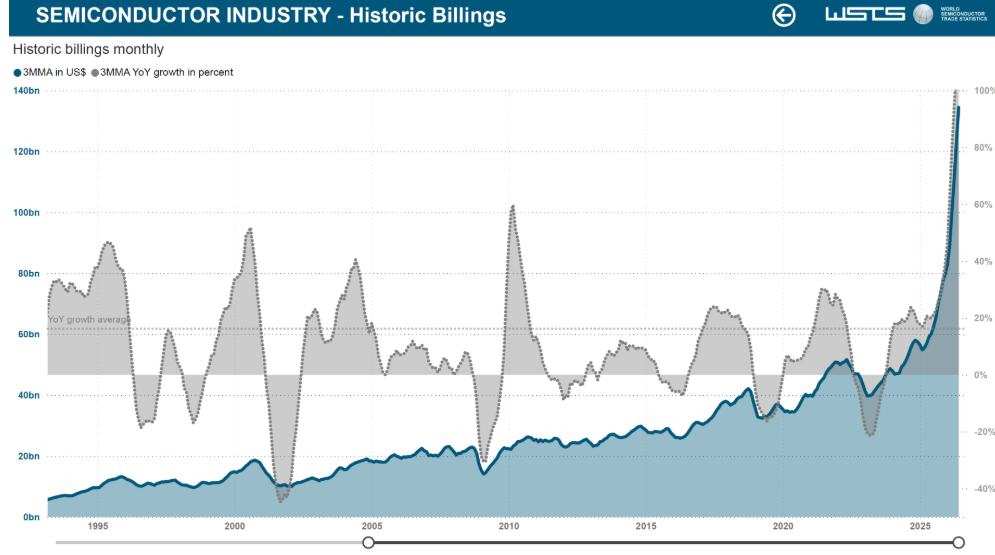
WSTS data aligns with Bernstein’s bullish thesis on memory storage: expanding AI computing demand provides a foundation for sales volume, constrained supply strengthens pricing power, and product upgrades coupled with long-term agreements improve profit structures.
Bernstein, one of Wall Street's major investment banks, recently released a research report stating that the semiconductor industry is experiencing a seasonal downturn as expected by the market. However, demand for semiconductors related to AI computing infrastructure—particularly pricing and demand for next-generation HBM memory systems closely tied to AI infrastructure, as well as data center server-grade DRAM/NAND memory chips—remains exceptionally strong. Citing data from the Semiconductor Industry Association (SIA), Bernstein noted that July is traditionally a slow month for semiconductor sales. Global semiconductor sales fell 9.5% month-on-month, slightly weaker than the historical seasonal average decline of 8.5%, but still posted a year-on-year growth of 131.4%.
Bernstein noted that memory chip sales surged 451.7% year-over-year. Excluding memory, global semiconductor industry sales grew approximately 35% year-over-year. Notably, while memory chip sales declined 16.3% month-over-month compared to the record-high June figures, this performance was significantly better than the historical average decline of 26.1% typically seen in July. This indicates that the seasonal performance of the memory sector is much stronger than market consensus expectations.
 Indicators for July 2026 also show that DRAM sales increased 427.8% year-over-year, with bit shipments rising 47.5% year-over-year. NAND sales also grew 427.8% year-over-year. The average selling price (ASP) per bit for DRAM rose 257.9% year-over-year, while the ASP per bit for NAND increased 344.1% year-over-year. These data on memory chip demand and semiconductor sales imply that although shipments declined quarter-over-quarter during the quarterly transition, the ASPs per bit for both DRAM and NAND continue to rise. Bit growth exceeding 40% year-over-year provides evidence of expanding physical demand, while the sharper increase in ASPs enhances the overall revenue elasticity of the three major memory chip manufacturers and NAND giants.
A deeper shift is that memory is becoming the primary driver of semiconductor revenue growth. The report shows that global semiconductor sales reached approximately $861 billion in the first seven months of this year, up from $408 billion in the same period last year, representing a year-over-year increase of about 111%. Memory contributed approximately $355 billion in incremental sales. Of this, the report attributes about $306 billion to changes in memory prices and product mix, accounting for roughly 68% of the industry's total incremental sales, or what the report describes as 'close to 70%.'
OpenAI's newly launched Astra large language model continues to actively expand the scope of professional tasks that AI can handle.$NVIDIA (NVDA.US)$On Sunday, CEO Jensen Huang made a significant statement on social media, asserting that the emergence of GPT-6 Astra means "AGI has arrived." This, combined with NVIDIA's confirmed strong revenue range and robust shipment guidance, along with the entry of large AI model development into a new phase of "Recursive Self-Improvement (RSI)"—which opens up another curve of surging AI computing demand—suggests that Astra is poised to expand commercial AI computing demand. Furthermore, the R&D trajectory of AI "creating AI" may increase investments in frontier operator experiments, evaluations, and long-term continuous training, collectively extending the investment cycle for computing power.
Astra and Research Self-Improvement (RSI) automation are providing new sources of semiconductor demand, driving an unprecedented boom in the memory chip-led semiconductor cycle. The investment significance of Astra and Recursive Self-Improvement (RSI) lies in the fact that cutting-edge high-performance AI large models, and AI R&D itself, are emerging as new scenarios that continuously consume computing power.
The release of Astra has reinforced market expectations regarding the progress toward Artificial General Intelligence (AGI). Observable progress includes the ability to complete more complex workflows: OpenAI's Legora case study showed that Astra reviewed 41 documents in a single agent run, improving benchmark performance for this financial statement workflow by nearly 40% over the previous generation. Meanwhile, on September 6, OpenAI disclosed that it had reached a new operational stage of 'automated research intern.' By mid-August, for every human workday invested by the research team, approximately 3.1 agent workdays were utilized. This latest model implies that 'AI developing AI' (i.e., the RSI training paradigm) is itself becoming a customer that continuously consumes inference, training, and evaluation resources, thereby adding a robust demand curve beyond external commercial applications.
In terms of global capital pricing, specific positive signals have emerged indicating that investors are regaining bullish sentiment toward memory chips and the broader semiconductor sector in both the South Korean stock market and the U.S. semiconductor segment. On September 7,$Samsung Electronics (005930.KR)$rising 5.68%,$SK hynix (SKHY.US)$and rising 8.26%. The KOSPI index, South Korea's benchmark stock index known as the "bellwether for AI computing power," surged 4.61% on the day to close at 6,995.39 points. This represents a cumulative rebound of approximately 25.06% from 5,593.56 points on July 30, surpassing the threshold commonly used to define a technical bull market.
Astra ignites the AGI frenzy + AI begins participating in AI R&D, bringing a dual wave of demand to the semiconductor sector
Astra represents the most cutting-edge mechanism for expanding performance demand: improvements in large model capabilities bring tasks that were previously difficult to complete reliably into the realm of commercial viability. Furthermore, Astra may shift the entire demand curve outward—meaning that as AI large models become smarter, companies can attempt work that was previously unreliable, and competitors must continue to invest in R&D and training. This provides new, strong support for the AI spending cycle.
OpenAI's GPT-6 Astra large language model, along with the RSI technical path focused on by AI leaders, is expected to become the two core drivers driving the exponential expansion of AI computing demand. Stronger AI large models and broader use of AI application tools, combined with the next generation of AI training paths featuring stronger computing demand, are reinforcing the basis for the continued growth in demand for AI computing infrastructure.
OpenAI disclosed that Astra achieved a score of 98% in the FrontierMath Level 4 test and 99.9% in ARC-AGI-3. Based on this, Jensen Huang expressed his judgment that 'AGI has arrived,' noting that model training utilized over 100,000 NVIDIA GPUs, with an additional 400,000 GPUs scheduled to come online subsequently. It is worth noting that the judgment that 'AGI has arrived' remains controversial, while the announcement of the deployment of larger-scale NVIDIA AI GPU clusters directly strengthens expectations for robust AI computing demand driven by continued expansion of training resources for frontier AI large models.
From a technical foundation perspective, memory benefits from changes in how models operate. Training requires saving model weights, activations, gradients, and optimizer states; long-context inference and parallel agents expand KV cache and working state requirements; and automated research increases experiments, evaluations, training checkpoints, and data read/write operations. These tasks respectively consume GPU-side HBM, server DRAM, and enterprise-grade SSDs.
Memory demand depends on parameter scale, context length, concurrency, and experiment density. HBM handles GPU-side model weights, intermediate training states, and active key-value caches; server DRAM manages data processing, runtime environments, and cache offloading; and NAND enterprise SSDs store datasets, training checkpoints, and reusable caches. As stronger models handle longer tasks, more agents run simultaneously, and RSI research processes add parallel experiments and checkpoint saving, the demand for capacity, bandwidth, and read/write throughput expands significantly in tandem.
NVIDIA, the "super hegemon" of AI chips, has already integrated this robust memory demand into its system-level server architecture. The Rubin platform configures each GPU with up to 288GB of HBM4 and a memory bandwidth of up to 22TB/s, while introducing a flash-based shared context storage layer to handle reusable KV caches. By extension, if enhanced model capabilities drive more concurrent tasks, longer runtimes, and denser experiments, memory demand will expand across the entire hierarchy. The focus of measuring AI economics will further shift toward the total cost per successful task, rather than merely the price per million tokens.
Storage chip components in AI data center server clusters remain the most evident supply bottleneck in the AI computing power industry chain. Market research firm TrendForce projects that contract prices for server DRAM will cumulatively rise by approximately 270% in 2026, while enterprise SSD prices will increase by about 235%. In 2027, HBM contract prices may still rise by 70%–140%. These figures reflect the combined effects of expanding AI computing capacity and rising storage costs. TrendForce’s latest estimates indicate that the share of DRAM and NAND in the capital expenditures of major cloud service providers will increase from 47% in 2026 to 68% in 2027, driven by both higher procurement volumes and price increases.
Bernstein is extremely bullish on the trajectory of the super-cycle in the memory market! It forecasts SanDisk surging to $3,000 and NVIDIA racing toward $400.
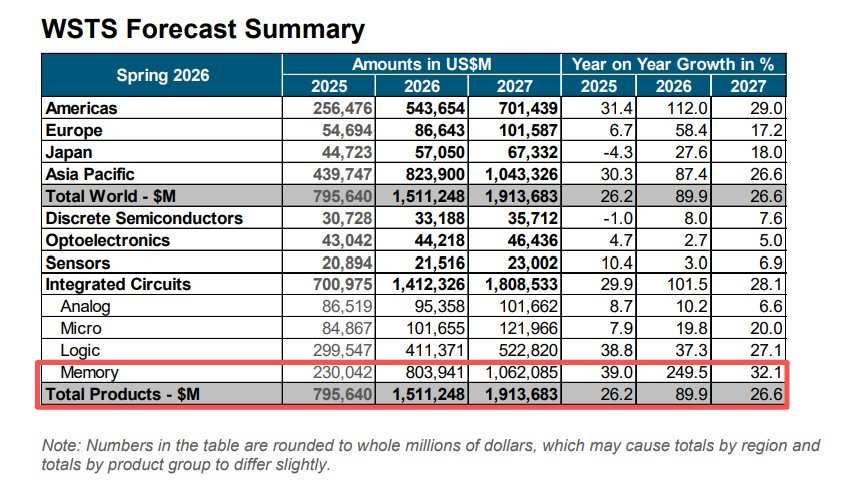
The impact of the memory chip super-cycle is evident from the market share and growth contributions shown in the WSTS report cited by Bernstein. According to the WSTS Spring Forecast, the memory market will grow from $230.042 billion in 2025 to $803.941 billion in 2026, a year-on-year increase of 249.5%, and further reach $1,062.085 billion in 2027, a year-on-year increase of 32.1%. Based on these calculations, memory's share of global semiconductor sales will rise from 28.9% to 53.2%, and then to 55.5%. Its contribution to the industry's incremental sales in 2026 and 2027 will be approximately 80.2% and 64.1%, respectively.
In other words, the preliminary forecast for the memory chip category alone in 2026 is already staggering—slightly exceeding the entire semiconductor market in 2025. The WSTS data aligns with Bernstein’s bullish logic on memory: expanding AI computing demand provides a volume base, limited supply strengthens pricing power, and product upgrades along with long-term agreements improve profit structures.
$NVIDIA (NVDA.US)$The strongest competitor to the GPU architecture$Advanced Micro Devices (AMD.US)$reiterated at the Citi Technology Conference on September 8 local time that the market size related to AI data center accelerated computing has expanded to $2 trillion by 2030. It was pointed out that AI inference demand has become the primary source of growth in AI computing resource demand, with AI agents focused on agentic AI workflows driving demand for both GPUs and server CPUs.
At the conference, AMD stated that future procurement forecasts from its three core Helios customers—Meta and two other AI laboratories—exceeded initial expectations when the strategic partnership was first established. The company expects its server CPU business to grow more than 80% year-on-year in the second half of this year and over 70% next year. This latest combination of expectations undoubtedly provides strong support for the continued expansion of computing demand. However, the substantial upward revision in customer demand forecasts should not be entirely viewed as irreversible orders for computing infrastructure already placed. Helios is$Advanced Micro Devices (AMD.US)$a rack-scale AI computing system, while Facebook's parent company$Meta Platforms (META.US)$It is one of the core customers purchasing this system.
Anthropic’s upcoming long-term computing power procurement further enhances the visibility of future AI infrastructure demand centered on memory chips. According to media reports, Anthropic has signed a cloud computing agreement worth approximately $35 billion with Lambda and a six-year computing power leasing deal worth about $45 billion with Nscale, totaling approximately $80 billion for the two agreements. While these are multi-period contract amounts, their direction is clear: frontier laboratories are locking in future infrastructure needed for training and inference in advance. The July WSTS data provides evidence of realized volume and price growth, while capacity procurement and model progress from August to September strengthen judgments regarding the continuity of subsequent demand.
Bernstein maintained its "Outperform" rating for the stocks that have surged since the beginning of this year,$Samsung Electronics (005930.KR)$、$SK Hynix (000660.KR)$、$Micron Technology (MU.US)$and$SanDisk (SNDK.US)$with target prices of KRW 440,000, KRW 3.3 million, USD 1,300, and USD 3,000 respectively, reflecting its positive outlook on the memory chip boom. Bernstein stated that, based on the latest survey data regarding volume, pricing, and downstream procurement, the advantages of leading memory chip manufacturers lie in bit growth, upgrades to high-value products, and pricing power, which jointly support profitability. However, rising memory chip prices will also increase material costs for GPU and server manufacturers, meaning industry profits will not grow evenly.
Bernstein states that price increases for commodity DRAM have widened the wafer profitability gap between it and HBM, driving renegotiations of HBM contract prices for the coming year, leaving room for further upward revisions in market profit forecasts. However, Bernstein adds that the most differentiating investment indicators going forward will be the actual selling prices, delivery volumes, and free cash flow of memory manufacturers, as well as whether downstream customers can sustain stronger returns based on AI computing deployments amid higher hardware and financing costs.
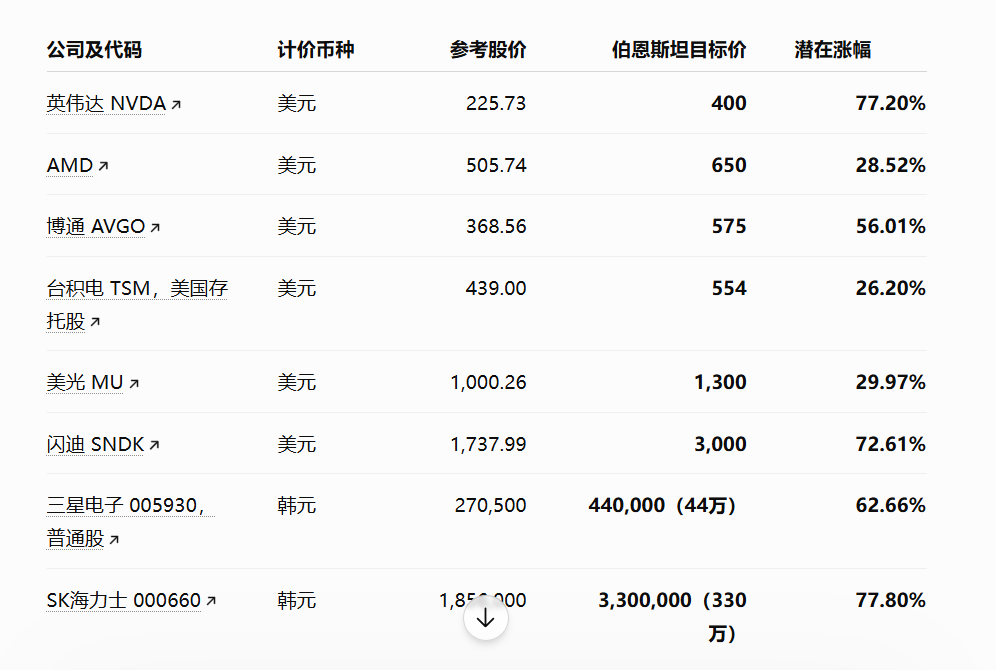
In addition to memory chip giants, Bernstein's favored semiconductor targets also cover AI chip leaders, wafer foundries and semiconductor equipment, as well as advanced packaging and high-end semiconductor testing segments. According to Bernstein's latest target prices,$NVIDIA (NVDA.US)$、$SK hynix (SKHY.US)$、$SanDisk (SNDK.US)$and$Samsung Electronics (005930.KR)$the target prices imply upside potential of approximately 77.20%, 77.80%, 72.61%, and 62.66%, respectively. Bernstein's target price for NVIDIA, the company with the highest market capitalization globally, is as high as USD 400, ranking among the most optimistic targets on Wall Street.
Editor/melody