
1. U.S. Treasury Secretary Bessent had pledged to take aggressive action to suppress U.S. Treasury yields, but his measures have clearly fallen short so far; 2. On Wednesday, the U.S. Treasury announced it would purchase up to $6 billion in long-term Treasury bonds in the following day's repo operations. This figure disappointed many investors who had anticipated a larger scale, while also pushing long-term U.S. Treasury yields to multi-year highs.
U.S. Treasury Secretary Bessent had pledged to take aggressive action to suppress U.S. Treasury yields, but his measures have clearly fallen short so far.
On Wednesday, the U.S. Treasury announced it would purchase up to $6 billion in long-term Treasury bonds in the following day's repo operations. This figure disappointed many investors who had anticipated a larger scale, while also pushing long-term U.S. Treasury yields to multi-year highs.
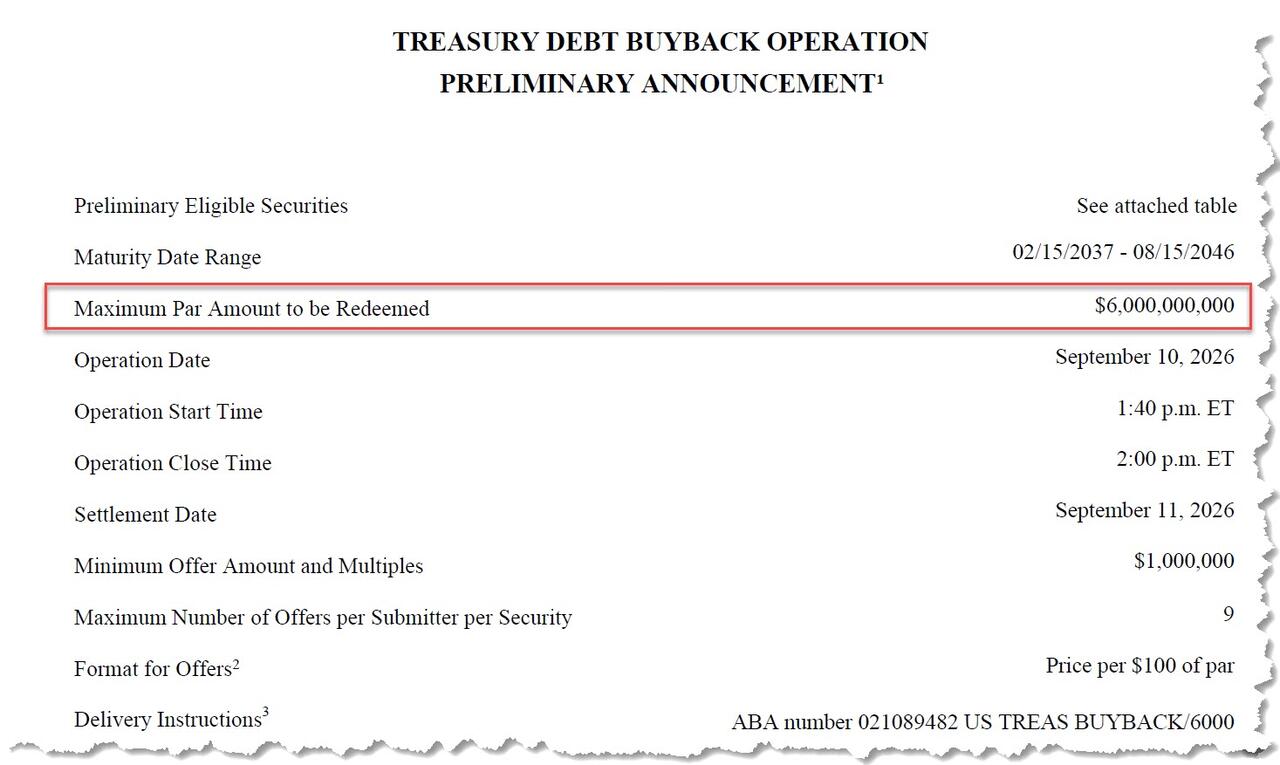
 Previously, the U.S. Treasury had announced last month that it would at least double the single-operation cap for long-term Treasury bond buybacks from $2 billion. The program was initially designed to improve market liquidity for older bonds with longer maturities and insufficient liquidity. However, given that long-term yields were approaching critical warning levels at the time, the market widely interpreted this move as the Treasury's intent to curb rising borrowing costs.
Bessent, who has billed himself as America's "chief bond salesman," made lowering the yield on 10-year U.S. Treasuries an administrative priority early in Trump's second term. However, this goal has recently been repeatedly hindered by geopolitical conflicts (such as the situation in Iran), tariff policies, and various unforeseen events beyond administrative control.
Overall, this "disciple of Soros" and former prominent hedge fund manager has adopted unusually aggressive approaches in managing the market, including direct intervention in foreign exchange markets to support the Argentine peso and the Japanese yen.
In recent days, his rhetoric has become increasingly high-profile. On Tuesday, when discussing recent interventions in the yen, he boldly stated: "I have asymmetric information; I am the house now. Anyone who wants to bet against me, bring it on."
However, the volatility in the U.S. bond market on Wednesday—though relatively limited in magnitude—revealed the risks behind this high-profile stance: the targets set by the Treasury Secretary may prove difficult to fully achieve.
Bessent's "market-rescue trump card" fails to win market confidence
"Any attempt to lower yields through buybacks has had little effect," said Jack Ablin, Chief Investment Strategist at Cresset Capital. "It is merely masking the problem."
Some investors have stated that the U.S. Treasury is currently in a dilemma: market expectations for the scale of buybacks are high, but it will be difficult to truly impress the market without relaxing the guideline of "purchasing bonds only at current market prices."
Leah Traub, fixed-income portfolio manager at Lord Abbett, stated that this has placed the U.S. Treasury in a difficult position regarding these buyback operations.
As bond prices fell, U.S. Treasury yields continued to rise throughout the summer, with the 30-year Treasury yield surging to its highest level in 19 years. One of the core drivers behind this was the spike in energy prices triggered by geopolitical conflicts—on Wednesday, as tensions in the Middle East escalated, Brent crude oil prices surpassed the $100 per barrel mark for the first time since July.
This has intensified market concerns about persistently high inflation, sparking fears that the Federal Reserve may raise interest rates as early as next week's monetary policy meeting.
Some traders added that a robust labor market, the expanding U.S. fiscal deficit, and the competition for market liquidity from intensive bond issuance by tech giants are also jointly pushing up long-term bond yields.
The sharp decline in the bond market has also cast a shadow over equities. In September, a month when U.S. stocks have historically tended to perform poorly, the three major U.S. stock indices fell consecutively over the past few trading sessions. On Wednesday, the Dow Jones Industrial Average dropped another 0.8%, the S&P 500 Index fell 0.5%, and the Nasdaq Composite Index declined 0.6%.
Elevated Treasury yields have increased borrowing costs for consumers and businesses, as well as mortgage rates, which will ultimately erode the profits of listed companies. Furthermore, rising yields attract more capital from the high-risk equity market to the extremely safe Treasury market.
Ablin added, "As yields rise, Treasuries are becoming more attractive to capital, diverting funds from the stock market. Many investors are already considering shifting their allocations."
Is a $6 billion buyback scale still far from sufficient?
Regarding the buyback figures announced by the U.S. Treasury on Wednesday, Deutsche Bank strategist Steven Zeng stated, "They tripled the initial scale, but the market still viewed it as disappointing news because it was not the 'shock-and-awe' action investors were looking for. It is as if the Treasury created a monster itself and now can only keep feeding it."
At least for now, the U.S. Treasury has not further "amped up" its repurchase guidance following Thursday's announcement. The Treasury stated that for the remaining six long-term nominal Treasury bond buyback operations in the current fiscal quarter, each purchase will be no less than $4 billion. This language is consistent with the announcement issued on August 19, when the Treasury indicated that the initially set operation size of $2 billion per transaction would be "at least doubled."
"Given the current situation, the U.S. Treasury is essentially bringing a water gun to a tank battle," quipped Elias Haddad of Brown Brothers Harriman.
Following the initial announcement of the expanded buyback program on August 19, yields on U.S. long-term Treasuries dipped briefly but quickly recovered their losses. Speaking at an event in Texas on Tuesday, Bessent stated that the recent market volatility stemmed from fears that "the U.S. would be unable to repay its debt," describing it as "absurd, yet it briefly became the dominant market narrative."
Furthermore, Bessent publicly framed the buybacks as a measure aimed at enhancing market liquidity. Last week, he noted that buybacks could help banks and other financial institutions offload less liquid legacy debt, thereby freeing up capital and balance sheet space to better participate in auctions for newly issued Treasury securities.
Krishna Guha, Head of Economics at Evercore ISI, and his team analyzed in their latest report that Wednesday's statement "indicates Bessent is acknowledging the limitations of the buyback tool." The report pointed out that Bessent may have realized that "the U.S. cannot forcefully intervene to suppress yields in defiance of economic fundamentals."
The difficulty of curbing surging yields was fully evident in the Treasury auction later on Wednesday: the U.S. Treasury sold $39 billion worth of 10-year notes. Although demand was relatively robust, the winning yield still reached a high of 4.834%, setting a record for this maturity in the history of Treasury auctions.
Several investors and analysts pointed out that ramping up buybacks at this critical juncture, just weeks before the November congressional elections, underscores the Trump administration's deep anxiety over soaring long-term borrowing costs. The successive rise in U.S. Treasury yields has directly pushed U.S. mortgage rates to their highest level in more than a year.
Subadra Rajappa, Head of U.S. Rates Strategy at Societe Generale, stated, "I am uncertain how much impact these buybacks will ultimately have on the Treasury market," referring to market expectations that the operations might help lower bond yields. "This shows they understand the significance of long-term selling pressure. However, I believe the real issue they need to address is the trajectory of debt and deficits. Everything else is superficial."
Macro strategist Sebastian Boyd pointed out that to bring down long-term yields, the U.S. Treasury "needs to make some difficult decisions that will not yield immediate results," such as reducing spending and lowering long-term inflation expectations through higher interest rates. If they lack the resolve to do so, yields appear likely to continue their gradual ascent.
Nevertheless, some industry insiders still believe that, given Wednesday's announcement directly triggered an opposite market reaction, Bessent may face pressure to further increase the single-transaction buyback size to above $6 billion. While some analysts argue that $10 billion is an insurmountable barrier, many others believe there is ample justification for him to continue raising the stakes.
Zeng at Deutsche Bank indicated that the U.S. Treasury could ultimately purchase more bonds. The department’s “Frequently Asked Questions” page on buybacks notes that a “final buyback announcement” is typically released at 11:00 a.m. on the day of the operation, superseding the earlier preliminary announcement.
“Bessent is signaling to the market through both words and actions: do not challenge the Treasury on 30-year Treasuries,” said Joseph Purtell, portfolio manager at Neuberger Berman. “He can still scale up buyback volumes significantly, potentially to tens of billions of dollars. There is no clear technical cap.”
Editor/lambor