① At present, the company most worthy of attention is likely Oracle, which is scheduled to release its first-quarter earnings after the U.S. stock market closes on Thursday. Among all the giants in the U.S. AI ecosystem, Oracle has the most fragile financial position; ② Will the message Oracle conveys on Thursday be one of continuing to "go full speed ahead" or of "proceeding with caution"?
Cailianshe, September 10 (Editor: Xiaoxiang) In the United States, the race for dominance in artificial intelligence is gradually evolving into a trillion-dollar "game of chicken."
Google co-founder Larry Page previously told employees that he would "rather go bankrupt than lose this race"; Amazon founder Jeff Bezos has described artificial intelligence as an "industrial bubble," noting that both good and bad projects are currently able to secure financing, much like during the dot-com bubble; meanwhile, Meta founder Mark Zuckerberg recently pledged to build "personal superintelligence for everyone."
 Nearly every hyperscale AI giant is going all out to win—whatever victory may mean. Even though the actual returns on the massive capital they are currently spending on data centers remain slim, no one has yet backed down...
At present, the company most worthy of attention is likely Oracle, which is scheduled to release its first-quarter earnings after the U.S. stock market closes on Thursday. Among all the giants in the U.S. AI ecosystem, Oracle has the most fragile financial position and is seen as the most likely to retreat first!
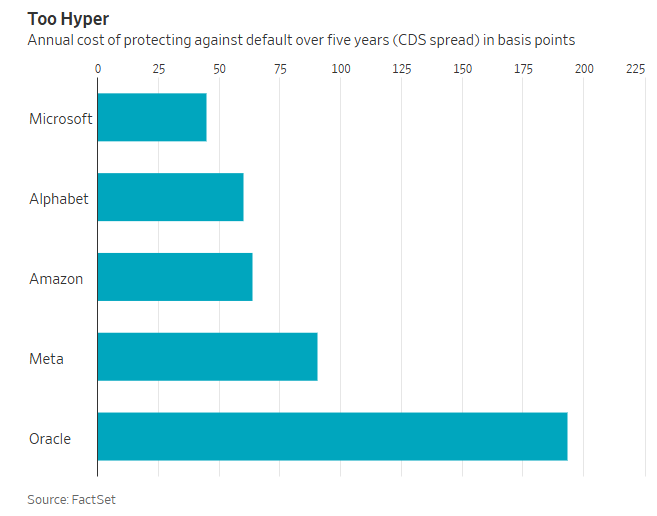
Since Oracle released its previous quarterly earnings report in June, S&P has downgraded its debt rating to just one notch above junk status. This summer, the cost of insuring against loan and bond defaults—credit default swaps (CDS)—hit a multi-year high. Although this cost has declined slightly in recent times, it remains approximately four times that of Microsoft, another hyperscale cloud service provider.
So, will the message Oracle conveys on Thursday be one of continuing to "go full speed ahead" or of "proceeding with caution"?
Oracle Delivers Its "Report Card" Tonight
According to FactSet estimates, Oracle's first-quarter revenue is expected to reach approximately $19.1 billion, representing a year-on-year increase of over 28%; adjusted earnings per share (EPS) are projected at $1.74, significantly higher than the $1.47 recorded in the same period last year. These forecasts largely fall within the guidance range previously provided by the company. Oracle expects total quarterly revenue growth of 27% to 29%, with adjusted EPS between $1.72 and $1.76.
However, demand for Oracle's services is clearly not the company's real problem; the billing is.
Concerns over Oracle's financing and spending plans, as well as the concentration of its backlog among a few large artificial intelligence companies, have caused Oracle's stock price to fall nearly 20% year-to-date in 2026, representing a decline of more than 50% from its historical high in September last year. Consequently, merely meeting revenue and profit expectations may not be sufficient to drive a significant rebound in Oracle's share price.
Oracle's capital expenditures for fiscal year 2026 amounted to approximately $55.7 billion, while operating cash flow for the same period was around $32 billion. As a result, capital expenditures represented approximately 174% of operating cash flow, leading to negative free cash flow.
These expenditures may still create value. However, the key question is whether future returns will be sufficient to offset today's outlays.
Oracle's customers have prepaid for or directly supplied GPUs worth approximately $75 billion, associated with major AI contracts. This has alleviated Oracle's funding burden. Nevertheless, investors must remain attentive to the pace at which the backlog converts into revenue and the remaining cash flow after new capacity comes online.
In tonight's earnings report, the performance of Oracle's Cloud Infrastructure (OCI) growth and the conversion of Remaining Performance Obligations (RPO) into revenue are likely to draw the most attention. If OCI growth reaches triple digits, it would indicate that demand for AI training, inference, and multi-cloud databases remains robust, providing initial evidence that the backlog is translating into actual revenue. Meanwhile, the market is no longer looking for Oracle to simply accumulate orders, but rather to convert them into tangible and reliable revenue.
Furthermore, during the previous earnings conference call, Oracle's new Chief Financial Officer, Hilary Maxson, pledged to "implement disciplined capital allocation, maintain a strong balance sheet, and preserve our investment-grade credit rating." This is undoubtedly welcome news for bond investors.
However, the capital expenditures she reported far exceeded expectations—approximately $56 billion for the fiscal year ending in May, with a planned $70 billion for the current fiscal year—which struck a dissonant chord akin to nails scratching a blackboard. Oracle's stock plummeted on that day and has remained weak since, underperforming the S&P 500 Index by 51 percentage points over the past 12 months.
The focal point of the entire AI industry
Analysts note that following such a sharp sell-off, two divergent signals could potentially trigger a rebound in Oracle's stock price tonight.
Investors may welcome either scenario: one where Oracle's growth projections justify its spending levels, or another where the company begins to show signs of exercising greater discipline in curbing expenditures.
Of course, the concern is that the latter could trigger adverse ripple effects for peers and chip manufacturers, potentially even dampening market enthusiasm for the upcoming initial public offerings of OpenAI and Anthropic.
Oracle and the other four hyperscale cloud service providers may see their total capital expenditure reach approximately $800 billion this year, with annual spending projected to exceed $1 trillion over the next four years. The future profits required to justify such expenditures are substantial, and Oracle has the smallest earnings buffer relative to its debt within this group.
In its report downgrading Oracle’s credit rating, S&P highlighted broader concerns about overinvestment in the artificial intelligence sector. “While short-term demand remains strong, this trend could reverse if leading frontier model developers fail to secure external financing or cease subsidizing customers.”
The equity market does not anticipate such a scenario, but more pragmatic bond investors may temper the exuberance—clearly a reason why the entire industry needs to monitor Oracle closely.
Recent options pricing suggests that Oracle’s stock price could fluctuate by as much as 11% before the end of the week. Such a move from Wednesday’s closing price could either push the stock up to $179, recovering some of its year-to-date losses, or drag it below $145.
Morgan Stanley analysts currently rate the stock as Neutral, warning in a recent report that Oracle may need several quarters of robust performance to win the trust of cautious investors. Meanwhile, Citi analysts told clients they “see an opportunity, given that the stock has experienced one of the most extreme market volatilities and declines in its history.”
Most Wall Street analysts remain bullish on Oracle. Among the 11 analysts tracked by Visible Alpha, nine recommend a “Buy” rating, while only one assigns a “Neutral” rating and one a “Sell” rating. Their average target price is $239, implying nearly 50% upside from Wednesday’s closing price.