
At the highly anticipated Goldman Sachs Communacopia + Technology Conference, U.S. NAND flash memory giant SanDisk clearly stated that supply growth for NAND chips is likely to remain severely constrained for the foreseeable future. Meanwhile, the widespread adoption of high-performance AI inference led by Astra, along with AI agent technologies focused on agentic AI workflows, is driving an explosive surge in demand for AI computing capacity and data center NAND storage.
Goldman Sachs analysts recently released conference notes from Communacopia + Technology Conference, covering remarks by SanDisk CEO David Goeckeler and CFO Luis Visoso, as well as their latest outlook on NAND's future growth prospects. The notes also included comments from executives of major technology companies such as Etsy, NXP Semiconductors, Comcast, and Block on the second day of the conference. The minutes indicate that as AI applications driven by large language models accelerate their penetration into various global sectors, AI inference is reshaping both the structure of NAND demand and procurement methods. Long-term agreements are enhancing the predictability of revenue and profits, low capital expenditure intensity supports effective capacity expansion, and expanded share buybacks focus on returning operational results to shareholders.
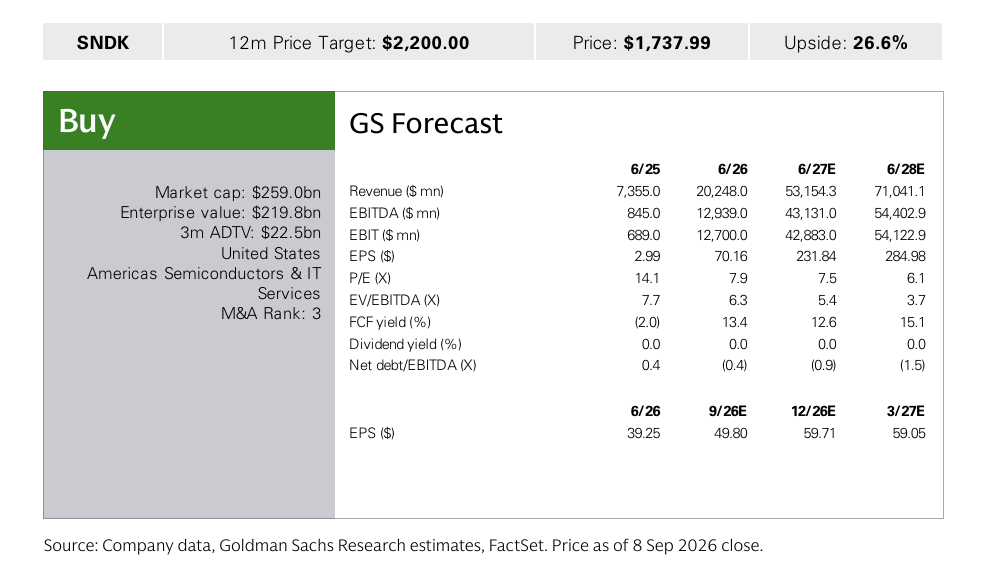
Goldman Sachs also remains bullish on SanDisk's accelerated development of next-generation NAND storage technology—specifically the High Bandwidth Flash (HBF) storage technology roadmap—as well as the long-term growth opportunities arising from the continuous layered expansion and offloading of Key-Value (KV) Cache to data center SSDs. The firm maintains a 'Buy' rating for SanDisk with a 12-month target price of $2,200. Relative to the closing price of $1,737.99 used in the report on September 8, this implies a potential upside of approximately 26.6%, following a staggering 570% projected rise in 2025 and a 600% year-to-date increase in the stock price.
 The Goldman Sachs notes emphasize two long-term opportunities highlighted by SanDisk's management: first, the NAND-based High Bandwidth Flash (HBF) technology roadmap, which expands the use of flash memory in AI inference storage architectures through high-capacity and high-bandwidth designs; second, long-context, multi-turn interaction, and high-concurrency agents driving tiered storage for KV caches, allowing more reusable and inactive cache data to be offloaded to data center SSDs. This reduces VRAM occupancy on AI GPUs/TPUs/XPU s and lowers repetitive computation costs, thereby increasing enterprise-grade NAND demand.
Another Wall Street financial giant, Bernstein, recently published a research report indicating that Astra and AI Training Operator Research Automation (i.e., Astra and RSI) are providing new sources of semiconductor demand, fueling an unprecedented boom in the storage chip sector. The firm set a target price of $3,000 for SanDisk. Bernstein maintains an 'Outperform' rating for the global leaders in memory chips that have seen strong gains this year—namely Samsung Electronics, SK Hynix, Micron, and SanDisk—with target prices of 440,000 KRW, 3.3 million KRW, $1,300, and $3,000, respectively. This reflects a new round of positive forecasts by Wall Street institutions regarding the prosperity of the memory chip industry.
Long-Term Contracts Reshape Profit Foundations: SanDisk's NAND Business Is Shifting Its Growth Engine
In the conference notes, the Goldman Sachs analyst team stated that SanDisk is transitioning from short-term spot pricing to a business model dominated by long-term agreements. Citing SanDisk management, the analysts noted that 50% and 67% of the planned sales volumes for fiscal years 2027 and 2028, respectively, are already covered by NBM long-term agreements. The floor price mechanism in these agreements supports gross margins of approximately 80% for most of the business even in downside scenarios, significantly improving earnings visibility. Goldman Sachs expects the company's revenue to reach approximately $53.15 billion and $71.04 billion in fiscal years 2027 and 2028, representing year-over-year growth of about 162.5% and 33.7%, respectively, with earnings per share of $231.84 and $284.98.
The long-term mismatch between supply and demand, coupled with capital allocation strategies, constitutes the second pillar supporting SanDisk's long-term bull case. Goldman Sachs stated that SanDisk's management believes the comprehensive adoption of AI applications across various sectors in the AI inference era will continue to drive demand, while NAND supply growth will remain limited in the foreseeable future. Additionally, new capacity added by Chinese competitors is primarily being absorbed by the domestic market.
The company has extended its joint venture partnership with Kioxia until 2034 and emphasized that its proprietary intellectual property, R&D investment, and BiCS technology roadmap can support bit output growth over the coming years, while maintaining a low capital expenditure intensity of approximately 5%. Goldman Sachs noted that this indicates SanDisk aims to increase salable capacity and improve output per unit of capital invested through manufacturing efficiency and technological upgrades. Furthermore, the company has executed approximately $4.5 billion in share buybacks and currently continues to use buybacks as the primary method for returning excess capital, while maintaining a positive and open attitude toward future dividends.
NVIDIA's revenue for the second quarter of fiscal year 2027 reached $96.2 billion, a 106% year-over-year increase; data center revenue was $89 billion, up 117% year-over-year. The company projected next-quarter revenue to reach $108 billion, plus or minus 2%, and provided a 70% growth guidance for the next fiscal year. Meanwhile, Anthropic, which is preparing for an IPO, reportedly signed a six-year computing power agreement worth approximately $45 billion with Nscale, corresponding to 460 megawatts of capacity, and reached a cloud computing deal worth approximately $35 billion with Lambda. These latest signs of global AI computing demand indicate that leading model companies are locking in long-term computing supply in advance to meet the continuously growing demand from AI applications, thereby driving large-scale procurement of data center infrastructure, including AI compute cluster accelerators, server memory, enterprise SSDs, high-performance networking equipment, and server CPUs.
From a technical infrastructure perspective, the incremental demand for NAND driven by AI inference stems from increased data retention and the greater role storage plays in the inference process. Agents need to repeatedly access enterprise knowledge bases, code, documents, and multimodal materials, while saving task states, tool outputs, and reusable contexts. Under typical Transformer architectures, longer context windows and higher concurrency further expand KV cache requirements. Active computation prioritizes HBM, with CPU-side DRAM serving as expanded memory, while caches suitable for reuse but currently inactive can be offloaded to enterprise-grade SSDs to reduce recomputation costs.
Consequently, opportunities for leading NAND memory chip manufacturers—namely SanDisk, Kioxia, Micron, and Samsung—span NAND capacity, read throughput, and product capabilities tailored to specific workloads. SanDisk’s management views High Bandwidth Flash (HBF) as a long-term option to alleviate the “DRAM/HBM memory wall” through higher density. Management projects that the AI data center storage capacity market will reach approximately 1.2 ZB by 2032, with KV cache-related demand accounting for about 35%, equivalent to roughly 0.42 ZB. However, these are capacity forecasts provided by SanDisk’s management and should not be directly equated with revenue expectations, nor do they imply that data center NAND technology can directly replace all HBM applications.
From answering questions to sustaining high-output work: Astra unlocks a new wave of demand for computing power
OpenAI's GPT-6 Astra large language model, along with the RSI technical path focused on by AI leaders, is expected to become the two core drivers driving the exponential expansion of AI computing demand. Stronger AI large models and broader use of AI application tools, combined with the next generation of AI training paths featuring stronger computing demand, are reinforcing the basis for the continued growth in demand for AI computing infrastructure.
Astra represents the most cutting-edge mechanism for expanding performance demand: improvements in large model capabilities bring tasks that were previously difficult to complete reliably into the realm of commercial viability. Furthermore, Astra may shift the entire demand curve outward—meaning that as AI large models become smarter, companies can attempt work that was previously unreliable, and competitors must continue to invest in R&D and training. This provides new, strong support for the AI spending cycle.
On Sunday, NVIDIA CEO Jensen Huang made a significant statement on social media, asserting that the release of GPT-6 Astra means “AGI has arrived.” NVIDIA’s confirmed strong revenue range and robust shipment guidance, combined with the entry of large AI model development into a new phase of “Recursive Self-Improvement (RSI),” are driving another surge in AI computing demand. Specifically, Astra is expected to expand AI computing demand on the commercial application side, while the R&D trajectory of AI “creating AI” may increase investment in frontier operator experiments, evaluations, and long-term continuous training, collectively extending the computing investment cycle.
The significance of Astra for the demand curve lies in improving the completion rate of complex workflows, thereby making tasks previously uneconomical to automate commercially viable. In OpenAI’s latest OSWorld 2.0 benchmarks, Astra scored 72.6%, surpassing GPT-5.6 Sol’s 65.7%. Its capabilities cover long-horizon tasks such as computer operation, software engineering, and scientific research.
By extension, global frontier technology research institutions or internet IT enterprises may deploy more parallel AI agent workflows, enabling them to execute longer-duration tasks involving larger datasets, thereby expanding demands for inference calls, cache reuse, and persistent storage. This aligns with Morgan Stanley’s logic of shifting focus to supply constraints in computing power, electricity, and materials. The suggestion by OpenAI’s product lead to “possibly pause new Pro subscriptions” also reflects the short-to-medium-term pressure on AI computing power and high-performance data center storage service capacity amidst explosive demand.
Scientific research agents centered around Astra further demonstrate the trajectory of AI computing demand entering a new phase of exponential expansion. The continuous generation and reuse of contexts, code, experimental results, and checkpoints in multi-agent research highlight how high-performance SSDs, potential HBF solutions, and scientific research agents could provide longer-term growth opportunities for NAND storage leaders like SanDisk. OpenAI disclosed that its Navier-Stokes research employed approximately 10,000 concurrent agents, forming a solution in about 88 hours. All attempted research tasks generated approximately 300 billion output tokens, with the Navier-Stokes portion accounting for about 130 billion. The solving process involved internal models more capable than Astra, while Astra separately completed Lean formal verification in about 17 hours.
The global semiconductor sector in equity markets has experienced a sequence of “panic selling triggered by the July deleveraging frenzy, sentiment repair in August, and a new bull market catalyzed by model advancements in September.” The Philadelphia Semiconductor Index fell nearly 29% between June and July, but rebounded approximately 20% from its July 29 low by mid-day on August 13, touching the threshold for a technical bull market. Meanwhile, South Korea’s KOSPI rebounded from around 5,593 points on July 30 to 7,129.34 points mid-day on September 8, a cumulative recovery of about 27.5%. On September 7, Samsung Electronics and SK Hynix rose 5.7% and 8.1% respectively, indicating that storage leaders remain key drivers in the Korean market. The launch of Astra adds new demand expectations to existing earnings and order support, prompting market capital to reassess how much computing power and storage services enterprises are willing to purchase as models become capable of handling more complex tasks.