
Since the outbreak of war in Iran in February, the European Central Bank has raised interest rates for the second time to address signs that inflation will remain well above 2%. On Thursday, the ECB's deposit facility rate was increased by 0.25 percentage points to 2.5%.
According to Zhitong Finance, the latest U.S. Producer Price Index (PPI) data and the European Central Bank (ECB) policy decision, released on the evening of September 10 (Beijing time), jointly highlight the ongoing constraints that surging oil and gas prices impose on the accommodative or neutral monetary policies of global central banks, against the backdrop of deteriorating geopolitical tensions in the Middle East. As energy inflation sounds another alarm, traders in European and American markets are reassessing interest rate ceilings. As expected by the market, the ECB announced a 25 basis point rate hike, raising the deposit facility rate to 2.50%. The core signal from the ECB is that the disinflation process is proceeding more slowly than anticipated, and the economy's resilience to rate hikes is stronger than previously assumed by ECB officials.
Compared to the Summary of Economic Projections released in June, the ECB has maintained its inflation forecast for the full year 2026 at 3.0%, with upward revisions concentrated in 2027 and 2028. Concurrently, economic growth forecasts have also been raised, effectively leaving room for further rate hikes. However, the central bank continues to emphasize a meeting-by-meeting approach to decision-making, noting that subsequent rate hikes priced in by the market do not constitute a policy commitment.
 The U.S. PPI for final demand rose 0.4% month-on-month in August, aligning with the consensus expectations of financial markets reported prior to the release. The year-on-year producer inflation indicator exceeded expectations, rising 5.4%, slightly above the projected 5.3%, thus accurately described as 'slightly exceeding expectations on a year-on-year basis.' Notably, energy prices rose 4.2% month-on-month, while diesel prices surged 24.1%, indicating that fuel supply shocks stemming from the Iran-U.S. conflict and its escalating intensity are driving up production and transportation costs.
However, the core PPI, excluding food, energy, and trade services, rose 0.3% month-on-month, down from 0.4% in July. While this does not yet confirm that all price pressures are accelerating, traders have largely priced in hawkish expectations for the Federal Reserve to commence rate hikes in October, assigning nearly an 80% probability to a return to tightening. Following the PPI release, the yield on the 30-year U.S. Treasury bond rose to around 5.34%, reaching its highest level since 2007. Nasdaq 100 index futures, often regarded as a bellwether for tech stocks, fell more than 1%, with AI computing power-themed stocks declining collectively in pre-market trading.
Middle East Conflict Reflected in Rate Decisions: ECB Takes Action Again
The European Central Bank raised interest rates for the second time since the outbreak of the Iran war in February, responding to signs that inflation may remain significantly above the 2% target.
On Thursday, the deposit rate was increased by 0.25 percentage points to 2.5%, consistent with the forecasts of nearly all economists surveyed by Bloomberg. The ECB reiterated that it would not pre-commit to future actions but would make decisions on a meeting-by-meeting basis depending on incoming data.
Interest rate futures traders in Europe believe the ECB will take further action, increasing their bets following the announcement. They currently expect three additional rate hikes before October 2027.
The ECB stated in its press release: "The ongoing conflict in the Middle East continues to exert inflationary pressure, and inflation is expected to remain significantly above the target level for an extended period." "The outlook remains highly uncertain, with upside risks to inflation and downside risks to economic growth."
Surging energy prices have pushed inflation to its fastest pace in nearly three years. Thursday's move places eurozone policymakers further ahead of other major central banks in addressing this shock. Traders anticipate further action from the ECB, with the market already pricing in expectations of two additional rate hikes by mid-2027.
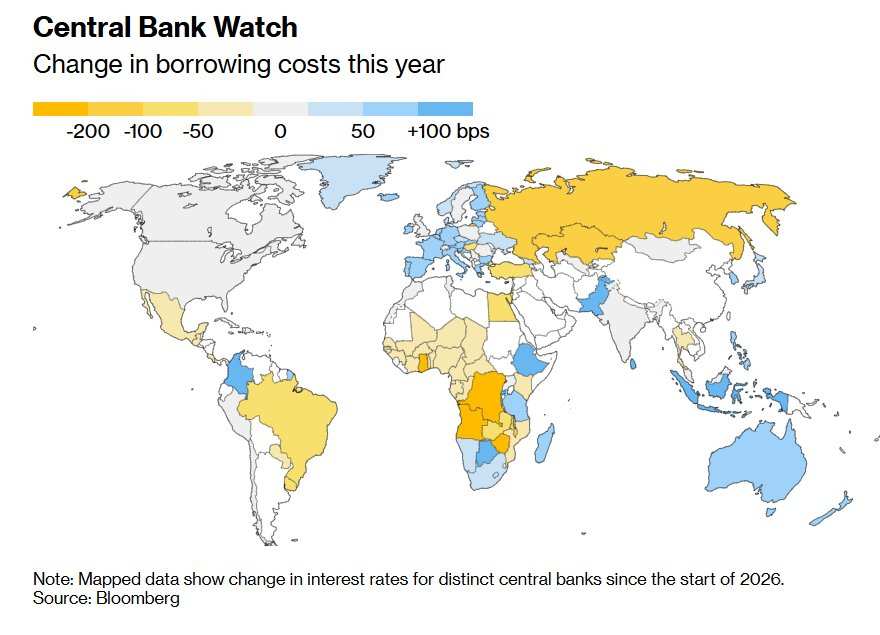
The chart above illustrates central bank monitoring—specifically, the trajectory of benchmark changes in global central bank borrowing costs since the beginning of this year. Note: The data shown on the map reflects interest rate changes by various central banks since early 2026.
This contrasts with the Federal Reserve and the Bank of England, neither of which has tightened monetary policy in response to the conflict in the Middle East, and both are likely to remain on hold next week as well.
The European Central Bank’s latest decision was guided by updated forecasts: inflation is projected to average 3% this year, before declining to 2.5% in 2027 and 2.1% in 2028. Due to a marked acceleration in euro area economic growth in the second quarter, the full-year growth forecast has been revised upward to 0.9%.
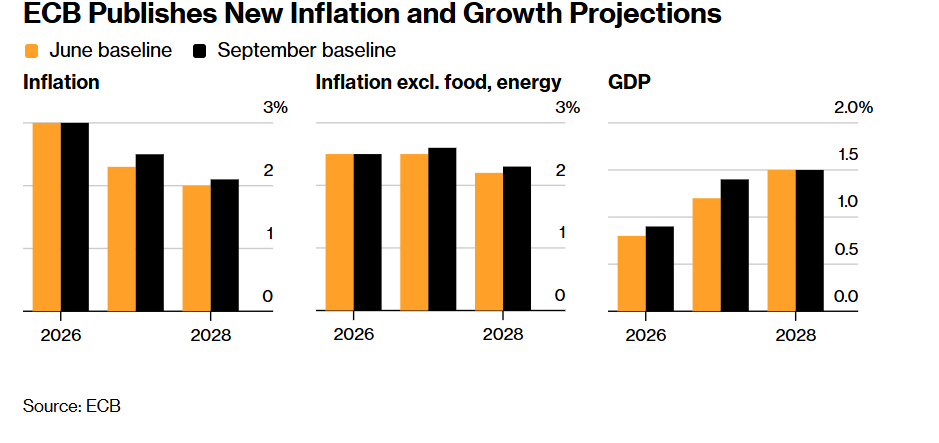
The chart above displays the latest inflation and economic growth projections released by the European Central Bank.
European Central Bank President Christine Lagarde will face questions from journalists at 2:45 p.m. in Berlin, amid ongoing speculation about her potential early departure. The ECB holds one meeting per year outside its Frankfurt headquarters; this year’s venue is Berlin.
With oil prices reaching $100 per barrel and European natural gas prices climbing to levels unseen since the winter following Russia’s invasion of Ukraine, consumer prices in the 21-country euro area rose by 3.3% year-on-year in August.
However, there are also some more encouraging signs: underlying inflation and a closely watched services price indicator have both retreated, while wage pressures have eased.
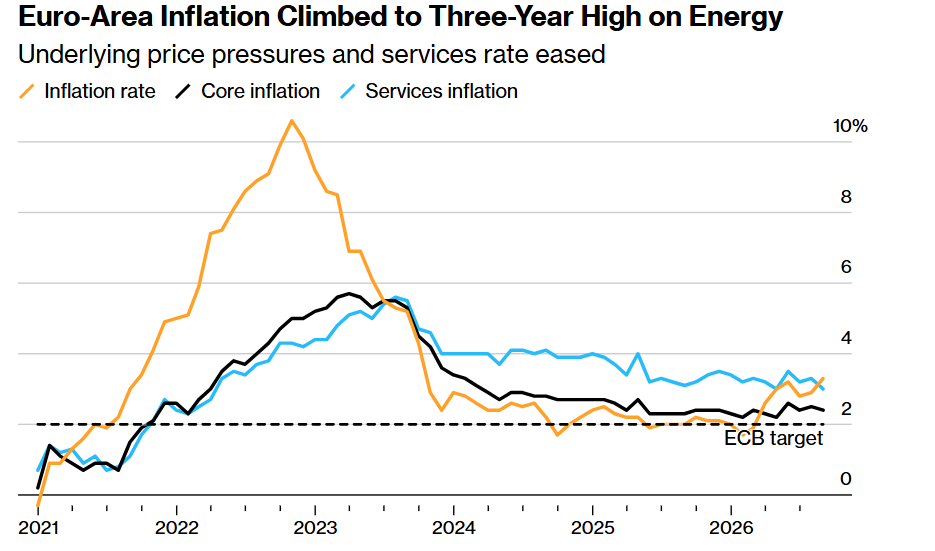
As shown in the chart above, energy costs have pushed euro area inflation to a three-year high, while underlying price pressures and services inflation have moderated. Source: Eurostat.
These developments should help alleviate concerns among some officials who argued at the ECB’s July meeting that a “moderately restrictive” policy stance might be necessary to bring inflation back to target. Achieving this would require raising the deposit facility rate above 2.5%, which is widely regarded by markets as the upper bound of the neutral interest rate range that neither stimulates nor restrains economic activity.
Gediminas Simkus, the Lithuanian member of the ECB Governing Council, has stated that the ECB is unlikely to end its rate-hiking cycle immediately after this week; meanwhile, his Bulgarian colleague Dimitar Radev indicated that further action remains possible at the December meeting.
The unexpected resilience demonstrated by the economy may facilitate further policy tightening. Following a significant revision of Irish data, eurozone economic output increased by 0.6% quarter-on-quarter in the second quarter; meanwhile, digital investment, along with government spending on infrastructure and defense, propelled manufacturing expansion to its fastest pace in over four years.
Camille Couval, Head of Eurozone Economic Research at Moody's Analytics, stated that the European Central Bank’s acknowledgment of unexpectedly strong economic performance, coupled with forecasts for higher inflation, indicates that the Governing Council is open to further rate hikes, thereby increasing the likelihood of a third hike. "Even if energy prices retreat from current levels, we currently assess the probability of a third rate hike at 50%."
Prolonged Inflation Battle: Equity Valuations Face Cash Flow Scrutiny
Regarding European inflation expectations, this rate hike primarily aims to prevent energy shocks from persistently spreading through corporate pricing, wage negotiations, and inflation expectations. Rate hikes operate by constraining credit and demand, offering limited improvement to oil and gas supply itself.
Therefore, the effectiveness of the ECB's monetary policy depends on whether energy price increases can be contained within a limited scope. The current easing of underlying inflation and wage pressures provides conditions for gradual adjustment; however, the upward revision of core inflation forecasts for 2027–2028 suggests that the central bank remains concerned about the lagged effects of cost pass-through.
For the European economy, upward revisions to growth forecasts have expanded the central bank's policy space to continue combating inflation. However, the 0.6% growth in the second quarter includes the impact of Irish data revisions and cannot be entirely interpreted as a comprehensive strengthening of household consumption and corporate demand. Rising energy prices compress real purchasing power, while rate hikes increase housing and corporate financing costs; both factors will continue to weigh on domestic demand. Meanwhile, investments in digitization, infrastructure, and defense provide partial support. Consequently, sectoral divergence is more likely in Europe. From an investment perspective, a company's ability to pass on costs, maintain orders, and control debt is more significant than merely observing upward revisions in economic growth rates.
For global equity investment strategies, these developments undoubtedly intensify market concerns regarding rising inflationary and even stagflationary pressures driven by global tariffs and deteriorating geopolitics, as well as the prospect of another round of severe volatility in global stock markets. This combination of latest inflation data, ECB rate hikes, and the central bank's economic outlook summary underscores the necessity of testing valuations and financing costs: if persistent inflation forces interest rates to remain high, companies reliant on forward-looking profits, high-leverage expansion, or frequent refinancing will face greater pressure, whereas firms with pricing power, stable free cash flow, and robust balance sheets will hold a comparative advantage.
Energy producers may benefit from rising prices, while the aviation, transportation, and energy-intensive manufacturing sectors will face greater tests of their cost pass-through capabilities. The U.S. Producer Price Index (PPI), which slightly exceeded expectations year-on-year, also heightens the importance of subsequent Consumer Price Index (CPI) data. However, neither the single-month PPI figure nor the ECB's rate hike alone is sufficient to determine the Federal Reserve's next move. In particular, as the European rate hike was widely anticipated, future market movements will depend more on how the interest rate path and earnings forecasts evolve.
Undeniably, the acceleration of the shift from highly concentrated trading in AI/U.S. large-cap growth stocks toward a portfolio strategy of "maintaining structural AI long positions + adding low-correlation, high-cash-flow, low-valuation assets" represents the consensus alpha investment strategy recommended by Wall Street strategists against the backdrop of rising inflation and climbing U.S. Treasury yields. This marks an accelerated diffusion from AI computing power themes with historically extreme leverage levels and highly crowded high-beta momentum trades toward alpha trades focused on "high-quality cash flow compounding + valuation dislocations."
As the AI bull market enters a phase characterized by "high valuations, high crowding, and high capital consumption," a team led by Michael Hartnett, senior strategist at Bank of America—often dubbed "Wall Street's most accurate strategist"—published a research report advocating a shift of marginal capital from the most expensive AI computing beta exposures to "cheaper earnings growth, genuine cash flows, and inflation-resistant assets." This represents a rebalancing from a single technology theme toward broader market earnings and high-quality cash flow sectors, rather than signaling the end of the AI bull market.
Edited by Deng