
The $6 billion figure remains limited relative to the roughly $32 trillion U.S. Treasury market and has failed to deliver the “shock effect” that some investors had anticipated. Deutsche Bank strategists bluntly described it as the Treasury “creating a monster that now needs to be fed constantly.”
The U.S. Treasury Department officially launched its first expanded long-term bond repurchase operation on Thursday, with a maximum size three times the previous single-operation cap. However, this "threefold expansion" failed to deliver the "shock" effect investors had anticipated, as the sell-off in U.S. Treasuries continued.
On Thursday, September 10 (U.S. Eastern Time), the U.S. Treasury confirmed that the maximum size for the day’s long-term bond repurchase operations was $6 billion. After this cap was confirmed during early U.S. trading, U.S. Treasury prices extended their losses. The benchmark 10-year U.S. Treasury yield, which had already surpassed 4.90% during European trading hours, briefly tested 4.94% during U.S. trading, marking a new high since October 2023.
 During midday U.S. trading, the U.S. Treasury announced that it had conducted liquidity repurchase operations on 10- to 20-year U.S. Treasuries worth $5.187 billion on Thursday, a figure below the previously confirmed cap of $6 billion. The yield on the 10-year U.S. Treasury remained above 4.95%, continuing to near the three-year high and approaching the 5% threshold.
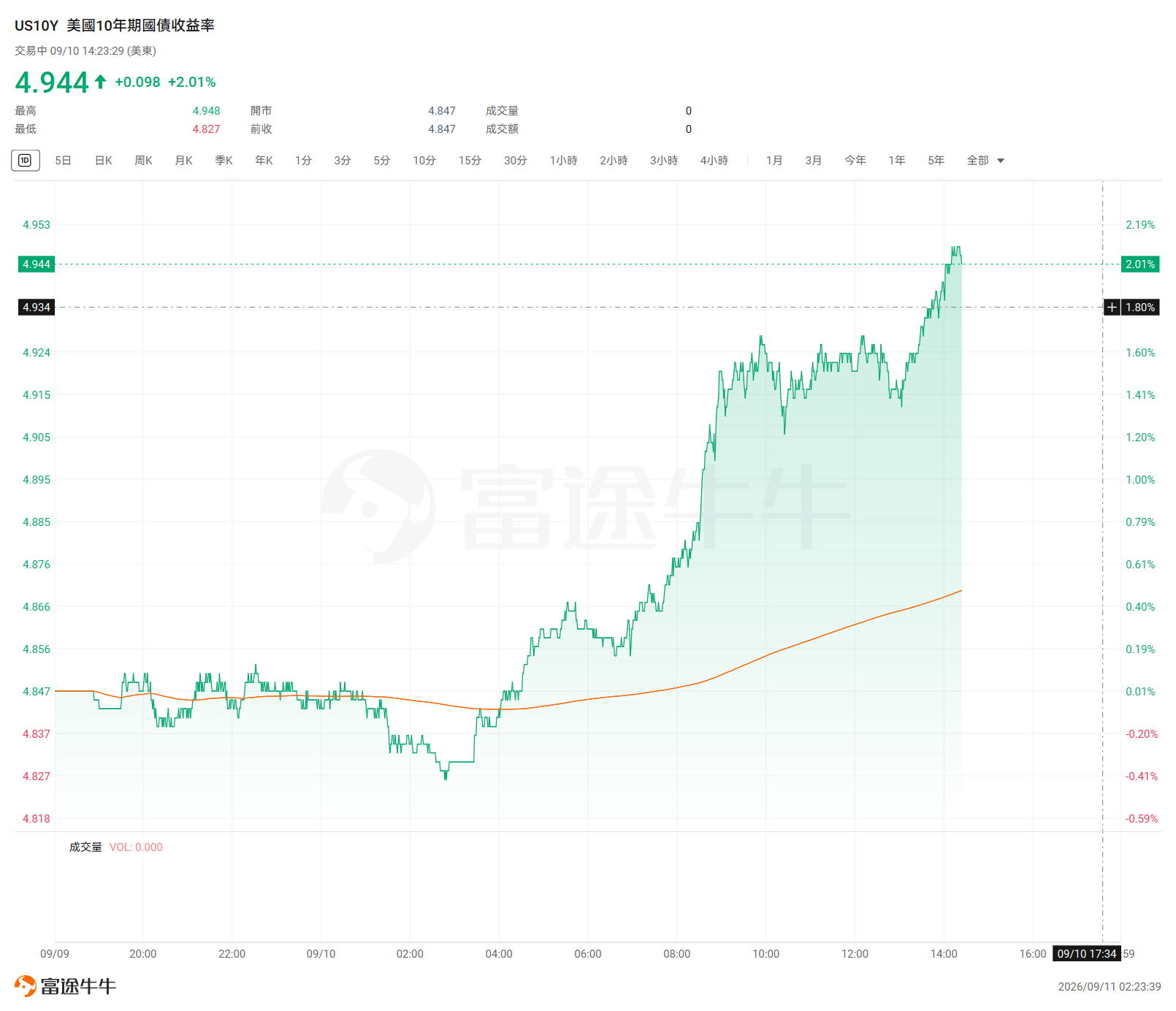
In fact, the market's initial reaction to this "threefold expansion" was evident the day before. On Wednesday, when the Treasury announced a repurchase plan of up to $6 billion for Thursday, the 10-year U.S. Treasury yield rose above 4.85% intraday, marking a new high since November 2023.
Bloomberg noted that $6 billion remains limited relative to the approximately $32 trillion U.S. Treasury market and fell short of the "shock effect" some investors had previously expected. Deutsche Bank strategist Steven Zeng bluntly stated that it was akin to the Treasury "creating a monster that now must be constantly fed."
$6 billion remained at the lower end of expectations, with Wall Street previously anticipating figures as high as $10 billion.
This repurchase operation marked the first large-scale execution following the Treasury's sudden expansion of its long-end repurchase program on August 19.
At that time, the Treasury announced that it would at least double the size of liquidity-support repurchases for 10-to-20-year and 20-to-30-year Treasury securities, raising the single-operation cap from $2 billion to at least $4 billion. Subsequently, Treasury Secretary Bessent indicated that the single-operation size could exceed $4 billion, further lifting market expectations.
Although the finally announced $6 billion represented a threefold increase over the previous cap, it did not reach the more aggressive levels some Wall Street institutions had anticipated. The market had previously estimated the repurchase size could reach $7 billion to $8 billion, with Morgan Stanley and Jefferies even projecting up to $10 billion.
Therefore, while the $6 billion figure constituted a nominal "significant expansion," it sat at the lower end of the expectation range given the continuously elevated market anticipations. Reuters also pointed out that investors had previously hoped for more aggressive action from the Treasury, with considerations for sizes as high as approximately $10 billion.
Oil prices rose again, with inflation concerns adding fuel to the sell-off in U.S. Treasuries.
As the scale of buybacks failed to deliver surprises, long-end U.S. Treasury bonds faced dual pressures from rising oil prices and inflation concerns.
According to Bloomberg, on Wednesday, when the Treasury Department announced a $6 billion buyback plan, a sharp surge in oil prices further intensified market fears of excessive inflation, causing U.S. Treasury yields to extend their previous upward trend. Oil prices remained high on Thursday, and the global bond market sell-off continued.
This highlights the gap between the problems that Treasury buybacks can address and the core contradictions currently facing the U.S. Treasury market. Buybacks primarily target older bonds with poor liquidity by providing banks and other institutions with an outlet for sales, thereby freeing up balance sheet space and facilitating their participation in new debt issuances. However, they do not directly eliminate the impact of massive fiscal deficits, Treasury supply, and inflation expectations on long-term yields.
Can further increases be expected?
The market's next focus is whether the Treasury Department will continue to expand the scale of subsequent buybacks.
The Treasury Department has not committed to maintaining the $6 billion level for every subsequent operation. Instead, it stated that the size of the remaining six long-term nominal Treasury buybacks in this fiscal quarter will reach or exceed $4 billion. This implies that $6 billion is not a fixed standard, leaving room for adjustments in future operations.
Krishna Guha, chief economist at Evercore ISI, and his team noted that Wednesday's arrangement may indicate that Bessent is accepting the reality that buybacks play only a limited role, meaning the U.S. Treasury cannot indefinitely prevent fundamental factors from determining long-term yields.
However, there is another expectation in the market: if long-end yields continue to rise rapidly, the Treasury Department may be forced to further expand the scale of buybacks.
Joseph Purtell, portfolio manager at Neuberger Berman, believes that, theoretically, the scale of buybacks could even be expanded to tens of billions of dollars or more, with no obvious upper limit.
The issue is that the $6 billion figure has already demonstrated that simply relying on a 'threefold expansion' did not halt the current round of U.S. Treasury sell-offs. With the 10-year yield hitting new highs since 2023 for two consecutive days and approaching the 5% threshold, the market will continue to closely watch how much additional capacity the Treasury Department can deploy from its 'toolbox,' and whether larger-scale buybacks can truly alter the pricing logic of long-end U.S. Treasuries.
Editor/Stephen