
Officers of the Yemeni government forces stated that on Thursday, Houthi rebels captured Mokha, a strategic port city in Taiz Province in southwestern Yemen and a key location on the Red Sea. On the same day, the Houthis claimed that Saudi Arabia had launched 64 airstrikes across multiple locations in Yemen within a 24-hour period. They asserted that navigation in the Red Sea remains "unthreatened" and described their military operations as defensive. Shipping industry experts noted that the capture of Mokha allows the Houthis to advance further south, effectively achieving "near-total control" of the Bab el-Mandeb Strait. The loss of Mokha will "undoubtedly impact maritime security in the region."
Signs of escalating tensions in the Middle East have re-emerged, with risks spilling over from the Strait of Hormuz to key shipping lanes in the Red Sea.
On Thursday, September 10, local time, CCTV News reported that Yemen’s Houthi rebels claimed the Saudi Air Force had launched 64 airstrikes in the past 24 hours against Taiz, Hodeidah, Marib, and Al Jawf provinces in Yemen. Meanwhile, citing a report by The Wall Street Journal, CCTV stated that “Iran has resumed ballistic missile production in underground facilities using stockpiled spare parts.”
 According to Xinhua News Agency, an officer in the Yemeni government forces revealed on Thursday that the Houthi rebels had captured Mocha, a strategic port city on the Red Sea and a key stronghold in Taiz Province in southwestern Yemen. Bloomberg reported that the Houthis had recently advanced toward coastal areas near the southern end of the Red Sea, close to the strategically vital Bab el-Mandeb Strait. Controlling Mocha would further expand their hold over the region surrounding this critical shipping lane.
However, according to another Xinhua report, the Houthi rebels stated on Thursday that international vessels passing through the Red Sea and the Bab el-Mandeb Strait remain “unthreatened” and safe.
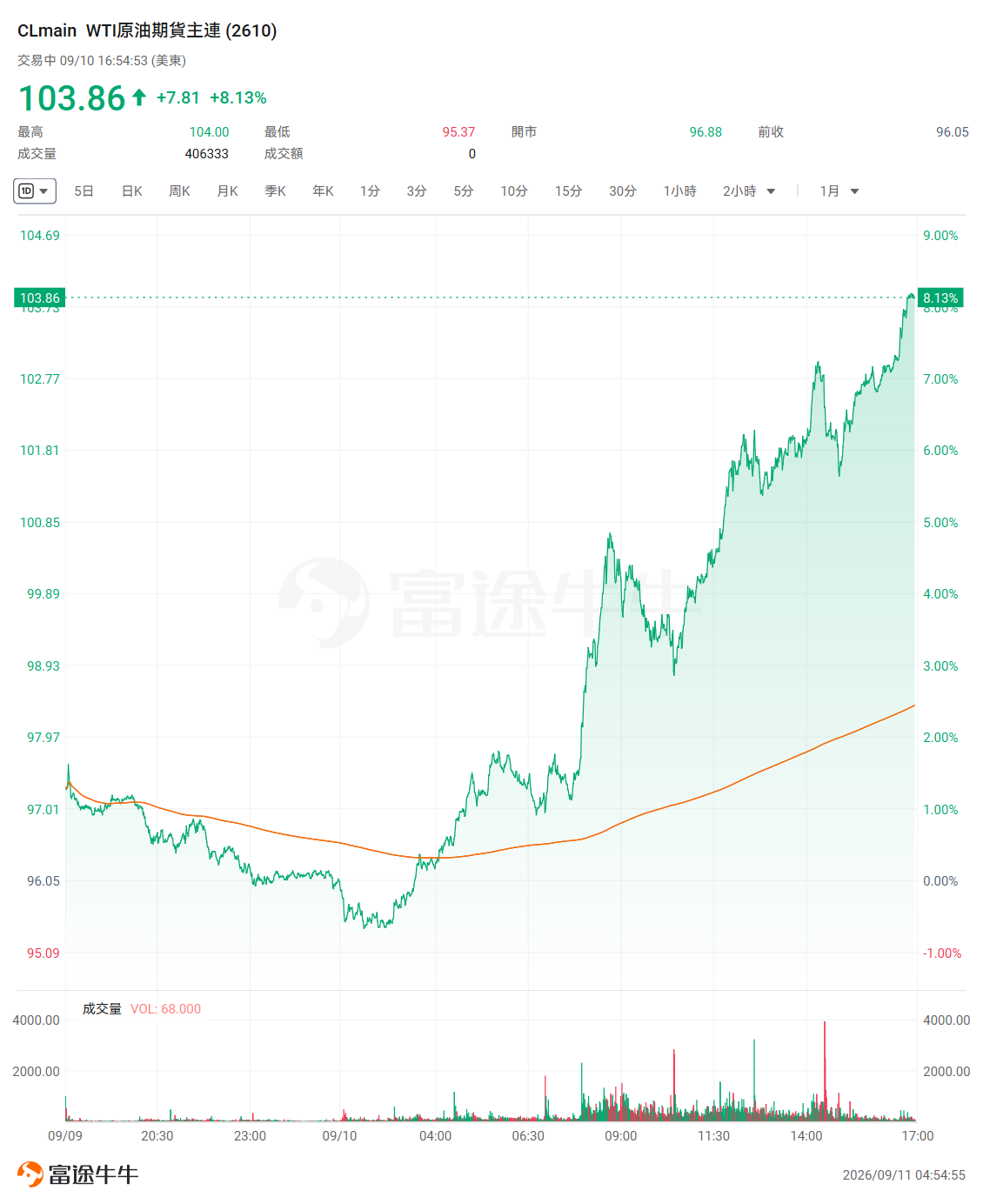
Markets reacted swiftly. Following reports that Iran had produced ballistic missiles, intraday gains in international crude oil futures expanded to over 7% during midday trading on Wall Street Thursday. Brent crude briefly rose to $108.42 per barrel, marking its highest level since May 21, while U.S. WTI crude briefly climbed to $103.86 per barrel, up approximately 8% for the day and surpassing the $100 per barrel threshold for the first time since late May.
Houthi Rebels Capture Mocha, Moving Closer to the Bab el-Mandeb Strait
Xinhua News Agency reported that Mocha is not only a port on the Red Sea but also a strategic stronghold in Taiz Province in southwestern Yemen. Its geographic location underscores the Houthis’ intent to advance toward the Bab el-Mandeb Strait with this capture.
A local officer in the government forces, who requested anonymity, told Xinhua that after hours of intense fighting, government troops were forced to retreat south to the Zubair area, located between Mocha and the Bab el-Mandeb Strait, allowing Houthi fighters to enter Mocha.
Bloomberg reported that the Houthi rebels made progress in their operation to seize Mocha. Shipping security consultant Bjorn Beirens stated that capturing Mocha would provide the Houthis with a new foothold, enabling them to advance further south and “almost completely control” the Bab el-Mandeb Strait. He added that the loss of Mocha would “undoubtedly impact maritime security in the region.”
Andrew Farrand, Head of Middle East and North Africa at Horizon Engage, a global geopolitical risk consulting and intelligence firm, stated that the Houthis’ continued southward advance along the coastline could reach “strategic strongholds” in the narrowest part of the Bab el-Mandeb Strait, representing a “very significant setback” for Saudi Arabia’s military operations in Yemen.
The Bab el-Mandeb Strait connects the Red Sea with the Gulf of Aden and serves as one of the world's critical maritime shipping lanes. The Houthi armed group has previously impacted international shipping by controlling coastal areas along the Red Sea, such as Hodeidah. The recent capture of Mokha signifies a further expansion of their control over the western coast of the Red Sea.
Saudi Arabia Conducts Intensive Airstrikes; Houthis Claim to Have Launched Counterattacks
As Mokha fell, military conflicts between Saudi Arabia and the Houthi armed group continued to escalate.
Citing a statement from the Houthi armed group, CCTV News reported that within the past 24 hours, the Saudi Air Force launched 64 airstrikes across four provinces in Yemen. The operations involved F-15 and Typhoon fighter jets taking off from King Fahd Air Base in Taif and King Khalid Air Base in Khamis Mushait, respectively.
The Houthis also claimed to have intercepted a combat formation in Taiz Governorate, using surface-to-air missiles to strike and force its withdrawal. Saudi authorities have not yet responded to this claim.
Bloomberg reported that the Houthis have recently continued launching missile and drone attacks on towns in southwestern Saudi Arabia, causing damage to energy facilities. Saudi officials stated that recent Houthi attacks resulted in 73 injuries, including among women and children.
The Houthis stated that their actions are a counterattack against continuous assaults by Saudi-backed factions in Yemen, as well as Saudi blockades of certain ports and airports in areas under their control.
According to Xinhua News Agency, Mohammed Abdul-Salam, spokesperson for the Yemeni Houthi armed group, issued a statement on social media platforms on Thursday, asserting that navigation in the Red Sea and the Bab el-Mandeb Strait, as well as international trade, remain "safe and normal." He claimed that the group's actions "do not pose a threat to international shipping." He described the current military operations conducted by the Houthis as having specific targets and being "defensive" in nature.
What Does the Resumption of Iranian Missile Production Mean?
CCTV News cited The Wall Street Journal, reporting that although Iran is currently assembling new missiles on a "more limited scale" primarily using existing components, this still undermines the "significant achievements" of the war touted by the United States and Israel.
The Wall Street Journal, citing informed officials in the United States and the Middle East, reported that Iran has resumed ballistic missile production using stockpiled components within underground facilities.
The report indicated that Iran is currently primarily assembling new ballistic missiles using previously stored components. Although production levels remain below pre-war figures, related activities have resumed. Intelligence held by U.S. and regional officials shows that Iran is conducting assembly operations in underground facilities and attempting to sustain its missile capabilities by restoring production.
This development implies that, despite previous strikes by the United States and Israel on Iranian military facilities—which were claimed to have significantly degraded Iran’s ballistic missile capabilities—Tehran retains a certain degree of production and recovery capacity. Because some production facilities are located underground and projects are highly dispersed, Iran’s missile production was not completely halted by the earlier strikes.
Compounding risks in two key shipping lanes drive up risk premiums in the oil market
Crude oil prices rose more than 7% during intraday trading, reflecting the market’s reassessment of the potential impact of Middle East conflicts on global energy transportation.
Previously, core market risks were concentrated in the Strait of Hormuz. However, as Houthi forces captured Mocha and advanced toward the Bab el-Mandeb Strait, the Red Sea—a vital shipping corridor connecting Europe and Asia—has once again become a focal point of geopolitical risk.
This is particularly significant for Saudi Arabia. If Houthi forces advance further toward the Bab el-Mandeb Strait and continue attacking facilities along Saudi Arabia’s Red Sea coast, Riyadh’s ability to mitigate Strait of Hormuz risks by utilizing alternative routes such as the Red Sea may be constrained.
With risks escalating simultaneously at the two critical energy transport chokepoints—the Strait of Hormuz and the Bab el-Mandeb Strait—market concerns over supply disruptions have intensified, leading to a marked increase in the geopolitical risk premium embedded in crude oil prices.
Editor/Stephen