
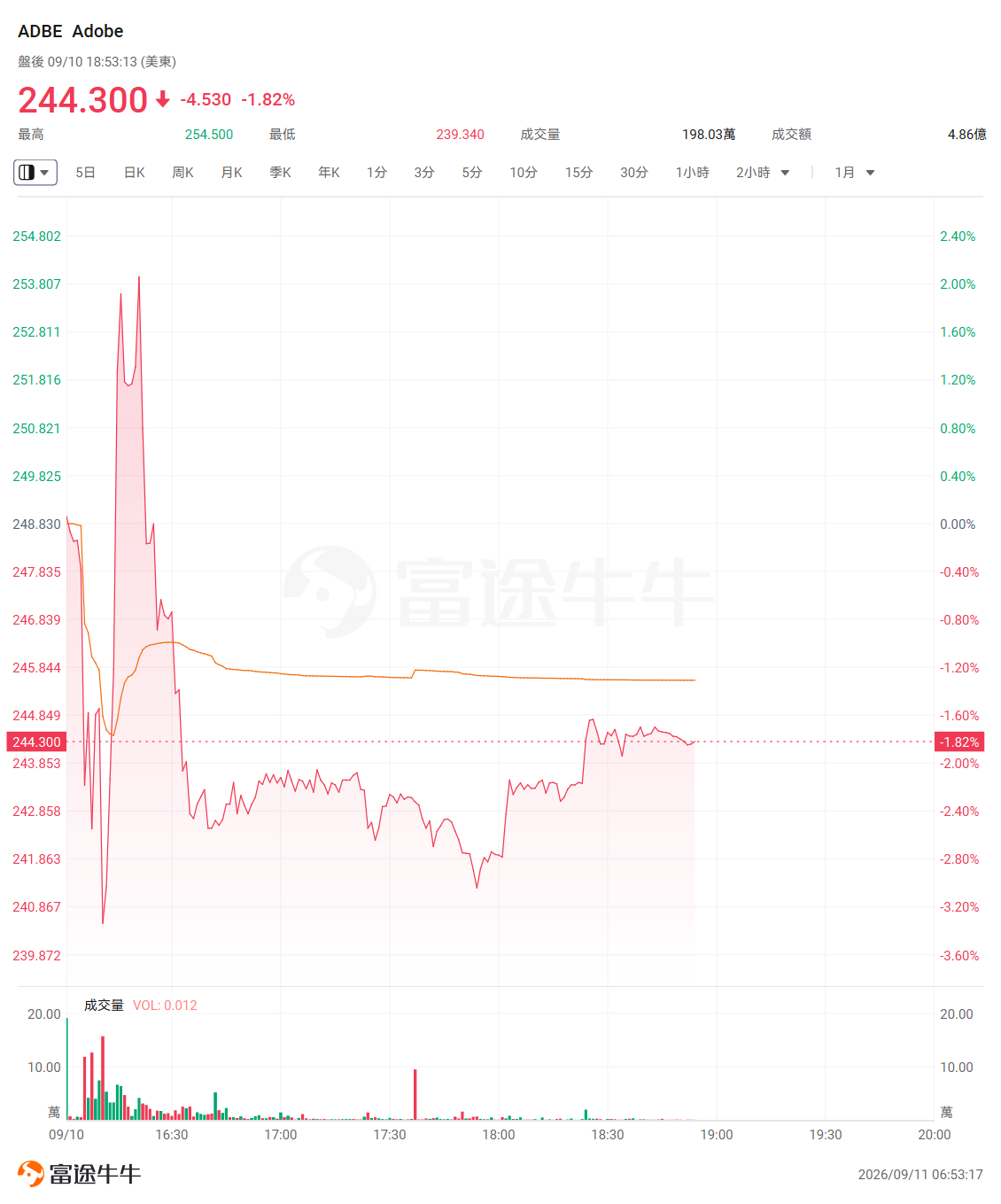
Adobe reported third-quarter revenue of $6.76 billion, a 13% year-over-year increase, surpassing the consensus analyst estimate of $6.7 billion. Non-GAAP adjusted earnings per share (EPS) stood at $6.13, exceeding the market expectation of $6.08. The company raised its full-year adjusted EPS guidance range to $24.45–$24.50 and slightly increased the upper end of its full-year revenue target. However, fourth-quarter revenue guidance came in slightly below analyst expectations, leading to an approximately 2% decline in after-hours share price.
Adobe reported record third-quarter fiscal results, with both revenue and earnings surpassing Wall Street expectations. Its AI-first strategy continues to deliver results, and monthly active users exceeded 1 billion for the first time. The company subsequently raised its full-year performance guidance; however, its fourth-quarter revenue forecast fell slightly short of analysts' expectations, leading to a 2% decline in its after-hours stock price.
After the U.S. market close on September 10, Adobe announced its financial results for the third quarter of fiscal year 2026. Revenue reached $6.76 billion, a 13% year-over-year increase, exceeding the market expectation of $6.7 billion and setting a new record for the company's third quarter.
 Profitability also outperformed expectations. The company reported non-GAAP diluted earnings per share (EPS) of $6.13, higher than the analyst consensus of $6.08, while GAAP diluted EPS stood at $4.62.
The core highlight of this earnings report remains AI. Adobe stated that its "AI-first" annual recurring revenue (ARR) grew by more than 150% year-over-year, demonstrating the continued commercialization of AI features such as Firefly across its creative, productivity, and customer experience tools for enterprises.
Meanwhile, the company announced that monthly active users for its creative and productivity solutions surpassed 1 billion, marking a significant milestone in expanding its user base through its freemium model. The company also raised its full-year performance targets:
Full-year fiscal 2026 revenue is projected to be between $26.576 billion and $26.626 billion, higher than the previous guidance range of $26.5 billion to $26.6 billion;
Full-year non-GAAP EPS is expected to be between $24.45 and $24.50, up from the previous range of $24.35 to $24.45.
However, the market reaction was lukewarm. Adobe's shares fell approximately 2% in after-hours trading. The primary pressure stemmed from the fourth-quarter revenue guidance lacking sufficient upside surprise: the company expects fourth-quarter revenue to be between $6.80 billion and $6.85 billion, with the upper end merely matching the analyst consensus of $6.85 billion, and the midpoint falling slightly below market expectations.
Record Revenue Driven Primarily by Subscription Business Growth
In the third quarter, Adobe's total revenue was $6.760 billion, compared to $5.988 billion in the same period last year, representing a year-over-year increase of approximately 13%. On a constant currency basis, revenue grew by 12% year-over-year.
From the perspective of revenue structure, subscription business remains the absolute core:
Subscription revenue amounted to USD 6.582 billion, compared with USD 5.791 billion in the same period last year, representing a year-on-year increase of approximately 14%;
Product revenue was USD 67 million, remaining largely flat;
Service and other revenue totaled USD 111 million, down from USD 129 million in the same period last year.
Subscription revenue accounted for over 97% of total revenue, indicating that Adobe’s business model remains highly dependent on recurring income. The company disclosed that its total Annualized Recurring Revenue (ARR) reached USD 27.5 billion by the end of the third fiscal quarter, underscoring the stability and predictability of its subscription business.
By customer segment, growth was also relatively balanced:
Subscription revenue from commercial and individual users: USD 1.91 billion, up 16% year-on-year (up 15% at constant exchange rates);
Subscription revenue from creative and marketing professionals: USD 4.65 billion, up 13% year-on-year (up 12% at constant exchange rates);
Total subscription revenue across customer segments: USD 6.56 billion, up 14% year-on-year.
Among these, the business targeting commercial professionals and consumers grew at a faster pace, indicating that productivity-focused and lightweight creative tools such as Acrobat and Express are expanding their reach. The traditional business serving creative and marketing professionals, while larger in scale, continues to be the primary source of revenue.
AI strategy accelerates implementation; monthly active users surpass the one-billion milestone
Adobe disclosed in its earnings report that annual recurring revenue (ARR) from AI-first products grew by over 150% year-over-year, emerging as one of the most closely watched highlight metrics for the quarter.
Meanwhile, the total number of monthly active users across the company’s creative and productivity solutions exceeded one billion, marking the first time Adobe has reached this scale in its history.
Although Adobe did not disclose the specific amount of AI-first ARR, this growth rate reflects that AI capabilities are gradually translating from product experience into commercial revenue.
Adobe’s AI initiatives primarily revolve around the Firefly generative AI model, Creative Cloud, Document Cloud, and Experience Cloud, with the aim of enhancing user stickiness and paid conversion in image generation, video, document processing, marketing automation, and customer experience management.
CEO Shantanu Narayen stated that third-quarter results reflected Adobe’s strengths in AI innovation, expanded customer reach, and leadership in creativity, productivity, and customer experience. He specifically highlighted that surpassing one billion monthly active users represents a key milestone in the company’s development.
Interim CFO Steve Day emphasized that the company is expanding its user base through a freemium strategy and deepening user engagement via “agent experiences.”
Profits exceed expectations, but expense growth pressures GAAP margins
On the profit front, Adobe’s GAAP net income for the third fiscal quarter was $1.827 billion, compared to $1.772 billion in the same period last year, representing a year-over-year increase of approximately 3%; non-GAAP net income was $2.424 billion, compared to $2.252 billion in the same period last year, representing a year-over-year increase of approximately 8%.
The company’s GAAP diluted EPS for the third fiscal quarter was $4.62, compared to $4.18 in the same period last year; non-GAAP diluted EPS was $6.13, compared to $5.31 in the same period last year, representing a year-over-year increase of approximately 15%, and exceeding the market expectation of $6.08.
However, from a margin perspective, expense growth continues to exert some pressure. Third Fiscal Quarter:
GAAP operating income was $2.354 billion, compared with $2.173 billion in the same period last year;
Non-GAAP operating income was $2.974 billion, compared with $2.773 billion in the same period last year;
GAAP operating margin was approximately 34.8%, lower than the approximately 36.3% recorded in the same period last year;
Non-GAAP operating margin was approximately 44.0%, lower than the approximately 46.3% recorded in the same period last year.
Expenses grew rapidly. R&D expenses were $1.288 billion, compared with $1.088 billion in the same period last year; sales and marketing expenses were $1.827 billion, compared with $1.639 billion in the same period last year.
General and administrative expenses were $488 million, compared with $408 million in the same period last year. Investments in AI R&D, cloud infrastructure, market promotion, and enterprise sales continue to absorb some operating leverage.
Cash flow sets a third-quarter record; share buybacks continue to support EPS
Adobe’s operating cash flow for the third fiscal quarter was $2.523 billion, setting a third-quarter record, compared with $2.198 billion in the same period last year. Strong cash flow remains a key advantage of Adobe’s business model.
The company repurchased approximately 9.5 million shares in the third fiscal quarter. The cash flow statement shows that the company spent $2.232 billion on common stock repurchases during the quarter. Due to the ongoing buyback program, Adobe’s diluted share count decreased from 424 million in the same period last year to 395 million, providing significant support to earnings per share growth.
As of the end of the third fiscal quarter, the company's cash and cash equivalents totaled $4.359 billion, with short-term investments of $1.280 billion, bringing the combined total to approximately $5.639 billion. On the debt side, current debt stood at $1.597 billion and long-term debt at $4.766 billion, for a total of approximately $6.363 billion.
Regarding deferred revenue, the company reported ending deferred revenue of $7.204 billion, of which $7.094 billion was current. Remaining Performance Obligations (RPO) amounted to $22.16 billion, with Current Remaining Performance Obligations (cRPO) accounting for 67%, indicating strong revenue visibility for the next 12 months.
Full-year guidance raised, but Q4 revenue outlook remains conservative
Adobe raised its full-year total revenue target to a range of $26.576 billion to $26.626 billion, a slight increase from the previous range of $26.5 billion to $26.6 billion.
The full-year non-GAAP adjusted EPS guidance was also raised to a range of $24.45 to $24.50, up from the previous range of $24.35 to $24.45. The target for full-year total Annual Recurring Revenue (ARR) growth is a year-over-year increase of 10.2%.
However, the company's outlook for the fourth fiscal quarter is relatively cautious. The revenue guidance range is $6.8 billion to $6.85 billion, with a midpoint of $6.825 billion, slightly below analysts' consensus expectation of $6.85 billion.
The non-GAAP adjusted EPS guidance for the fourth fiscal quarter is $6.30 to $6.35, largely in line with analysts' expectation of $6.30. This Q4 guidance assumes the current macroeconomic environment remains unchanged, with a non-GAAP operating margin of approximately 44%.
Adobe's approximate 2% decline in after-hours trading does not reflect weak financial results. On the contrary, the company delivered solid performance in Q3 revenue, EPS, cash flow, and AI-related metrics, while also raising its full-year targets.
The issue lies in the market's shifting focus regarding Adobe, moving from "whether it has AI products" to "how much incremental revenue AI can generate and how quickly this will be reflected in ARR and profit margins." Although Adobe disclosed that AI-first ARR grew by more than 150% year-over-year, it did not provide specific scale figures, making it difficult for investors to assess its actual contribution to the overall $27.5 billion ARR.
Furthermore, competition in the AI landscape has intensified. While Adobe possesses a strong ecosystem in creative software, it faces competition from native generative AI tools, design platforms, video generation platforms, and enterprise marketing automation vendors. The market expects Adobe to maintain high profit margins and drive an increase in subscription ARPU while expanding its AI user base.
Editor/Stephen