
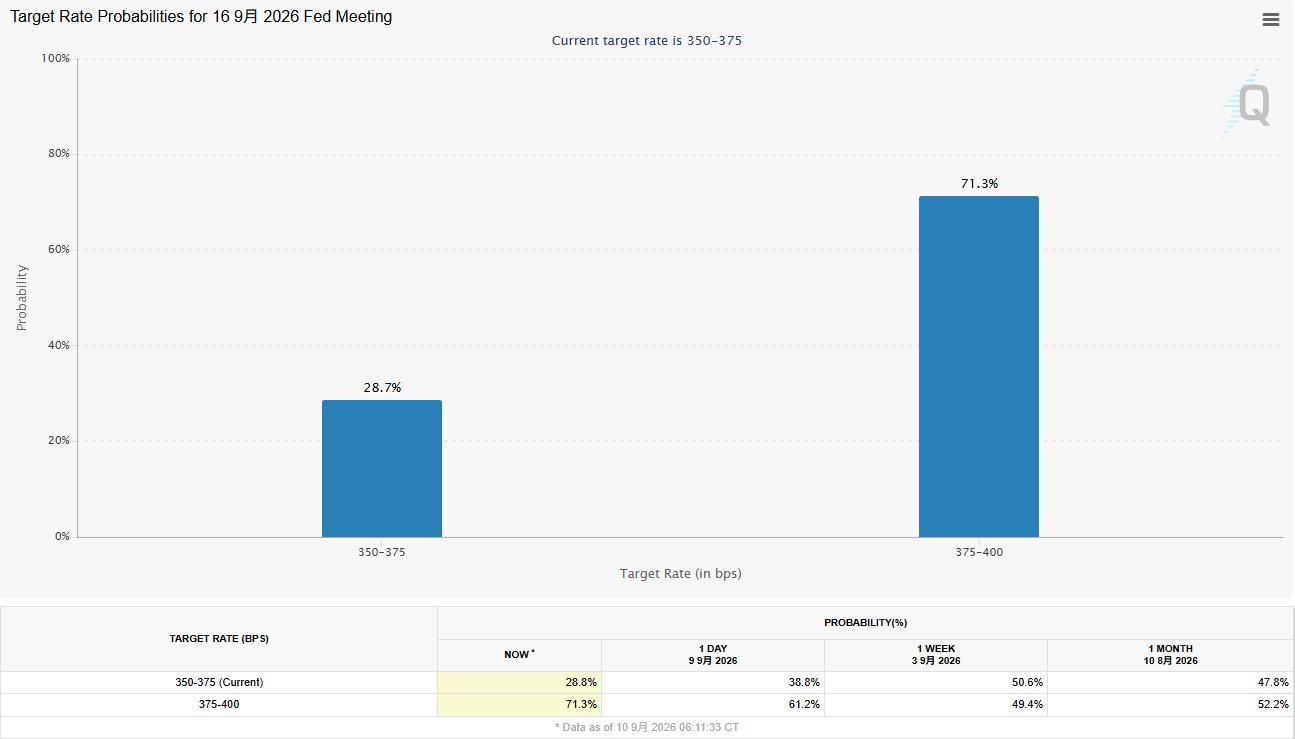
Ahead of the U.S. CPI release on Friday, the bond market moved first. The yield on the 10-year U.S. Treasury note rose to 4.943%, and the probability of a Federal Reserve rate hike next week climbed to 71%. Rising oil prices and inflationary pressures have fueled market concerns that the Fed may resume tightening, with the CPI data poised to deliver the decisive blow.
U.S. Treasury yields rose significantly again on Thursday. As bond prices and yields move inversely, the rise in yields indicates continued pressure on bond prices. Market stress was further exacerbated by a surge in oil prices, robust wholesale inflation data, and Trump’s proposed $5,000 check plan.
Trump has pledged to issue $5,000 checks to Americans if the Republican Party maintains control of Congress. According to relevant estimates, this plan could increase the federal deficit by more than $1 trillion.
 U.S. Treasury yields have been climbing steadily since late June. U.S. Treasury Secretary Bessent previously attempted to curb the rise in yields by expanding government buybacks of long-term Treasuries, but the bond market continues to reach levels unseen in years, with the 30-year Treasury yield even touching its highest point in 19 years.
Currently, market focus has shifted to the 10-year U.S. Treasury yield.
The 10-year U.S. Treasury yield is approaching 5%, putting broad pressure on borrowing costs.
The yield on the 10-year U.S. Treasury note is nearing the critical 5% level. Borrowing costs for mortgages, student loans, and corporate bonds are closely tied to the 10-year Treasury yield; therefore, a continued rise in this benchmark rate will directly impact financing costs for consumers and businesses.
Sam Stovall, Chief Investment Strategist at CFRA Research, believes that the 10-year U.S. Treasury yield breaking above 5% is not a positive development. He stated, “I view 5% as a psychological threshold; once crossed, investor concerns are likely to intensify. This could lead to further softening in the market.”
Rising yields also alter the relative attractiveness of different assets. As bonds offer higher yields, some capital that might otherwise flow into risk assets such as equities may shift toward bonds instead.
The stock market has not yet reacted to the same extent as the bond market. Despite ongoing conflicts in the Middle East and gradually rising domestic inflation in the United States, U.S. equities have remained near record highs for much of the year, with strong corporate earnings helping the market withstand these pressures.
However, the situation changed in September, with all three major stock indices declining this month. Stocks more sensitive to interest rate changes experienced larger declines.
Rising oil prices have led markets to increase bets on a Federal Reserve rate hike.
Another key variable currently facing the bond market is inflation. The protracted conflict between the United States and Iran has raised investor concerns that energy prices may remain elevated for an extended period, thereby further driving up overall inflation and continuing to pressure the Federal Reserve to raise interest rates.
On Thursday, Brent crude oil prices rose 6.3% to $107.63 per barrel. Amid the surge in oil prices, investors have already increased their bets on a rate hike at the Federal Reserve’s meeting next week, without waiting for the release of the crucial U.S. Consumer Price Index (CPI) report on Friday.
Data from the CME Group shows that interest rate futures currently reflect a 71% probability of a Federal Reserve rate hike, up from 61% on Wednesday and 49% a week ago.
Last week, Federal Reserve Governor Waller stated that he would support keeping interest rates unchanged if the CPI showed a month-on-month increase of 0.2% in core prices, in line with economists' expectations.
However, investors are currently paying closer attention to the speech delivered last month by Federal Reserve Chair Walsh at the Jackson Hole symposium. The degree of concern Walsh expressed regarding inflation risks has led many investors to believe that he has positioned himself in favor of a rate hike, potentially necessitating action to uphold the Federal Reserve's credibility even if the economic fundamentals do not strictly require it.
Ray Remy, Vice Chairman of Daiwa Capital Markets America, stated: "The bond market is clearly signaling that the Federal Reserve will raise interest rates. The bond market will not wait until tomorrow (Friday) for the CPI data to make this determination."
The yield on the 10-year U.S. Treasury note is significant because it largely reflects investors' expectations for the average level of the Federal Reserve's short-term interest rates over the life of the bond, which in turn influences other borrowing costs.
Data released by Freddie Mac on Thursday also showed that the average rate for a 30-year fixed-rate mortgage rose to 6.76% this week, up from 6.71% the previous week.
Bessent expanded repurchase operations but failed to suppress long-term bond yields.
Last month, Bessent unexpectedly expanded the long-term U.S. Treasury repurchase program, at least doubling the scale of buybacks for longer-dated Treasuries. The initiative was originally designed primarily to improve liquidity for older, less actively traded U.S. government bonds.
In the early stages of Trump’s second term, Bessent stated that lowering the yield on 10-year U.S. Treasuries was a government priority. In explaining the expansion of the repurchase program, he argued that current yields did not reflect the fundamentals of the U.S. economy, a view Wall Street interpreted as a signal that the Treasury Department was attempting to curb further rises in yields.
The measure has not been entirely ineffective. Since Bessent announced the expansion of the repurchase program, the increase in long-term Treasury yields has indeed been smaller than that of short-term yields; however, long-end yields have not stopped rising.
On Thursday, the U.S. Treasury Department even raised the cap on long-term Treasury purchases in a single operation to $6 billion, triple the previous limit of $2 billion. Nevertheless, yields continued to climb.
The U.S. government was originally expected to purchase U.S. Treasuries at prevailing market prices. However, results released by the Treasury Department on Thursday showed that only $5.2 billion worth of 10- to 30-year Treasuries were ultimately purchased. This suggests that without relaxing requirements on bid levels, the Treasury may struggle to buy more bonds than the market had previously anticipated.
Following the release of the results, yields on long-term U.S. Treasuries rose further. According to data from Tradeweb, the yield on the 10-year U.S. Treasury closed at 4.943% on Thursday, up from 4.836% on Wednesday, marking its highest closing level since October 2023.
This market movement has reminded bond investors of autumn 2023. At that time, the yield on the 10-year U.S. Treasury also broke through 4.9%, briefly touching 5%. However, on the very day it breached this threshold, Treasuries experienced a sharp rebound, with the final close falling back below 4.9%.
Consequently, some investors may still be waiting for yields to break above 5% before purchasing bonds. However, unlike in 2023, the market may not replicate the same trajectory this time.
One reason is that although market anxiety is intensifying, most investors are currently not overly concerned that rising yields will rapidly lead to a sharp slowdown in economic growth.
Meanwhile, some investors believe that the conflict between the United States and Iran could persist for several years. If energy prices remain elevated for an extended period as a result, inflationary pressures may continue, presenting the Federal Reserve with more challenging interest rate decisions.
Equity investors therefore need to simultaneously contend with pressures in the bond market, persistent inflation, oil prices driven up by geopolitical conflicts, and uncertainty surrounding the Federal Reserve's interest rate trajectory.
September is also traditionally one of the weakest months for equity markets. As investors conclude their summer hiatus and rebalance their portfolios, market volatility may be further amplified.
Some equity investors are currently choosing to temporarily overlook turbulence in the bond market, instead awaiting Friday's CPI data and next week's Federal Reserve interest rate decision.
Mark Hackett, Chief Market Strategist at Nationwide, stated: "If Friday's CPI figure significantly exceeds consensus expectations, will the stock market enter a more prolonged decline? This poses a greater risk than the somewhat arbitrary nature of a 5% yield."
Editor/Jayden