
Oracle reported Q1 revenue of $19.3 billion, a 30% year-over-year increase; cloud infrastructure revenue reached $7.4 billion, surging 121% year-over-year and exceeding the market expectation of $7.19 billion. Remaining performance obligations (RPO) stood at $664 billion as of the end of August, higher than the expected approximately $639.9 billion. The company forecasts adjusted earnings per share (EPS) of $8.10 for fiscal year 2027, up from the previous estimate of $8.05. Oracle’s shares rose as much as 8% in after-hours trading.
On Thursday local time, $Oracle (ORCL.US)$ Both the first-quarter results and guidance exceeded market expectations, with demand for AI infrastructure continuing to drive rapid growth in the cloud business.
Oracle’s cloud infrastructure revenue jumped 121% year-over-year to $7.4 billion in the first quarter, surpassing the average analyst expectation of $7.19 billion.
 Remaining performance obligations (RPO) continued to grow significantly. As of the end of August, RPO reached $664 billion, up from $638 billion at the end of the previous quarter and exceeding analyst expectations of approximately $639.9 billion.
The company’s overall first-quarter revenue grew 30% to $19.3 billion, compared with analysts’ expectation of $19.13 billion; adjusted earnings per share were $1.92, also beating the analyst consensus of $1.75.
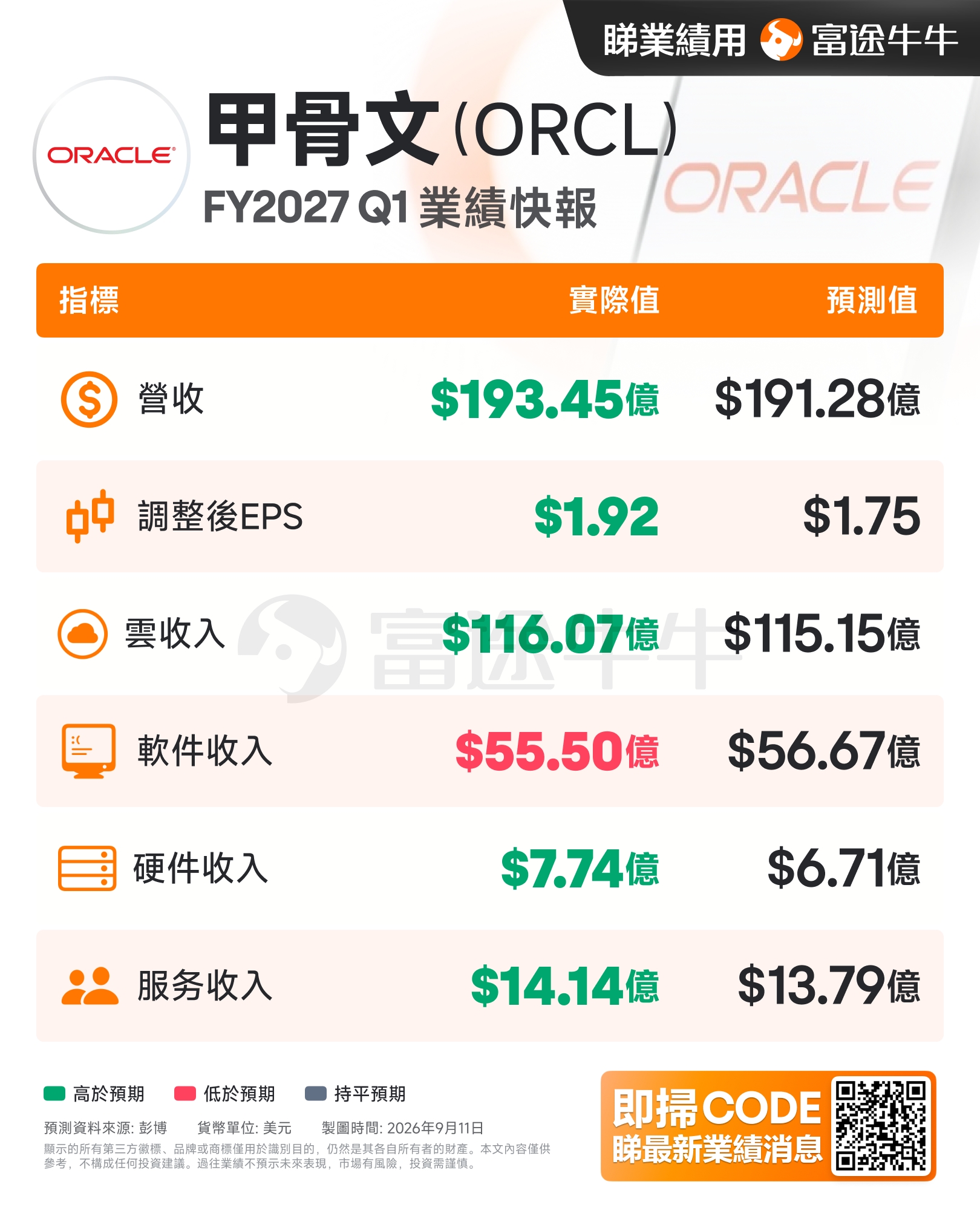
The company raised its full-year profit outlook. It now expects adjusted earnings per share of $8.10 for fiscal year 2027, higher than the prior estimate of $8.05; it projects full-year cloud revenue to grow by approximately 64% to 70%, with total annual revenue reaching at least $90 billion.
Following the earnings release, Oracle’s stock rose nearly 8% in after-hours trading before paring some of its gains.
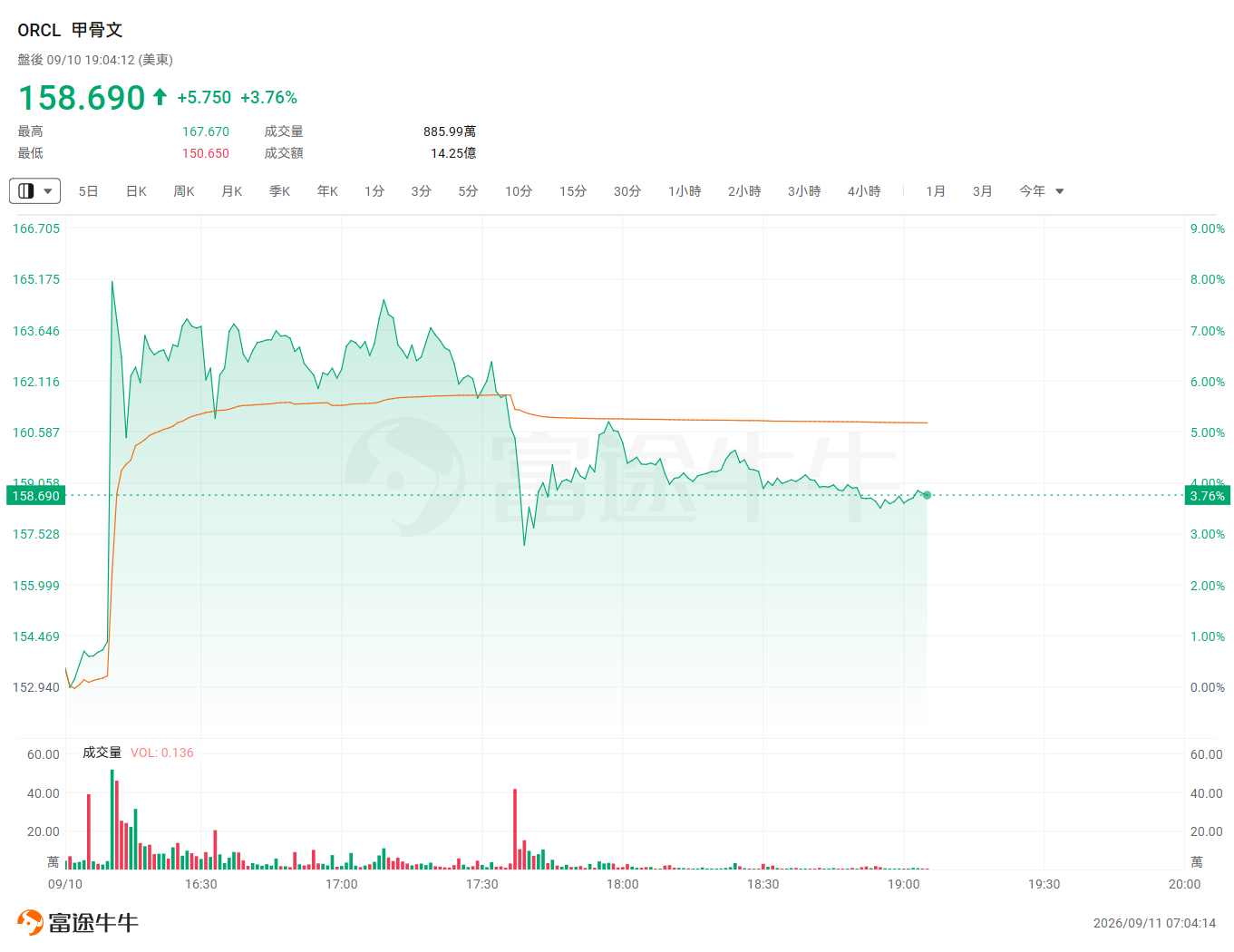
TD Cowen analyst Derrick Wood noted prior to the earnings release that the stock had fallen 38% from its year-to-date high on June 1, weighed down by financing needs, rising component costs, and market concerns over data center construction progress.
The company stated that it completed $20 billion in equity financing through an at-the-market (ATM) offering in the first quarter.
AI cloud infrastructure revenue doubled year-over-year, while RPO exceeded expectations to reach $664 billion.
From a business structure perspective, AI infrastructure remains Oracle's strongest growth engine.
This quarter, Oracle Cloud Infrastructure (IaaS) revenue grew approximately 120% year-over-year to $7.4 billion, significantly outpacing the company's overall revenue growth rate of 30%.
Meanwhile, Oracle's remaining performance obligations (RPO) continued to grow substantially. As of the end of August, RPO reached $66.4 billion, up from $63.8 billion at the end of the previous quarter and exceeding analysts' expectations of approximately $63.99 billion.
RPO primarily reflects the scale of contracts that have been signed but for which revenue has not yet been recognized. The significant increase in Oracle's RPO over the past few quarters has been driven mainly by large AI cloud contracts, indicating that demand for AI infrastructure is still expanding rapidly.
In the previous fiscal quarter, Oracle disclosed that many AI contracts involve customers prepaying for GPU costs or providing their own GPUs, thereby reducing the capital expenditure required from the company to fulfill these contracts.
In this earnings report, Chief Financial Officer Safra Catz stated that most new orders signed in the latest quarter also adopted models such as prepayments or customer-provided hardware, meaning they will not impose proportional pressure on Oracle's capital expenditures.
Raised full-year profit guidance; cloud business growth expectations further increased
Oracle also raised its full-year earnings outlook. The company expects adjusted earnings per share (EPS) of $8.10 for fiscal year 2027, higher than the previously projected $8.05, with full-year revenue expected to reach at least $90 billion.
For the second fiscal quarter, Oracle expects revenue to grow 30% to 34% year-over-year, with total cloud revenue increasing by 65% to 71%. Adjusted EPS is projected to be between $1.85 and $1.93, representing a growth of 21% to 25%.
The company stated that demand for AI training and inference is driving rapid growth in its cloud infrastructure business and announced plans to significantly expand its data center capacity.
However, the expansion of AI data centers has also brought substantial pressure on capital expenditures.
Nevertheless, behind strong order and revenue growth, Oracle is bearing increasingly high capital investments.
Capital expenditures for the quarter reached approximately $28.5 billion, a significant increase from $8.5 billion in the same period last year. Meanwhile, the company expects to invest around $70 billion in data center expansion in fiscal year 2027, up from $55.7 billion in the previous fiscal year.
This indicates that Oracle is catching up with AI infrastructure demand at an extremely high capital intensity.
Investors have consequently remained cautious about the company's cash flow and financing needs. Oracle's free cash flow for the quarter was negative $5.4 billion, while the company had previously completed a $20 billion At-The-Market (ATM) equity offering.
S&P had previously downgraded Oracle's credit rating, citing among other reasons the company's reliance on a few large customers and the ongoing uncertainty regarding the profitability of its AI-related businesses.
The market is renewing its bet that "AI orders are being realized."
Although capital expenditures and cash flow remain risks that the market needs to monitor, a positive signal from this earnings report is that the large-scale AI contracts Oracle previously secured are gradually translating into actual revenue growth.
The company added approximately 850 megawatts of data center capacity online this quarter, with AI cloud infrastructure revenue growing by about 120% year-over-year, while Remaining Performance Obligations (RPO) further rose to $664 billion.
This suggests that Oracle's strategy of heavily investing in data centers is beginning to yield returns, helping the company win more enterprise customers from cloud giants such as Amazon, Microsoft, and Google.
However, as investment in AI data centers continues to expand, whether Oracle can convert its substantial remaining performance obligations (RPO) into revenue and cash flow, while simultaneously managing financing costs and return on capital, will remain a key variable for the market in assessing the valuation of its AI business.
 AI-powered earnings snapshot highlights key takeaways—build your options strategy! Open Futubull > Stock Page > Click [Company] >Earnings Snapshot

Editor/Jayden