
① At 8:30 PM Beijing Time tonight, the U.S. Bureau of Labor Statistics is set to release the August CPI data, which will be the final piece of the "inflation puzzle" for the Federal Reserve before its interest rate decision next week. ② As widely discussed by market participants recently, this week's inflation report is crucial in determining the Federal Reserve's actions at next week's monetary policy meeting.
At 8:30 PM Beijing Time tonight, the U.S. Bureau of Labor Statistics is set to release the August CPI data, which will be the final piece of the "inflation puzzle" for the Federal Reserve before its interest rate decision next week.
As widely discussed by market participants recently, this week's inflation report is crucial in determining the Federal Reserve's actions at next week's monetary policy meeting.
 If the CPI report comes in mild and shows a continued cooling in core inflation, it will strengthen the case for the Federal Reserve to keep interest rates unchanged, particularly given Governor Waller's previously emphasized "reaction function." Conversely, if the report indicates overheating inflation or a reversal in the disinflation trend, it could reinforce market expectations of a 25-basis-point rate hike by the Federal Reserve next week.
Regarding tonight's CPI report, macroeconomist Anna Wong noted that this "could be the most watched U.S. economic report in years, as Federal Reserve policymakers—especially Governor Waller—have clearly signaled that the decision at the September 15-16 FOMC meeting will depend entirely on evidence of sustained easing in inflation."
In describing her outlook for the CPI report, Wong wrote, "To give you an idea of how closely balanced the September rate hike decision is, my team is using three decimal places (0.001) for our inflation forecasts."
So, what are the market expectations for tonight's CPI report?
Overview of Market Expectations for Tonight's CPI Report
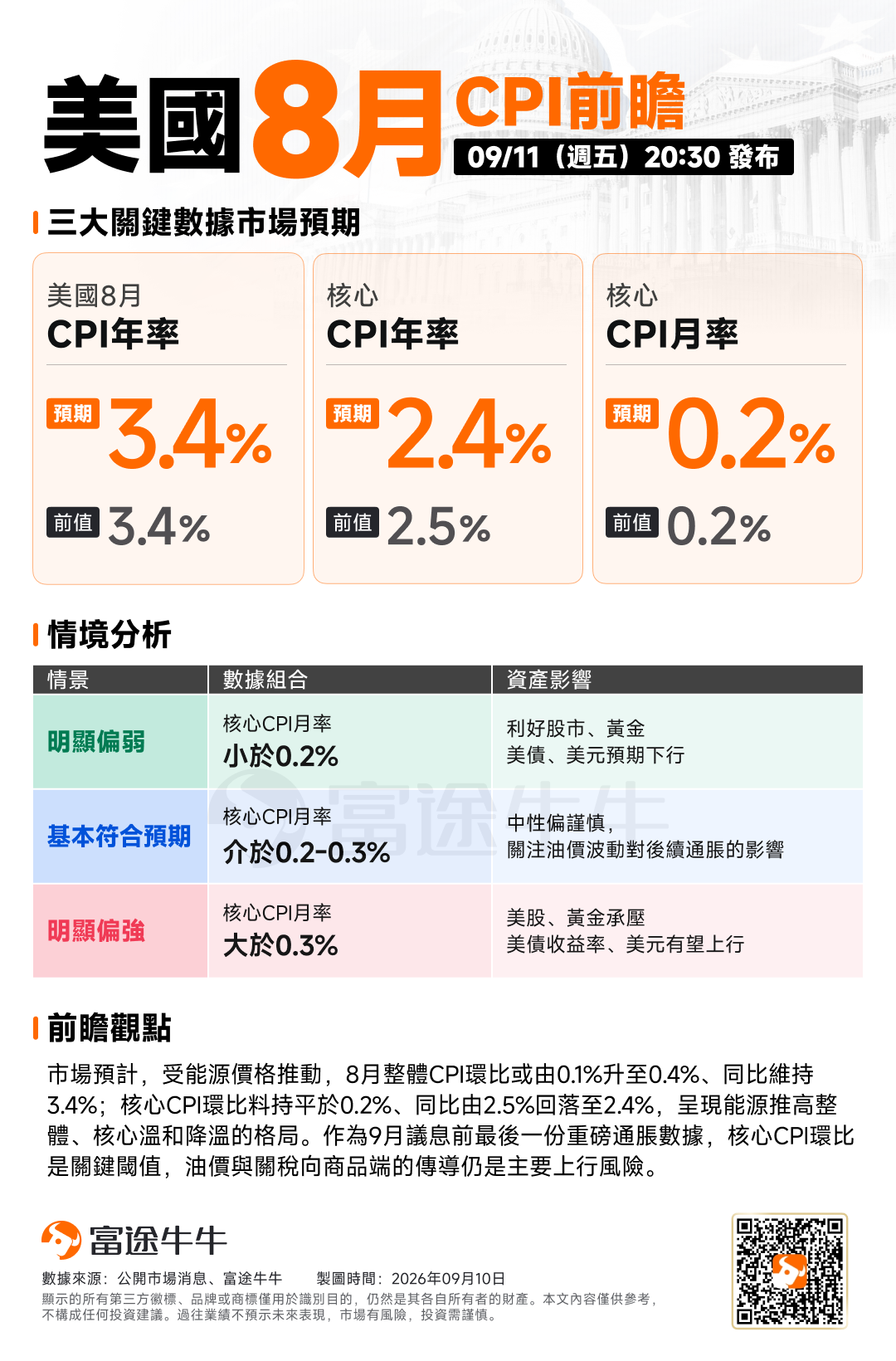
According to the median forecast from a survey of economists by industry media, the U.S. CPI for August is expected to rise by 0.4% month-on-month, higher than July's 0.1%; the year-on-year increase is expected to remain at 3.4%.
The August core CPI, excluding food and energy, is expected to rise by 0.2% month-on-month, while the year-on-year increase is projected to decline from 2.5% to 2.4%.
Given the sharp rise in energy prices in August, a month-on-month increase in the overall CPI was virtually assured. Consequently, market focus tonight is likely to remain on core CPI—particularly whether the impact of rising energy prices is spreading to broader sectors.
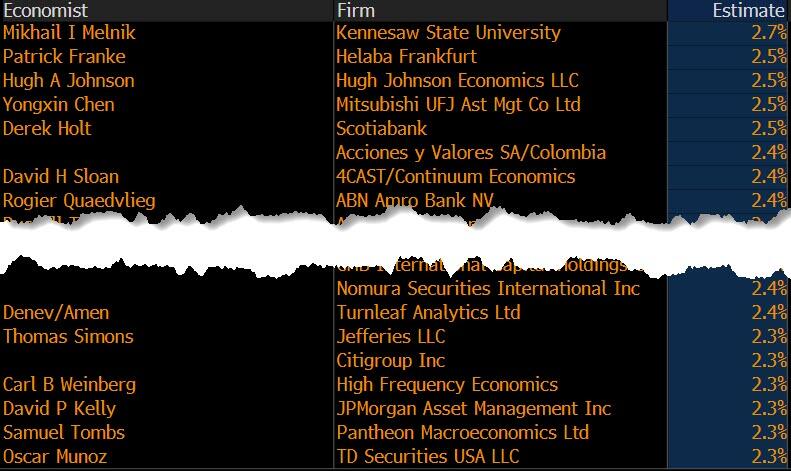
According to institutional surveys, Wall Street investment banks’ forecasts for the year-on-year increase in core CPI generally follow a normal distribution (mostly concentrated between 2.3% and 2.5%), with only one extreme outlier at 2.7% at the upper end.
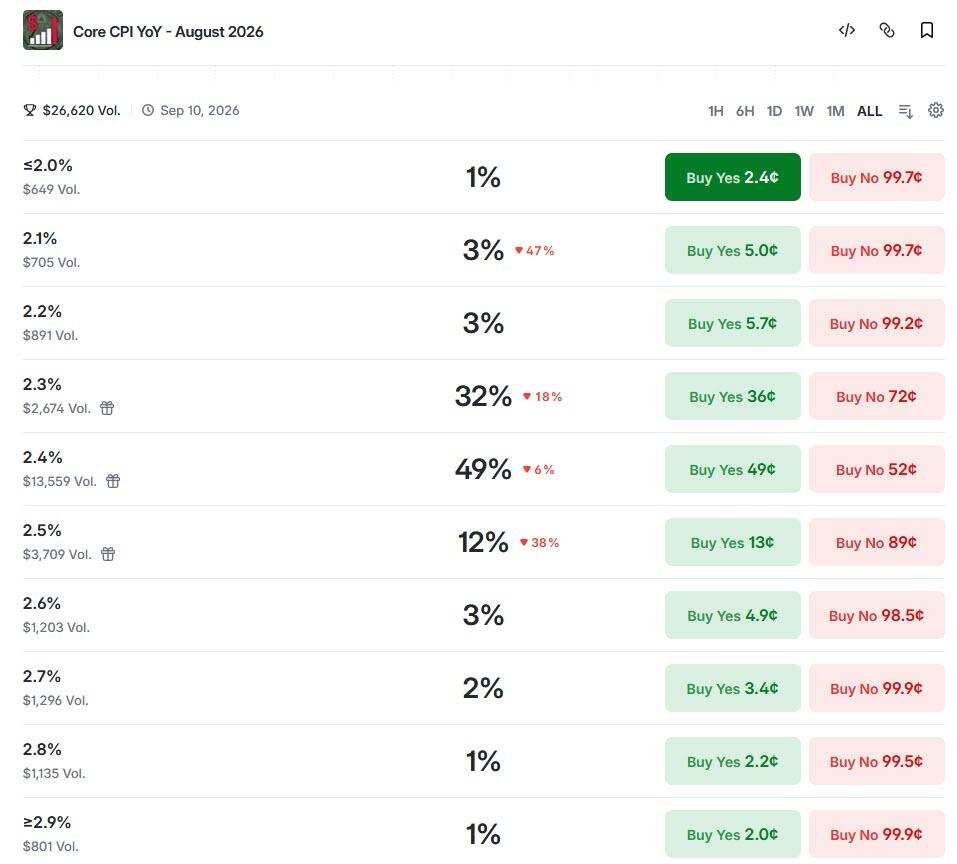
In the increasingly active prediction markets, Polymarket data shows that the median forecast of institutional economists—2.4%—is also considered by market participants as the most likely outcome for tonight’s year-on-year core CPI increase. However, regarding the specific distribution, market probabilities clearly favor data coming in below expectations (2.3% or lower) rather than above expectations (2.5% or higher).
JPMorgan Chief Economist Michael Feroli predicts that the U.S. overall CPI will rise by 0.38% month-on-month in August, while core CPI will increase by 0.21% month-on-month (equating to an annualized rate of 2.37%), which would round the year-on-year core CPI growth rate to exactly 2.4%.
The bank’s forecasts for specific components of U.S. inflation are as follows:
Energy: After several consecutive months of declines, the renewed rise in oil prices should have pushed up the overall CPI energy index. JPMorgan expects energy prices to surge by 2.5% month-on-month, primarily driven by a 4.2% increase in vehicle fuel prices.
Food: The recent sharp rise in futures prices for major agricultural commodities may bring additional inflationary pressure over time, but JPMorgan expects this has not yet been immediately reflected in final consumer prices; weekly food price data from Circana shows that the year-on-year increase is slowing. JPMorgan forecasts a 0.2% month-on-month increase in food prices for August, consistent with recent months, which would cause the year-on-year increase to ease slightly from 2.9% to 2.7%.
New and Used Vehicles: Industry data on new car transaction prices and incentives again indicate that new car prices changed little in August. Since 2023, the new car CPI has remained broadly flat. For used cars, significant price changes are not expected either. Previously, JPMorgan had anticipated price increases given the rise in the Manheim Used Car Wholesale Price Index, but the Manheim index has since reversed those gains.
Apparel: U.S. apparel prices rose sharply at the beginning of the year, possibly reflecting the pass-through effect of tariffs following seasonal restocking, but prices stabilized after May. Although the reciprocal tariffs imposed under the International Emergency Economic Powers Act (IEEPA) have been repealed, granting some tariff relief to the apparel sector, import prices prior to the implementation of those tariffs also rose, so prices are expected to remain stable.
Healthcare Goods: U.S. drug prices have continued to decline this year. One reason is likely the Medicare negotiations aimed at lowering drug prices, which took effect earlier this year. JPMorgan equity analysts also note that list prices for GLP-1 drugs have been reduced and the number of generic drugs has increased. This downward trend in prices is expected to continue into August.
Recreational Goods: The most notable price increase in this category was Microsoft’s adjustment of Xbox prices on August 1, with the base model rising by 25% and other models seeing similar increases. JPMorgan estimates, based on the Consumer Expenditure Survey, that video game hardware accounts for approximately 3% of recreational goods. Given Xbox’s market share of around 23%, a 25% price hike would contribute an overall increase of 3% × 23% × 25% = 0.2% to the broader category. Although pricing trends remain strong in other subcategories, the two-month change through July is near historical highs, suggesting that growth may moderate in August. The bank forecasts a 0.3% month-over-month increase for the entire recreational goods category.
Education and Communication Goods: Driven by Apple’s adjustments to Mac and iPad pricing, this category recorded a near-record 1.3% increase in July, with computer prices leading the rise. Memory prices are expected to continue exerting upward pressure on computer and smartphone prices, sometimes manifesting as a combination of enhanced features and higher prices for new devices. JPMorgan believes this price increase will not be as pronounced as Apple’s July adjustment. Given that online retailers have reported largely flat prices for portable storage devices for several months, software and accessories—a component with a significantly larger weight in the PCE index—are expected to see modest increases.
Rent and Owners’ Equivalent Rent (OER): With new rental growth remaining sluggish according to sources such as Zillow and ApartmentList, rent and OER data for August are expected to continue their weak trend.
Airline Fares: Over the past three months, airline fares have risen by 26%-27% year-on-year, and JPMorgan expects strong gains to persist in August. This view is based on airfare trends reported by Kayak, whose weekly data shows domestic flight prices up approximately 34% year-on-year and international flights up 24%, both matching July’s levels.
Auto Insurance: High industry profitability prompted insurers to significantly lower prices in May and June. The decline narrowed markedly in July, and this trend of moderating decreases is expected to continue in August.
Healthcare Services: Although the month-over-month increase in July was as high as 0.6%, the year-on-year inflation rate for healthcare services rose by only 2.7%, the lowest level since the beginning of last year. Given the substantial monthly gain in July, the pace of increase is expected to slow in August.
The Market’s Deciding Factor Tonight: 0.2%?
Before entering the Federal Reserve’s blackout period, Governor Waller provided an exceptionally clear “reaction function” for this report: If August inflation data shows sustained improvement, he would support holding interest rates steady in September. Waller remains confident that inflation will ultimately decline, noting that signs of disinflation are already emerging, particularly with significant improvement in the three-month core inflation rate, even though overall inflation remains well above the 2% target.
However, if August data heats up again, Waller indicated he would consider supporting a rate hike. He added that if the data suggests a reversal in the disinflation process, modest policy adjustments would help ensure the disinflation trajectory returns to track.
In light of this, many industry institutions interpreting tonight’s CPI report are focusing more on the month-over-month performance of core CPI. In other words, whether tonight’s core CPI month-over-month figure meets the expected 0.2%, or comes in higher or lower, could become the deciding factor for market performance across various asset classes.
If the month-on-month increase in core CPI for August is 0.1% or lower, the Federal Reserve will most likely hold rates steady; conversely, if the increase reaches 0.3% or higher, a rate hike is virtually certain. Should core CPI rise by 0.2% as expected, uncertainty is likely to persist.
Christopher Hodge, Chief U.S. Economist at Natixis, stated, "We project core CPI to rise by 0.19%, and precision to two decimal places is critical. Given the significant divergence among Federal Reserve policymakers regarding the appropriate course of action, we believe that core CPI growth would need to remain below 0.20% to avoid a rate hike at the September meeting."
JPMorgan's Market Intelligence team noted that the current debate centers on whether the figure rounds to 0.2% or 0.3%.
JPMorgan economists argue that a month-on-month core CPI increase of 0.2% is sufficiently low for the Federal Reserve to hold rates steady, whereas a 0.3% reading is high enough to prompt a rate hike. The bond market has currently priced in approximately a 70% probability of a 25-basis-point rate hike at the FOMC meeting on September 16. This CPI report will set the tone for the September monetary policy meeting.
Five market scenarios outlined by the JPMorgan team:
Core CPI month-on-month increase above 0.30%: S&P 500 Index expected to decline by 1.5%–2.5%; probability of occurrence 10.0%;
Core CPI month-on-month increase between 0.25%–0.30%: S&P 500 Index expected to decline by 0.25%–1.0%; probability of occurrence 25.0%;
Core CPI month-on-month increase between 0.20%–0.25%: S&P 500 Index expected to rise by 0.50%–1.25%; probability of occurrence 30.0%;
Core CPI month-on-month increase between 0.15%–0.20%: S&P 500 Index expected to rise by 1.0%–1.5%; probability of occurrence 25.0%;
Core CPI month-on-month increase below 0.15%: S&P 500 Index projected to rise 1.5%–2.0%; probability of occurrence 10.0%.
The JPMorgan team believes that the risk-reward ratio is generally skewed to the upside.
If data supports holding rates steady or a "hawkish hold," technology, momentum, and cyclical sectors are expected to be the primary drivers of the rebound. JPMorgan's positioning tracking data shows that hedge funds have increased their overall exposure for four consecutive trading days over the past week, with the weekly net increase reaching its highest level since the end of June (+1.3 standard deviations). Ample room for re-leveraging remains, constituting a potential upside catalyst.
However, JPMorgan also pointed out that market movements will remain range-bound ahead of the data release, which is the direct reason for the bank's recent adjustment of its short-term rating to "tactically neutral." The options market currently implies a single-day volatility of approximately 1.0% for contracts expiring on September 11.
The most significant tail risk lies in core inflation coming in substantially higher than expected. Should this occur, expectations for rate hikes in October and December—currently priced at approximately 27% and 54%, respectively—will be rapidly repriced, exerting substantial pressure on equity markets.
A numerical paradox: precise to three decimal places
Another deeper implication of this report is an extreme stress test of the "data-dependent" monetary policy itself.
Anna Wong, Bloomberg's Chief US Economist, wrote that her team has projected core PCE forecasts with precision to three decimal places to determine which way the rate hike decision leans. This was cited by FX trader Brent Donnelly and contrasted intriguingly with a previous statement by Warsh himself—who, in his 2025 speech, criticized the limited value of "data-dependent" policies, arguing that excessive focus on the second decimal place of government data reflects "false precision and analytical laziness."
However, as Donnelly pointed out, "we are now in exactly this situation." Tonight's figures may become the most subtle contest between the Federal Reserve's policy credibility and market expectations.
 Stay ahead of major financial events and spot investment opportunities early! Open Futubull > Market > US Stocks >Economic Calendar/Featured Macro Data, seize the investment opportunity ahead of the curve!
Editor/lambor