
All 52 economists surveyed by Bloomberg expect the Bank of Japan to raise borrowing costs at the conclusion of its two-day meeting on September 18, with 93% anticipating another move by January. Economists forecast an acceleration in the pace of policy normalization, with approximately 46% expecting the central bank to increase interest rates at a frequency of roughly once per quarter.
Zhitong Finance APP reports that the most significant shift in market expectations regarding the Bank of Japan's (BOJ) monetary policy is a consensus view that the central bank will accelerate its rate-hiking pace beyond the recent gradual trajectory. All 52 economists surveyed by Bloomberg expect a rate hike on September 18, with approximately 93% anticipating at least one additional hike by January next year. The proportion expecting quarterly hikes has reached 46%, while those forecasting semi-annual hikes dropped from 82% in July to just 6% in the latest Bloomberg survey.
However, the median expectation for the terminal rate in this BOJ hiking cycle remains around 1.75%. Based on the current policy rate of 1% and assuming 25-basis-point increments, this implies room for three more hikes, including the anticipated move in September. For global equity markets, this represents an unexpectedly accelerated timeline for rising financing costs. The comprehensive acceleration of the BOJ’s rate hikes will significantly increase the funding costs for yen carry trades—borrowing low-interest yen to invest in high-yield overseas bonds and equities—which has been a key driver supporting the bull market in international stock markets outside Japan in recent years.
 With the rate-hike clock moved forward, are global stocks reassessing the cost of yen funding?
Even if interest rates rise to 1.25%, the BOJ still expects financial conditions to remain accommodative. Meanwhile, ongoing energy shocks are undoubtedly reinforcing the urgency of the BOJ’s hawkish stance.
Japan’s corporate goods prices rose 7.6% year-on-year in August, while import prices in yen terms surged 24.8% year-on-year, indicating that higher fuel costs and previous yen depreciation continue to feed into corporate expenses. Globally, major economies are facing broader tightening pressures. The European Central Bank announced another 25-basis-point rate hike on September 10, raising the deposit facility rate to 2.5%. Prior to the release of the U.S. Consumer Price Index on September 11, futures markets priced in a 71.1% probability of a 25-basis-point Fed rate hike in September, up from 61.2% in the previous trading session.
Meanwhile, Houthi forces have seized the port of Mocha in Yemen, threatening Red Sea shipping, while mutual strikes between the U.S. and Iran continue to restrict transportation through the Strait of Hormuz. Brent crude oil surged more than 6% on September 10, approaching the $110 mark. On September 11, reports emerged that diplomatic teams from Gulf states were attempting to negotiate temporary shipping arrangements with Iran, causing oil prices to retreat. As of 06:43 GMT, Brent was quoted at $105.99, though its weekly gain remained above 10%. This pattern of "supply constraints and fluctuating negotiations" heightens central banks' vigilance regarding the persistent pass-through of energy price increases to other goods and services. Using the closing price of $72.48 for Brent crude on February 27—the last trading day before the outbreak of war between the U.S. and Iran—as a baseline, Brent prices have risen more than 50% since then.
From an equity investment strategy perspective, the acceleration of BOJ rate hikes will simultaneously impact financing, exchange rates, and valuations. Rising yen borrowing costs, coupled with rapid yen appreciation, could prompt deleveraging in some carry trade positions, amplifying volatility in global risk assets. Meanwhile, upward revisions to U.S. and European interest rate expectations further pressure AI-themed growth stocks characterized by high valuations and reliance on long-term earnings growth trajectories.
The acceleration of BOJ rate hikes will raise the funding costs for carry trades that involve borrowing low-interest yen to invest in high-yield overseas assets. If accompanied by rapid yen appreciation, investors may also face foreign exchange losses when repaying yen-denominated debt, potentially triggering margin calls or forced liquidation of leveraged positions. Selling overseas assets such as equities to buy back yen for debt repayment during liquidation could further drive up the yen, creating a feedback loop between currency appreciation and asset sell-offs that amplifies global stock market volatility.
Therefore, if the BOJ accelerates its rate-hiking pace, it will significantly increase the funding costs of yen carry trades and potentially weaken their support for risk assets such as overseas equities. If combined with rapid yen appreciation, it could also intensify deleveraging pressures.
However, the BOJ’s progression of rate hikes does not necessarily trigger a collapse of carry trades. The key factors are whether the policy path and tone exceed expectations, how domestic and foreign interest rate differentials evolve, and the speed of yen appreciation alongside the crowding of leveraged positions.
The Bank of Japan stands to benefit from higher lending yields, but it must still assess deposit costs, bond valuation losses, and credit risks. Export-oriented firms are more sensitive to yen appreciation and overseas demand. As the September rate hike is widely anticipated, the key drivers of subsequent market movements are more likely to be divergences in voting, Governor Kazuo Ueda’s commentary on the timeline for the next and further hikes, and whether the terminal rate will be revised upward.
Following the September rate hike, another increase is expected by January at the latest! Market expectations for Japanese rate hikes have shifted significantly forward, moving from a semi-annual pace to a quarterly rhythm.
The latest Bloomberg survey of economists shows a consensus that the Bank of Japan will raise its benchmark interest rate next week and implement another hike by January at the latest, markedly accelerating the pace of policy normalization.
The survey indicates that all 52 Bank of Japan watchers predict borrowing costs will be raised at the two-day meeting concluding on September 18. Approximately 93% expect another move by January at the latest, with about one-third forecasting a potential hike in December. The remainder selected January, while no respondents predicted consecutive or back-to-back rate hikes in October.
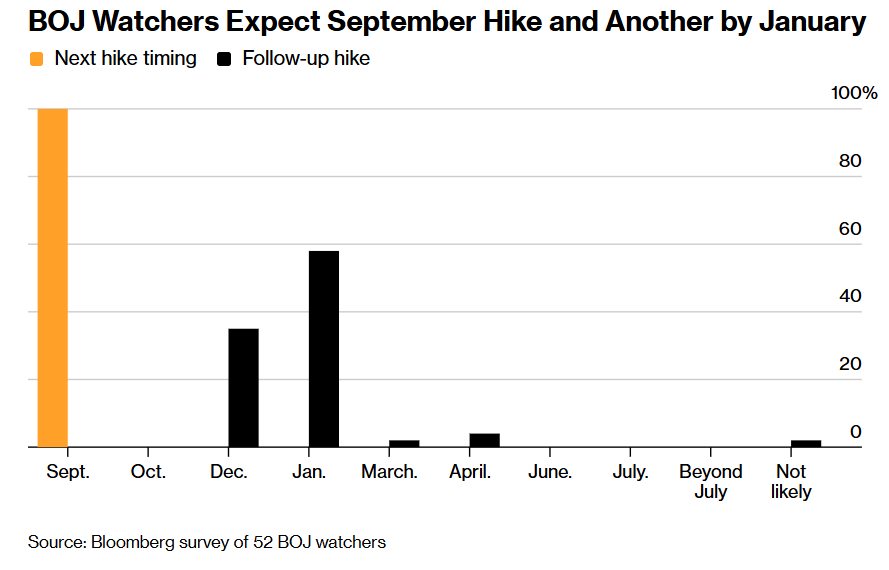
As shown in the chart above, Bank of Japan watchers unanimously expect another rate hike in September, followed by at least one more by January at the latest. Source: Latest Bloomberg survey of 52 Bank of Japan watchers.
The results reflect a sharp shift in economists’ views: in the previous survey conducted in July, no one anticipated a policy adjustment in September. The Bank of Japan faces upside inflation risks, while repeated calls for action by U.S. Treasury Secretary Scott Bessent have also bolstered market expectations for a rate hike this month.
Izuru Kato, Chief Economist at Totan Research Institute, wrote in his survey response: "The Bank of Japan may signal to the market that rate hikes could typically occur at intervals of around three months." "The focus will be on how strongly it hints that the frequency of hikes could increase further if conditions permit."
Data continues to highlight inflation risks. On Friday, the Bank of Japan stated that Japan’s corporate goods prices rose 7.6% year-on-year in August, little changed from the revised 7.7% gain in July, which was the fastest pace since February 2023.
Approximately 46% of respondents believe the Bank of Japan will accelerate its rate-hiking pace to roughly once per quarter, contrasting with the prevailing view from a few months ago of adjustments every six months. About 36% expect intervals of four to five months between hikes, while the proportion expecting semi-annual hikes plummeted from 82% in July to just 6% in the latest survey.
In late July, U.S. Treasury Secretary Bessent ordered the first coordinated purchase of the yen in 28 years to help Japan prevent further depreciation of its currency. This week, he challenged speculators betting against him with remarks highly unusual for his position, further underscoring his determination to defend the yen.
Approximately 82% of respondents indicated that, following coordinated U.S.-Japan intervention in the yen exchange rate, the government led by Prime Minister Sanae Takaichi would find it difficult to oppose a rate hike by the Bank of Japan this month.
An overwhelming majority of respondents stated that Scott Bessent’s repeated remarks supporting further rate hikes were an attempt to ensure that Sanae Takaichi would not obstruct the central bank. While it is well known that Takaichi generally supports monetary easing, there is currently no evidence suggesting she will oppose this month’s rate hike.
Naoya Hasegawa, Chief Bond Strategist at Okasan Securities, stated: “Rather than directly urging the Bank of Japan to raise rates, the United States is pressuring the government not to hinder the central bank’s progress toward policy normalization.”
Several respondents highlighted the importance of next week’s vote on the policy interest rate. Market participants are paying particular attention to two Policy Board members—Ayano Sato and Ichiro Asada—who were personally appointed by Sanae Takaichi to the nine-member committee.
Ryutaro Kono, Chief Economist for Japan at BNP Paribas, stated: “If they support a rate hike, the market is likely to perceive a significant reduction in pressure from the government for the Bank of Japan to maintain accommodative policies. If they oppose it, investors may interpret this as a signal that political pressure to keep interest rates low persists.”
Although economists anticipate an acceleration in the pace of policy normalization, their forecasts for the terminal rate of this tightening cycle have remained largely unchanged.
The survey showed that the median expectation remained unchanged at 1.75%, implying three additional rate hikes. The highest expectation also remained at 2.5%.
Edited by Deng