
The latest Markets Pulse survey shows that intensifying bond sell-offs are pushing U.S. Treasury yields to levels that could significantly impact the stock market.
According to the Zhitong Finance app, the latest Markets Pulse survey indicates that intensifying bond sell-offs are pushing U.S. Treasury yields to levels that could inflict significant damage on equity markets.
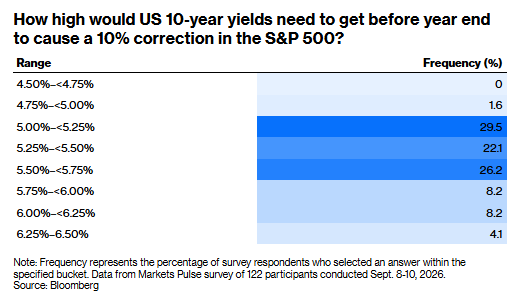
Among the 122 respondents in the survey, approximately 30% believe that a 10-year U.S. Treasury yield of 5% to 5.25% would be sufficient to trigger a 10% decline in stock prices from their peaks—a drop that would meet the definition of a technical correction. Another 22% set the threshold slightly higher, at 5.25%–5.5%.
 On Thursday, the benchmark 10-year U.S. Treasury yield briefly climbed above 4.98%, reaching a three-year high. Conflicts ignited by U.S. President Trump in the Middle East have driven oil prices well above $100 per barrel, exacerbating inflationary shocks and sharply increasing the risk of policy responses from the Federal Reserve.
"Investors may perceive that we are on the verge of a long-awaited equity market correction, as real economy data and central bank policies deliver a harsh reality check to risk-seeking investors," said Joseph Brusuelas, Chief Economist at RSM.
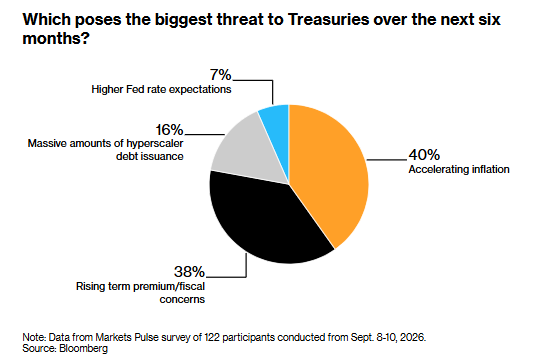
With the November midterm elections approaching, U.S. Treasury yields—a key benchmark for funding costs and equity valuations across the broader economy—have become a source of concern for the Trump administration. Survey participants cited accelerating price pressures and fiscal concerns as the greatest threats facing U.S. Treasuries over the next six months.
Since Trump began bombing Iran in late February, this key yield has risen by a full percentage point, currently hovering just below the peak level of approximately 5% reached at the end of 2023. At that time, the Federal Reserve had just concluded its rate-hiking campaign aimed at curbing post-pandemic inflation surges.
This round of yield increases occurs against the backdrop of traders expecting the Federal Reserve to raise interest rates again as early as next week. New Chair Walsh faces pressure to demonstrate his readiness to fulfill the commitment to contain inflation, which has remained above the Fed's target since 2021.
However, more than 80% of survey participants believe that even if Walsh does lead the Federal Reserve in raising rates, it will constitute one or two adjustments within the current cycle rather than the start of a new, larger-scale hiking cycle.
To date, consistently strong corporate earnings reports have partially offset the impact of rising interest rates. Although the S&P 500 Index has fallen by 2% over the past four days, it remains close to the record high set last month.
Global borrowing costs have been rising due to factors including growing government deficits and the surge in borrowing for artificial intelligence (AI) investments, which is testing the market's capacity to absorb such substantial debt.
However, inflation has remained a key driver. On Thursday, the U.S. Department of Labor reported that wholesale prices rose more than 5% year-on-year in August, even before the recent surge in oil prices. The department is scheduled to release Consumer Price Index data on Friday.
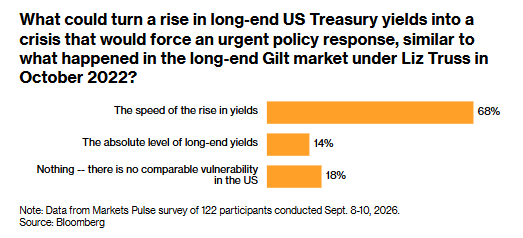
A disorderly bond sell-off poses the greatest risk. When asked what could trigger a crisis severe enough to force a response from Washington, more than two-thirds of respondents indicated that the speed of yield increases, rather than their absolute level, was the most critical factor.
"The 10-year yield appears poised to test the 2023 cycle high of 4.99%; a new high would place greater pressure on equity markets," said Andrew Graham, Partner at Jackson Square Capital. "However, from the perspective of equity market risk, the pace of yield increases is far more significant than the level itself."
Sustained expansion in corporate earnings and substantial capital inflows into the AI sector have been supporting U.S. equity valuations.
Macro strategist Tatiana Daria stated: "The extent of pressure on equity markets depends on how long interest rate volatility persists. Focusing solely on yield levels may overstate the threat to equities, as the market is being supported by a very real earnings boom."
Hitesh Jain, an analyst at Yes Securities, noted that based on analyst expectations, the S&P 500’s earnings growth rate over the next year is around 35% or even higher. He pointed out that the key risk lies in these profits failing to materialize.
"As long as corporate earnings continue to exhibit strong compound growth, equity markets should be able to absorb structurally higher risk-free rates," he wrote.
Meanwhile, some institutions predict that U.S. Treasury yields may not reach levels that would drag down equity markets. Strategists at Sumitomo Mitsui Banking Corporation wrote: "We believe the range of 4.80% to 5% could represent the near-term peak for the 10-year U.S. Treasury yield over the coming months. There are signs that global demand for bonds may emerge when yields are at attractive levels."
Edited by Deng