The IEA has significantly raised its estimate for this year's global oil demand decline to 2.5 million barrels per day, marking the largest drop since the pandemic. The agency no longer expects shipping through the Strait of Hormuz to resume this year and warns that with supply constraints persisting and commercial stock buffers rapidly depleting, "further demand compression may be needed in the coming months to bridge the supply-demand gap." The years 2026 and 2027 are projected to be a "lost period" for global oil demand growth.
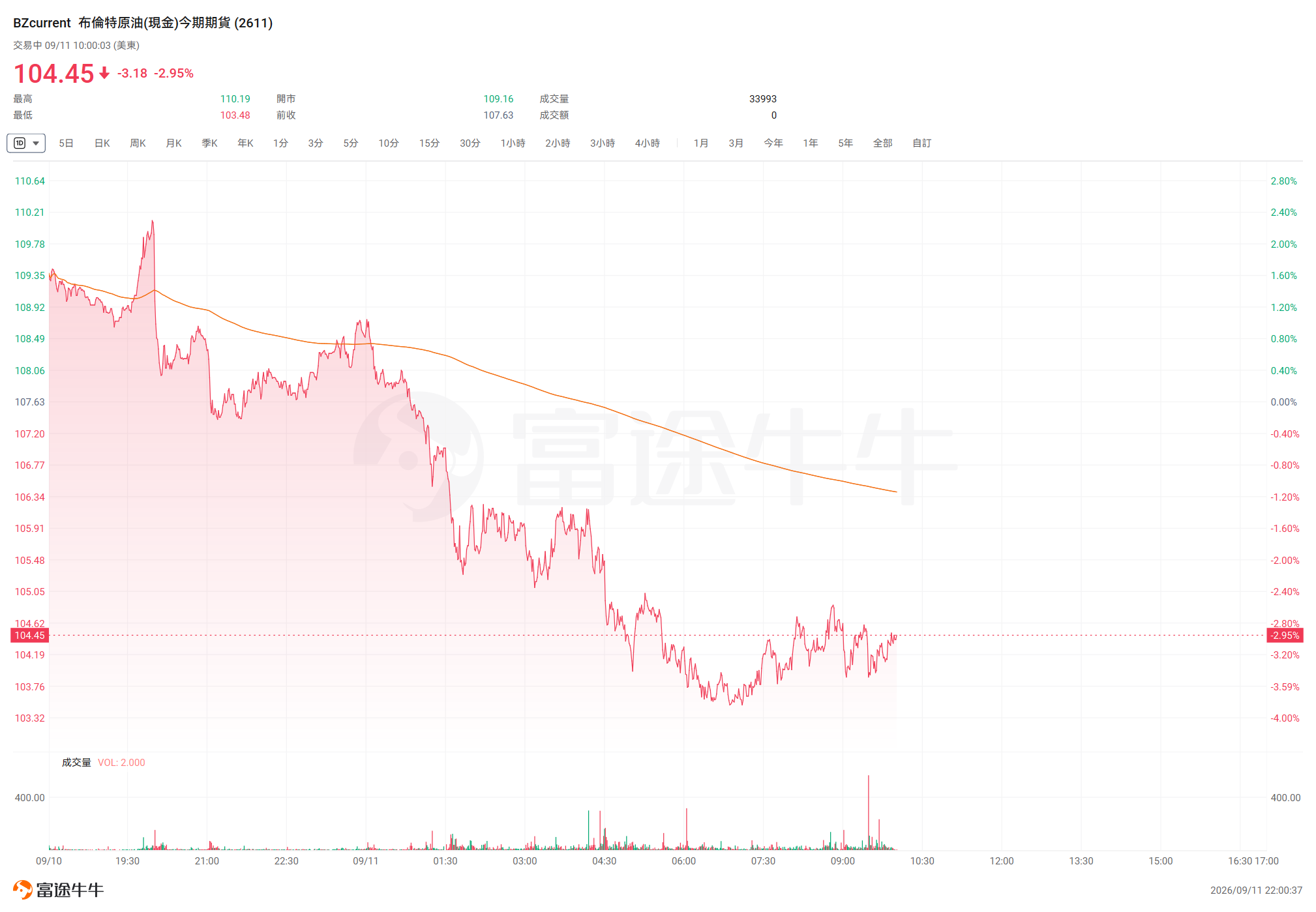
Brent crude oil plummeted after touching the $110 mark, as the International Energy Agency (IEA) simultaneously issued a warning: the ongoing conflict involving Iran continues to weigh on global oil demand. The decline in demand this year has reached its largest level since the outbreak of the COVID-19 pandemic, and may shrink further in the coming months.
According to Bloomberg, the IEA raised its forecast for the annual decline in global oil demand this year to 2.5 million barrels per day in its September monthly report, an increase of 940,000 barrels per day from the previous month's projection. This represents the largest annual drop in demand since the shock of the COVID-19 pandemic in 2020.
 The IEA no longer expects shipping through the Strait of Hormuz to resume this year, warning that with supply constraints persisting and commercial inventory buffers rapidly depleting, "further demand compression may be required in the coming months to bridge the supply-demand gap." The years 2026 and 2027 are projected to be a "lost period" for global oil demand growth.
Affected by the aforementioned warnings,$Brent Last Day Financial Futures (DEC6) (BZmain.US)$prices retreated nearly 3% from intraday highs approaching $110, falling to around $104. Nevertheless, oil prices recorded their largest weekly gain since July this week, bringing the year-to-date increase to over 70%.
The supply gap continues to widen, while inventories are declining at a record pace.
In its report, the IEA lowered its forecast for the annual decline in global oil supply this year to 5.7 million barrels per day, a further reduction of 1.3 million barrels per day from the previous month's estimate, and pushed back expectations for supply recovery to next year. Balancing both supply and demand, the global oil supply deficit this year is projected to be approximately 1.75 million barrels per day, higher than the 1.3 million barrels per day predicted in last month's report.
The IEA characterized this crisis as a "record-breaking supply disruption."
Report data shows that between February and August this year, global oil inventories declined at an accelerating rate of 2.8 million barrels per day. Inventories are expected to continue falling in the fourth quarter, contrary to the IEA's earlier prediction of a slight rebound during the same period. The IEA's August report had also anticipated a return to supply surplus by the end of this year, a judgment that has now been completely overturned.
The Strait of Hormuz crisis impacts distribution; the war's impact on supply exceeds that on the demand side.
The IEA pointed out that the current conflict's impact on oil distribution is even greater than its effect on consumption, which is the core reason for the widening supply gap. The strategic chokepoint of the Strait of Hormuz remains obstructed, and attacks on energy infrastructure have extended from the Persian Gulf to the battlefields of Russia and Ukraine.
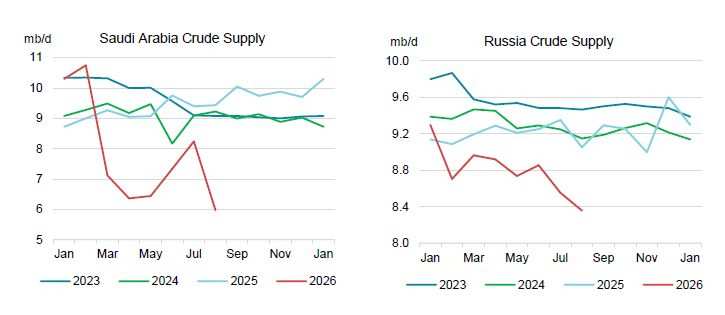
According to Bloomberg, Iran-backed Houthi rebels claimed to have struck Saudi Arabia's East-West Pipeline, a critical alternative route bypassing the Strait of Hormuz that connects to Red Sea export terminals. Meanwhile, Houthi forces are advancing toward coastal areas near the strategic Bab el-Mandeb Strait, approaching the port of Mocha at the southern end of the Red Sea. Saudi oil production fell again last month, dropping to its lowest level since 1990.
Helima Croft, an analyst at RBC Capital Markets, wrote in a research note: "The resurgence of full-scale war between Saudi Arabia and the Houthis could serve as a catalyst triggering our high oil price scenario."
Global diesel shortage hits hard, with Asia's petrochemical industry bearing the brunt
The IEA warned that the scale of the shock to oil demand in 2026 could rival the four largest energy crises of the past 60 years, with the most concentrated impact on middle distillates such as diesel and feedstock supplies for Asian petrochemical plants.
Diesel shortages have triggered ripple effects globally. The U.S. diesel crack spread currently stands at approximately $110 per barrel, while the national average retail price for industrial diesel has reached a historic high of $6 per gallon, with prices at some stations in California exceeding $9.99 per gallon.
Hamad Hussain, a commodities analyst at Capital Economics, warned that dwindling inventories combined with early signs of recovering demand in China have made oil prices highly sensitive to any new disruptions in Middle East supply. Jeff Currie, former head of commodities at Goldman Sachs and current head of Real Macro, stated in an interview with CNBC that Chinese buyers are actively entering the market to bid for crude oil, adding, "I actually place greater weight on the factor of China's return to the market."
Diplomatic efforts show glimmers of hope as markets closely monitor developments in the Gulf
Amid escalating geopolitical tensions, there are faint signs of diplomatic easing. According to Bloomberg, the six member states of the Gulf Cooperation Council are considering holding talks with Iranian officials next week to discuss navigation issues in the Strait of Hormuz.
Justinus Steinhorst, an analyst at UBS, pointed out in a research note: "Brent crude remains above $105 amid dual chokepoint concerns triggered by the Houthi situation and tensions in the Bab el-Mandeb Strait, while the yield on 10-year German government bonds has risen to its highest level since 2009, and the yield on 10-year U.S. Treasuries is approaching the 5% threshold."
The core contradiction facing the market is that war-induced damage to the supply side far outpaces the natural adjustment speed of the demand side. The IEA's latest warning suggests that, with the outlook for supply recovery remaining unclear, passive compression on the demand side may become the only way to balance the market.
Editor/melody