
Executives at refining companies stated that new refineries require several years to become operational, leading them to prioritize improving the efficiency of existing facilities. Currently, the average price of diesel in the United States has surpassed $6 per gallon for the first time, while gasoline prices remain elevated, and refinery utilization rates have reached approximately 98%. According to data from the CFTC, as of the week ending September 8, net long positions in NYMEX WTI crude oil hit a 20-week high, and net long positions in gasoline reached a nine-month high.
As oil prices climb back above $100 per barrel, the U.S. government is considering invoking the Defense Production Act to expand domestic refining capacity, while speculative capital in the crude oil market is further increasing its bullish bets.
According to Reuters, citing sources familiar with the matter, the Trump administration is examining how to utilize the Defense Production Act to boost U.S. domestic refining capacity. Related proposals were discussed during Trump’s recent meetings with nearly a dozen U.S. refiners, where White House officials asked refining companies how federal support funds could be most effectively used to increase refining capacity.
 No final decision has been made yet, and participants expect discussions to continue. Executives from refining companies told the government that if federal funding is secured, it would be more appropriate to use it for improving the efficiency of existing refineries or expanding current facilities, rather than building new ones, as constructing new refineries is costly and requires years to become operational.
Rising prices for refined petroleum products have intensified policy pressure. The national average price of diesel in the United States surpassed $6 per gallon for the first time, representing an increase of nearly 60% since the military actions by the U.S. and Israel against Iran in February; U.S. diesel inventories are also 13% lower than the five-year average for the same period. Gasoline prices in the U.S. remain equally elevated.
WTI crude oil fell 2.43% on Friday, but prices remained near $100 per barrel.
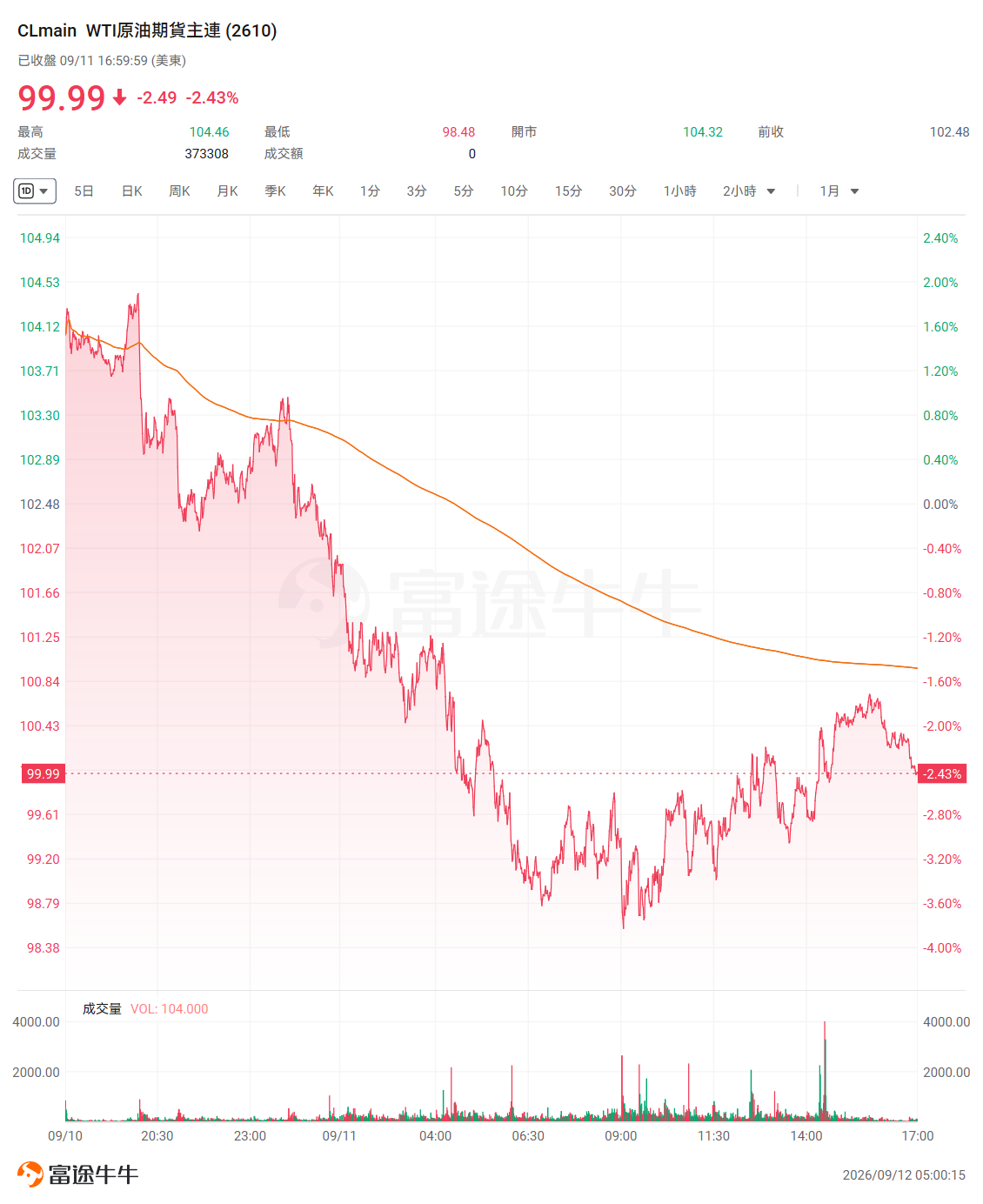
Crude oil bullish positions rise to multi-month highs
The latest commitment of traders data from the U.S. Commodity Futures Trading Commission (CFTC) shows that speculative capital continued to increase its bets on rising crude oil prices for the week ended September 8.
Net long positions in NYMEX WTI crude increased by 19,720 contracts for the week to 139,339 contracts, marking a 20-week high; combined net long positions in Brent and WTI crude rose by 25,890 contracts to 411,159 contracts, reaching a 16-week high.
The refined products market also showed some bullish倾向. Net long positions in NYMEX gasoline increased to 92,926 contracts, hitting a roughly nine-month high. However, net long positions in NYMEX heating oil/diesel fell to 16,004 contracts, marking a four-week low.
The natural gas market remained bearish, with net short positions in NYMEX natural gas increasing to 76,518 contracts, a five-week high.
In other words, during the week ending September 8, capital flows significantly increased bets on rising crude oil and gasoline prices, rather than adopting a broadly bullish stance on the entire energy sector.
It is worth noting that the aforementioned CFTC positioning data is as of September 8, while WTI crude subsequently broke through the $100 per barrel mark. Therefore, the temporal relationship should be interpreted as speculative capital increasing long positions in crude oil ahead of time, followed by a further rise in oil prices, rather than the CFTC data directly causing the breach of the $100 level.
U.S. refining capacity has approached its upper limit.
The Trump administration's consideration of invoking the Defense Production Act (DPA) to expand refining capacity reflects a current reality facing the United States: even if crude oil supplies increase, the U.S. refining sector may not be able to rapidly convert additional crude into gasoline and diesel.
The operating rate of U.S. refineries has reached approximately 98%, nearing full capacity. With robust fuel demand and global refining capacity constrained by factors such as the situation in the Middle East and attacks on Russian refineries, U.S. refiners have limited room to increase output.
U.S. refining capacity has declined over the past decade, with several unprofitable refineries closing down, leading to a further concentration of existing capacity along the Gulf Coast. Consequently, the Trump administration views increasing domestic refining capacity as a long-term solution to alleviate pressure on fuel prices.
Taylor Rogers, spokesperson for the White House, stated that U.S. refining capacity is crucial for ensuring energy security and reliable supply. Expanding refining capacity is a priority for President Trump and his energy team. The administration is currently evaluating specific measures, including regulatory reforms, expedited approvals, and increased investment.
The DPA could become a policy tool for expanding refining capacity.
The Defense Production Act is generally regarded as a key instrument for the U.S. government to mobilize industrial resources in emergencies.
In April of this year, the Trump administration took action to designate domestic U.S. oil production, refining, and logistics capabilities as critical to national defense, authorizing the use of the DPA to support the expansion of these capabilities. At the time, the White House stated that petroleum fuels are vital to the U.S. military, industrial base, and critical infrastructure.
The crux of the discussion is that the Trump administration may further extend the use of the Defense Production Act (DPA) from a policy tool safeguarding energy supply to directly supporting refinery expansion and efficiency improvements.
However, refiners are reluctant to rely on government funding to build new large-scale refineries. Industry executives prefer federal funds to be directed toward expanding and improving the efficiency of existing facilities, as building new refineries requires substantial investment and long construction periods, making it difficult to address current fuel supply shortages.
Crude oil, refined products, and inflation have become major factors influencing policy.
From a market perspective, the current U.S. government is facing more than just rising crude oil prices.
Conflict in the Middle East has disrupted global supplies of crude oil and refined products. After international oil prices surpassed $100 per barrel, prices for end-user fuels such as diesel and gasoline rose in tandem, transmitting higher costs to transportation, agriculture, and industry, thereby renewing upward pressure on U.S. inflation.
Rising oil prices have begun to affect U.S. financial markets, with investors concerned that higher energy costs could drive up inflation and influence the Federal Reserve’s future policy path.
The International Energy Agency (IEA) has also warned that due to conflict in the Middle East and supply disruptions in the Gulf region, the global oil supply shortfall could widen further to 5.7 million barrels per day in 2026, equivalent to approximately 6% of total supply. Saudi Arabia’s crude oil production fell to around 6 million barrels per day in August, its lowest level in over three decades.
For the U.S. government, expanding refining capacity can increase the medium- to long-term supply of refined products. However, since building new capacity takes years, whether gasoline and diesel prices can be lowered in the short term still depends on the restoration of Middle Eastern supplies, global refining capacity, and the actual potential for increased output at existing U.S. refineries.
Editor/Stephen