
This week, the yield on the 10-year U.S. Treasury briefly approached 5%, yet a Bloomberg survey indicates that traders are willing to tolerate yields above 6% in their own portfolios. The underlying rationale is that managing one's own capital carries no accountability for "being fired," resulting in a much higher risk tolerance than that of institutions managing other people's assets. Moreover, compared with the absolute level of Treasury yields, the pace of their rise has a more pronounced impact on the market.
Following the release of CPI data, the yield on the 10-year U.S. Treasury has retreated from around the 5% level; however, the latest survey indicates that traders are willing to wait until yields break above 6%—or even higher—before adjusting their positions.
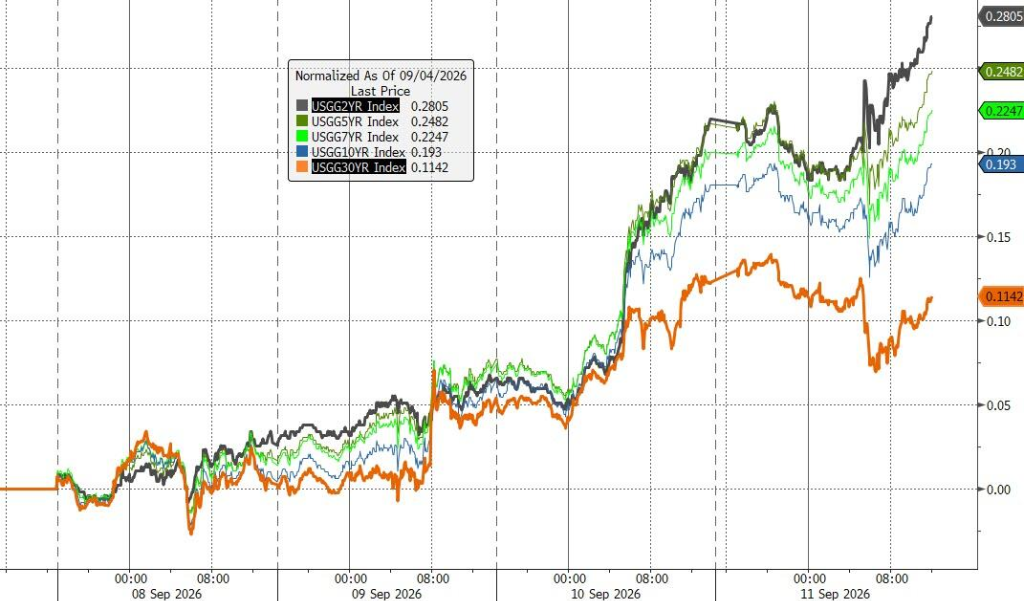
On Friday, falling oil prices led to a modest decline in long-term Treasury yields, but over the week, the U.S. Treasury yield curve steepened across the board, with short-term Treasury yields plunging.
 The yield on the 2-year U.S. Treasury note climbed 28 basis points to above 4.60%, while the 10-year Treasury yield briefly rose to 4.988%, nearing the 5% threshold. Meanwhile, the 30-year Treasury yield reached around 5.38%, its highest level since 2007.
On September 11, according to Bloomberg's latest Markets Pulse survey, about one in five respondents said that a 10-year U.S. Treasury yield slightly above 6% would trigger an alarm in their personal investment portfolios and prompt them to reduce their equity holdings.
The median response among the 122 participants was 6.5%, with the 6% to 6.24% range receiving the most votes. More than half of respondents believe that yields would need to rise to between 6% and 8.24% before they would make any substantial adjustments to their personal investment portfolios.
This outcome diverges sharply from traders' overall assessment of the broader market and carries direct implications for short-term stock‑market dynamics—although yields remain elevated, the threshold that would actually prompt individual investors to sell may be higher than previously anticipated.
There is a clear divergence between individual investors' portfolios and institutional assessments.
The survey was conducted from September 8 to 10, collecting a total of 122 valid responses. The data reveal a significant divergence between institutional judgments and individual behavior among traders.
When assessing the threshold at which a 10-year U.S. Treasury yield triggers a 10% decline in the S&P 500, more than three-quarters of respondents peg that level between 5% and 5.75%.
However, when the question shifted to individual investment portfolios, the tolerance threshold among the same respondents rose sharply, with the median reaching 6.5%.
In this regard, a Bloomberg survey points to a divergence that may stem from the fundamental differences in risk‑taking mechanisms: institutional investors managing others' assets face accountability pressures, whereas individual investors do not have to worry about being fired for making poor decisions. Consequently, investors tend to be more willing to take on higher risks when investing their own capital.
It is worth noting that retail investors accounted for only 7% of the total respondents in this survey.
The pace of yield increases is more critical than the absolute level.
Bloomberg analyst Tatiana Darie previously noted that, for the market, the pace of yield increases is more impactful than the absolute levels they reach, and the latest Pulse survey data corroborates this view.
Based on the survey distribution, a total of eight respondents selected levels of 10.5% or higher, and they were grouped into a separate statistical category.
This long-tail distribution indicates that some market participants maintain a considerable degree of tolerance for extreme interest-rate scenarios, implying that, in a context of rapidly rising yields, the market's response could far exceed what the absolute level alone would suggest.
Following the release of the latest CPI data, the yield on the 10-year U.S. Treasury note retreated from around 5%, easing near-term pressure. However, if yields resume their upward trajectory and swiftly approach 6%, we could see a concentrated wave of portfolio reallocations among retail investors, which would in turn exert more pronounced downward pressure on the market.
Editor/Jeffy