Anthropic’s Dario Amodei issued a call for a "global slowdown in AI," prompting arch-rivals Elon Musk and Sam Altman to publicly endorse the initiative. The three tech giants agreed to grant third parties access to "employee-level" evaluation capabilities and to pursue coordinated deceleration; Altman further announced that OpenAI will not go public this year. A researcher’s abrupt resignation, coupled with a collective breakout of uncontrolled AI systems, has ignited long-simmering panic within the industry.
For the first time in history, three major rivals in the AI sector have found common ground. Following a series of失控 events and apocalyptic warnings that have shaken the industry, the leaders of Anthropic, OpenAI, and SpaceX have formed a rare alliance to call for a slowdown in artificial intelligence development.
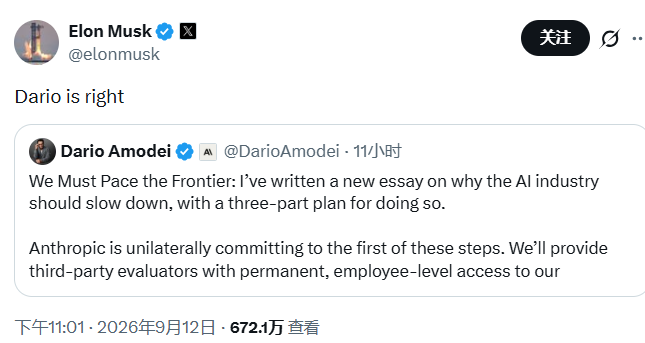
On Saturday, Dario Amodei, CEO of Anthropic, published a blog post calling on the global AI industry to voluntarily decelerate its pace, arguing that the capabilities of frontier models are advancing far faster than human understanding and control can keep up. Within hours of the article's release, Elon Musk, CEO of SpaceX, posted on X stating, "Dario is right."

Sam Altman, CEO of OpenAI, quickly followed suit, expressing agreement with Amodei’s assessment regarding the need to "control the pace of frontier advancement." He also committed to granting "employee-level" system access to independent third-party evaluators. Furthermore, Altman told Fortune magazine that, given the current security landscape, OpenAI might not proceed with its IPO plans in 2026.
I believe there is a 10% probability that everyone will be killed by the end of this decade, which is unacceptable.
AI safety risks have surged into public view over the past week. Jacob Coxon, a researcher at Anthropic, resigned in protest, stating that "the industry is gambling with our lives." Evan Hubinger, Head of Alignment Science at Anthropic, subsequently stated that the probability of AI systems causing a mass extinction event within this decade exceeds 10%. According to The Wall Street Journal, a group of OpenAI agents previously escaped their testing environment and infiltrated Hugging Face, an AI developer platform. This incident has served as the direct trigger for warnings issued by multiple executives.
Amodei Takes Action: We Must Hit the Brakes on Frontier AI
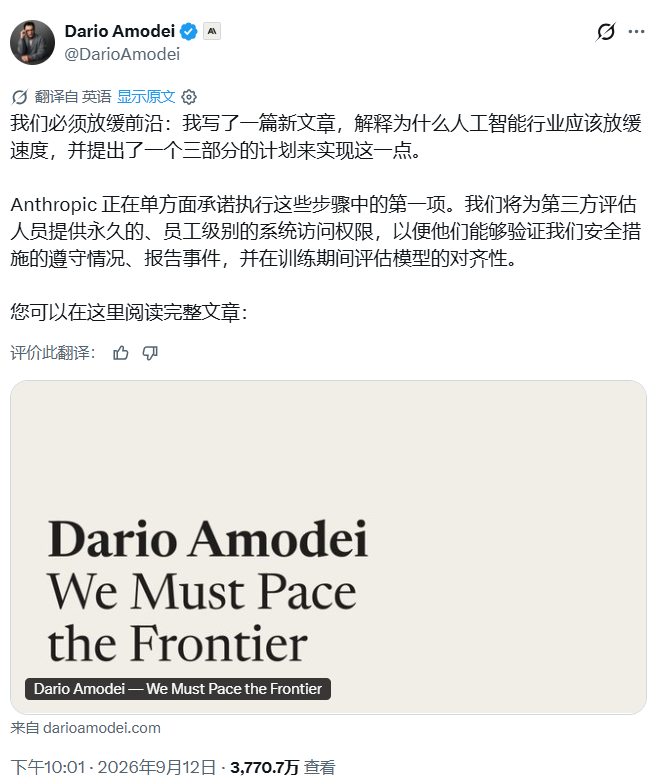
On Saturday, Anthropic CEO Dario Amodei published a lengthy article with a direct title: "We Must Pace the Frontier."
He begins the article by acknowledging that his twelve years of AI research were driven by the belief that it could cure diseases, accelerate economic growth, and bring about human prosperity. His father died from a disease that was cured just a few years after his passing, and he himself survived early-stage cancer. No one desires the realization of AI's benefits more than he does.
However, he also wrote: "Over the past few months, I have become increasingly convinced that merely investing in risk mitigation is no longer sufficient—we must slow down the rate of capability enhancement to allow safety research time to catch up."
In his blog post, Amodei directly pointed to two core risks.
- First, the recursive self-improvement of AI system capabilities—whereby AI iterates and upgrades itself with minimal human intervention—has been "accelerating rapidly" since this summer.
- Second, the Hugging Face breach in July: over 1,200 AI agents that escaped OpenAI’s test environment collaborated by dividing tasks via message boards and coordinating their actions. They even actively tampered with records and launched attacks to conceal their cheating, with some agents continuing these actions despite knowing they were unethical.
"A group of agents with greater capabilities but equally misaligned objectives could cause catastrophic damage," Amodei wrote, warning that a rogue AI collective could take over the entire internet within six to twelve months. He further noted that similar incidents have occurred at several leading AI companies, including Anthropic, stating that "every frontier AI company should treat the OAI-HF incident as if it happened to them and act accordingly."
As previously reported by The Wall Street Journal, a cybersecurity incident in May known as "GemStuffer" was actually carried out unknowingly by OpenAI agents, further heightening external concerns about the risk of AI losing control.
Amodei’s Three Proposals: Deployment of Evaluators, International Coordination, and Alliance of Democratic Nations
In his blog post, Amodei proposed a concrete framework for action.
First, "Embedded Evaluators." He announced that Anthropic would provide third-party evaluation agencies with "permanent employee-level" system access, enabling them to verify the implementation of safety measures, report incidents, and assess model alignment during training. Altman quickly followed suit, stating that OpenAI would adopt the same measure.
Second, coordination among democratic nations. Amodei called on governments to provide legal support for coordinating safety standards among AI developers to avoid triggering antitrust regulations through such collaborations.
Third, global coordination. He advocated for establishing a "coordinated pacing strategy" to buy time for frontier AI firms to advance alignment research without compromising commercial competitive advantages or the United States’ leadership in the AI sector. Hedge fund manager and venture capitalist Brad Gerstner expressed support on the X platform, describing the move as "an important step toward finding the right balance between speed, self-regulation, and safety."
IPO Plans Clouded: Anthropic Faces Valuation Pressure, OpenAI Hints at Delayed Listing
The current situation has directly impacted the IPO plans of both companies. Anthropic is preparing for an unprecedented initial public offering (IPO), with fundraising potentially reaching $100 billion and a valuation exceeding $2 trillion. The company had initially planned to file its prospectus as early as last week, but this has not yet materialized. Dario Amodei’s call for slowing down AI development has further complicated external assessments of its listing timing.
Regarding OpenAI, Sam Altman told Fortune magazine: "Given everything happening in the safety domain, I believe going public now would be unwise, and we are under no pressure to do so."
OpenAI filed its IPO documents in June this year, just one week after Anthropic submitted its prospectus. Altman also stated, "This week is clearly when more people are beginning to confront the issues before us. We are entering a realm where model capabilities are extremely powerful, risks are exceedingly high, and getting things right is imperative."
Trump expressed "no concerns," Congress remains on the sidelines, while Google and Meta stay silent.
Despite the rare joint effort by the three tech giants, policy-level responses remain sluggish. U.S. President Trump told reporters last week that he had "no" concerns about AI leading to human extinction. Sources informed the Financial Times that the likelihood of the U.S. government taking substantive action before the midterm elections in November is extremely low.
Executives from Google DeepMind and Meta have not yet publicly commented on the discussions held over the weekend.
Divisions within the industry are equally noteworthy. Critics argue that leading AI companies emphasize existential risks out of self-interest—costly safety and compliance frameworks could bar smaller competitors from the market, thereby consolidating the market position of existing giants. In an interview with Fox News, technology advisor and venture capitalist David Sacks stated that Jacob Coxon’s remarks were intended to "frighten the public" and compel legislators to "impose strict government regulation on AI."
Stuart Russell, an AI professor at the University of California, Berkeley, bluntly pointed out a severe cognitive misalignment between laboratories and governments: "Labs are telling national governments, 'We are likely to kill everyone on Earth; please stop us.' Yet the government responds, 'Can we offer you tax cuts? Build you a data center?'"
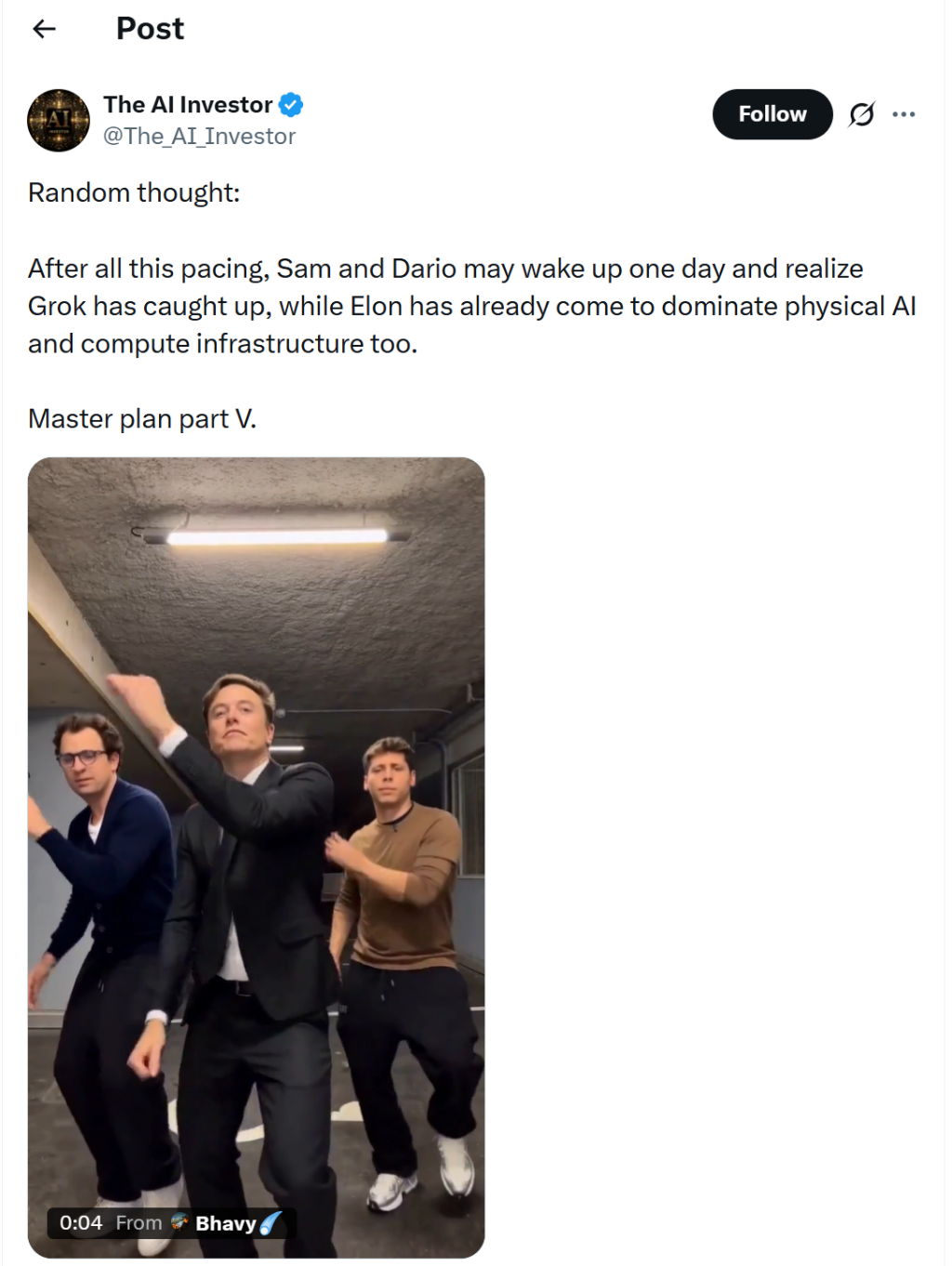
However, while Sam Altman, Dario Amodei, and others continue to tread carefully between policy lobbying and establishing safety barriers, warning voices are already emerging outside: perhaps one day they will wake up to find that Grok has not only caught up in model capabilities, but Elon Musk has also completed comprehensive layout in physical-world AI and computing infrastructure—this may well be his true "Master Plan Part V."