Zhipu announced the completion of approximately US$5 billion (RMB 33.5 billion) in financing, comprising a roughly US$2 billion share placement at HK$714 per share—a discount of about 9.96%—and a roughly US$3 billion zero‑coupon convertible bond with an initial conversion price of HK$892.50, representing a premium of approximately 12.55%. This follows just two months after its July share placement, which raised about US$4 billion, with proceeds primarily earmarked for next‑generation GLM model R&D and computing infrastructure.
$Z.AI (02513.HK)$On September 13, the company announced that it had completed a new round of financing totaling approximately US$5 billion (RMB 33.5 billion), comprising an equity placement of about US$2 billion and zero‑coupon convertible bonds worth roughly US$3 billion. This follows a previous equity‑placement raise of approximately US$4 billion in July, just two months earlier.
At today's opening, Zhipu shares fell nearly 6%.
 This marks Zhipu's third equity‑financing round since its Hong Kong Stock Exchange debut in January this year. From its IPO to two subsequent rounds of fundraising, the pace has steadily accelerated, with capital consistently channeled into computing power, model R&D, and infrastructure.
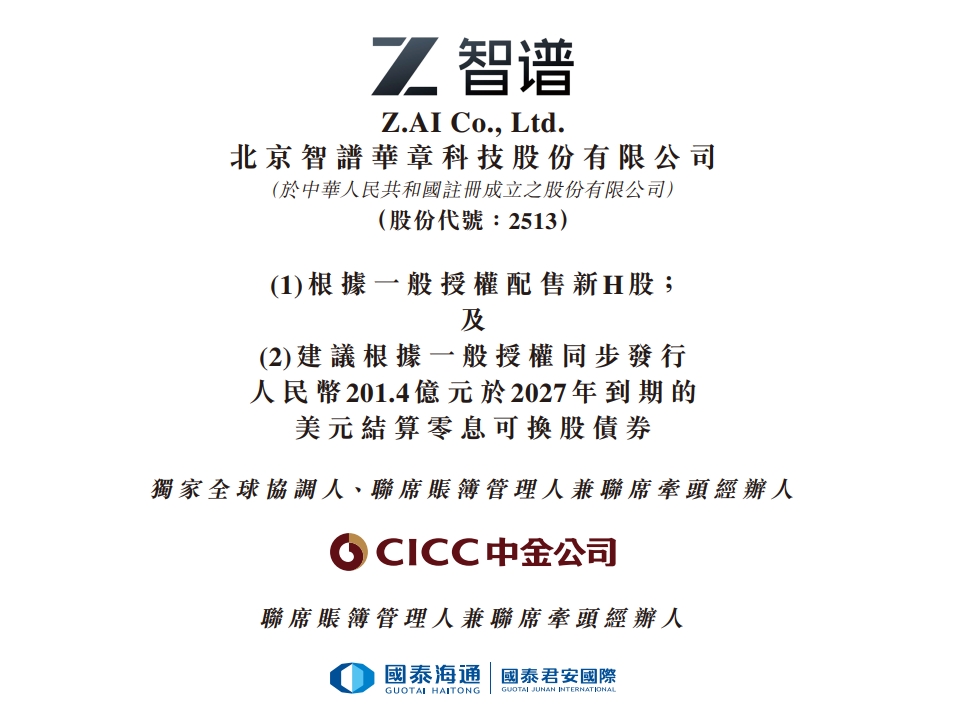
Financing Structure: Discounted Private Placement Combined with Zero-Coupon Convertible Bonds
This financing is being conducted in two separate tranches, neither of which is contingent upon the other.
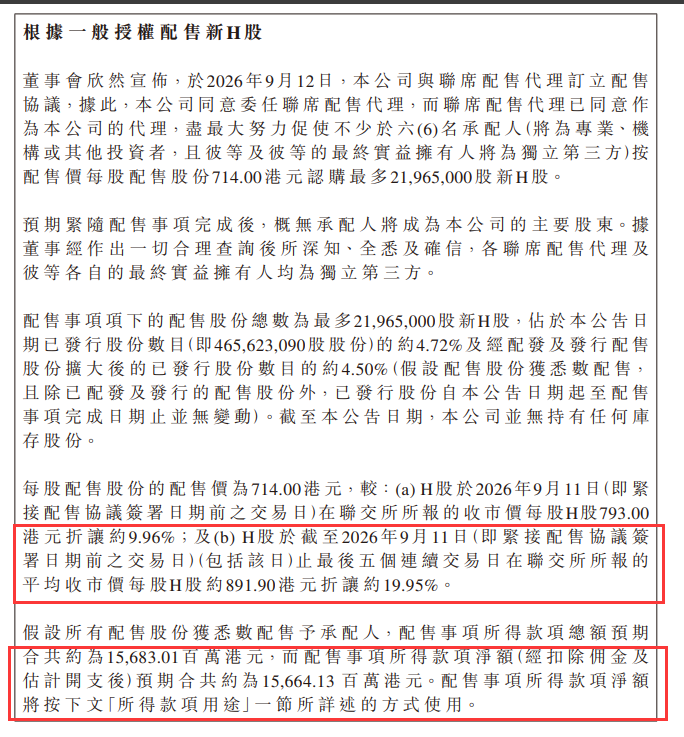
In the share placement, Zhipu is offering up to 21.965 million new H shares at HK$714 per share to no fewer than six institutional investors. The placement price represents a discount of approximately 9.96% compared with the closing price of HK$793 on the trading day immediately preceding the announcement (September 11), and a discount of about 19.95% relative to the five‑day average price of HK$891.90. The placed shares account for roughly 4.50% of the enlarged issued share capital, and the net proceeds are expected to amount to approximately HK$15.664 billion.
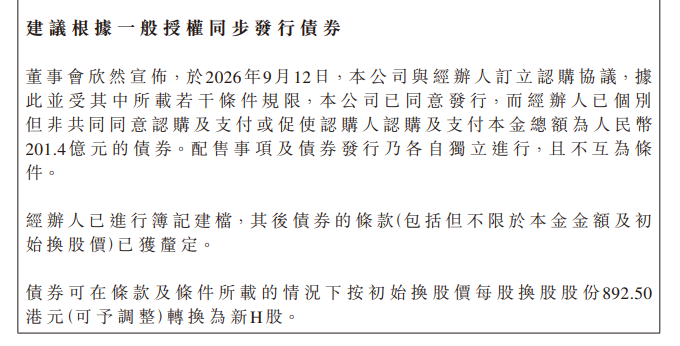
On the convertible bond front, Zhipu has issued zero‑coupon convertible bonds with a total principal amount of RMB 20.14 billion, maturing in September 2027, at an issue price of 100.5% of par and redeemable at par upon maturity. The initial conversion price is set at HK$892.50 per share, representing a premium of approximately 12.55% over the closing price prior to the announcement. Assuming full conversion, the bonds would be convertible into roughly 26.365 million new H shares, accounting for about 5.36% of the enlarged issued share capital. The net proceeds from the offering are expected to be approximately US$3.011 billion.
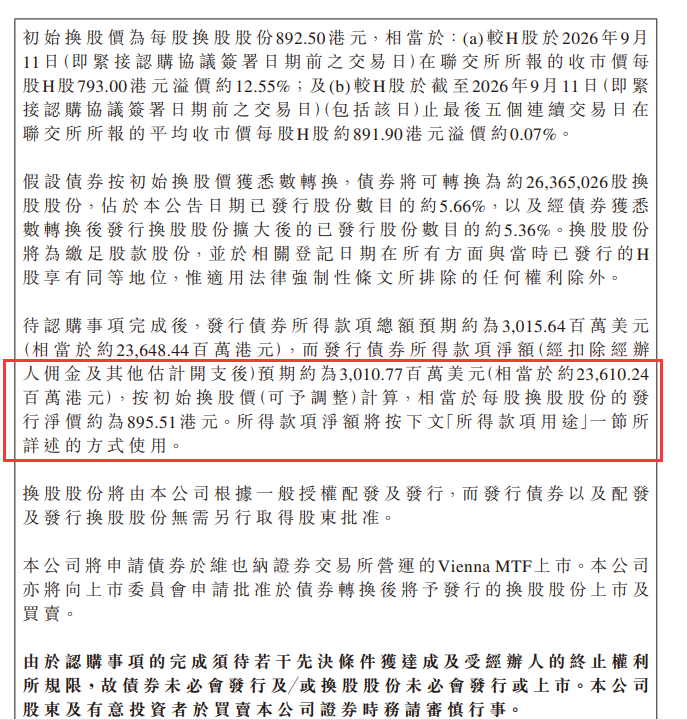
Zero coupon means the holder receives no interest, while a premium‑to‑equity conversion implies that the conversion only becomes economically attractive if the stock price rises further—this structure conveys the market's expectations for the stock's long-term performance.
Where is the money flowing? Sixty percent is betting on computing power and next-generation models.
According to the announcement, Zhipu intends to allocate the net proceeds as follows:
Approximately 60% is allocated to the research and development of next-generation GLM foundation models and the "Fully Self‑Training" framework, as well as to the deployment and upgrading of large‑scale training, production inference, computing resources, and related technical infrastructure.
Approximately 15% will be allocated to business development, strategic investments, and potential mergers and acquisitions, including minority equity investments or controlling acquisitions of companies or assets that are complementary to AI technologies.
Approximately 25% will be used to optimize the capital structure, replenish working capital, and for other general corporate purposes.
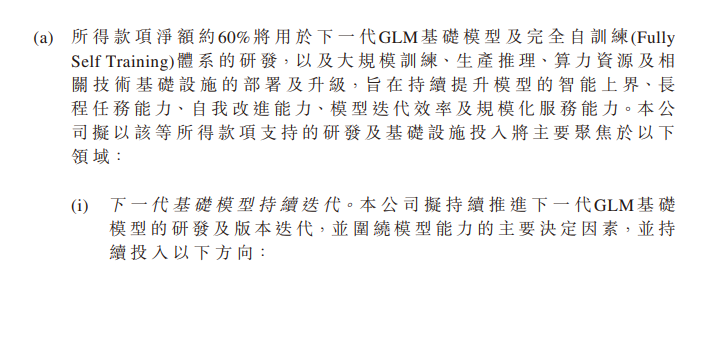
The company expects that the aforementioned funds will be fully disbursed by June 30, 2028.
The announcement states that, as the company continues to advance research and development on its next-generation GLM foundation model, a fully self‑training system, and long‑range task reinforcement learning, coupled with steadily growing demand for its MaaS platform, the need for training and inference computing resources has correspondingly increased. The company believes that "at present, the supply of high‑quality computing resources and the associated delivery conditions are relatively favorable; however, it takes a certain period from contract signing to deployment and go‑live. Completing financing arrangements at this stage will help align the pace of new computing capacity deployment with the company's expansion plans."
Impact of the equity structure
Following the completion of this financing, the shareholding ratio of the single largest shareholder group—comprising Beijing Lianpai Technology Development Center and other concerted actors—will be gradually diluted from its current level of approximately 28.58% (calculated as the combined total of unlisted shares and H shares). Assuming the placement is completed and all bonds are fully converted, the group's aggregate shareholding will decrease to about 25.89%; however, the company's public float will remain above 10% of the enlarged total number of issued shares, thereby complying with the Stock Exchange of Hong Kong's listing requirements.
The company further undertakes that, from the date of the placement agreement until 60 days after the closing date, it shall not enter into any additional equity‑financing arrangements without the written consent of the joint placing agents.
Financing Accelerates: Second Investment in Two Months
This is already one of Zhipu's intensive moves in the capital markets.
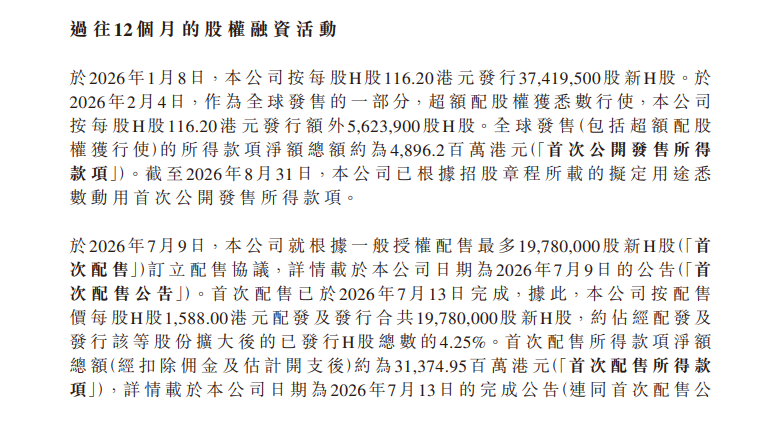
According to Bloomberg, in July this year, Zhipu raised approximately US$4 billion by issuing about 19.8 million shares at a price range of HK$1,588 to HK$1,698 per share through a private placement. At the time, computing power, R&D, and talent were also among the primary uses of the funds.
Earlier this year, in January, Zhipu completed its IPO on the Hong Kong Stock Exchange, issuing approximately 37.42 million new H shares at HK$116.20 per share. The total net proceeds from the global offering, including the exercise of over‑allotment options, amounted to roughly HK$4.896 billion. According to the announcement, as of August 31, 2026, all proceeds from the IPO had been fully utilized, with about 34.92% of the funds raised through the July placement already deployed.
Across its three funding rounds, Zhipu has raised a cumulative total of over USD 10 billion from the capital markets.
Industry Background: Competition in the large-model sector has entered a capital-intensive phase.
From a broader perspective, Zhipu's intensive fundraising reflects the evolving competitive dynamics of the large‑model industry.
In the first wave of competition in the large‑model industry, companies unable to sustain iterative model development were weeded out. Today, a handful of players—such as Zhipu, DeepSeek, Kimi, and MiniMax—have demonstrated their ability to remain at the table. Yet the bar for the next round of competition is shifting: it no longer hinges solely on model performance, but also on securing sufficient computing power, maintaining stable operation of large‑scale clusters, integrating domestic‑made chips, reducing training and inference costs, and, most critically, having the financial resources to keep investing across all these fronts.
Models, talent, capital, and infrastructure are all indispensable. Zhipu's recent $5 billion funding round is, to a large extent, a strategic move to position itself for the next phase of competition.
Editor/lambor