
Microsoft CEO Satya Nadella announced that the company will release the first "Code of Conduct" for its MAI model for public consultation tomorrow, stating that AI governance must not be controlled by a few entities but must have broad representation across ecosystems, countries, and academia. Meanwhile, sources familiar with the matter revealed that Anthropic, OpenAI, and Google have been holding private discussions on establishing an industry standards body for AI, with working groups continuing to meet as recently as last week.
As the debate over AI safety sweeps across the industry, Microsoft CEO Satya Nadella has announced his entry into the discussion and will release the company’s code of conduct for its AI models tomorrow.
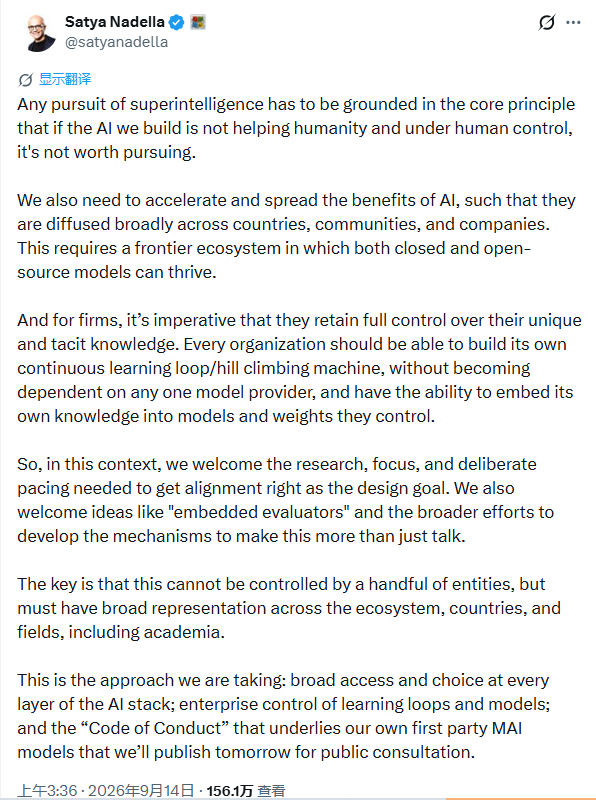
The AI industry is undergoing a rare collective period of "self-reflection." Last Saturday, Anthropic CEO Dario Amodei published an article calling for a "global slowdown in AI development," which subsequently received public endorsements from Elon Musk and Sam Altman. Against this backdrop, on September 14, Microsoft CEO Satya Nadella posted on X, explicitly supporting the "conscious control of R&D pace" to advance alignment research. He also announced that Microsoft would release the first "Code of Conduct" for its MAI model the following day, opening it for public consultation.
 This marks the first time Microsoft has publicly disclosed behavioral standards for its proprietary AI models in document form.
Meanwhile, sources familiar with the matter told The Information that Anthropic, OpenAI, and Google are already discussing collaboration to establish an industry standards body for artificial intelligence (AI). During an all-hands meeting, OpenAI CEO Sam Altman stated his support for creating a testing and auditing institution dedicated to the AI industry.
Nadella Draws Red Line: AI Without Human Control Is "Not Worth Pursuing"
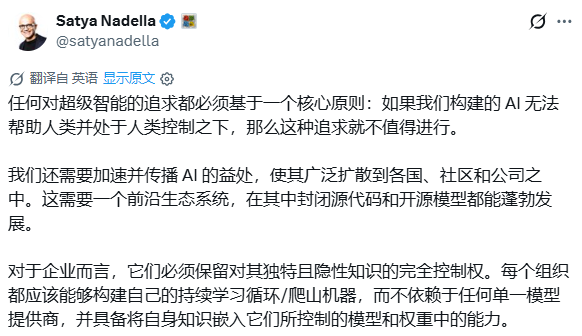
In his post, Nadella got straight to the point: "Any pursuit of superintelligence must be built on a core principle—if the AI we build cannot help humanity or cannot be controlled by humans, then it is not worth pursuing."
He also emphasized that the benefits of AI must be widely disseminated, "benefiting countries, communities, and businesses of all types," rather than being concentrated among a few players. He argued that this requires a cutting-edge ecosystem where both open and closed models can coexist.
Regarding the corporate level, Nadella’s stance was equally clear: "Enterprises must maintain full control over their unique, tacit knowledge. Every organization should be able to build its own continuous learning loop without relying on any single model provider, and have the capability to embed its knowledge into the models and weights under its control."
Microsoft’s Three-Tiered Approach: Open Access, Corporate Self-Control, and Public Disclosure of Code of Conduct
In his post, Nadella outlined Microsoft’s specific action framework, divided into three levels:
First, provide broad access and choice across every layer of the AI technology stack;
Second, ensure that enterprises retain full control over their own learning loops and models;
Third, release a "Code of Conduct" for MAI models for public consultation.
He stated that Microsoft welcomes the “research, focus, and deliberate pace required to achieve alignment goals,” as well as institutional concepts such as “embedded evaluators” to “ensure these efforts go beyond mere rhetoric.”
In a blog post last Saturday, Amodei proposed that major AI companies should grant external evaluation organizations, such as Model Evaluation and Threat Research, system access privileges equivalent to those of employees. Anthropic has committed to implementing this step, and Altman promptly indicated that OpenAI would follow suit.
Decentralized governance: Decision-making power must not rest with a few entities
Nadella issued a clear warning regarding the current landscape of AI governance.
He wrote, “The key point is that this cannot be controlled by a few entities; instead, it must have broad representation across ecosystems, countries, and sectors, including academia.”
This statement directly echoes ongoing discussions within the industry regarding the establishment of standard-setting bodies. According to sources familiar with the matter who spoke to the media, Anthropic, OpenAI, and Google have formed a working group since July this year, with representatives below the CEO level from the three companies meeting regularly to discuss plans for establishing an industry standards organization. The most recent meeting took place last week.
Sam Altman stated at an all-hands meeting at OpenAI this week that he supports the establishment of a testing and auditing body for the AI industry, but believes that “major labs must drive this themselves and cannot rely on support from the U.S. government,” according to a person familiar with the matter. He also noted that sufficient consensus has not yet been reached within the industry, with some companies expressing opposition, adding that “the best path forward is to advance this initiative jointly with other labs.”
White House Executive Order Stalls; Industry Self-Regulation Emerges as Main Focus
Government-led initiatives have currently stalled. According to a previous report by The Information, a draft executive order circulated within the White House proposing the establishment of an AI self-regulatory body similar to FINRA (Financial Industry Regulatory Authority). However, the proposal was shelved in late summer after failing to garner sufficient support within the Trump administration.
David Sacks, former White House lead on AI affairs, has publicly opposed the creation of a FINRA-like AI regulatory agency, arguing against government intervention. According to Politico, Meta CEO Mark Zuckerberg also expressed concerns about establishing a national AI regulatory body during a call with Trump in August.
Sacks stated on X that AI companies can advance safety efforts directly, noting that “no antitrust exemption is needed for coordination.” However, he questioned whether slowing development was “purely altruistic,” pointing out that product liability risks themselves provide financial incentives to prevent AI-related harms.
There has also been criticism from within the industry. Aidan Gomez, CEO of Cohere, posted on X expressing concern that the largest AI companies are coordinating to set rules that could restrict smaller competitors, writing directly: “Some great ideas from the cartel here.”