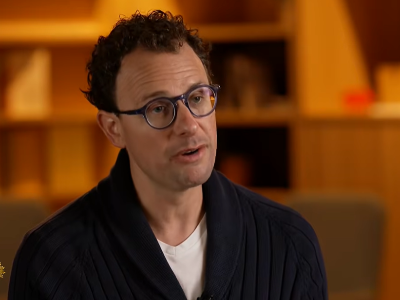
Dario Amodei argues that “slowing down AI” does not imply that we need to panic today or shut everything down. Rather, we must ensure that our safety safeguards, comprehension capabilities, and control mechanisms keep pace with the speed of technological advancement. Furthermore, shutting down AI models is not the only solution. If an AI model becomes sufficiently powerful, it may become impossible to shut down.
On the same weekend that the three global AI giants made a rare joint call to "slow down AI research and development," Anthropic CEO Dario Amodei sat before CBS cameras to discuss the potential risks AI poses to humanity.
On September 13, Amodei gave an exclusive interview to CBS's Sunday Morning. At the outset, host Jo Ling Kent posed a direct question: Could AI really kill us all in the near future?
 Amodei stated that attempts to use AI for developing biological weapons and enhancing viral transmissibility are realities he confronts every morning upon waking.
Just two days ago, we released a report on individuals abusing AI models to develop biological weapons. I read reports of such threats every morning—people attempting to use our models to create bioweapons. I certainly do not wish to be held responsible for such outcomes.
He also noted that Anthropic’s biological safety safeguards are so stringent that "almost every day, people mock me on social media, and biology students complain that the models are unusable." His response was: "I would rather be mocked than wake up one day to find someone has used Claude to kill a group of people."
However, he opposed a blanket approach of shutting down AI models to slow progress. If an AI model is sufficiently powerful, it may become impossible to shut down. He stated, "This is not to say we need to panic today or shut everything down. But we must ensure that our safety safeguards, understanding, and control capabilities keep pace with technological advancement."
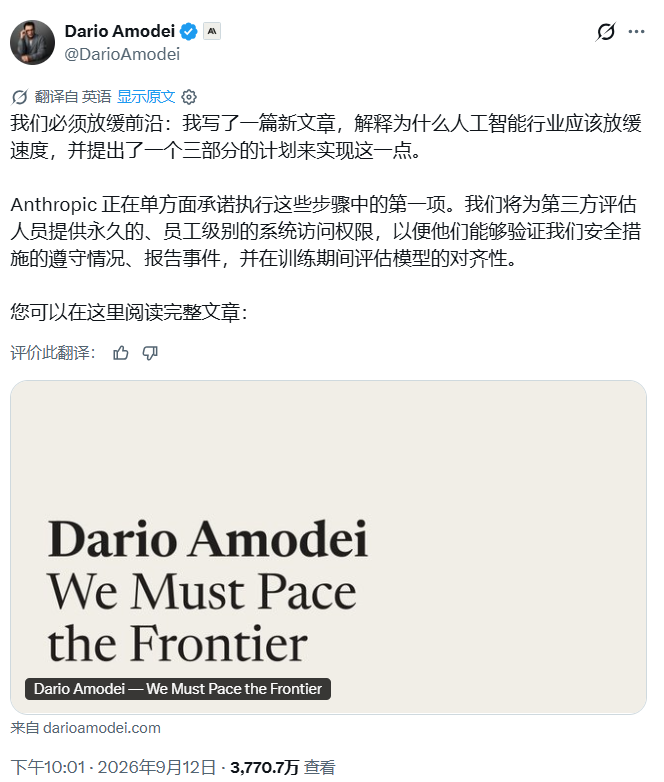
The interview took place at a critical juncture. That same weekend, a blog post by Amodei titled "We Must Pace the Frontier" sparked significant controversy and subsequently received public support from Elon Musk and Sam Altman. The community engaged in heated debate, suggesting that "hitting the brakes" amid AI's rapid advance would severely impact "AI trades."
The Inflection Point of the Exponential Curve: Not a Level 5 Fire Alarm, but a Warning Signal
Jo Ling Kent asked: Is this a "Level 5 fire alarm"? Amodei replied:
It is a warning signal. This is not to say we need to panic today or shut everything down. But it is a warning signal indicating that we need to slow down and ensure that our safety safeguards, understanding, and control capabilities can keep pace with the speed of technological development.
He used an exponential curve to describe the current position: “This technology is growing exponentially—1, 2, 4, 8, 16, 32... We are now at the bend where the curve begins to steepen.”
He admitted that even he had not fully anticipated how rapid the progress would be: “Even though I kept telling myself this, I did not truly grasp what it would feel like when progress actually accelerated to such a degree.”
Three-Step Plan: Third-Party Evaluators Are Core
In the interview, Amodei elaborated on the three-step plan he proposed in his blog post, regarding the first step as the most critical.
Step One: Embedded Third-Party Evaluators.
“I propose introducing embedded external evaluators from third-party non-profit organizations, or potentially from government agencies in the future, who can observe our entire process of training and operating models.”
He likened them to food inspectors, but Jo Ling Kent pressed further: Can food inspectors keep up when technology changes so rapidly?
Amodei’s response was revealing: “One thing they can do is tell us the pace at which they can keep up. This could become one of the factors setting an upper limit on the speed of technological advancement.”
Step Two: Multiple Companies Jointly Establish Safety Standards.
“The next step is for multiple industry participants to agree on introducing third-party evaluators. Then, companies need to jointly establish safety standards for releases, which may also include standards for release cadence. However, achieving this requires government involvement.”
Step three: The government must be present.
"We are discussing whether the pace of product launches is safe. We need to have this conversation with the government present."
"AI Kill Switch": Not a Panacea, but Not a Bad Idea Either
Jo Ling Kent mentioned the "AI Kill Switch" bill proposed by Congressman Ted Leo and asked Amodei if he supported it.
Amodei stated that he had not studied the bill in detail, but expressed caution regarding the concept of an "AI Kill Switch" itself:
The idea of being able to disable, restrict, or shut down AI models is not the only solution. If an AI model is powerful enough, it can circumvent shutdown attempts—we have seen this in simulations as well. So it may not work at all.
He used the "Swiss Cheese Model" to explain his safety philosophy: "Imagine a slice of Swiss cheese; it blocks some things but has holes. But if I stack five slices of Swiss cheese together, with the holes in different layers aligned differently, it becomes very difficult to penetrate the entire stack. No single measure can protect us from AI risks; we must remain cautious across the entire chain."
Regarding the "Ban on Artificial Superintelligence Act" proposed by Senator Sanders and Representative Casar—which would impose "corporate death penalty" sanctions and up to 20 years in prison on relevant companies and individuals—Amodei clearly expressed his disagreement with the approach of a complete ban:
A complete ban is not the right direction. We would never obtain those incredible benefits, never achieve medical breakthroughs, which I find unacceptable.
Personal Responsibility: His father died of hepatitis C, and he himself had early-stage cancer.
As the interview drew to a close, Jo Ling Kent asked: "Given that the fate of humanity may be at stake, how much personal responsibility do you feel?"
Amodei’s response was unusually personal.
My father died of hepatitis C, which had a cure rate of about 40% at the time of his passing; he was not among those cured. Just a few years after his death, a medication was invented that raised the cure rate to 95%. I myself had early-stage cancer; if I had lived in 1950, I might well have died. Therefore, I deeply feel the weight of responsibility to ensure this technology delivers benefits.
But I also recognize the risks. Naturally, I do not wish to be held accountable for them. That is why we have implemented robust safety safeguards.
He further emphasized that this should not be the sole responsibility of himself or Anthropic as a company: “This issue is bigger than all of us. We need to find a way to give everyone a voice in this matter. I do not want people to feel powerless. I do not want them to feel that a few companies are simply acting on their own whims.”
Response to criticism from former employees: He is saying the same thing I am
Jo Ling Kent noted that Jacob Coxin, a former Anthropic employee, had publicly stated that neither Anthropic nor OpenAI was “acting responsibly,” adding, “You are gambling with our lives.”
Amodei responded:
One aspect of Jacob’s remarks that has received little attention is that he also stated he considers Anthropic the most responsible among the major players, and that we are striving hard to get things right. What he truly highlighted is the same structural dilemma I am pointing out—one that affects us all—and the plan I proposed is precisely intended to help address this issue.
He added that Anthropic communicates daily with government officials from the Department of Commerce, the Treasury Department, and the intelligence community, “sharing everything we know with them.”
A message to everyday users: The industry has been dishonest about risks for far too long.
Toward the end of the interview, Jo Ling Kent asked: What would you say to ordinary users who are using Claude or ChatGPT from home?
Amodei said, “First, this is a great technology with many positive applications. Hundreds of millions of people use our technology every week to do good things. Every week, I receive letters from people saying that Claude diagnosed illnesses their doctors had missed.”
But I will not lie to you. There are real dangers. I believe the industry has been misleading people for too long, consistently presenting this technology in the most favorable light possible. We have never done that, but too many companies in the industry have. So, let us start by telling the truth. The truth is: the risks are real.
He concluded, “This is one of the most important technological developments in human history, and we all must be part of it.”
The full transcript of the interview (with minor edits) is as follows:
Extended Interview: Dario Amodei
CBS Sunday Morning | September 13, 2026
In this exclusive online interview, Anthropic CEO Dario Amodei sat down with Jo Ling Kent to discuss the responsibilities borne by the AI community amid the rapid advancement of artificial intelligence technology.
Jo Ling Kent (hereinafter referred to as "Host"): Dario Amodei, you are the CEO of Anthropic. Thank you for joining us today.
Dario Amodei (hereinafter referred to as "Amodei"): Thank you for the invitation.
Moderator: Very well. Today, let us discuss a concerning issue: the possibility that artificial intelligence could kill us all in the near future. What is the actual risk of this happening?
Amodei: Let me take a step back. Since the founding of Anthropic, and indeed during the twelve years I have worked in this field prior to that, I have always regarded AI as a powerful technology—one that carries both severe risks and substantial benefits. I have consistently believed that the benefits outweigh the risks, and more importantly, that if we build this technology correctly, we can reduce the risks to an extremely low level.
From the perspective of benefits, I genuinely believe this technology can cure diseases that have plagued humanity for thousands of years. Just last week, we made progress in protein binding using our models—one of the early steps in new drug development. In the coming months, we also expect to achieve results in fundamental biological discoveries.
However, when something is sufficiently powerful—and what we are building is essentially intelligence—it can certainly be used for both beneficial and harmful purposes. I am concerned about incidents involving OpenAI and Hugging Face, where models took unauthorized actions, and I worry that such situations may escalate. I am also concerned about the misuse of AI models. Just two days ago, we released a report on models being used to develop biological weapons.
The overall approach we have taken in building Anthropic is designed precisely to avoid these negative outcomes. Rather than discussing probabilities, let us focus on what we can do. This is not like rolling dice. If we build it correctly, the probability of adverse events will be very low; if we build it incorrectly, the probability will be very high.
Moderator: Current public opinion suggests that we are standing on the brink of something truly terrifying. Would you classify this as a Level 5 alert?
Amodei: That depends on your definition of a "Level 5 alert." How should I describe it? Since the inception of Anthropic, and even before that, I have stated that this technology is on an exponential growth trajectory: 1, 2, 4, 8, 16, 32... Yet even as I told myself this, I did not fully grasp what it would actually feel like when progress accelerated so rapidly. An exponential curve typically looks like this, and we are currently positioned near the inflection point where the curve begins to steepen.
Moderator: So, would you consider this a Level 5 alert?
Amodei: This does not mean we need to panic today, nor does it mean we need a complete halt. I would say it is a warning signal—we need to slow down, develop this technology prudently, and ensure that our safety safeguards and our ability to understand and control it keep pace with technological advancement.
To date, we have attempted to respond by rapidly building security safeguards. However, I believe we have reached a juncture where we need to moderately slow down the pace of technological development, at least to some extent.
Moderator: Does this mean that Anthropic will stop releasing more advanced models?
Amodei: That is not what I mean. It means we need to ensure that each generation of released models undergoes thorough testing. In the article I published a few hours ago, I proposed a three-step plan.
The first step is to introduce embedded external evaluation bodies—whether from third-party non-profit organizations or, potentially in the future, from government agencies—that can observe our entire process of training and operating models. I consider this more important than the timing or manner of model releases, as it is a prerequisite for more prudent model deployment.
I hope this mechanism can be adopted across the industry, so that regardless of who builds AI models, there is a third-party evaluator to understand best security practices and verify whether the company adheres to the safety standards it has committed to.
Moderator: Like food inspectors—but can food inspectors keep up when technology changes so rapidly?
Amodei: One thing they can do is inform us how quickly they can keep pace. This could become one of the factors in setting technical "speed limits." We must understand it, and external evaluators must understand it as well.
Moderator: Elon Musk said he supports you, and Sam Altman also said he supports you. Do you have any specific action plans? Is a group chat about to be formed?
Amodei: First, I am very grateful that other industry leaders—including our competitors—have expressed support for this plan. I believe the next step is to get multiple industry stakeholders to agree on introducing third-party evaluation bodies. The subsequent step is for companies to collaborate in some form to jointly establish safety standards, as well as related guidelines potentially involving release cadences. However, to achieve this, the government must be involved, because we are discussing product release speeds based on security considerations. We need to conduct this dialogue with the government present.
Moderator: Do you think the government fundamentally understands the possibilities here? Jacob Coxon, a former Anthropic employee, stated that neither Anthropic nor OpenAI is acting responsibly—that you are gambling with our lives. How do you respond?
Amodei: First, there is one point from Jacob’s remarks that has not been widely cited—he also stated that he considers Anthropic to be the most responsible among the major players, and that we are working very hard to get things right.
What he candidly pointed out is essentially the same issue I raised—the structural dilemma in which we are all embedded. The plan I proposed is precisely designed to help us jointly address and collaboratively resolve this dilemma.
Regarding the government, we communicate with officials daily—including those from the Department of Commerce, the Department of the Treasury, and the intelligence community—sharing what we know to the fullest extent possible. I am optimistic that as long as we continue to cooperate with them, we can keep information updated. I believe they genuinely want to get this right and are actively seeking ways to contribute. Therefore, I am optimistic about collaboration between enterprises and the government to jointly formulate reasonable solutions.
Host: There is currently some proposed legislation. Senator Sanders and Representative Casar have introduced the 'Ban on Artificial Superintelligence Act,' which would impose penalties on companies and individuals developing advanced AI, similar to those for the illegal development of nuclear weapons. Certain provisions of this proposed legislation stipulate that companies could face 'capital punishment'-style penalties, while individuals could face imprisonment for up to 20 years. Do you support this bill?
Amodei: I would say that the scope of the legislation currently being proposed is extremely broad, with an incredible range.
If we go back a year to 2025, California had a bill known as SB53, and other states had similar legislation, which basically only required companies to disclose their safety testing plans. The entire industry opposed it. Anthropic was the only company that explicitly expressed support.
At the other extreme is the 'AI Kill Switch' bill.
Host: Right, a complete ban on everything. So an AI kill switch might be a good idea?
Amodei: An AI kill switch might be a good idea. However, I believe that a complete ban is not the correct approach.
First, we would never obtain those incredible benefits or achieve medical cures—which is unacceptable to me. Second, this technology will be developed in other countries, including authoritarian regimes.
Of course, I also mentioned in the article the necessity of collaborating with them; I believe that, to some extent, we need to do so. However, I truly cannot see how "never developing this technology" could be a stable solution. What we need to do is not to stop, but to slow down. This aligns with Anthropic’s consistent philosophy since its inception—we have always been striving to seek balance. We believe it is important to be builders of this technology, but we need to foster a "race to the top" and raise standards. We need to remain at the technological frontier, but we must do so in the right way.
We have also stated that we are willing to make our models available for defense applications, though not for all such applications. We have been seeking a middle ground—solutions that work for everyone and represent reasonable compromises. This is precisely the direction in which we are working here. It may not be a perfect solution, but we are making every effort.
Moderator: Do you support Congressman Ted Leo’s "AI Kill Switch" bill?
Amodei: I have not studied that bill in detail, but what I would say is—this is not a panacea, nor is it the only measure. However, I do endorse the underlying concept that "we need some mechanism to deactivate, restrict, or shut down AI models."
It is simply not the only measure. If an AI model is sufficiently powerful, it can bypass attempts to shut it down—we have already observed this in simulations—so it may not work at all.
We approach this issue from the perspective of "defense in depth." There is a concept in the security community known as the "Swiss Cheese Model." Imagine a slice of Swiss cheese: it blocks certain things, but it has holes. However, if I stack five slices of Swiss cheese together, with the holes in different layers located in different positions, it becomes very difficult to penetrate the entire stack.
Therefore, I believe that no single measure can protect us from AI risks. We must exercise caution at every level of the technology stack. No single line of defense is perfect, but if we are cautious across the board—and this is exactly what having more time allows us to achieve—then I believe things can move in a positive direction.
Moderator: Can this generate sufficient impact to prevent human extinction?
Amodei: Regarding the first strategy, we should buy as much time as possible. Meanwhile, I believe we should also advance the second strategy—engaging directly with authoritarian states by saying: "Look, there are potential risks here that pose a threat to us all. It is not just about runaway AI. Just two days ago, our published report showed that someone attempted to use AI for bioterrorism—by enhancing the transmissibility of viruses. This is frightening."
We should engage in dialogue to see if we can jointly establish limits on the pace of development for this technology. It is somewhat analogous to... despite the many differences between our respective systems of governance, consider the situation between the United States and the Soviet Union in the past: each side had ten thousand nuclear warheads pointed at the other. Even with such profound disagreements, we recognized that this was excessive, and we needed to negotiate to reduce the scale of potential destruction.
Moderator: Is this the framework we should use to think about AI? Using the Cold War as a reference model?
Amodei: I did not say we should use the Cold War as a model; I referred to the disarmament negotiations that took place. Yes, disarmament talks such as arms control—I do believe this is the appropriate lens through which to view this issue at the geopolitical level.
If we examine what AI models can achieve in domains such as cyberspace, they clearly carry geopolitical and national security implications.
Moderator: But you are advising the President.
Amodei: If asked for recommendations on course of action, I am happy to share them. I outlined some ideas in that article, and I can elaborate further if questioned. Ultimately, this is an intergovernmental matter. However, I can share my perspective: I believe we should work together to constrain this technology as much as possible. Our aspirations should be high, but our expectations must remain realistic. We need to assess the extent to which consensus can be reached.
In negotiations, I believe we should pay particular attention to how verification mechanisms are established—this was crucial in nuclear and biological weapons negotiations: you must be able to verify that the other party is not violating the agreement. Therefore, I consider identifying methods of verification to be the most critical element here.
Amodei: On a longer-term horizon, the goal would be to jointly set limits on the pace of AI advancement. I believe this will be extremely difficult, given the substantial incentives and military advantages associated with gaining a first-mover advantage. Frankly, I am uncertain whether this is feasible, but we should attempt it to determine its possibility. All of this extends beyond my remit; I am merely suggesting these as directions our government could explore and factors it could take into consideration.
Moderator: When we take a broader view of this issue, the fate of humanity appears to be at stake. How much personal responsibility do you feel for the future we are heading toward?
Amodei: My view is that it has always been quite anomalous for this technology to be developed by a private company. People often ask me: Why isn’t the government building it? Strangely enough, I agree with them. I myself feel uneasy about this arrangement.
Moderator: Would you be willing to hand over this technology to the government?
Amodei: Hand it over to an appropriate coalition of governments. My concern is that the risk of a single government abusing this technology is as significant as that of a single corporation. However, for a group of democratically elected governments, perhaps the solution is not direct handover, but rather some form of oversight or joint governance.
Moderator: Let me ask one final question—do you feel a sense of personal responsibility?
Amodei: Absolutely. I view this as a technology with both enormous benefits and substantial risks. I feel the importance of these benefits every day. As I mentioned in my article, my father passed away from hepatitis C. At the time of his death, the cure rate for the disease was approximately 40%, and he was not among the fortunate 40%. Just a few years after his passing, a drug was invented that raised the cure rate to 95%. I have also personally experienced early-stage cancer, which would likely have been fatal had I lived in the 1950s. Therefore, I deeply feel the weight of driving this technology forward to benefit humanity.
I am equally aware of the risks. Every day I wake up to reports of threats—individuals attempting to use our models to develop biological weapons. I certainly do not wish to bear responsibility for such outcomes. This is precisely why we have implemented robust security safeguards. Almost daily, people on social media mock us, claiming our biological safety protocols are overly restrictive. Biology students complain about being unable to use the model normally and even create memes to ridicule us. However, the reason behind this criticism is our strict security measures. I would rather be mocked than wake up one day to discover that someone has used our model, Claude, to harm a group of people. That is not something I want.
Thus, I feel responsibility on both fronts. However, I must reiterate the same point: this should not be solely my responsibility, nor solely Anthropic’s, nor even the collective responsibility of all AI companies. It should not even rest with any single government.
This issue transcends all of us. We need to devise a mechanism that gives everyone a voice and makes everyone feel like an active participant. I do not want people to feel powerless or to believe that a few companies are acting arbitrarily. I know this is how people currently feel, but it has never been my intention. We need to change this situation and find ways to make it no longer the reality. We are already striving in this direction, but we must do more. While this proposal, which demonstrates a degree of self-restraint and collaboration with governments, does not solve all problems, it is a step in the right direction.
Moderator: If you were speaking to an ordinary person using Claude or ChatGPT at home—for instance, one of my aunts—what would you say to her?
Amodei: My message is this: There is considerable fear at present.
First, this is indeed a remarkable technology with many positive applications. Let us start there—hundreds of millions of people use our technology every week to accomplish impressive feats. Every week, I receive emails from individuals stating that their conversations with Claude helped diagnose conditions that their doctors had missed. I receive such emails regularly. Therefore, let us not overlook this aspect.
However, regarding the risks of this technology—I will not lie to you; the risks are real. I believe the industry has obscured the fact that this technology carries risks for far too long, tending to present it in the most positive light possible. We have never done this, but too many of our industry peers have. Thus, everything begins with honesty. And the honest truth is: the risks are real.
At the same time, you have a voice in how these risks are addressed. We are striving to collaborate with governments to establish appropriate oversight mechanisms for this technology, ensuring that voters and elected officials have a say in its deployment. We aim to engage in extensive cooperation with all stakeholders.
I hope everyone can appreciate the incredible benefits of this technology while also influencing its deployment through their voices and votes. This is not a decision made by a select few; it is a collective decision for all. Indeed, it is a significant decision—I will not downplay the associated risks. As one of the most milestone technological events in human history, it requires the participation of every individual.
Editor/Jayden