
Saudi Arabia strikes back against Houthi attacks, while talks between Iran and the Gulf states have been postponed, adding further uncertainty to crude oil supply.
A regional meeting on the Houthi‑controlled Strait of Hormuz, which had been widely anticipated by the market, was put on hold at the very last minute before it was set to begin. The talks between Iran and the Gulf states, originally scheduled for Monday in Oman, were postponed at the request of Saudi Arabia.
According to reports on September 14, against the backdrop of ongoing Houthi attacks on targets inside Saudi Arabia, the long-awaited first regional summit since February—when the U.S. and Israel launched military operations against Iran—has been called off. Meanwhile, Brent crude oil prices have recently surged above $108 per barrel. As markets grow anxious over rising energy inflation driven by Middle East tensions, the Federal Reserve is set to hold its next policy meeting on September 15–16, with interest-rate futures now pricing in a greater than 85% probability of a rate hike in September. At the same time, U.S. midterm elections are just 50 days away.
The Inside and Outside Story Behind the Postponement of the Talks: Saudi Dissatisfaction Emerges as a Key Variable
 According to Iran's Foreign Ministry, the talks were originally scheduled for Monday in Oman but have been "temporarily" postponed at Saudi Arabia's request. An informed source, who asked not to be named due to the sensitivity of the matter, said the delay was partly driven by Saudi Arabia's anger over the continued attacks on its territory by Houthi forces and other Iran-backed groups.
"Saudi Arabia has attributed the postponement of the regional summit to developments in Yemen, a move that seeks to deflect attention from the root causes of the crisis," Iran's Foreign Ministry said in a statement on Monday. The Saudi government did not immediately respond to requests for comment.
Oman's Foreign Minister, Badr Albusaidi, who has been negotiating with Iran for weeks over maritime traffic management in the Strait of Hormuz, said Sunday evening that the decision to postpone the talks was "in the interest of consensus."
This was originally set to be the first meeting among Iran, the Gulf Cooperation Council (GCC) member states, and Iraq since the U.S. and Israel launched military operations against the Islamic Republic of Iran in February this year. However, the escalating conflict between Saudi-backed forces and the Houthi rebels entrenched in neighboring Yemen has complicated the conference's plans.
Diplomatic Stalemate: The United States "Steps Backstage," and Regional Consensus Remains Elusive
Adding to the complexity is the shift in the United States' role in Hormuz shipping diplomacy. According to three sources familiar with the matter, officials in the Trump administration have privately informed relevant parties in the Gulf region that they hope future U.S.-Iran negotiations will focus on Iran's nuclear program rather than on issues related to passage through the Strait of Hormuz. This means Washington has chosen to remain outside the Oman‑mediated shipping diplomacy.
This "separate-track strategy" implies that the path to de-escalation will hinge largely on regional consensus among Iran, Oman, and the Gulf states. Without direct U.S. involvement, reaching a durable maritime arrangement could be prolonged, and each incident—such as the attack on Saudi Arabia's oil pipelines—could reset the negotiation process to square one.
U.S. Energy Secretary Steven Chu on Sunday sent a clear message to the market in Vienna, cautioning oil traders against expecting a quick breakthrough on the Strait of Hormuz issue. "Hoping for a consensus agreement with Iran today is clearly not a viable option," he said. At the same time, Chu delivered a tough stance on Iran's nuclear program, asserting that Tehran's nuclear ambitions will be brought to an end "no matter what."
Impact: Supply through the Strait of Hormuz, a critical chokepoint, remains under sustained pressure.
The intensity of the attacks is escalating. This month, towns housing several energy facilities in southwestern Saudi Arabia have continued to suffer heavy damage at the hands of Houthi forces. The Saudi government stated that its critical East-West pipeline was shut down last week following multiple drone strikes originating from Iraq—where numerous Iran-backed militias operate. On Monday, the Yemeni Houthis issued a statement claiming they had struck a Saudi air base in Khamis Mushait. Earlier, Riyadh had issued a potential‑danger alert for cities in the southwest, though it did not confirm the specific targets of the attacks.
Supply-side tensions extend beyond Saudi Arabia. According to earlier reports, the 1,200-kilometer export corridor that bypasses the Strait of Hormuz has remained closed since it was attacked on September 11, leaving only enough crude oil in Yanbu port to sustain exports for five to seven days. Once these reserves are depleted, as much as 4% of global oil supplies could be at risk. Meanwhile, the average daily number of tankers passing through the Strait of Hormuz has fallen to single digits, down from a recent ten-day average of 14 vessels.
This east–west pipeline spans the entire length of Saudi Arabia, stretching over 1,000 kilometers and linking the oil-producing regions along the Persian Gulf with export terminals on the Red Sea. Since the Strait of Hormuz has been effectively closed due to U.S.–Iran tensions, Saudi Arabia has used this pipeline to shift its crude‑oil export routes from the Gulf to the Red Sea, thereby effectively sidestepping the risks associated with a strait blockade. At an August earnings call, Saudi Aramco CEO Amin Nasser stated that the pipeline's role in stabilizing the oil market even surpasses that of the large‑scale strategic petroleum reserve releases led by the United States.
Oil prices surge past $100.
Concerns that the protracted conflict in the Middle East will further tighten supplies of diesel and other fuels have pushed Brent crude above $108 per barrel, hitting a recent high. On Monday, September 14, Brent rose 3% to $107 per barrel, at one point approaching $110, while WTI gained 3% to $102 per barrel. Last week, Brent broke through $100 per barrel for the first time since July, with intraday highs reaching $109; according to market data, U.S. diesel prices have surpassed the previous record of $6.20 per gallon.
However, U.S. officials have adopted a relatively more measured assessment of the supply outlook. Speaking last Sunday, Wright downplayed expectations that a short-term deal on the Hormuz Strait issue would be reached. He estimated that current crude and refined‑product shipments through the Strait of Hormuz stand at roughly 10 million barrels per day, and with pipeline diversions factored in, "we've already restored two-thirds or even more of pre‑disruption volumes. The global oil market is tighter than we'd like, but it's not overly tense."
Analysts note that the United States' decision not to intervene directly in the Hormuz shipping diplomacy signals that the party wielding the greatest military leverage has chosen not to bring that leverage to the negotiating table, leaving the path to de-escalation largely dependent on regional consensus. For oil prices, this implies that the geopolitical risk premium currently embedded in pricing may unwind more slowly than the market had previously anticipated.
From Gas Stations to the CPI: Inflation Expectations Are Rising Across the Board
For the Federal Reserve, none of this could have come at a worse time. Soaring oil prices are driving up pump prices across the United States, and with just over 50 days until the midterm elections, this has become a political headache for President Trump's Republican Party. Earlier Sunday, when asked about a possible meeting between Gulf states and Iran, Trump told reporters, "I don't care. That's their business. No problem."
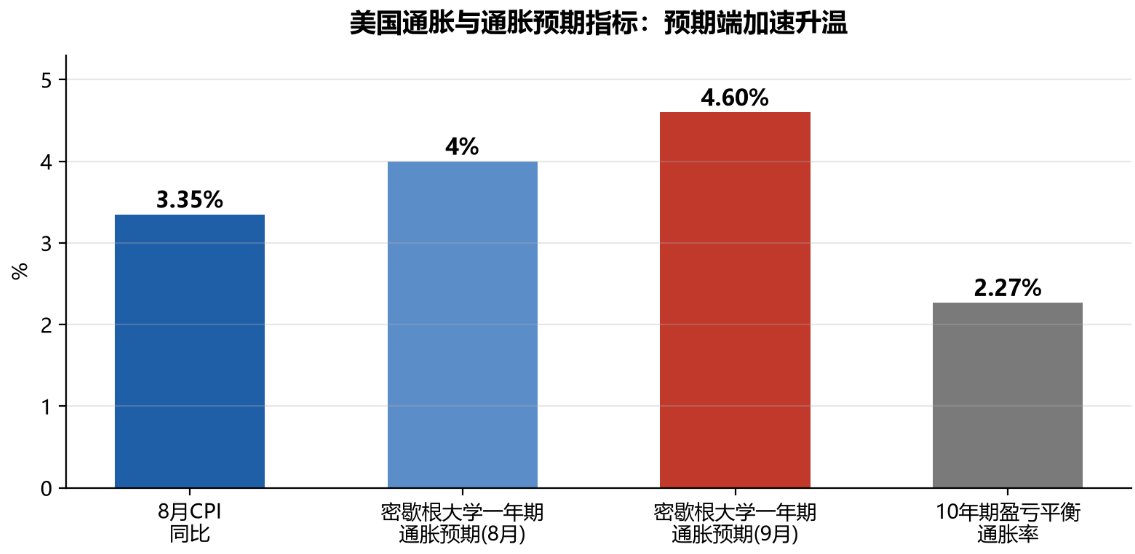
Inflation data had already put pressure on policymakers: in August, the U.S. CPI rose 3.35% year over year, while core CPI increased 0.3% month over month, exceeding expectations (according to the U.S. Bureau of Labor Statistics); a University of Michigan survey showed that consumers' one-year inflation expectations climbed to 4.6% in September, up from 4.0% in August; and the 10-year breakeven inflation rate stood at 2.27%.
Oil prices are shaking up the midterm elections.
Rising energy prices are placing mounting political pressure on the Trump administration and the Republican-controlled Congress. Last week, the national retail price of diesel surpassed $6 per gallon for the first time, hitting a record high; the average gasoline price remains above $4 per gallon. Diesel is a key fuel for freight, agriculture, and logistics, and its sharp price increase means that transportation costs for food and consumer goods will face renewed upward pressure, which in turn will feed through to overall inflation.
According to a poll conducted last month, the Democratic Party leads the Republican Party by 8 percentage points on the question of which party has a better plan to address rising living costs. High diesel prices are particularly affecting Maine—where the share of households that rely on heating oil is the highest in the nation—as well as agricultural states such as Ohio, Kansas, and Iowa.
Secondly, a national poll commissioned by the Financial Times and conducted by the London-based nonpartisan research firm Focaldata from August 28 to September 1 among 1,914 registered voters shows that only 33% of registered voters approve of Trump's performance as president, down 3 percentage points from last month and marking the lowest level since the survey began in May this year. The poll data clearly indicates that growing voter dissatisfaction with the economy and rising living costs is the primary driver behind the continued decline in Trump's approval ratings.
The Fed's Decision This Week: Rate Hike All but Certain
The Federal Reserve will hold its interest-rate meeting on September 15–16. Pricing in the interest-rate market has clearly shifted hawkish: according to CME FedWatch, the probability of a rate hike in September has risen from about 70% a week ago to over 85%, and the market has begun pricing in a second rate hike before December. Institutional forecasts are also turning hawkish in tandem: TD Bank and JPMorgan have already revised their policy outlook to a tighter stance.
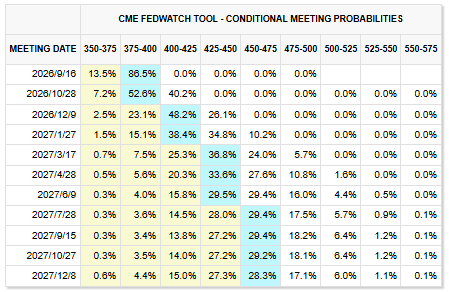
The traders' line of reasoning is clear: the postponement of talks pushes back the timeline for a full reopening of the Strait of Hormuz, while the shutdown of Saudi Arabia's East–West pipeline further undermines short-term supply flexibility. High oil prices will directly lift the CPI through the energy component and, via inflation expectations, exacerbate the risk of a wage‑price spiral. Against the backdrop of the Federal Reserve under Jerome Powell maintaining a hawkish stance on inflation, the Fed is likely to respond with even more resolute rate hikes to counter energy‑driven inflation—tightening expectations, already stoked by the August CPI rebound, are now being reinforced by the escalating geopolitical situation in the Middle East.
Editor/Deng