
Saudi Arabia's east–west oil pipeline was attacked and shut down, further exacerbating global oil supply pressures amid disruptions to shipping through the Strait of Hormuz, the Red Sea, and the Suez Canal. Meanwhile, the postponement of a regional conference between Iran and Gulf states has dampened expectations of diplomatic de-escalation. Bernstein warns that if supply disruptions persist, Brent crude could climb to $120–$150 per barrel, significantly heightening risks to energy markets and global inflation.
The closure of Saudi Arabia's east–west oil pipeline following an attack, coupled with the postponement of diplomatic talks between Iran and Gulf states, has sent two major shocks rippling through the market, leaving the global energy sector under the most severe supply pressures in decades. Bernstein analysts warn that Brent crude prices could surge further, climbing to $120–$150 per barrel from current levels.
Brent crude oil futures rose as much as 3.7% overnight, climbing above $108 per barrel before easing back to $107.70; WTI futures were trading near $103. According to a previous Xinhua News Agency report, the regional meeting originally scheduled for the 14th in Salalah, a city in southern Oman, has been postponed. On Sunday evening, Omani Foreign Minister Badr Albusaidi stated on social media that the delay was "to seek consensus," while reaffirming all parties' commitment to advancing regional dialogue and cooperation.
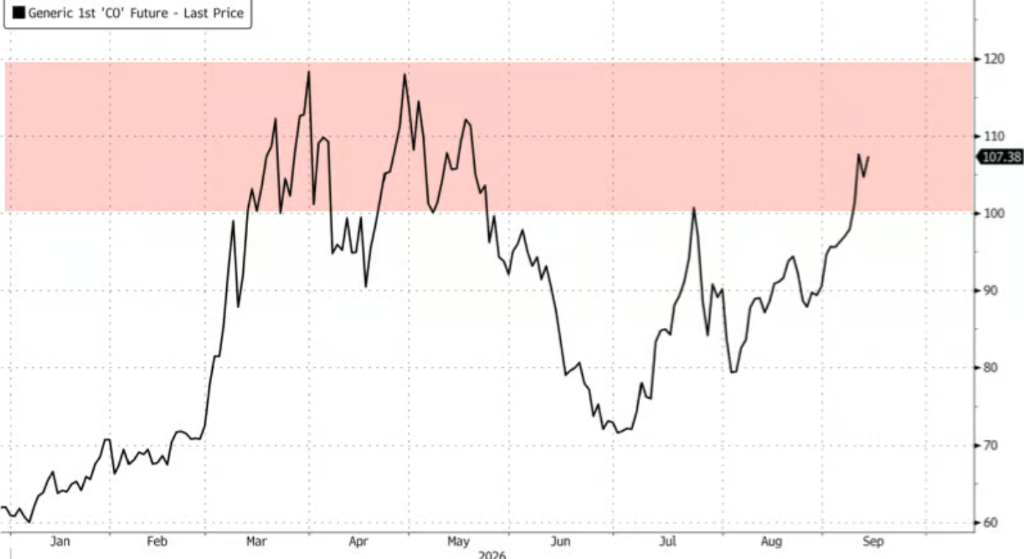
 In their latest report, Bernstein analysts Neil Beveridge and Brian Ho characterized the current market as "long-term supply‑shortage driven," noting that their previous 2026 Brent price forecast of $90 per barrel has already been "outrun by reality." Meanwhile, U.S. Energy Secretary Chris Wright dampened market expectations in Vienna, stating, "It is clearly unwise to pin hopes on reaching a mutually agreeable deal with Iran at this time," and cautioning traders against anticipating a diplomatic breakthrough on the Strait of Hormuz issue.
4% of global supply remains unresolved.
Saudi Arabia's east–west oil pipeline was damaged in a drone attack last Thursday, prompting Riyadh to shut it down immediately. With a daily capacity of up to 7 million barrels, the pipeline has been a critical route for maintaining Saudi oil exports by bypassing the Strait of Hormuz since the outbreak of the war with Iran.
According to Reuters, citing multiple Saudi oil traders, if the pipeline cannot be restored to operation promptly, Saudi Arabia will exhaust its inventory reserves earmarked for Red Sea exports. Three industry sources familiar with Saudi export operations said that current stockpiles at the port of Yanbu can cover only five to seven days of export demand; another source added that Saudi inventories at Egypt's Ain Sokhna and Sidi Kerir ports can likewise sustain shipments for just a few days. Industry estimates put Yanbu's storage capacity at roughly 35 million barrels, with Ain Sokhna and Sidi Kerir at around 18 million and 20 million barrels, respectively—but none of these facilities is currently operating at full capacity.
The Saudi government's media office and the Ministry of Energy have not commented on a timeline for repairing the pipeline. According to Reuters sources, estimates for the repair period range from several weeks to five or six weeks, with some sources suggesting that pumping could be partially resumed during the restoration process.
The International Energy Agency (IEA) released data last Friday showing that, amid disruptions to the Strait of Hormuz and the Red Sea shipping lanes, Saudi oil supplies fell in August to their lowest level in more than three decades. The IEA also forecasts that global oil supply will decline by approximately 5.7 million barrels per day this year, a drop of about 6%.
Diplomatic Stalemate: Hormuz Talks Postponed Indefinitely
This summit was originally the first formal meeting among Iran, the member states of the Gulf Cooperation Council, and Iraq since the United States and Israel launched military operations against Iran in February this year, with the agenda centered on establishing a temporary shipping lane in the Strait of Hormuz.
Iran's Foreign Ministry stated that Saudi Arabia had requested a postponement, citing the situation in Yemen. In response, Iran's Foreign Ministry countered that "Saudi Arabia's call to delay the regional summit and its attribution of the delay to the Yemeni crisis amounts to a diversion from the root causes of this crisis." A source familiar with the matter revealed that part of Saudi Arabia's dissatisfaction stems from the continued attacks on its territory by the Iran-backed Houthi rebels.
Bahrain has explicitly declined to participate in the meeting, citing recent attacks in the Gulf region carried out by Iran-backed militias. The proposal originally under discussion at the summit was jointly put forward by Oman and Iran, broadly granting Iran the authority to determine which vessels may enter the Persian Gulf and potentially imposing fees on passing ships.
Meanwhile, tensions in the Strait of Hormuz continue to escalate. The UK Maritime Trade Operations (UKMTO) reported on Sunday that a vessel caught fire after being struck by projectiles, while Iran's official IRIB news agency stated that a commercial ship was hit by an "enemy strike" near Qeshm and Hengam islands, resulting in one fatality.
Dual-channel bottlenecks persist: the supply gap continues to widen.
According to Bloomberg data, the combined transit volume through the Strait of Hormuz, the Bab al-Mandeb, and the Suez Canal has now fallen below 7 million barrels per day, compared with roughly 20 million barrels per day before the conflict erupted.
UBS energy analyst Dominic Ellis noted that the shutdown of the East–West pipeline, combined with the Houthi rebels' ongoing disruption of Red Sea shipping, will continue to support oil prices in the foreseeable future. He added that UBS's team had earlier this month projected a 40% upside for third-quarter earnings in the energy sector relative to the market consensus, with even greater potential—ranging from 80% to 90%—for refining‑related stocks such as Repsol, Galp, and OMV.
According to China Central Television, on September 14 local time, Yemen's Houthi rebels claimed to have struck an air base in Khamis Mushait, Saudi Arabia. Last Friday, the Houthis seized an island at the entrance to the Red Sea, further heightening uncertainty in Red Sea shipping.
Another key factor that had previously kept oil prices under pressure—the sharp decline in China's imports—is also reversing. Analysts note that Chinese imports had fallen by roughly 5 million barrels per day, partly due to the drawdown of an estimated 1.5 billion barrels from its strategic petroleum reserve; now, imports have begun to rebound, pushing up oil prices worldwide.
Upward price risks are significant.
Bernstein's warning lays bare the gravity of the current situation: with the Strait of Hormuz blocked, Red Sea shipping disrupted, and Saudi Arabia's East–West pipeline shut down, these three concurrent shocks are placing unprecedented strain on the global oil supply system.
Although Chris Wright sought to steady market expectations, noting that combined flows through the Strait of Hormuz and bypass pipelines have rebounded to more than two-thirds of pre‑conflict levels, he added, "The global oil market is tighter than we'd like, but it's not overly tight." Nevertheless, with Saudi inventory buffers shrinking to just a few days' supply and diplomatic negotiations stalled, the market's pricing for potential supply disruptions is likely to persist.
With only about 50 days left until the U.S. midterm elections, the surge in oil prices is also a political pressure that cannot be ignored for Trump's Republican Party.
Editor/KOKO