
AI giants' synchronized calls for "slowing down" have triggered a sell-off in chip stocks, but Bernstein has bucked the trend, arguing that slowing growth does not equate to cutting investment in computing power.
Zhitong Finance APP learned that a rare "AI safety consensus" over the weekend sent global chip stocks reeling on Monday (September 14). Dario Amodei, CEO of Anthropic, published a lengthy essay titled "We Must Slow the Pace of Advancing Frontier AI," calling on the industry to proactively decelerate the rate at which model capabilities improve. He received public backing from OpenAI CEO Sam Altman and Elon Musk; Altman also announced that OpenAI will not go public in 2026. In response, Stacy Rasgon, head of the semiconductor team at Bernstein Research and a veteran analyst, released a report titled—"Can We Put the AI Genie Back in the Bottle?" Her answer is no—and moreover, it's unnecessary: "slowing the narrative" does not equate to "slowing spending," and the fundamental demand for AI semiconductors remains intact.
Event: The Big Three Reach a Rare Consensus; Amodei Proposes a Three-Step Plan
 According to a Bernstein report, sentiment in the semiconductor sector had been steadily improving over the past few weeks—though it remained roughly 19% below its June peak, it had already rebounded about 13% from its July low, with year-to-date gains reaching 67%. Optimism surrounding AI‑related spending had briefly overshadowed concerns about sustainability. However, this "braking" signal from within the industry is now bringing the latter set of worries back into the spotlight.
In a lengthy essay, Amodei outlined a three‑step "rhythm framework": first, embedding independent third‑party assessment bodies endowed with the authority to verify and report on the implementation of industry‑wide commitments to safety practices (Anthropic has already unilaterally pledged to grant such third parties "permanent, employee‑level" access to its systems); second, "democratic coordination," meaning U.S. regulatory oversight applicable to all American AI companies, regardless of whether they opt in voluntarily; and third, a "global synchronized slowdown," entailing some form of cooperation and coordination with China. The report notes that this stance is set against a backdrop of public resignations among safety and alignment staff at several leading foundation‑model labs, as well as the labs' own acknowledgment that AI poses a "nonzero probability" of posing risks to humanity—Olmsted's formulation being that the risk of human extinction is "unacceptable."
Bernstein's Six Interpretations: From Expectation Management to "SkyNet"
The Lasgoon team has outlined six possible interpretations of this call—ranging from the most favorable to the most dire: diverting public attention from mounting hostility toward AI and data-center construction; countering and curbing China's "distillation" practices; acknowledging that it is no longer feasible to secure the full computational power needed to sustain previous rates of progress; seeking to slow down competing ecosystems, such as the open-source community; recognizing that the returns on training new models are declining and using this as an excuse to scale back (i.e., "stepping down a gear"); and, in the worst-case scenario, laboratories have indeed detected something truly alarming—such as recursive self-improvement (RSI) spiraling beyond human control, commonly referred to as the "Skynet" scenario.
The report specifically notes that the "China factor" may carry considerable weight. Amodei rightly argues that U.S. restrictions should not come at the cost of allowing China to overtake the United States, and recommends maintaining bans on the sale of advanced AI chips and semiconductor equipment to China, cracking down on unauthorized model distillation, and preventing the theft of model weights—reporting that recent news has revealed Chinese labs secretly using unauthorized distillation of Claude to train their models. Amodei reiterated these points on a weekend television program. "Although this proposal wields RSI and security concerns like a hammer, we suspect that China is the primary driving force behind it," the report states.
Key takeaway: Slowing down doesn't mean cutting back on spending.
The market's primary concern is whether the "slowdown" will dent AI capital spending. Bernstein's response is, "We don't think so." The report lays out a three‑part rationale: First, Amodio's stated pace has merely moderated from "extremely rapid" to "still quite fast"—a level that, at current scaling rates, "we believe remains more than sufficient," and he did not indicate that training would be halted. Second, demand for AI semiconductors is increasingly driven by inference, particularly as agentic use cases gain traction; yet existing compute capacity falls far short of meeting the inference needs of today's models, let alone those of future generations. Third, this is not the first time calls have been made for AI standards and regulation—Google DeepMind head Demis Hassabis put forward a similar proposal back in July. Accordingly, Bernstein concludes that companies' near‑term AI revenue targets "should already factor in their spending plans," and the likelihood of any material revisions to these plans is low.
The report also offers a longer-term defense: "Safer AI is more readily adopted." Third-party assessments and other safety mechanisms help alleviate political and societal anxieties about AI—while also reducing the likelihood of apocalyptic scenarios, however small—and thereby foster the industry's long-term penetration. "We suspect it may already be too late to put the AI genie back in the bottle; so we might as well find safer ways to let it out."
Market Reaction: Asian chip stocks plunged, while U.S. chip stocks tumbled in pre-market trading.
Asian markets have already registered their initial reaction.$SoftBank Group (9984.JP)$It closed down 10.7%, making it one of the biggest decliners among large Asian tech stocks that day.$Kioxia Holdings (285A.JP)$The market closed down 6.4%, Tokyo Electron fell about 1%, and the Nikkei 225 index ended the session down roughly 0.8%.$SK hynix (SKHY.US)$Closed down 6.4%,$Samsung Electronics (005930.KR)$It closed down 4.1%, while the KOSPI index fell by about 3.3%—by rough market-capitalization estimates, only SoftBank, Kioxia, Tokyo Electron, and…$SK Hynix (000660.KR)$, Samsung,$Taiwan Semiconductor (TSM.US)$On that day, the combined market capitalization of six companies evaporated by as much as one trillion yuan.
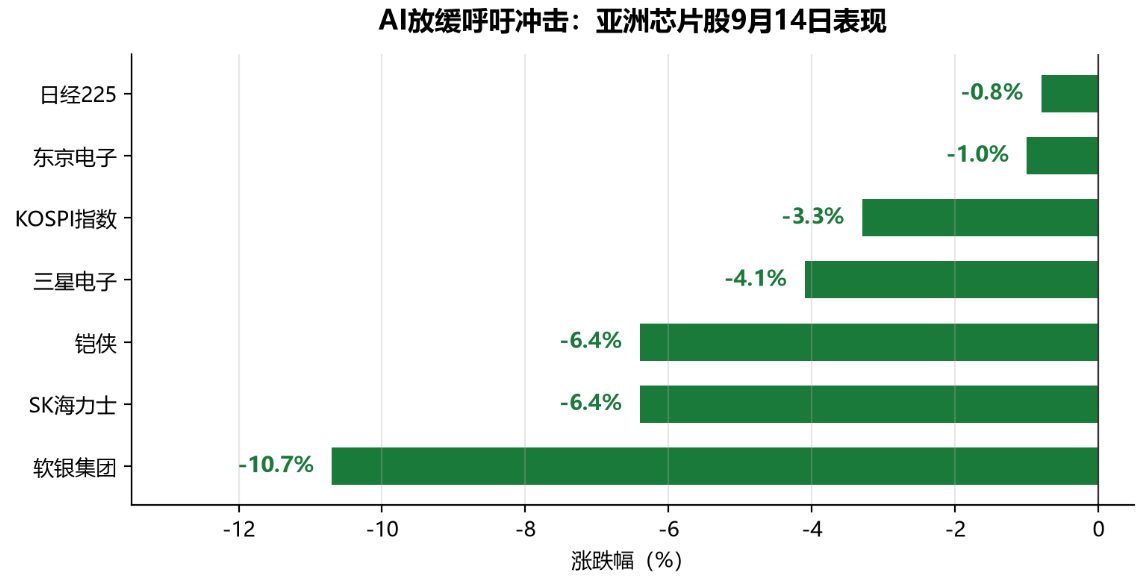
As of Monday evening Beijing time, U.S. stocks had not yet opened; pre-market data indicated that…$NVIDIA (NVDA.US)$At one point, it fell by more than 2.47%, with chip stocks such as AMD, Intel, and Micron all dropping by around 5% at times, while Nasdaq futures fell by over 1%; software stocks ($Adobe (ADBE.US)$、$ServiceNow (NOW.US)$Meanwhile, it has strengthened relatively.
Undercurrents in the Capital Markets: IPO Variables, Earnings Narratives, and Antitrust Concerns
This "consensus on slowing down" comes as Anthropic is racing toward an IPO valued at roughly $2 trillion, sharply increasing the uncertainty surrounding its public‑market debut. According to sources cited by the media, Anthropic has confirmed with some investors that its adjusted operating profit for the third quarter will be positive for the second consecutive quarter, with gross margins exceeding 80% before accounting for distribution royalties and training costs. As of the end of July, its annualized revenue had already reached $65 billion—up from just $9 billion at year‑end last year. However, reports suggest the market is speculating that Anthropic will need to revise its S‑1 filing, which it quietly submitted to the SEC; underwriters may even lower the valuation or delay the listing. Meanwhile, industry outlets have been even more critical, calling Amodei's initiative "far from sufficient" and arguing that if the company truly recognizes the risks, it should simply halt cutting‑edge research such as RSI altogether.
It's not just one firm that has questioned the "motivation behind the slowdown." D.A. Davidson analyst Luria argues that Anthropic and OpenAI's approach increasingly resembles "pulling the ladder up," suggesting monopolistic behavior; meanwhile, OpenAI has sought congressional advice on whether industry‑wide coordination to slow down might violate antitrust laws. Gartner analyst Chandrasekaran points out that if smaller competitors cannot afford the investments required for cutting‑edge safety and evaluation, these standards effectively favor Anthropic and OpenAI. Among institutional investors, bullish and bearish views diverge over where capital will flow once the pace slows: Chanana of Saxo Markets cautions that valuations in both AI and chip stocks rest on robust demand and rapid technological progress, and "even a mere possibility of delay could trigger profit‑taking"; Billy Leung of GlobalX and Gary Tan of Allspring both contend that leading firms' calls for a slower pace do not necessarily translate into a synchronized deceleration across the entire sector—longer development cycles may instead prompt the industry to shift from "spending on building" to monetizing existing assets; meanwhile, Mallet of T. Rowe Price puts it bluntly: investors' focus has shifted from "how much compute is needed for AI" to "how much money can that compute ultimately generate."
Bernstein's Target Preferences
The report reaffirms its optimistic outlook on the prospects of AI development.$NVIDIA (NVDA.US)$ 、$Broadcom (AVGO.US)$And semiconductor equipment stocks remain the team's top picks within the sector. According to the report, Bernstein has set a $400 price target for NVIDIA ("outperform" rating, implying about 83% upside), and for$Applied Materials (AMAT.US)$Target price of $700 (implying approximately 53%),$Broadcom (AVGO.US)$$575 (implying approximately 59%),$KLA Corp (KLAC.US)$$250 (implying approximately 38%),$Lam Research (LRCX.US)$$385 (implying approximately 29%);$Advanced Micro Devices (AMD.US)$(Target price: $650, implying roughly 26% upside) – Upgraded to "Outperform" on the back of "AI-driven demand fueling both CPU and GPU narratives."$Intel (INTC.US)$and$Qualcomm (QCOM.US)$、$Texas Instruments (TXN.US)$、$NXP Semiconductors (NXPI.US)$It is rated as "in line with the market," with Qualcomm being the only stock whose target price is below its current share price ($165, implying a roughly -9% discount).
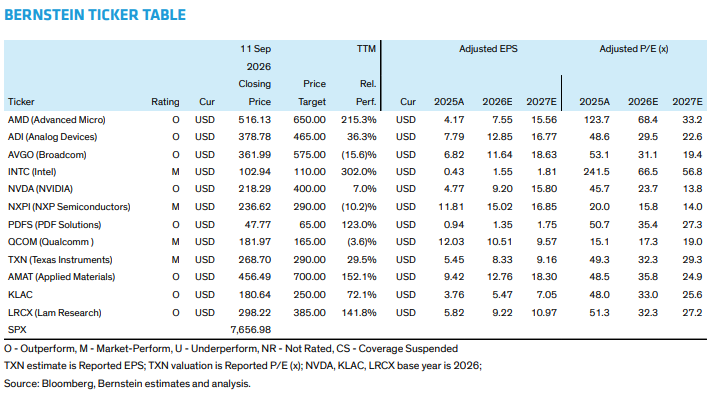
Overall, this sell-off—triggered by "insiders"—has shifted expectations rather than orders. If Bernstein's assessment holds—that the slowdown is in the pace of cutting-edge model training, not in spending on computing power—then Monday's decline was more akin to a concentrated release of market sentiment. The hard indicators worth monitoring going forward are whether AI companies' capital‑expenditure guidance shows any meaningful downward revisions, and the final pricing of Anthropic's IPO.
Editor/Deng