
Bank of America estimates that if the Federal Reserve accumulates a 75-basis-point rate hike by year-end, the annual interest expense on short-term Treasury securities alone would increase by roughly $50 billion, equivalent to about 15 basis points of GDP. Coupled with U.S. government debt exceeding $40 trillion, risks to fiscal sustainability continue to mount.
The U.S. fiscal situation is facing a severe test from the twin pressures of rising interest rates and mounting debt. With the Federal Reserve expected to raise rates again this year, coupled with the U.S. national debt surpassing $40 trillion for the first time, spiraling interest payments are emerging as Washington's most inescapable fiscal risk.
In his latest report, Aditya Bhave, Chief Economist at the Bank of America, estimates that if the Federal Reserve raises interest rates by a cumulative 75 basis points this year, as the market expects, the annual interest expense on short-term Treasury bills alone will increase by approximately $50 billion, equivalent to about 15 basis points of GDP. Meanwhile, U.S. interest expenditures over the past 12 months have already reached a record high of $1.4 trillion and are expected to surpass Social Security spending within the next two years, becoming the federal government's largest single expenditure category.
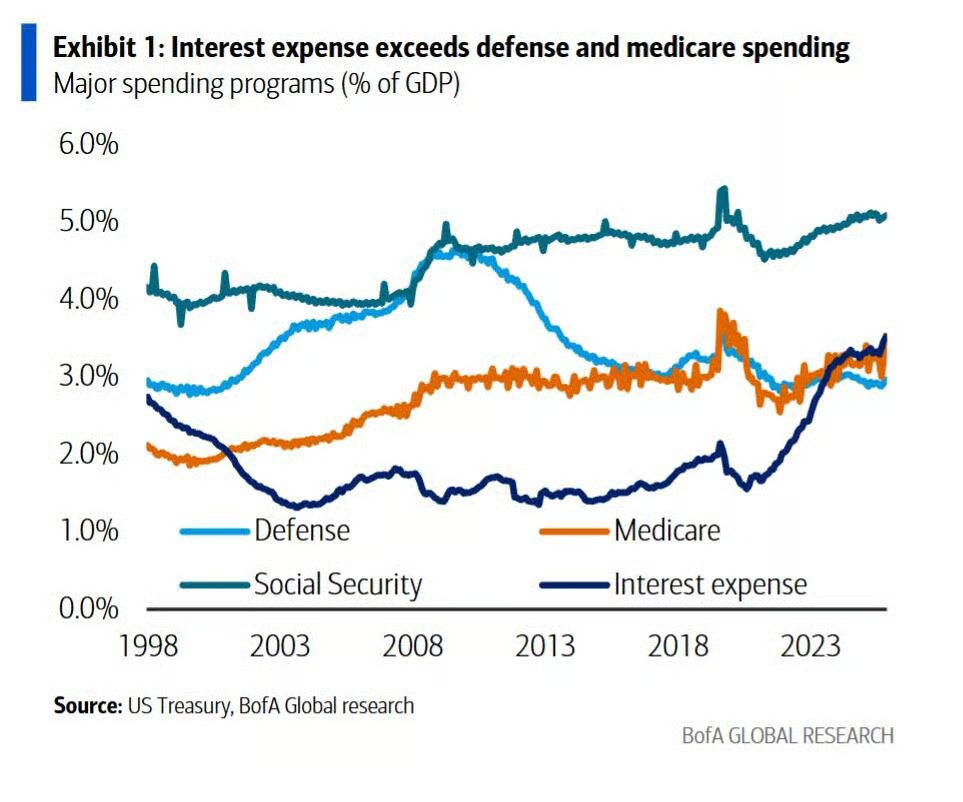
 This trend has significantly heightened market concerns about the fiscal sustainability of the United States. Bank of America warns that there is a self-reinforcing feedback loop between interest expenses and the budget deficit—higher interest costs drive up the deficit and the scale of Treasury bond issuance, which in turn raises term premiums and borrowing costs, further exacerbating the interest burden and creating a vicious cycle that is difficult to break.
The share of short-term debt has risen, sharply increasing sensitivity to interest-rate hikes.
The U.S. Treasury's reliance on short-term Treasury bills has risen to its highest level since 2010—excluding the emergency financing phase during the COVID-19 pandemic. Currently, T-Bills account for 23% of the total outstanding U.S. debt, with the outstanding balance of T-Bills approaching $7 trillion, the vast majority of which will mature within one year.
The direct consequence of this debt structure is that the federal government's borrowing costs are highly sensitive to changes in short-term monetary policy. Bank of America points out that once the Federal Reserve raises interest rates, the interest expense on this portion of short-term debt will be reflected in the fiscal budget almost immediately, without having to wait for the refinancing cycle of long-term bonds to mature.
Bank of America expects the Federal Reserve to raise interest rates once this week, followed by two more hikes within the year, totaling 75 basis points. Based on this projection, the annual interest cost for T-Bills will increase by approximately $50 billion.
Refinancing pressures continue to mount, and long-term interest rates remain at elevated levels.
In addition to the immediate impact of short-term debt, the refinancing pressure on long-term debt should not be overlooked either. According to data from the Bank of America, the average interest rate on outstanding marketable Treasury bonds is currently around 3.4%, significantly lower than current market yield levels.
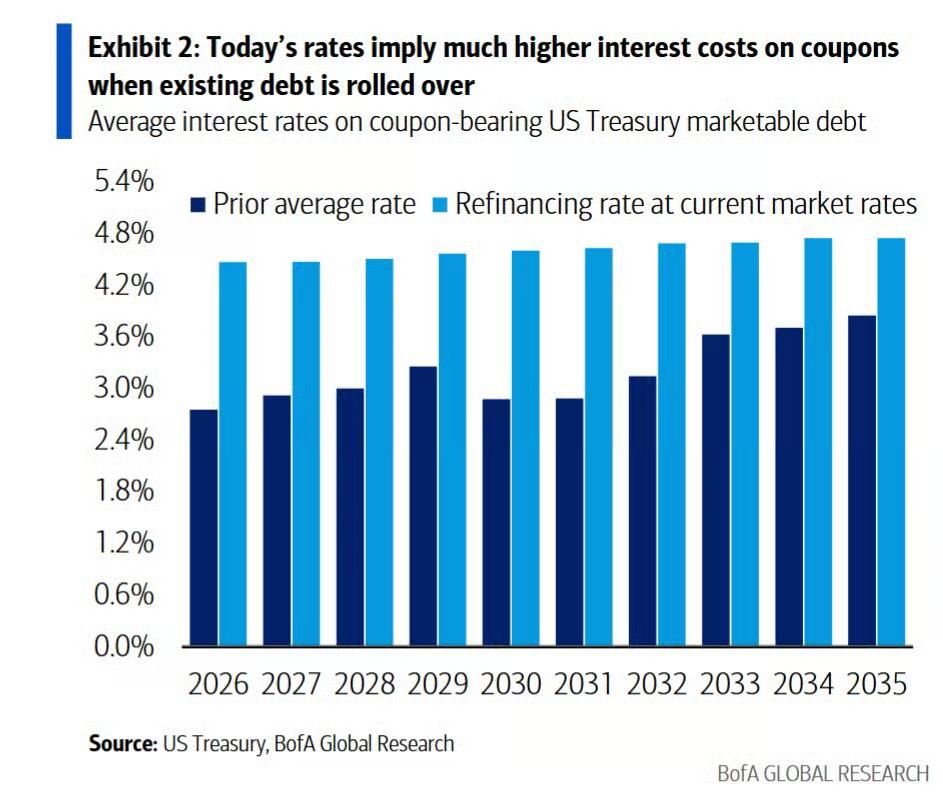
Specifically, for interest‑bearing securities, the refinancing rates on debt that will mature and be rolled over over the next few years are expected to average approximately 1.4 percentage points higher than those of maturing bonds. This implies that, even if the Federal Reserve refrains from further rate hikes, U.S. interest expenditures will continue to rise as the maturity profile of outstanding debt evolves, driven solely by current interest‑rate levels.
This year, the U.S. budget deficit is expected to exceed 6% of GDP once again, and interest payments have already surpassed both defense spending and Medicare expenditures, becoming one of the primary drivers of the deficit's expansion. Bank of America notes that, compared with relatively stable spending categories such as Medicare, defense, and Social Security, the deteriorating trend in interest costs stands out particularly.
The feedback loop between debt and interest rates, with fiscal risks accumulating over the long term.
In its report, Bank of America underscored a more fundamental risk: the feedback loop between interest rates and debt. At the heart of debt sustainability lies the gap between borrowing costs and nominal GDP growth—when nominal growth outpaces borrowing costs, the debt-to-GDP ratio can stabilize over time; however, once this gap narrows, high levels of debt become increasingly unsustainable.
Bank of America simulated debt-to-GDP trends under three scenarios: under low, medium, and high assumptions, each 1-percentage-point increase in the debt-to-GDP ratio would push interest rates up by 1, 2, and 3 basis points, respectively. Although the initial impact is limited, over time, the debt trajectories across the three scenarios will diverge significantly—higher debt levels lead to higher borrowing costs, which in turn accelerate debt accumulation.
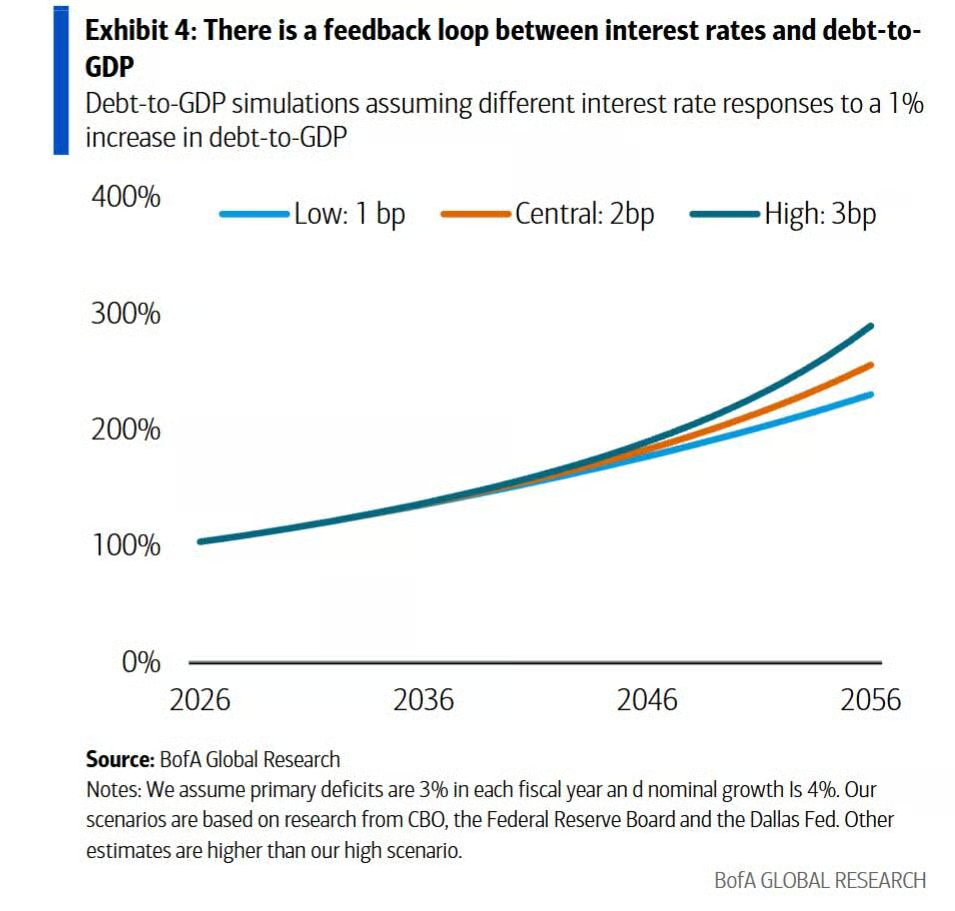
Bank of America also pointed out that deficits driven by interest expenditures differ fundamentally from those driven by tax cuts or government spending in their economic effects: the former provide far weaker support to economic activity than the latter, while potentially crowding out both public and private investment by continuously pushing up long-term interest rates, and undermining the government's ability to provide fiscal support during economic downturns.
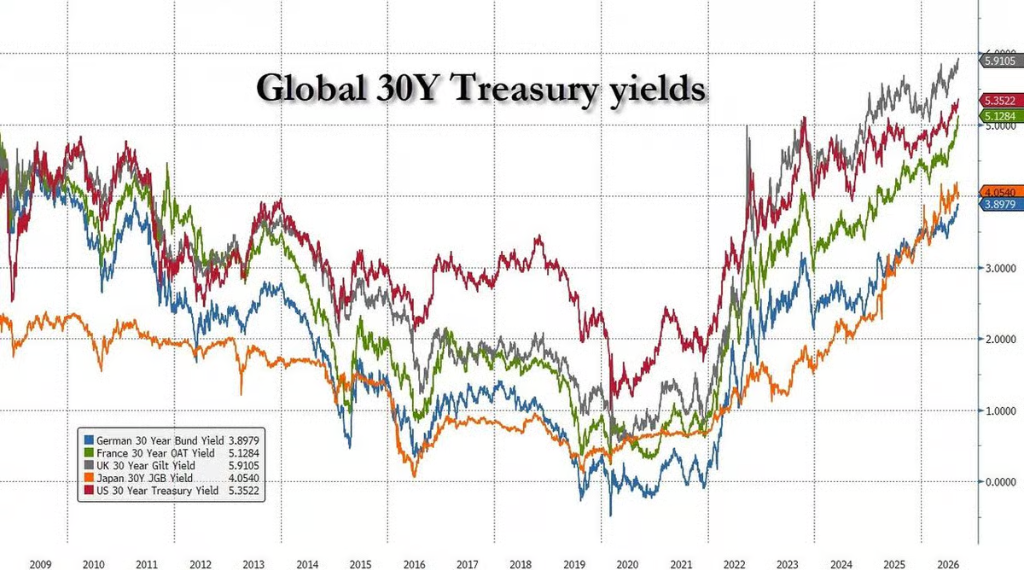
Bond supply pressures may spill over to the long end.
From a market perspective, the shift in the deficit composition implies an increase in Treasury supply, but it is not accompanied by a corresponding boost to economic growth. Bank of America believes this will exert additional upward pressure on Treasury supply, term premiums, and the long end of the yield curve.
Academy Securities trader Peter Tchir said that, with interest payments already posing a problem relative to defense or discretionary spending, raising interest rates would do nothing to improve the fiscal situation. He added, "It's hard to imagine President Trump would be pleased by this, even if higher rates help push down long-term yields, as the stock market has yet to fully price in that effect."
The Bank of America's conclusion is straightforward: an additional $50 billion in interest costs would leave no winners for the United States—except for creditors holding short-term U.S. debt.
Editor/Deng