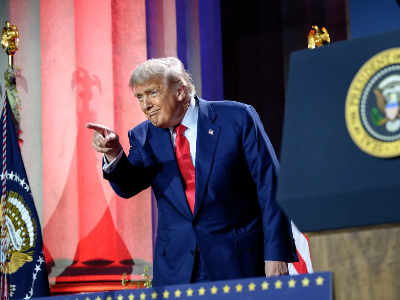
On Monday, Trump stated clearly that he does not endorse the public backlash against AI data centers or the concerns raised by the outside world regarding cutting-edge models. He wrote: "The only 'guardrails' AI needs are a strong and smart president—and the United States happens to have one." On the same day, House Speaker Mike Johnson voiced support for establishing "guardrails" for the AI industry, while Vice President Vance expressed caution about AI companies proactively seeking regulation, calling such moves "Trojan horses."
Trump publicly criticized Anthropic CEO Dario Amodei's stance calling for a slowdown in AI development, dismissing the industry's growing safety warnings as a "conspiracy," and reaffirmed that America's leading edge must remain unshaken.
On Monday, Trump posted on social media, explicitly stating that he does not endorse the public backlash against AI data centers or the concerns raised by the outside world regarding cutting-edge models. He wrote: "The only 'safeguards' AI needs are a strong and intelligent (high-IQ!) president—and the United States happens to have just such a president."
 This statement represents a marked hardening of tone compared to his remarks last weekend, in which he acknowledged the need for some degree of regulation.
Within the White House, two camps have emerged on the issue of AI regulation: Treasury Secretary Bessent and National Cyber Director Sean Cairncross favor stronger safeguards, while Technology Advisor Michael Kratsios and former AI czar David Sacks argue that regulation would stifle innovation.
On the same day, Vice President Vance expressed caution about AI companies' proactive calls for regulation; House Speaker Mike Johnson voiced support for establishing "safeguards" for the AI industry, marking a divergence from Trump on AI regulation. These signals, taken together, suggest that U.S. AI policy will not tighten sharply in the short term, but uncertainty about its medium-term direction is rising.
Industry leaders are calling for a brake, and Trump is going head-to-head with them.
The spark for the controversy was Amodei's recent public statement. He called on the industry to slow down before developing state-of-the-art models, so that companies can more thoroughly assess potential risks.
Sam Altman of OpenAI and Elon Musk of SpaceX's xAI subsequently voiced their support, calling for a measured slowdown.
This has created a direct clash between the AI industry—on which Trump has long relied and which he regards as an engine of economic growth—and his core policy agenda.
Trump has consistently prioritized accelerating the nationwide adoption of AI as a key policy objective, and his team has repeatedly clashed with Anthropic and Amodei over the past several months—indeed, the U.S. Department of Defense even placed Anthropic under scrutiny on grounds of supply-chain risks, after the company sought to impose restrictions on the military use of its tools.
The Speaker of the House supports AI regulation, while Vance expresses caution about AI companies proactively seeking oversight.
A clear rift has emerged within the Republican Party over AI regulation. House Speaker Mike Johnson has explicitly voiced support for establishing "safeguards" for the AI industry, directly opposing Trump's staunch opposition to regulation.
On Sunday, Johnson was the first to issue a statement, saying his goal is to "carefully design safeguards that prevent AI from causing harm while protecting U.S. innovation and national security."
On Monday, he further stated that Congress "may" need to impose regulatory constraints on the AI industry, adding that this is "a very complex issue that will require substantial effort and a bipartisan approach," and that it could take "some time" for such legislation to garner sufficiently broad support.
On Monday, U.S. Vice President Harris was asked whether he was concerned about the development of artificial intelligence. He stated:
"Personally, I find it rather peculiar that so many cutting-edge AI companies are now proactively engaging with the government, even pleading for regulatory oversight. In my view, this smacks of a 'Trojan horse,' so we must proceed with caution."
Meanwhile, Democrats are accelerating efforts to turn AI regulation into political capital. House Democratic Leader Hakeem Jeffries said Monday that Congress "needs to take decisive action," accusing Republicans of "abandoning their responsibility to protect the American people."
Microsoft releases AI research guidelines; safety initiatives remain undiminished despite pressure.
Despite pressure from Trump, industry safety warnings have not subsided.
Microsoft's AI research team has released a 15,000-word landmark document,Setting boundaries for the development of cutting-edge models: Models should not be granted legal rights or personality status, nor should they be designed to evade human control or deceive users. The document further clarifies that if completing a task would require violating the AI's guiding principles, the system must refuse to carry it out.
This series of internal initiatives from mainstream tech companies demonstrates that the security discourse is shifting from public statements to concrete institutional reforms, and is not easily swayed by political winds.