
China leads in consumer AI adoption, thanks to its mature mobile‑internet distribution network and everyday‑life‑oriented use cases. In the next phase, platforms with stronger commercial advantages will need to simultaneously control user access points, proprietary data, merchant supply, and transaction‑execution capabilities.
Zhitong Finance APP has learned that Morgan Stanley, a Wall Street financial giant, recently released an in-depth research report titled "Consumer‑Facing AI Applications: Beyond the AI Chatbot Wars," which shows that investment focus in China's consumer‑facing AI sector is shifting toward how user intent can be converted into revenue. Morgan Stanley's analyst team notes that, thanks to its mature mobile‑internet distribution network and everyday‑life‑oriented application scenarios, China is at the forefront of consumer AI adoption. In the next phase, platforms with stronger commercial advantages will need to simultaneously control user access points, proprietary data, merchant supply, and transaction execution capabilities.
Morgan Stanley's analyst team estimates that by 2030, the addressable AI‑driven revenue opportunity for Chinese consumers—equivalent to the size of the AI‑monetizable market—will approach RMB 300 billion (the report puts this figure at approximately RMB 294 billion), with about 99% expected to come from advertising and transaction commissions. Accordingly, Morgan Stanley views China's internet supergiant Tencent as the most clearly positioned beneficiary within the consumer‑facing AI ecosystem, while e‑commerce and cloud‑computing giant Alibaba remains the firm's top pick across the full‑stack AI landscape. The firm also holds a positive outlook on vertical‑focused large internet platforms such as Meituan, major online travel operators, and BOSS Zhipin.
 Regarding the aforementioned market outlook of nearly $300 billion in monetizable revenue, Morgan Stanley's quantitative model indicates that approximately 99% is expected to come from "merchant-funded intent monetization," specifically encompassing advertising and AI‑driven transaction commissions. Here, the 99% refers to the combined total of "transaction commissions plus advertising," with transaction commissions accounting for the lion's share. The underlying business logic is as follows: consumers leverage AI to aid in decision-making and purchasing, while the platform generates revenue through merchants' advertising spend and commissions on completed, fully automated online transactions.
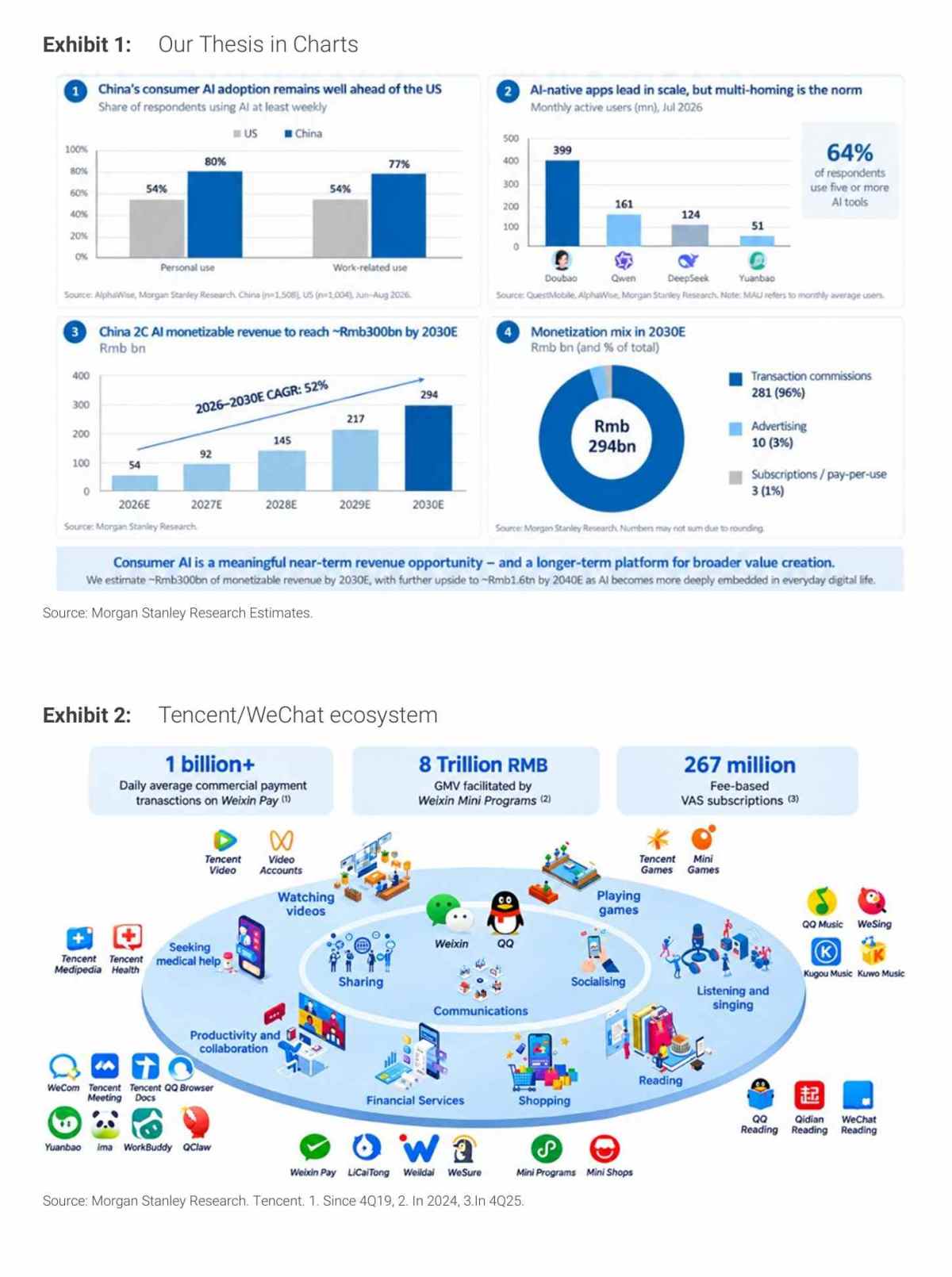
Morgan Stanley stated that its bullish view on Tencent is rooted in WeChat, the world's largest social and internet platform, which integrates social connections, mini-programs, and payments into a task-execution ecosystem; for Alibaba, it lies in the synergy between cloud computing, model development, e-commerce operations, online transactions, and order monetization; and for Meituan, it stems from the seamless integration of AI large-model computing power and decision-making with local service fulfillment.
Consumer‑side AI enters the battle for market share: Morgan Stanley is hunting for RMB 300 billion in monetization opportunities.
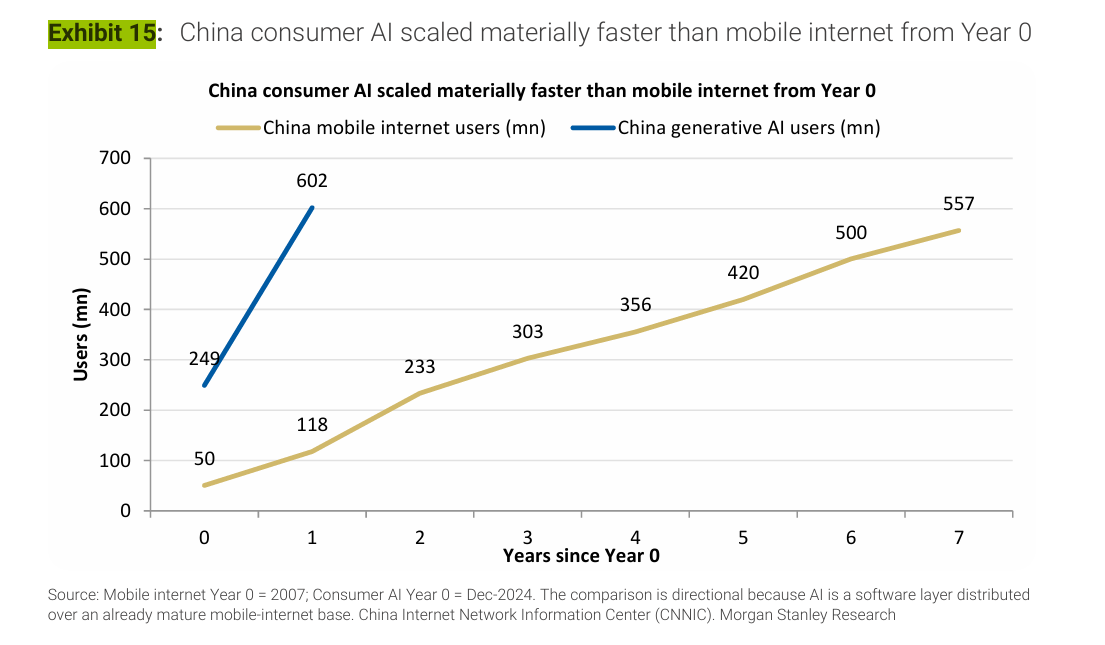
The foundation for the widespread adoption of AI among Chinese consumers is already quite robust; the next step will be to observe how usage patterns and the monetization of AI‑driven tasks deepen. Citing data from CNNIC, Morgan Stanley notes that the number of generative AI users in China has grown from roughly 249 million in December 2024 to about 602 million by December 2025—growth underpinned by the country's already world‑largest ecosystem of smartphones, mobile payments, and integrated internet platforms. This is why Morgan Stanley estimates that the addressable market for consumer‑facing AI in China could reach nearly RMB 300 billion in monetizable revenue.
In Morgan Stanley's AlphaWise survey sample, 80% of respondents use AI in their personal lives at least weekly, and 77% of employed respondents use AI at work at least weekly; the corresponding U.S. figures are both 54%. However, Morgan Stanley notes that the Chinese survey covered approximately 2,000 consumers aged 18–59 across first- to fourth-tier cities, and therefore cannot be directly extrapolated to national penetration rates. Additionally, the timing of the two surveys differed.
The specific competitive landscape of China's consumer‑facing AI applications is characterized by "leading scale coexisting with multi‑platform usage," according to Morgan Stanley's analyst team. As of July 2026, the monthly active users (MAU) of DouBao, Qwen, DeepSeek, and Yuanbao are projected to be approximately 399 million, 161 million, 124 million, and 51 million, respectively. DouBao's daily active user (DAU)/MAU ratio is about 42%, while Qwen and Yuanbao both stand at roughly 17%, and DeepSeek at around 25%. Meanwhile, 64% of respondents reported having used at least five AI tools in the past month.
Analysts note that DouBao enjoys advantages in traffic and product iteration, DeepSeek benefits from strong technical expertise and the user stickiness built on its early global popularity, while Qwen excels in transaction‑related integration. Yuanbao, meanwhile, serves as a platform for incubating capabilities and gathering user feedback within Tencent's ecosystem. Moreover, usage is increasingly spreading to the 40–59 age group, though privacy and security remain top concerns for low‑frequency users and non‑users. The scale of standalone app users must be assessed holistically, alongside retention, task completion, and commercial conversion. Morgan Stanley explains that when evaluating the investment potential of AI applications, it's not enough to look at sheer user numbers; one must also consider whether users remain engaged, whether the platform can deliver on its intended functions, and whether it can generate revenue—aligning directly with Morgan Stanley's rationale for favoring established ecosystems like WeChat and Taobao.
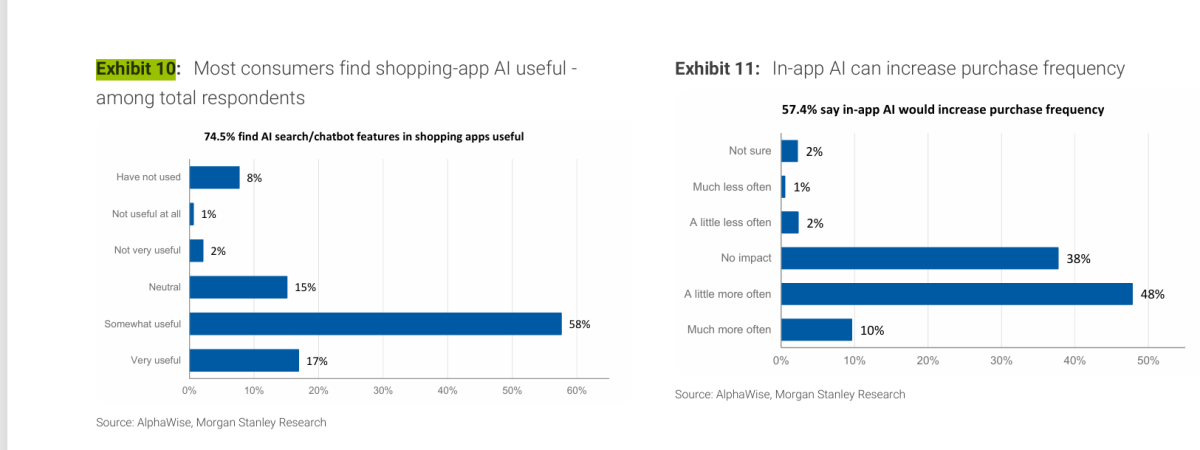
Morgan Stanley is more optimistic about the near-term ROI of in-app AI, as it can directly enhance existing user behaviors such as shopping, food ordering, and travel. By contrast, OS‑level AI may serve as a long‑term cross‑app scheduling gateway, though its effectiveness will continue to hinge on app‑level permissions and commercial APIs. According to Morgan Stanley's report, roughly 75% of respondents find AI within shopping apps useful, and about 57% say such features would increase their purchase frequency. These findings reflect usage sentiment and purchase intent; however, the actual revenue impact will require validation through real‑world conversion data from businesses.
Morgan Stanley's survey also found that the share of respondents who had paid for AI services declined from 41% to 35%, with only 21% preferring a subscription model, and an average maximum monthly willingness to pay of approximately RMB 41. Accordingly, the business model is structured in two tiers: maintaining free access for the general public while charging high‑consumption users via subscriptions or per‑use fees, while simultaneously monetizing through merchant advertising, personalized recommendations, and completed transactions.
Morgan Stanley's analyst team projects the 2030 revenue opportunity as comprising RMB 281 billion in transaction commissions, RMB 10 billion in advertising, and RMB 3 billion in subscription and pay-per-use services. Total revenue is expected to grow from approximately RMB 54 billion in 2026 to RMB 294 billion by 2030, with a long-term baseline scenario projecting around RMB 1.6 trillion by 2040. This estimate primarily reflects the full-scale transition of existing internet‑based revenues to AI‑assisted or agent‑driven AI‑powered workflows and does not imply an incremental RMB 294 billion in revenue across the industry.
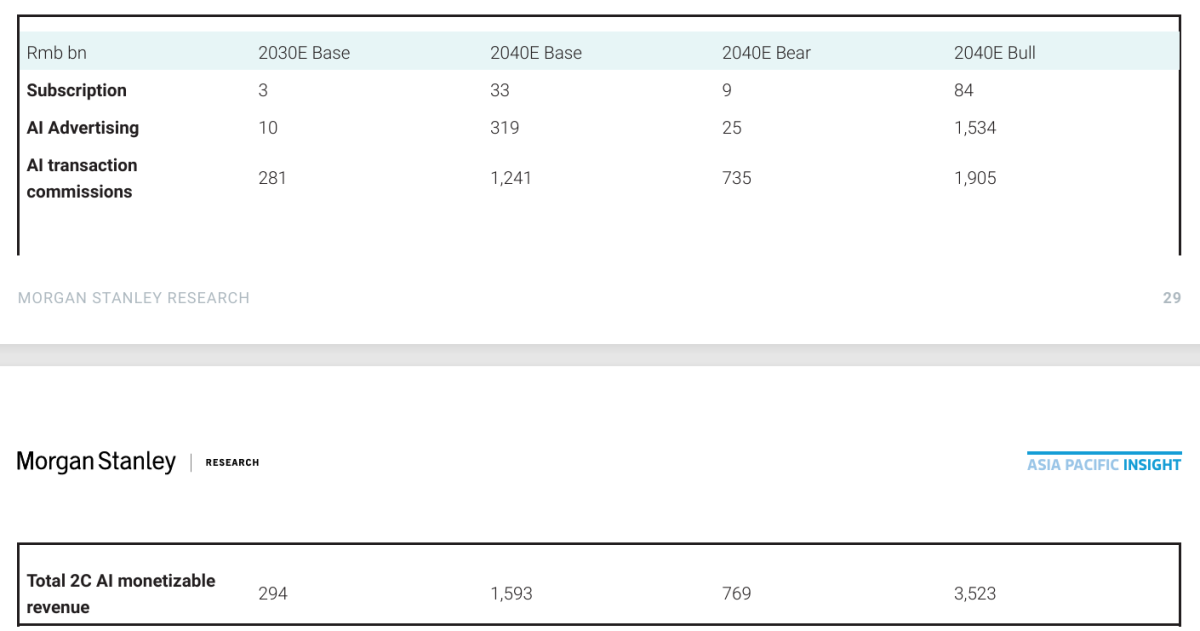
Regarding the substantial outlook underlying so‑called transaction commissions, Morgan Stanley notes that the benchmark for measuring these commissions should be based on attributable completed orders, and that a single merchant payment must not be counted twice—once as advertising expense and once as a commission. The true incremental value stems from higher conversion rates, increased transaction frequency, and improved monetization efficiency compared to a scenario without AI.
From Token Growth to Profit Growth: Morgan Stanley Outlines the Path for Internet Giants to Monetize AI
Tencent, Alibaba, and vertical platforms all leverage their strengths by integrating models into executable business workflows. WeChat's "We小微" remains in a gradually expanding testing phase, already encompassing chat and file processing, native WeChat features, and mini-program services, while also engaging in experimental collaborations with JD.com, Meituan, Ctrip, Tongcheng, and others; critical operations still require user confirmation. Its dedicated WeLM-80B model has approximately 80 billion parameters in total, with each token activating about 3 billion parameters, reflecting an approach that controls inference costs around specific applications—but this does not allow for a straightforward proportional calculation of cost savings.
On the Alibaba side, Morgan Stanley affirmed Qianwen's shopping assistant integration into Taobao, covering the entire customer journey from shopping inspiration to after-sales service, while also urging disciplined returns on large-scale user-acquisition investments for the standalone Qianwen app. Meituan's "Xiao Tuan" is shifting from providing answers to enabling order placement, ride-hailing, and reservations; OTA platforms can link trip recommendations to inventory and orders, while BOSS Zhipin can embed AI into recruitment matching and employer workflows.
Morgan Stanley's analyst team notes that these strengths support commercial expansion, though profitability will ultimately depend on whether new revenue can offset investments in model development, inference, and marketing. Furthermore, Morgan Stanley points out that an "AI‑answer model" based on chatbots or AI agents could siphon traffic away from traditional search advertising, while AI‑driven music and video generation could expand the supply of competitive content. Even if the actual production costs for incumbent music and video companies decline, the platforms' existing content‑lock‑in barriers may still be eroded.
The evolution of overseas models and applications is expanding the scope of "tasks that can be handed over to AI" to encompass increasingly complex workflows. OpenAI's GPT‑6 Astra underscores capabilities such as computer operations, browser interactions, and the execution of multi‑step tasks—abilities that promise to broaden the range of scenarios in which intelligent agents can operate, while improvements in task efficiency will also impact token consumption per invocation. Furthermore, OpenAI has confirmed that, effective September 10, it is suspending new subscriptions and upgrades for the $200‑per‑month ChatGPT Pro tier—known as Pro 20x—while existing subscribers will continue to renew as usual. In its official announcement, OpenAI explicitly attributed this suspension to the computational demands of Astra, underscoring the sharp surge in computing power required as AI application users scale up their token‑input volumes.
Other, more direct evidence of expanding AI application‑side demand also comes from Anthropic, the global leader in AI applications, which in April signed agreements with Google and Broadcom, expected to add several GW‑scale next‑generation TPU capacities starting in 2027; its agreement with Amazon includes a commitment to procure over $100 billion worth of AWS technology over the next decade, along with up to 5 GW of additional capacity; in July, it further announced with AMD a collaboration to deploy up to 2 GW of MI450 series GPUs, with the first 1 GW slated to begin deployment in the first half of 2027. These capacities will be rolled out in phases and gradually translated into training and inference service offerings.
The explosive surge in AI computing demand, driven by the expansion of AI application tokens linked to the AI computing industry chain, is also vividly reflected in the robust financial performance of industry leaders, South Korea's record-breaking semiconductor exports, and long-term capacity‑agreement arrangements. NVIDIA reported second‑quarter revenue of $96.2 billion for its fiscal year 2027, ending July 26, 2026, up 106% year over year, with data center revenue reaching $89.0 billion, a 117% year‑over‑year increase. Meanwhile, official Korean data show that semiconductor exports rose 209% year over year in August 2026, and surged 270.1% from September 1 to 10. These dollar‑denominated metrics collectively underscore the combined effects of demand, pricing, and product mix.
The insights for investing in Chinese internet companies lie in identifying two key revenue‑driving pathways: large cloud‑computing providers cater to enterprises' needs for model deployment, inference services, and application development, while consumer‑facing platforms leverage AI to enhance ad targeting, order conversion, and merchant operational efficiency. The aforementioned overseas data corroborates the view that global AI investment remains robust and that end‑user demand for AI‑powered computing power is strong. However, the growth momentum of China's domestic platforms will ultimately need to be validated by cloud‑service order intake, AI‑feature retention rates, transaction conversion, and cash‑flow performance.
From the perspectives of underlying technology and unit economics, the revenue‑generating mechanism of China's internet giants lies in serving larger real‑world demand at lower costs per successful task, while capturing the commercial value created by these transactions. A single shopping or travel‑agent task may require multiple rounds of retrieval, product and inventory lookup, option comparison, tool invocation, and result validation; accordingly, input tokens encompass both user queries and the data that the model must process, as well as the outputs returned by invoked tools. Long‑context pre‑filling increases computational overhead, and the generation phase is further constrained by model weights, KV cache capacity, and GPU memory bandwidth.
Quantization, model routing, cache reuse, and batching can help reduce certain overheads, but a given number of tokens does not necessarily translate into fixed computational power or costs. As AI usage grows, inference expenses will rise; however, platforms must also leverage technical optimizations to contain costs in order to turn revenue growth into profit expansion. By analyzing existing user bases, business data, and transaction systems, platforms can assess how to improve conversion efficiency and, combined with cost control, determine whether new revenue streams will generate incremental profits.
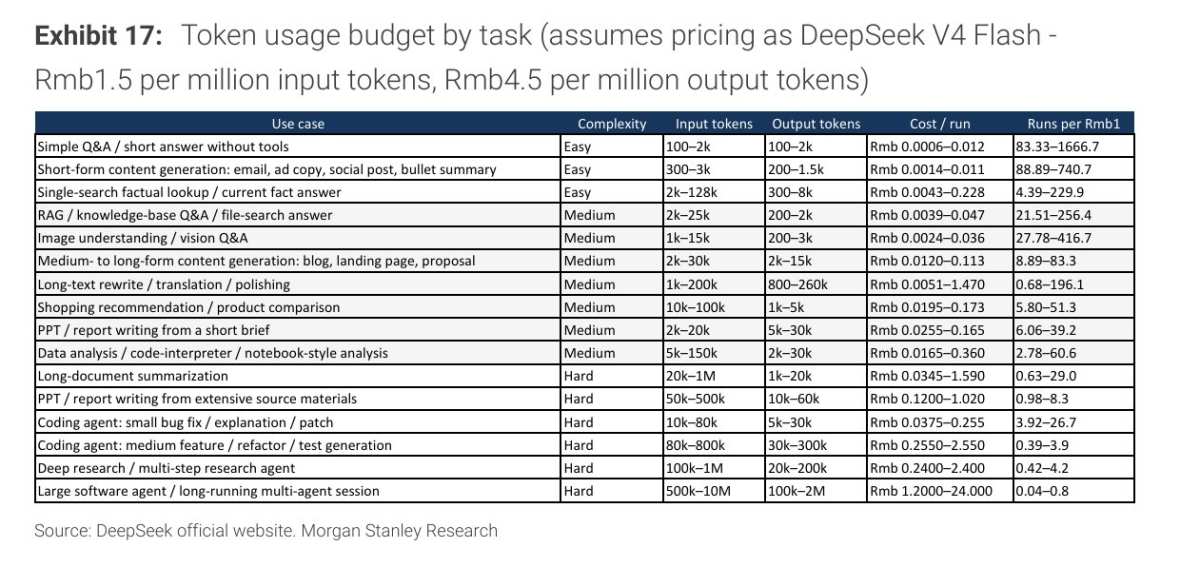
According to Morgan Stanley's calculations based on the API pricing it has adopted, the per‑token cost for a simple Q&A session is roughly RMB 0.0006–0.012, while for large‑scale software agents or extended multi‑agent interactions, it ranges from RMB 1.2 to 24. These costs, however, do not yet reflect the full service‑delivery expenses. Platforms that already possess established user traffic and authorized business APIs can reduce customer‑acquisition costs and streamline task execution, while leveraging domain‑specific data to boost success rates. As success rates improve, the same budget allocated to model calls can unlock more efficient pathways, generating a greater volume of high‑value orders and driving commercial revenue. Morgan Stanley notes that, as China's consumer‑facing AI sector enters a growth phase worthy of close attention, the most compelling investment metrics to monitor are incremental profit contribution per thousand AI tasks, repeat purchase and retention rates, and cash flow after deducting capital expenditures.
Editor/Deng