
Standard Chartered believes that core inflation pressures may be overstated and that raising interest rates remains a "misguided policy choice": tariffs have added roughly 0.7 percentage points to the PCE, but their impact is expected to fade; headline‑excluding CPI has returned to its normal range, suggesting limited upward pressure on the consumer side. In July, only three voting members supported a rate hike, and current data are still insufficient to prompt additional committee members to shift their stance. A more prudent approach would be to wait for the tariff‑related shock and any revisions to the data to subside before reassessing the inflation trajectory.
With the Federal Reserve's September meeting just days away, markets are holding their breath as they await a shift in policy direction.
In a report released on September 14, Standard Chartered Bank clearly concluded that the Federal Reserve will hold interest rates steady at its FOMC meeting on September 15–16 (with the rate decision to be announced in the early hours of Thursday, Beijing time). The bank believes that raising rates at this juncture would still be "the wrong policy choice," and that a more prudent approach would be to wait for the impact of tariffs and recent data revisions to subside before assessing whether inflation has established a sustained trend.
 The issue is that the market has already priced in a fairly aggressive stance. Federal Funds futures currently assign an 88% probability to a 25-basis-point rate hike in September; should the Fed hold steady, the interest-rate market could undergo a sharp repricing, and the U.S. dollar might weaken temporarily. Conversely, if the Fed does raise rates, market expectations of a hawkish policy path could strengthen further. Standard Chartered believes that William Dudley's credibility could help stabilize the situation, providing support for both the dollar and the long end of the U.S. Treasury yield curve.
Accordingly, the focus of the September meeting will not only be the interest-rate decision itself, but also how the Federal Reserve communicates its future policy trajectory to the market—particularly whether Chair Powell can re-anchor market expectations.
Inflationary pressures may be overstated, and the impact of tariffs is waning.
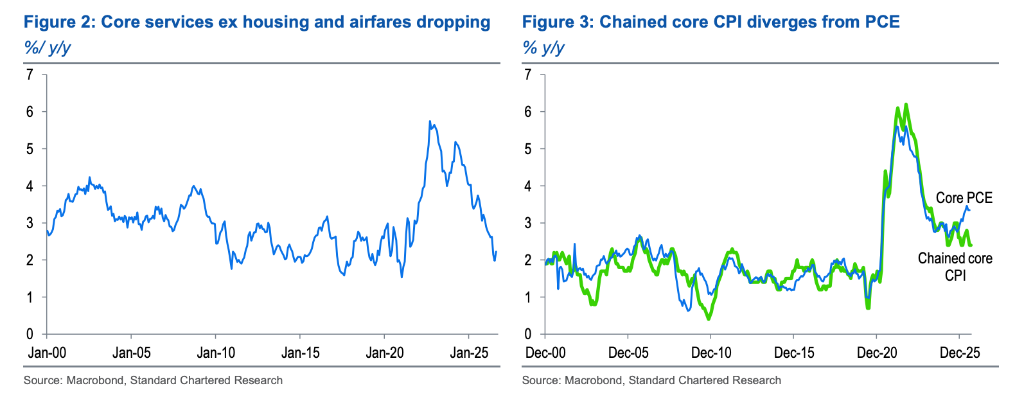
The report suggests that core inflation may currently be overstated. Tariffs have indeed pushed up core PCE, but the magnitude and duration of their impact remain highly uncertain, and revisions to GDP estimates could also alter market expectations for economic and inflationary trends. Until the data stabilize, the Federal Reserve has no pressing need to rush into raising interest rates.
The bank's closely watched core CPI has recently declined markedly, returning to the normal range observed in the 2010s. The report argues that current CPI pressures are largely driven by commodity prices, with tariffs serving as a key contributing factor; however, this does not imply that sustained inflationary pressures have taken hold within the economy.
The chained CPI and the core PCE have long moved in close tandem, but recently they have diverged markedly. The report notes that the chained CPI more accurately reflects consumers' actual spending, and its recent trajectory warrants close attention from policymakers.
Moreover, multiple analyses within the Federal Reserve suggest that tariffs could contribute roughly 0.7 percentage points to PCE inflation. As tariff revenues peak in the fourth quarter of 2025, their inflationary impact is likely to gradually diminish over the following months. In other words, we may currently be at a window where the inflationary shock from tariffs is beginning to subside.
From a risk-management perspective, waiting for data confirmation would not rule out the option of raising interest rates. If subsequent data confirm that inflation is picking up again, the Federal Reserve could still deliver a one‑off 50‑basis‑point hike; conversely, if it raises rates prematurely only to be forced to reverse course later, it could undermine its policy credibility.
88% of rate hike pricing is heating up, and Walsh faces the risk of policy feedback.
Despite Standard Chartered's view that a rate hike in September is unlikely, the market has clearly shifted to a hawkish stance. Federal Funds futures now price in an 88% probability of a 25-basis-point increase in September and project cumulative hikes of roughly 74 basis points by March next year. This surge in expectations has been largely fueled by speeches delivered at Jackson Hole by Fed officials such as Bullard and Evans.
However, the report notes that the market may have focused only on the hawkish elements in Mr. Wash's remarks. While emphasizing the importance of bringing inflation back to its target, Mr. Wash also cautioned that policymakers must assess whether underlying inflation is rising, falling, or stagnant, rather than relying on a single data point.
Wash also cautioned that if markets come to rely on the Federal Reserve's guidance, while the Fed in turn depends on market prices, policymakers may overlook emerging economic developments, thereby increasing the risk of policy errors.
In Standard Chartered's view, this risk is steadily amplifying. The stronger the expectations of rate hikes, the more pronounced the market's pricing exerts a countervailing constraint on policy, and the more susceptible the Federal Reserve becomes to those prevailing expectations—creating a feedback loop in which "market expectations drive policy, and policy, in turn, reinforces market expectations."
Accordingly, if the Fed ultimately holds steady in September, the real question will be how Chairman Powell manages the already elevated expectations for rate hikes: he will need to explain why no hike is warranted at this juncture while also demonstrating that the Fed will not simply follow market pricing.
The voting‑based logic also does not support a rate hike in September.
The voting dynamics also serve as a key basis for Standard Chartered's assessment. At the July FOMC meeting, three members already supported a rate hike; for a rate increase to materialize in September, at least four additional members who had previously favored holding steady would need to shift their stance, bringing the tally to the seven‑vote threshold.
Standard Chartered believes that Wash's most likely strategy is to avoid being in the minority, but he will not actively push for a rate hike. If four more policymakers shift their stance, he may join the hawkish camp; if only three switch, Wash could vote in favor of a hike to prevent a 6–6 deadlock; and if just two change course, he would still have room to support keeping rates unchanged.
The key question is whether the data since the July meeting are sufficient to persuade at least three members of the "hold‑steady" camp to change their stance. Standard Chartered believes that, for now, the available data fall short of meeting this threshold.
The real test lies in the Wash press conference.
The report expects that the FOMC statement will not undergo any major revisions. On the SEP front, the dot plot is unlikely to turn markedly more hawkish; however, compared with June, the room for rate cuts may have narrowed further, and the weighted-average rate projection could move slightly higher.
If the Fed ultimately holds steady, Chairman Powell will face an even tougher test at the press conference: he will need to explain why interest-rate hikes are not warranted at this time, while also clarifying how the Fed views the market's already entrenched expectations of significant rate increases.
The market is likely to press further on whether the October meeting still leaves open the possibility of a rate hike. Mr. Warsh will probably emphasize that "each meeting will be data‑dependent," but without clearer policy triggers, market skepticism about his stance could persist.
Accordingly, the September FOMC's impact will hinge not only on the interest-rate decision itself but also on whether Chair Powell can effectively guide market expectations going forward. For the U.S. dollar and the long end of the Treasury yield curve, the key variable after the meeting will be how markets recalibrate their pricing of the future path of interest rates.
Editor/rice