As U.S. Treasury yields surpass 5%, hitting a new high since 2007, Treasury Secretary Bessent's strategy of "using growth to eliminate debt" is now being put to the test by a confluence of historical realities, welfare spending, interest costs, and deficit targets.
Zhitong Finance APP learned that the yield on the U.S. 10-year Treasury note hit 5.04% on Tuesday, reaching a new high since 2007. As U.S. Treasury yields continue to climb and market attention once again turns to the sustainability of U.S. public finances, U.S. Treasury Secretary Bessent is scheduled to appear before the U.S. House Financial Services Committee at 10:00 p.m. Beijing time tonight. Markets will closely watch whether he offers fresh signals on fiscal policy, Treasury bond issuance and buyback programs, debt management, and the outlook for the U.S. dollar and interest rates. Meanwhile, the "growth-driven debt reduction" strategy that Bessent has long emphasized is facing mounting real-world skepticism.
Bessent's "Growth-Debt" Theory: The Ideal Is Full, the Reality Is Lean
 Bessent had stated in August, "Global growth is the way to tackle this mountain of debt." At an event in Texas last week, he reiterated that as long as U.S. federal spending remains restrained and coupled with "3% growth, we can use growth to pay down the debt."
However, empirical data do not support this optimistic scenario.
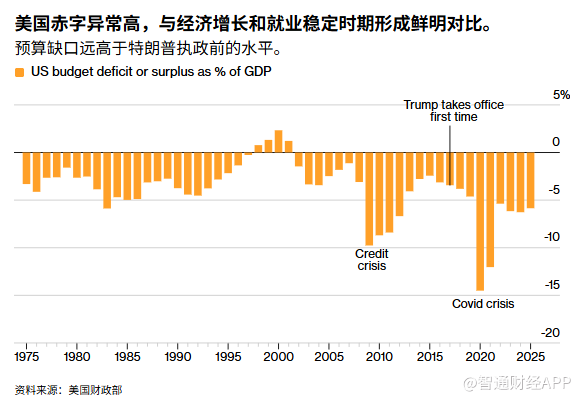
Even in 2023 and 2024, the U.S. economy posted inflation-adjusted growth rates close to 3%. Yet during these two years, publicly held U.S. debt rose by roughly 10% and 7%, respectively; annual deficits exceeded $1.6 trillion each year, and the debt-to-GDP ratio continued to climb.
Looking back to the late 1990s, the United States' gross domestic product (GDP) sustained growth of over 4 percent, yet its fiscal position underwent a dramatic shift—from deficit to surplus. However, this turnaround was accompanied by tax increases and a slowdown in defense spending following the end of the Cold War.
Today, the situation is entirely different. Following multiple rounds of Republican-led tax cuts, tax rates have been significantly reduced. In recent years, lawmakers from both parties have generally voted to increase, rather than cut, federal spending. An aging population is driving up expenditures on major welfare programs such as Social Security and Medicare. Meanwhile, amid geopolitical tensions, U.S. President Donald Trump is seeking congressional approval for $1.5 trillion in defense spending, representing a 44% increase.
"You can't solve this problem through growth," said Douglas Holtz-Eakin, president of the right-leaning American Action Forum and former director of the Congressional Budget Office. "It doesn't add up numerically."
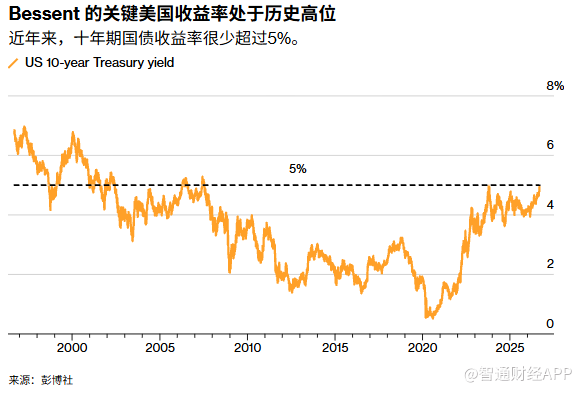
The 10-year U.S. Treasury yield has broken 5%, and Bessent's hearing is under intense scrutiny.
Recently, the rapid rise in U.S. Treasury yields has heightened concerns about the sustainability of America's long-term debt. Bessent's own benchmark—the 10-year Treasury yield—has surpassed 5%, a level that has been extremely rare since the early 2000s. On Tuesday morning, local time, Bessent may face questioning about his strategy at a hearing before the House Financial Services Committee.
Bessent predicts that the AI boom will help accelerate U.S. economic growth, but the mainstream consensus does not expect a 3% GDP growth rate anytime soon. Surveys of economists conducted by the media, as well as the International Monetary Fund's (IMF) latest forecasts, both indicate that U.S. economic growth in 2027 and 2028 will only slightly exceed 2%.
Joe Lavernia, a former adviser to Bessent, stated that growth is an important component of reducing the deficit and the overall debt burden, and that Bessent was right to emphasize this point. However, he also believes that growth alone may not be sufficient to accomplish this task.
"Looking at the 3% growth potential, that's a very respectable figure and would go a long way toward improving the deficit," he said. But "you may need more than just growth."
An aging population is intensifying pressure on welfare spending, while debt‑service costs are rising.
One of the key issues is that the number of U.S. retirees has been steadily rising, which in turn has driven up Social Security and healthcare spending—two of the largest items in the U.S. budget. From Trump's return to the White House through May this year, the number of Social Security retirement beneficiaries in the United States increased by 2.8 million. However, the number of U.S. workers contributing to these benefits rose by only 593,000.
Trump has stated that he will not alter these welfare programs, and Congress has also failed to push for major reforms to them.
Holz‑Ecking pointed out that, if all goes well and the economy grows rapidly, fiscal revenues will expand at the rate of nominal GDP. Nominal GDP incorporates inflation. He noted that a 3% real growth rate combined with 2% inflation translates into 5% nominal growth. However, Social Security spending is rising by an average of 5.5%, while Medicare expenditures are increasing as much as 7.5%. "So you simply can't solve this problem," he said.
The third-largest category of U.S. government spending is interest payments on outstanding debt, and this item is growing at an even faster pace. With one month remaining in the current fiscal year, total net interest payments have already reached $1.02 trillion, up 8.9% from the same period last year.
Rising U.S. Treasury yields imply that these costs face the risk of accelerating. According to data from the U.S. Department of the Treasury, as of the end of August, the average yield on outstanding Treasury securities stood at 3.48%, significantly below current yields. Meanwhile, the benchmark five-year Treasury yield—closest in maturity to the outstanding debt—was around 4.77%.
Meanwhile, the U.S. Treasury has recently relied on lower-cost, short-term Treasury bills with maturities of one year or less to finance its debt. If Federal Reserve Chair Kevin Warsh and his colleagues raise the overnight policy rate on Wednesday, as widely expected by the market, the cost of these short-term securities will also increase.
"There are no credible estimates suggesting that growth will be strong enough to make the fiscal situation magically disappear," said Maya MacGuineas, president of the Committee for a Responsible Federal Budget (CRFB).
A $5,000 Check and the Deficit Target: The Challenge of Fiscal Consolidation Remains Unresolved
At Tuesday's hearing, Bessent may be asked about a proposal by Trump: if the Republican Party retains control of Congress in the November midterm elections, it would issue $5,000 checks to every adult American.
The CRFB estimates that the proposal would cost as much as $1.2 trillion in a single year, while the current annual deficit stands at roughly $2 trillion. The organization calculates that, absent offsetting measures, next year's deficit as a share of GDP could reach 9% or 10%.
After taking office, Bessent set a goal: to reduce the deficit-to-GDP ratio to around 3% before the end of Trump's term in January 2029. In 2023 and 2024, that ratio exceeded 6%, while last year it dipped slightly below that level, partly due to a one-time change in the accounting treatment of federal student loans.
Economists project that the deficit-to-GDP ratio will stand at 6.4% in 2028, with forecasts ranging from a low of 4.5% to a high of 8%.
Bessent stated that he is working with White House Budget Director Russ Vought to develop a fiscal consolidation plan aimed at reducing the deficit. Although he has not yet provided detailed specifics of the plan, he hinted that anti-fraud measures could be part of it.
For many budget experts, a credible fiscal plan requires reforming welfare programs. Stanley Druckenmiller, Bessent's mentor during his hedge-fund career, signed an appeal last month proposing a phased reform of these programs.
Seth Carpenter, Morgan Stanley's chief global economist and a former Treasury official during the Obama administration, stated, "Some form of fiscal consolidation based on growth" is very likely. "But this hinges on fiscal policy no longer turning expansionary—this is the real sticking point."
Holz-Eakin estimates that, relying solely on economic growth, achieving the deficit level Bessent envisions would require a growth rate of 6%. He notes that, given the aging U.S. population and stringent immigration restrictions, even a 3% growth rate would be nothing short of a "miracle."
Editor/Deng