
Bank of America's September Global Fund Manager Survey shows that the disorderly rise in bond yields has, for the first time, surpassed the AI bubble to become the biggest tail risk, with 33% of respondents expressing concern. Investors have turned noticeably more hawkish on the interest-rate outlook, as expectations for Fed rate hikes have intensified, while they continue to underweight bonds and overweight banks and healthcare. Although confidence in AI-related capital spending remains strong, market sentiment has cooled compared with August, and concerns about systemic risk have risen.
Global fund managers' risk appetite is quietly shifting. According to Bank of America's September Global Fund Manager Survey (FMS), "disorderly bond yield increases" have, for the first time, surpassed the "AI bubble" to become the market's biggest tail risk, reflecting investors' deep-seated anxiety about the interest-rate outlook.
The survey was conducted from September 4 to 10 and included 190 fund managers overseeing a combined $512 billion in assets. The results show that 33% of respondents identified "an uncontrolled surge in bond yields" as the top tail risk, up from 27% in August, while "the AI bubble," which topped the list last month, slipped to second place, with its share falling from 32% to 28%.
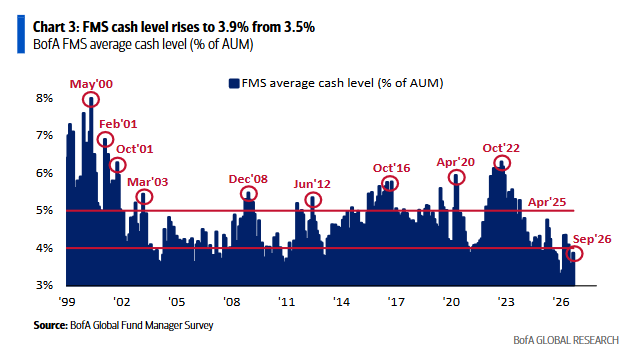
 Meanwhile, Bank of America's FMS cash rule and the bull–bear indicator both issued "sell" signals—cash allocation rose from 3.5% to 3.9%, and the bull–bear indicator reached a reading of 9.5, both remaining in sell‑side territory.
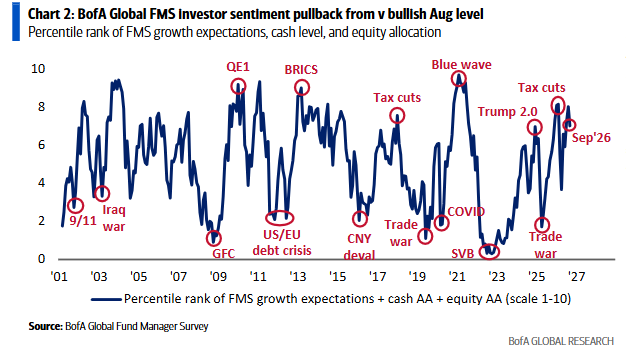
The overall cooling of investor sentiment corroborates the aforementioned shift in risk appetite. Bank of America's broad FMS Sentiment Composite Index fell to 7.0 from 8.0 in August, its lowest level in nearly three months—after August's survey had been the third‑most optimistic monthly reading since 2022. On the asset allocation front, fund managers increased their holdings in healthcare, industrials, and banks, while simultaneously reducing positions in REITs and consumer staples; the latter saw their underweighting reach its highest level since January 2004.
Bond risk has surged to the top of the list, and interest-rate expectations have shifted sharply.
Concerns in the bond market have risen across the board in this month's survey. A net 36% of FMS investors expect short-term interest rates to increase, the highest level since September 2022; meanwhile, a net 25% believe that current global monetary policy is too accommodative, also the highest since September 2022.
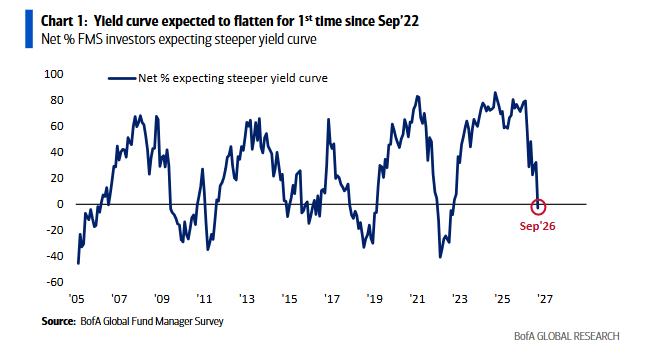
Expectations for Federal Reserve policy have diverged markedly. The survey shows that 52% of respondents believe the Fed will not raise interest rates before the November midterm elections, though this share has dropped sharply from 72% in August. Meanwhile, 41% of respondents expect the Fed to hike rates before the midterms, a significant increase from 22% in August.
In the context of the U.S. Treasury's bond‑repo program, market sentiment remains cautiously muted. Regarding the Treasury's decision to expand the scale of its bond repos from September 9 to November 4, 46% of respondents believe the move will have no impact on U.S. Treasury yields, 29% expect it to push yields higher, and only 16% anticipate a decline.
In terms of bond allocation, FMS investors currently maintain a net underweight position in bonds, at 48%—the largest underweight since May 2022—and have been underweighting bonds for 17 consecutive months. The survey also indicates that 27% of respondents believe asset allocators would only shift to an overweight stance on government bonds if U.S. 30-year Treasury yields rose to an attractive level, such as 6%.
AI capital spending remains strongly supported, but concerns about systemic risk are mounting.
Although the "AI bubble" has slipped from the top of the list of tail risks, fund managers remain confident about AI‑related capital spending. Seventy-nine percent of respondents do not expect the AI hyperscalers to announce cuts in capital expenditures by 2026, up from 71% in August; only 14% anticipate such reductions.
However, the share of respondents who view AI‑related ultra‑large capital expenditures as the most likely source of a systemic credit event rose to 42%, up from 38% in August, while government debt ranked second at 25%. Meanwhile, a net 33% of respondents believe that firms are overinvesting, matching the historical peak recorded in February 2026.
Among the most crowded trades, "going long global semiconductors" remained firmly in first place with 53%, followed by "shorting U.S. Treasuries" at 18% in second, and "going long the Magnificent Seven" at 7% in third.
The Asian fund manager survey, meanwhile, reflects greater caution regarding AI's monetization potential. According to Bank of America's Asia FMS, 80% of respondents said they would only increase their allocations to AI‑related equities once they see clearer evidence of AI‑driven revenue generation. Meanwhile, 55% of Asian respondents believe that the positive impact of AI on equity markets has already been "roughly fairly priced" or "overpriced," a sharp rise from 37% in August.
Macroeconomic expectations remain solid, and the "soft landing" scenario continues to be the prevailing view.
Despite a moderation in risk sentiment, fund managers remain broadly optimistic about the macroeconomic fundamentals. Fifty-five percent of respondents expect the global economy to avoid a "hard landing," slightly down from the 56% record high reached in August; 38% anticipate a "soft landing," while only 2% foresee a "hard landing"—a level that ties the historical low recorded in July 2026.
A net 8% of respondents expect global economic growth to accelerate over the next 12 months, down from 14% last month. On the earnings front, the share of investors forecasting double-digit EPS growth over the next 12 months is at its highest level since August 2021.
Inflation expectations have shifted slightly: a net 4% of respondents now anticipate a decline in global CPI, compared with a net 3% who expected inflation to rise in August. Among respondents, 50% describe the global economy over the next 12 months as "stagflation" (below-trend growth and above-trend inflation), while 38% foresee "prosperity" (above-trend growth and above-trend inflation).
In Asia, Bank of America's Asia FMS indicates that a net 55% of respondents expect corporate earnings in the Asia-Pacific region (excluding Japan) to improve, up from 45% in August. Investors' expected return on Asia-Pacific equities (excluding Japan) over the next 12 months stands at 6.3%, placing it at the 89th percentile historically; meanwhile, the expected return on Japanese equities has risen to 6.4%, now at the 94th percentile.
Risks in the midterm elections are mounting, and the likelihood of a Democratic sweep is increasing.
Political risk has emerged as another key focus of this month's survey. Forty-four percent of respondents anticipate a divided Congress, with Democrats controlling the House of Representatives and Republicans holding the Senate; meanwhile, the likelihood of a Democratic sweep—winning both chambers—has risen from 23% in August to 31%.
If the Democrats were to sweep the elections, 45% of respondents expect the market reaction to be "rising bond yields and a falling stock market," 19% anticipate "lower bond yields and a rising stock market," 13% foresee "lower bond yields and a declining stock market," while only 4% foresee a "boom" scenario in which both rise in tandem.
Asset Allocation: Increase holdings in the financial and healthcare sectors; reduce exposure to defensive sectors.
At the asset allocation level, FMS investors' net overweight in equities fell from 56% last month to 49%, yet remains 0.9 standard deviations above the long-term average. The net overweight in commodities declined from 24% to 19%, while the net underweight in real estate widened from 7% to 21%, marking the largest underweight since September 2025.
In terms of sector rotation, in September, capital flowed into finance (banks and insurers), healthcare, and industrials, while outflows were seen in REITs, consumer staples, and telecommunications. Banks' net overweight allocation rose to 34%, the highest level since November 2025; meanwhile, the net underweight position in consumer staples widened to 33%, the largest underweight since January 2004.
In terms of regional allocation, U.S. equities are overweight by 25%, emerging-market equities by 38%, while Eurozone equities have shifted from a 6% overweight last month to a 5% underweight. UK equities remain underweighted by 35%, making it one of the regions with the most pronounced underweight positions.
Bank of America's contrarian trading recommendations include: going long on UK equities and shorting U.S. equities; going long on consumer staples and shorting banks; and going long on small-cap stocks while shorting large-cap stocks.
Edited by melody