
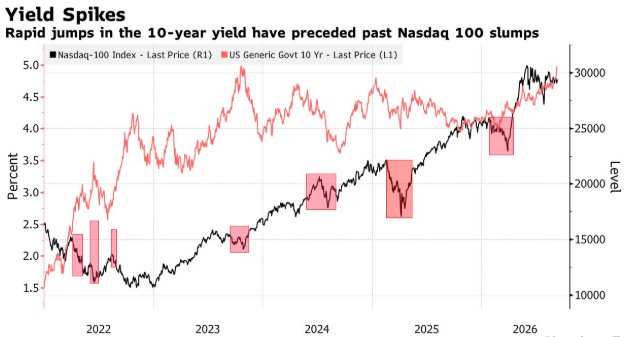
This week, the yield on the 10-year U.S. Treasury bond rose above 5%, triggering a sell-off in both U.S. stocks and bonds. However, analysts warn that a further climb to 5.25% could sharply increase market volatility.
U.S. stocks are entering what is historically one of the most volatile seasons, while the bond market has already begun to fray: on Monday, September 14, the yield on the 10-year U.S. Treasury note hit 5% for the first time since October 2023; by Tuesday, it had climbed further to 5.041%, a level not seen since July 2007, while the 30-year yield briefly surged to 5.399%.
But unlike in October 2023—when the S&P 500 was about 10% below its all-time high and the market had already priced in the spillover effects of a global bond sell-off—the benchmark index is now just 2.5% shy of its record peak set in August. The real question for the market is: Do U.S. equity valuations still leave virtually no room to absorb this round of rising yields?
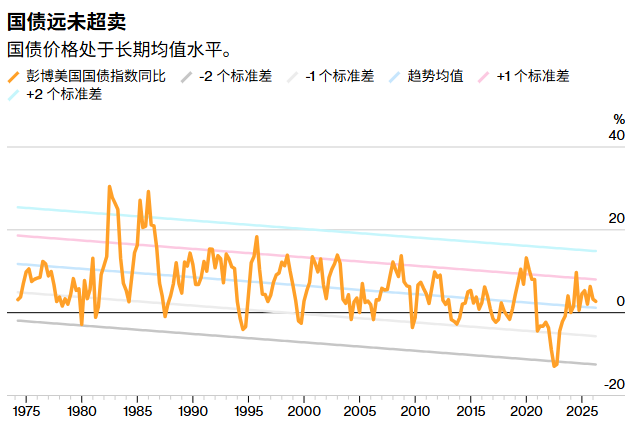
 Meanwhile, another question arises. This week, the yield on the 10-year U.S. Treasury bond climbed above 5%; the key issue is whether this upward trend can persist. While yields appear elevated—having even surged to their highest level since 2007—the U.S. Treasury market has yet to become oversold. When factoring in returns on capital and price dynamics, the yield, measured as an annualized rate, has merely reverted to its long-term average.
Everyone is waiting for Wash's answer.
Strategists at several institutions, including Wells Fargo & Co., believe that the rapid rise in yields will trigger anxiety on Wall Street, and the specific impact on U.S. stocks may depend on the pace of future yield increases.
The yield‑driven threat mechanism is nothing new: higher bond yields discount future earnings, rendering equities less attractive relative to risk‑free assets, while also raising corporate borrowing costs and squeezing profit margins. Prior to 2023, 10‑year Treasury yields last reached such elevated levels at the onset of the global financial crisis—a crisis that ultimately compelled policymakers to push interest rates close to zero and launch large‑scale quantitative easing.
Notably, high-growth, highly valued tech stocks are generally considered more vulnerable to rising interest rates, as their valuations are largely anchored to projected earnings that will materialize over the coming years. Portfolio managers—including those who have long been bullish on the sector—believe that rate‑sensitive tech stocks could face further losses going forward. With commodity and service prices remaining elevated, mounting evidence suggests that Powell is likely to follow through on his policy threats.
Against this backdrop, what truly has traders on edge is the Federal Reserve's interest-rate decision this Wednesday (September 16) and Chairman Powell's subsequent press conference. Following the August inflation report, which showed prices continuing to rise, traders now see a greater than 90% probability of a rate hike on Wednesday; Morgan Stanley has even joined the hawkish camp, forecasting that the Fed will raise rates by 25 basis points in both September and December.
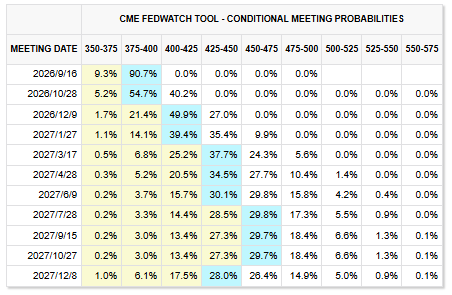
"If the Fed signals that it will hit the brakes after just one rate hike, traders will breathe a sigh of relief," said Max Wasserman, Senior Vice President and Portfolio Manager at Wealth Enhancement's Miramar team. "But if there's no clarity on how many more hikes lie ahead, or if there's any indication that inflation will take some time to come down, yields above 5% could prompt a selloff in long-duration tech stocks—forcing investors to reassess those lofty valuation multiples."
Wells Fargo & Co.'s chief equity strategist, Ohsung Kwon, offered a counterintuitive assessment in a phone interview: "Investors would likely welcome the message that 'one more hike and that's it.' If the Fed refrains from raising rates, that would actually be negative for the stock market"—as long-term U.S. Treasury yields could surge further. Francisco Pesole, an FX strategist at ING, also described the current bond-market performance as a "warning sign": if the Fed holds steady at this juncture, it could trigger unnecessary market volatility.
Point‑level map: 5%, 5.10%, 5.25%—each line reflects a distinct market rationale.
Government bond prices exhibit mean-reverting behavior, meaning they fluctuate around a long-term average. While they eventually revert to this mean, they often overshoot afterward. Consequently, bond prices may decline further before they truly become oversold.
Wall Street has already mapped this yield breakout as a tiered scenario. Wasserman believes the S&P 500's psychological threshold lies between 5% and 5.25% for the 10-year Treasury yield; Andrew Graham, a partner at Jackson Square Capital, argues that once yields climb above 5.10%, it will trigger a correction in U.S. equities; meanwhile, Dennis Debusschere of 22V Research contends that even a yield range of 4.8% to 5% would, by itself, weigh on economic growth.
Stephanie Roche, chief economist at Wolfe Research, put it more bluntly: bond yields must come down before U.S. stocks can resume their upward momentum. "If interest rates or oil prices rise further, a more substantial market correction could be just around the corner."
Another analysis elevates the issue from a "point‑in‑time" concern to a systemic one: when the 10‑year Treasury yield rises significantly above 5.25%, equity–bond dynamics have historically almost invariably turned positively correlated, with stocks and bonds reinforcing each other's losses. During periods when yields remain below 5.25%, it is strikingly rare for the correlation between the S&P 500 and U.S. Treasuries to be negative. From 2022 through last year, equity–bond correlation was positive whenever yields stayed below 5.25%; since the start of this year, it has edged toward zero. Should yields continue to climb, the correlation could well re‑establish itself firmly in positive territory.
When the yield on the 10-year U.S. Treasury bond rises well above 5.25%, the market landscape undergoes a marked shift. Subsequently, bond‑market volatility—and by extension, equity volatility and credit spreads—tend to increase substantially.
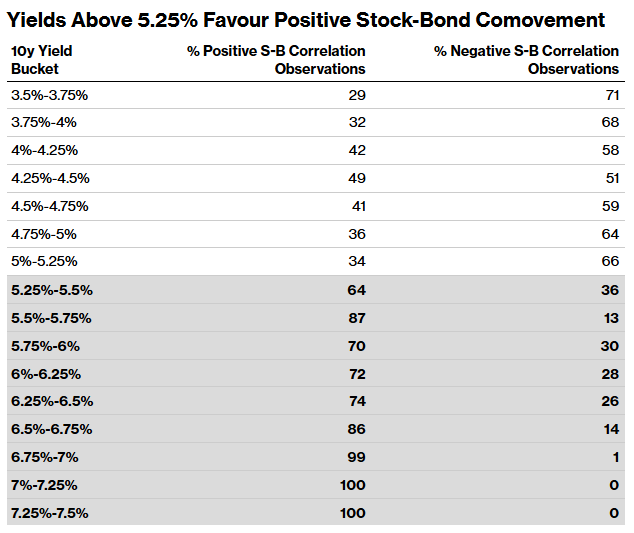
That means bonds are no longer a hedge against equities. The transmission chain unfolds in a tightly linked sequence: as U.S. Treasuries lose their appeal as portfolio‑hedging instruments, marginal buyers become more price‑sensitive, and the market's responsiveness to capital flows intensifies; investors then turn to options to hedge U.S. Treasuries, driving up implied volatility—leading Treasury yields to rise first, which was precisely the official rationale the U.S. Treasury cited last month when it announced an expansion of its repurchase program (to safeguard Treasury liquidity).
Next, equity‑index volatility cannot remain unaffected: the mutual amplification of gains and losses between stocks and bonds will further destabilize rebalancing flows and push the VIX higher; rising demand for stock‑option hedging will also support implied volatility. The third channel is particularly critical today—bond‑market volatility has heightened uncertainty around discount rates for cash flows, while historically low cross‑stock correlations suggest that the market has scarcely priced in "long‑term interest rates," the single most dominant source of factor risk.
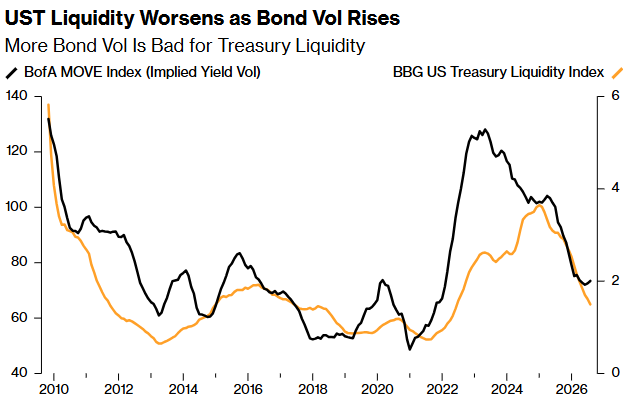
Extremely low stock‑level correlations have dampened the transmission of individual‑stock volatility to the VIX index. Although individual‑stock volatility has eased from its peak during the euphoric phase, a rise in correlation could still deliver a substantial shock to the VIX.
Credit spreads are likewise hard to avoid. Low index volatility is one of the key factors suppressing spreads, while high-yield spreads tend to track the VIX closely—this latter often feeds into credit pricing via the Merton model.
Valuation Alerts and Contrarian Bets
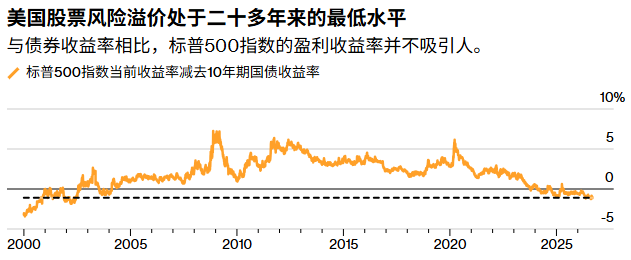
One closely watched metric is the equity risk premium—the difference between the S&P 500's earnings yield and the yield on the 10-year U.S. Treasury bond, often used to gauge stocks' relative attractiveness compared with other assets—which currently hovers near its lowest level since 2002, implying that equities will become more sensitive to any changes in bond yields. JPMorgan's strategist team, led by Nikolaos Panigirtzoglou, expects this premium to narrow to below its historical average by 100 basis points, partly because equities have grown more sensitive to bond yields.
Of course, some are betting that the bond-market sell-off is nearing its end. Larry Adam, Chief Investment Officer at Raymond James, notes: "Investor bearishness on bonds has turned extremely pessimistic, with speculative short positions in the 10-year Treasury near record highs. This round of selling increasingly appears overextended—suggesting that yields may be closer to a peak than to the start of another sustained rally."
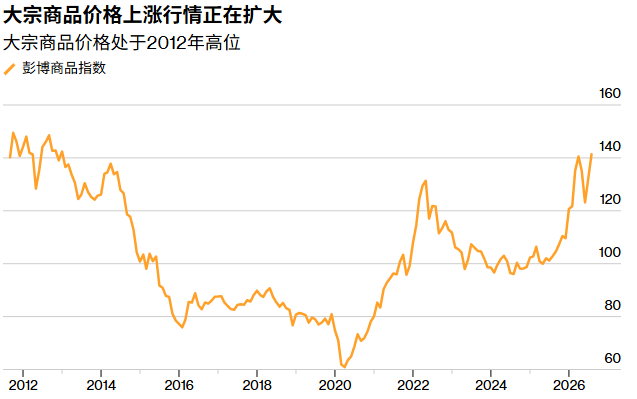
Several potential inflection points where yields may stall: News of AI labs scaling back model development could merely be a convenient pretext for a pullback in capital spending—hardly a boost to economic growth. Yet, given that fixed‑price computing‑power contracts are already locked in through next year and beyond, such developments may not be enough to spark a bond‑market rally in the near term. Real‑money investors or funds hedging mortgage‑backed securities might step in if yields remain above 5%, but that hasn't materialized yet, and any impact would likely be only temporary. Meanwhile, commodity price pressures continue to build; disruptions to energy and food supplies from the Middle East and Russia show no signs of easing, and structural inflationary headwinds are keeping yields stubbornly elevated.
A paradoxical scenario could unfold on Wednesday: raising interest rates might actually attract buyers of U.S. Treasuries—if the market believes the Fed is genuinely committed to curbing inflation; conversely, holding rates steady could push yields even higher. Tim Chaboud, Chief Investment Officer at Girard, echoes the dovish camp: "As long as rate hikes remain moderate, the Fed won't derail this bull market. However, the most vulnerable and overreactive segment of the market is likely to be overvalued tech stocks."
In any case, U.S. Treasury yields are nearing a turning point. The S&P 500 has risen 20% from its late-March low, with market capitalization swelling by $11 trillion, and during Monday's bond sell-off, the VIX remained steady around 17—far from the typical levels seen when markets are under pressure. How much longer this calm can persist depends on whether the 5.25% threshold is truly breached after Wednesday. If the 10-year yield stays above 5.25% for an extended period, trading conditions and asset pricing dynamics will look markedly different from the past three years.
Editor/Deng