
International crude oil prices are on track to post a four-month closing high. According to reports, Saudi Aramco has notified some European customers of cancellations for certain crude oil shipments, prompting major buyers—including Polish refiners—to urgently seek alternative supplies. Trade sources say the prices for these cargoes have risen above $120 per barrel.
Saudi crude oil exports have suffered another blow.
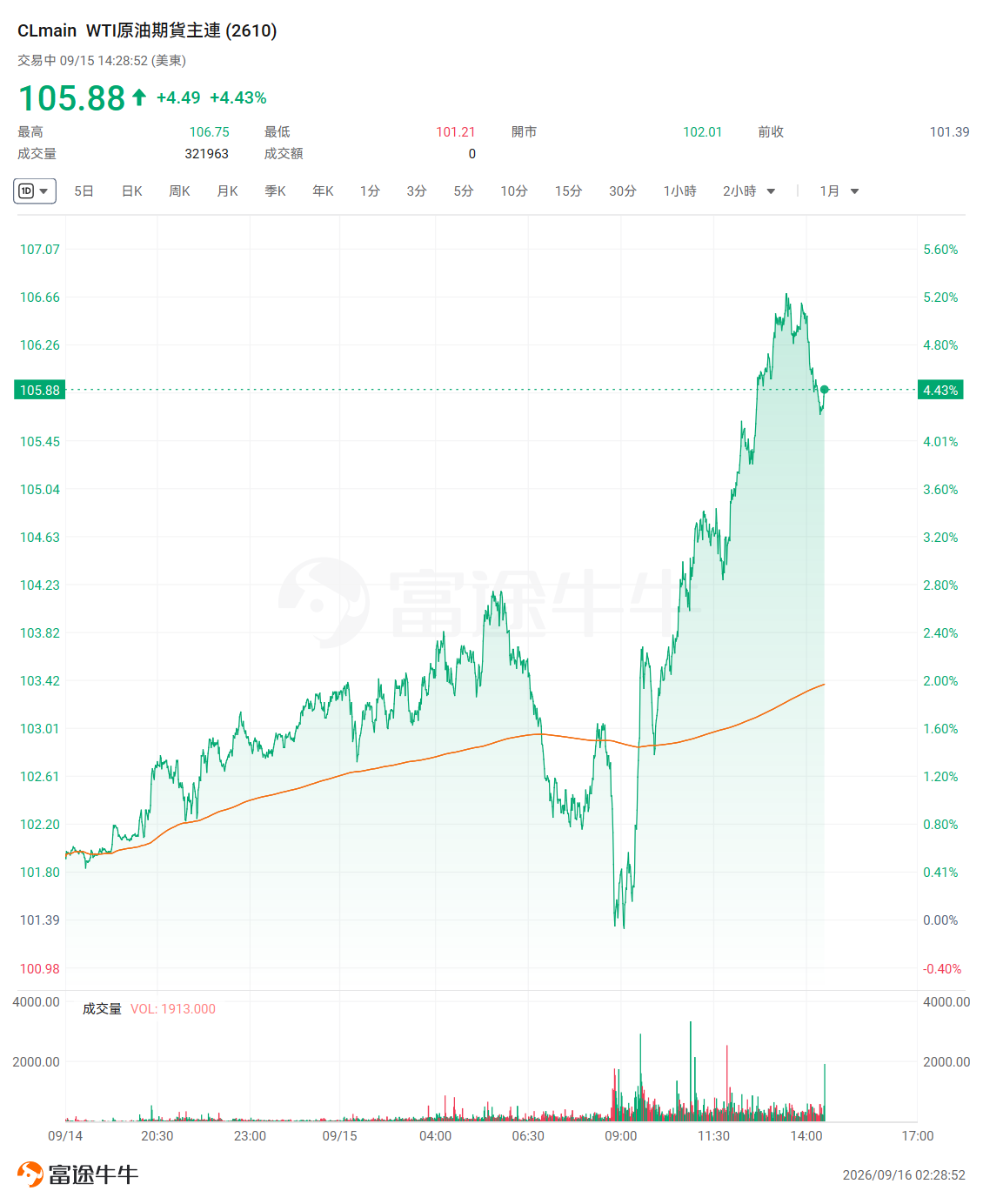
On Tuesday, the 15th, Eastern Time, shipping and industry sources reported that Yanbu, Saudi Arabia's major oil-export terminal on the Red Sea, has suspended crude oil loading operations. Following this news during the U.S. stock market's midday session, international oil prices climbed further: U.S. WTI crude futures briefly surged above $106.50, with intraday gains widening to over 5%, while Brent crude rose above $109, up more than 3% for the day.
 Reuters subsequently cited trade and shipping sources, reporting that Saudi Arabia has suspended crude oil loading at the port of Yanbu and canceled several cargoes destined for European customers, prompting major buyers—including Poland's state-owned Orlen—to urgently seek alternative supplies. Market concerns over further constraints on Saudi crude exports have risen sharply.
At the close, WTI October crude oil futures rose 4.38% to $105.83 per barrel, while Brent November crude oil futures gained about 2.9% to $108.75 per barrel, both hitting new highs in nearly four months.
Bloomberg reported Tuesday that, with shipping in both the Strait of Hormuz and the Red Sea disrupted, Saudi Aramco has informed at least three European refineries that it will deliver the full contracted volumes of crude oil for September and is offering various offloading options to some buyers, including ship-to-ship transfers from Port Said in Egypt, Yanbu in Saudi Arabia, or near Malta.
Earlier, Saudi Arabia's East-West Pipeline, which connects the eastern oilfields to the Red Sea port of Yanbu, was shut down after a drone attack, disrupting this critical export route that had been used to bypass the Strait of Hormuz. Now, if loading operations at the port of Yanbu are also affected, it would further impede the alternative pathway for shipping Saudi crude from the Persian Gulf to the Red Sea and then exporting it via the Red Sea.
Yanbu suspends loading, as Saudi Arabia's efforts to bypass the critical Strait of Hormuz are hampered.
Yanbu is one of the most important oil-export hubs along Saudi Arabia's Red Sea coast and serves as the western terminus of the East–West Pipeline.
This oil pipeline, approximately 1,200 kilometers in length, connects Saudi Arabia's eastern oilfields to the port of Yanbu on the Red Sea. With a designed capacity of about 7 million barrels per day, it serves as a critical route for Saudi crude exports, enabling the country to bypass the Strait of Hormuz following disruptions to shipping through that waterway.
However, in earlier attacks, the eastern and western oil pipelines were damaged and forced to shut down. According to a Reuters report on September 15, crude oil loading at Yanbu has been suspended, and no Saudi crude has been loaded for export from the port since September 11.
This has placed dual pressure on Saudi Arabia's alternative export routes, which were originally intended to diversify risks in the Strait of Hormuz: the eastern‑end pipeline has been shut down, while the western‑end port of Yanbu is unable to load shipments as usual.
Reuters reports that Saudi Arabia is currently considering increasing exports through the Strait of Hormuz and adopting a "dark shipping" approach—similar to that used by the United Arab Emirates and Iraq—to transport some of its crude oil, thereby offsetting the shortfall caused by disruptions to Red Sea exports.
Reports indicate that some European shipments have been canceled, and buyers are now seeking alternative sources of oil.
While Aramco is working to maintain supplies to some European customers, cancellations and adjustments have already begun at the individual cargo level.
Reuters reported on September 15 that Saudi Arabia has cut crude oil shipments to Europe, with some cargoes scheduled for late-September loading at Yanbu being canceled. As a result, Poland's state-owned energy company Orlen is urgently seeking alternative supplies.
Approximately 40% of Orlen's crude oil supply comes from Saudi Aramco. According to Reuters, the company has recently procured North Sea crude and has launched tenders for U.S. WTI Midland, Kazakh CPC Blend, Algerian, and Guyanese crudes to offset potential gaps in Saudi supplies.
Another Reuters report indicates that European spot crude oil prices broke through $130 per barrel on Tuesday, with North Sea Forties crude briefly climbing to $136.75 per barrel, nearing the April record of $147.37 per barrel.
Accordingly, the market is currently characterized by a situation in which "contractual supply is still struggling to hold steady, while actual logistics have already been significantly disrupted."
This also explains why Bloomberg's report of "full allocations" and Reuters' account of "partial cargo cancellations" can both be true: Aramco is still prioritizing contract deliveries to certain European customers, but not all originally scheduled cargoes can be loaded as planned from ports such as Yanbu.
Report: Saudi Aramco Remains Committed to Fully Supplying Certain European Customers
It is worth noting that Saudi Aramco has not imposed across-the-board cuts to its crude oil supplies to Europe.
Bloomberg reported on September 15, citing sources familiar with the matter, that at least three European refineries have been notified by Saudi Aramco that they will receive their full contracted volumes of crude oil for September.
Among them, two buyers can pick up their cargoes at Egypt's Mediterranean port of Port Said; the third may choose to collect from either Port Said or Yanbu, a Red Sea port in Saudi Arabia, or receive the crude oil via ship-to-ship transfer near Malta.
This means that, following disruptions to its major export routes, Saudi Aramco is adjusting its loading ports and shipping methods to maintain contractual supplies to European customers as much as possible.
Bloomberg reported that Aramco's allocation schedule for European customers was delayed by about a week compared to the usual timing, owing to the conflict in the Red Sea, which has disrupted Saudi Arabia's normal logistics operations.
Meanwhile, European refiners had also feared that Asian buyers might snap up more crude oil from Port Said, further tightening Europe's supply.
With both the Strait of Hormuz and the Red Sea facing mounting pressure, oil prices are surging once again.
What the market fears most is that Saudi crude oil exports are simultaneously constrained at multiple critical chokepoints.
On the one hand, shipping volumes through the Strait of Hormuz have declined sharply recently, and Iran continues to emphasize its control over the strait. On the other hand, following an attack that forced the closure of Saudi Arabia's east–west oil pipeline, the Red Sea export route—meant to serve as an alternative to bypassing the Strait of Hormuz—has been further constrained by the suspension of loading at the port of Yanbu and the risk of Houthi attacks.
Following further reports of a suspension in loading at Yanbu, oil prices extended their intraday gains. During the midday session on Tuesday, U.S. crude rose by more than 5%, hitting a new intraday high since early May, though the closing gain narrowed to under 5%. Brent crude also posted fresh closing highs not seen since May 19.
Reuters reported that the suspension of loading at Yanbu, the shutdown of several oilfields in Libya, and a sharp decline in shipping volumes through the Strait of Hormuz have collectively heightened market concerns about disruptions to global crude oil supplies.
With global crude oil inventories offering limited buffer capacity, if the East–West pipelines cannot be restored promptly, ship-loading at Yanbu remains suspended, and shipping risks in the Strait of Hormuz and the Bab al-Mandab continue to escalate, market concerns about Saudi Arabia's actual exportable crude oil volumes could intensify further.
From Hormuz to the Red Sea, Saudi Arabia's two critical oil export lifelines are under simultaneous pressure.
Editor/stephen