
The U.S. "Clarity for Digital Asset Market Structure Act" failed to advance, with 49 votes in favor and 50 against, falling short of the 60-vote threshold required for passage. Bitcoin plunged as much as 5.3% to $74,910, Ethereum dropped more than 8%, and Coinbase sank 12%. The industry's hundreds of millions of dollars in lobbying investments came to naught, extending the regulatory vacuum. Coupled with rising U.S. Treasury yields tightening liquidity, the crypto market faced a dual blow from macroeconomic and policy headwinds.
On Tuesday, the U.S. Senate rejected a landmark digital asset regulation bill in a procedural vote, completely shattering the long-awaited policy catalyst for the cryptocurrency industry and triggering a sharp market sell-off.
According to reports, the "Clarity for Digital Asset Market Structure Act" (Clarity Act), which aims to establish a comprehensive regulatory framework for digital assets, failed to advance with 49 votes in favor and 50 against, missing the 60-vote threshold needed for passage. Shocked by this news, Bitcoin prices fell as much as 5.3% to $74,910, closing near their lowest level in a month, while Ethereum dropped more than 8.3%, marking the largest single-day decline for both since June of this year.
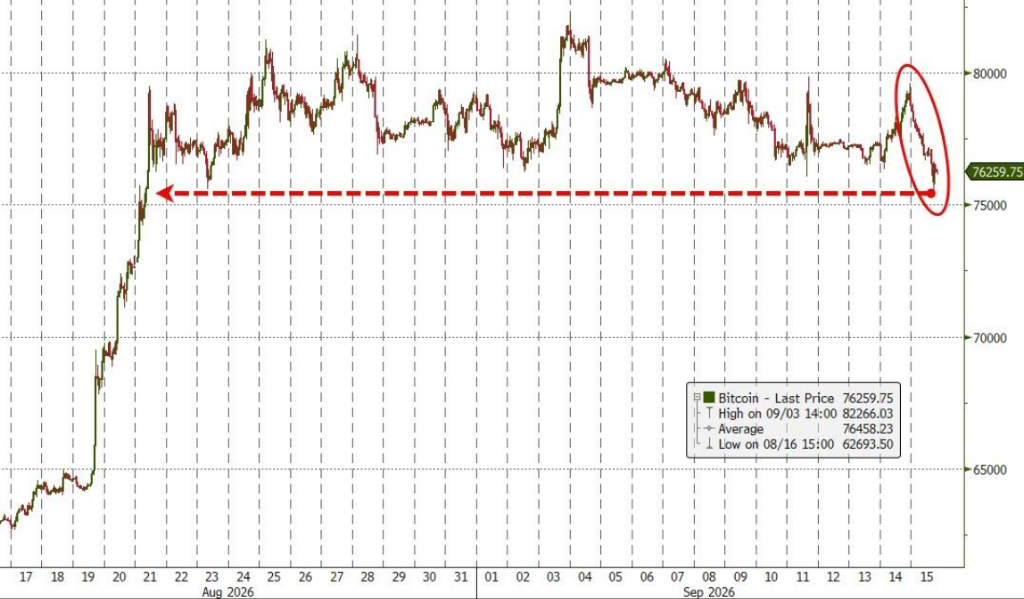
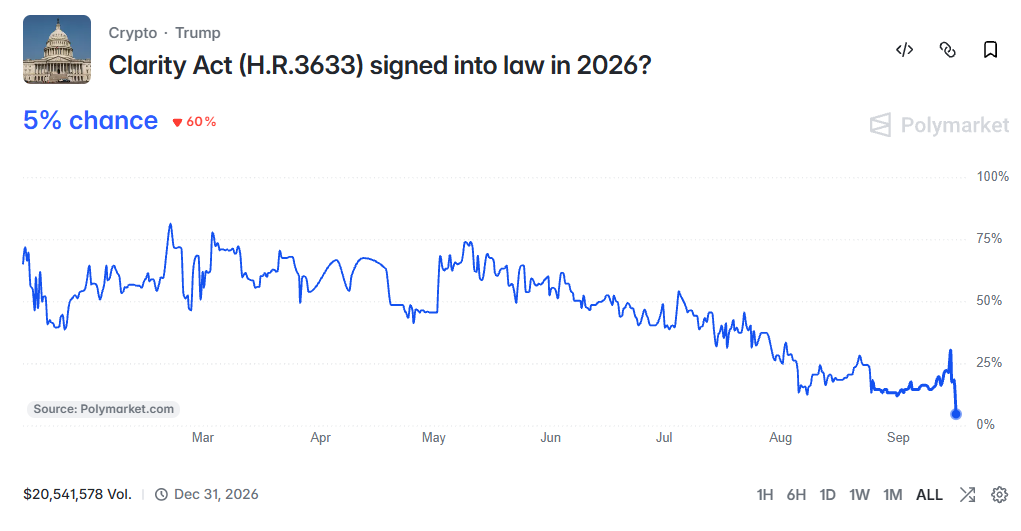
 In prediction markets, the probability of the bill passing this year plummeted. Cryptocurrency-related stocks and derivatives markets suffered simultaneous heavy losses. Coinbase's stock price fell as much as 12%, stablecoin issuer Circle dropped 13%, and MicroStrategy declined 8%. According to data from CoinGlass, nearly $300 million in long positions on crypto assets were liquidated in the last hour before the vote, as leveraged long positions in the futures market were acceleratedly unwound.
This legislative setback,叠加ing with the current macroeconomic environment of rising interest rates and tightening liquidity, has pushed the digital asset market into a slump. The collapse of expectations for regulatory clarity means that investors have temporarily lost the core logic supporting the valuation of this asset class amid intensifying macroeconomic headwinds.
Conflicts of Interest and Banking Concerns Become Key Obstacles
Despite more than a year of negotiations over the bill, partisan divisions on core provisions ultimately remained unresolved. The primary reason for Democratic opposition was that the bill failed to sufficiently restrict former President Trump from profiting from the crypto industry.
According to reports, Democratic Senators Mark Warner and Elizabeth Warren both pointed out flaws in the bill regarding conflict of interest resolution. Cory Booker told reporters that the bill did not do enough in terms of ethical standards. Although Republicans put forward a "final offer" over the weekend including amendments such as expanding the enforcement powers of state attorneys general, requiring officials to divest crypto assets or place them in blind trusts, this restriction did not extend to the sons operating the Trump family's crypto business. Previously, Trump reported earning more than $1.4 billion from his crypto businesses last year.
Furthermore, strong opposition from the banking sector prompted some Republicans to defect. Provisions in the bill allowing platforms to pay interest on stablecoin holdings raised concerns among community banks about deposit outflows. Republican Senator Josh Hawley stated that he voted against the bill because farmers in his constituency worried it would threaten the availability of regional loans.
Ultimately, some Republicans, including Susan Collins, as well as pro-crypto Democrats like Kirsten Gillibrand, voted against advancing the bill. New York Attorney General Letitia James also joined 18 other attorneys general in writing to the Senate, warning that the bill would weaken their ability to protect investors from fraud.
Regulatory vacuum persists, clouding the outlook for institutional adoption
The Clarity Act was originally designed to grant the Commodity Futures Trading Commission (CFTC) primary regulatory authority over the digital asset industry and was regarded as the most systematic attempt at crypto legislation in recent years. Its defeat marks a significant setback for the crypto industry, rendering temporarily futile the hundreds of millions of dollars in lobbying funds invested over the past few years to establish a long-term regulatory framework.
The prolonged regulatory vacuum has directly impacted the industry's compliance pathways and capital allocation. Ayesha Kiani, Chief Operating Officer of Monarq Asset Management, stated that the failure to advance the Clarity Act extends the period of regulatory uncertainty, which has practical implications for where companies choose to establish operations, how capital is allocated, and the pace of adoption by U.S. institutions.
The market had previously viewed regulatory clarity as a critical turning point for crypto assets to return to an upward trajectory. Analysts note that while Washington may provide institutional legitimacy for this asset class, it cannot compel investors to embrace high-volatility assets on a large scale amid a tightening macroeconomic environment.
With no hope for a short-term legislative restart, the focus of contention shifts to elections and regulatory agencies.
Prior to the bill's rejection, crypto markets had already been digesting the potential impact of rising interest rates on risk assets this week. The news of the policy failure further exacerbated the accumulating selling pressure, creating a dual burden of macroeconomic headwinds and negative policy developments.
Eric Jackson, Founder and Chief Investment Officer of EMJ Capital, stated that although this outcome was undesirable, market volatility continues. For assets such as Bitcoin, Ethereum, and Coinbase, which had previously risen on regulatory expectations, the disappearance of this catalyst means asset prices must seek new foundational support logic.
With less than two months remaining until the midterm elections, the compressed political schedule leaves very little room for restarting the bill in the short term. Jasper De Maere, an over-the-counter trader at Wintermute, pointed out that the window for market structure legislation in 2026 has closed, and the next realistic opportunity lies with the new Congress. Data from the prediction market platform Kalshi shows that traders currently assign only a 17% probability to the bill becoming law before July 2027. If the Democratic Party regains control of the House of Representatives in November, passing similar legislation without significant concessions will become even more difficult.
In this context, the industry's political funding and actions by federal regulatory agencies will become the next focal point. Fairshake, the largest crypto political action committee supported by entities such as Coinbase, currently holds approximately $122.8 million and is expected to influence the upcoming elections.
Meanwhile, the regulatory burden will fall back on federal agencies. Kristin Smith, President of the Solana Policy Institute, stated that the CFTC and the Securities and Exchange Commission (SEC) could take additional measures to clarify rules. Patrick Witt, a senior crypto advisor to Trump, explicitly described the vote as a 'major disappointment' on social media, naming CFTC Chairman Michael Selig and SEC Chairman Paul Atkins, implying that regulators need to utilize their existing authority to take over and advance rulemaking.
Editor/Stephen