
On Tuesday, the U.S. Treasury auctioned $13 billion of 20-year Treasury bonds, with the winning yield reaching 5.420%, up 21.6 basis points from the previous auction of the same maturity, which had a yield of 5.204%, marking a record high for this maturity. On the same day, the yield on the 10-year U.S. Treasury briefly climbed to 5.045%, hitting its highest level since 2007. Bessent stated that the rise in bond yields is a "global issue" and acknowledged that it also reflects factors such as "the need to address the deficit."
Pressure in the U.S. long-term Treasury market persists.
On Tuesday, U.S. time, the U.S. Treasury auctioned $13 billion of 20-year Treasury bonds, with the winning yield reaching 5.420%, up 21.6 basis points from the previous auction of the same maturity, which posted a yield of 5.204%. This marks a record high for the yield on this maturity, surpassing the previous peak of 5.245% set in October 2023.
 The bid-to-cover ratio for this auction was 2.57, higher than the previous auction's ratio of 2.53.
The results of this auction show that investors remain willing to take on U.S. long-term government debt at relatively high yields; however, amid the combined influence of inflation, energy prices, fiscal financing needs, and the Federal Reserve's interest-rate trajectory, risk premiums demanded for long-term Treasury bonds are rising.
From the perspective of investor composition, indirect bidders received an allocation ratio of 52.47%, down from the previous level of 62.93%; direct bidders' allocation ratio was 30.68%, up from 24.59%; and primary dealers' allocation ratio stood at 16.85%, also higher than the prior figure of 12.49%.
Accordingly, judging solely by the bid‑to‑cover ratio, this auction cannot be characterized as evidence of "weak demand." A ratio of 2.57 is even slightly higher than in the previous offering. Nevertheless, the sharp rise in the winning yield and the marked decline in the allocation share for indirect bidders both underscore that the market requires a higher yield to entice capital into longer‑dated U.S. Treasuries.
On Tuesday, the yield on the U.S. 10-year Treasury bond once again climbed above 5%, rising as high as 5.045% and reaching its highest level since 2007.
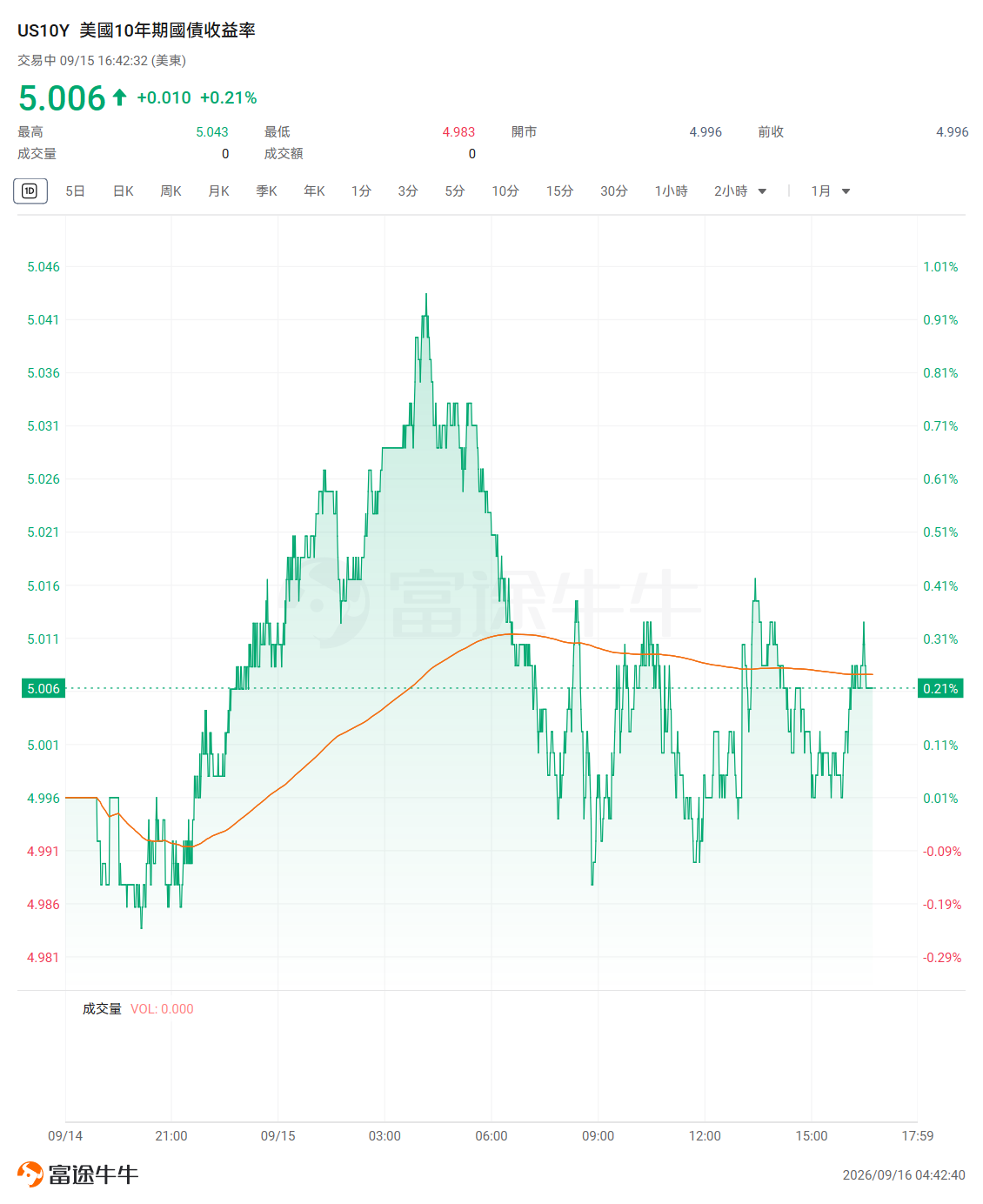
The yield on the 10-year U.S. Treasury bond has hit a nearly two-decade high again.
At the time of this 20-year Treasury auction, the U.S. long-end government bond market is experiencing significant volatility.
U.S. Treasury Secretary Bessent said at a congressional hearing on Tuesday that the rise in bond yields is due to "global issues."
On Tuesday, U.S. 10-year Treasury yields hit their highest level since 2007, amid a sharp sell-off in bond markets across most major global economies.
Analysts attribute the rise in U.S. Treasury yields to higher oil prices, market expectations that the Federal Reserve will raise its policy rate this week, capital competition driven by AI-related spending, and concerns about the trajectory of U.S. fiscal policy.
At the hearing, Bessent acknowledged that the rise in 10-year Treasury yields reflected factors such as "the need to address the deficit."
Persistently high U.S. Treasury yields will weigh on real‑economy financing costs and suppress risk assets.
Rising long-term U.S. Treasury yields will transmit to the real economy via mortgage markets, corporate bonds, and other credit markets.
U.S. 30-year fixed mortgage rates have already been affected by the 10-year Treasury yield breaking above 5%, thereby imposing higher financing costs on the housing market's recovery.
For the stock market, rising long-term Treasury yields also imply a higher discount rate used in valuation, which, in theory, is particularly unfavorable for growth stocks that rely on forward-looking earnings expectations.
However, U.S. equities remain supported by corporate earnings growth and the AI investment boom, with no pronounced risk aversion yet to match the volatility in the bond market.
Editor/stephen