① At present, Wall Street traders have almost fully priced in expectations that the Federal Reserve will raise interest rates tonight; ② This level of conviction has proven unfailing over the past several decades…
At present, Wall Street traders have almost fully priced in expectations of a Fed rate hike tonight, and this level of conviction has historically proven unwavering over the past several decades…
Interest-rate swap contracts linked to the Federal Reserve's meeting date indicate that traders assign roughly a 94% probability that Fed Chair Kevin Warsh and his colleagues will raise the federal funds rate target range by 25 basis points tonight, from its current level of 3.5%–3.75%.
 This implies that the market has fully priced in a tightening of approximately 23 basis points…
Moreover, according to industry data dating back to 2008, whenever expectations of interest-rate hikes reach such a high level, the Federal Reserve has invariably raised rates.
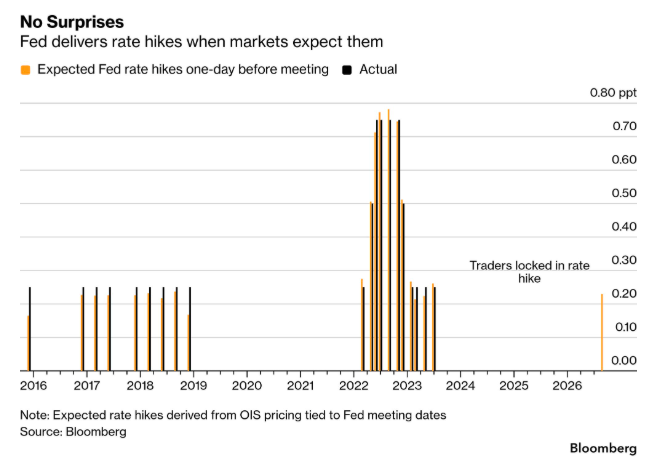
Deutsche Bank strategists have even concluded, based on federal funds futures data, that if the Fed does not raise rates on Wednesday, it would be the "biggest dovish surprise" at a routine policy meeting since 1994—when the Fed officially began announcing its interest-rate decisions at the conclusion of each policy meeting.
Caesar Maasry, head of investment research at Lunate, commented, "The market is simply not prepared for a hold or a dovish rate hike."
Historically, the Federal Reserve has sought to avoid surprising the market, particularly during periods of rate hikes, as such surprises can trigger sharp market volatility.
Of course, tonight's interest-rate decision—crucial for rate hikes—also comes against an unusual backdrop, as U.S. President Trump, who once promoted Walsh, repeatedly pressured the Federal Reserve to cut rates sharply during former Fed Chair Powell's tenure. And in recent weeks, Trump has continued to call for rate cuts.
Moreover, since Powell took the helm of the Federal Reserve in May and abandoned the Fed's longstanding practice of providing advance notice of policy moves, uncertainty surrounding his decision-making has also increased.
This became abundantly clear in late July, when traders assigned a 38% probability to a rate hike on the day the decision was announced—only for the Fed to ultimately hold rates steady. At the July meeting, Wash's vague remarks on the plan to combat inflation partly triggered a sell-off in long-term U.S. Treasury bonds.
However, this time, the market's level of confidence is indeed much higher.
Following Federal Reserve Chair Jerome Powell's remarks last month that the Fed would ensure inflation cools at a "sufficiently rapid pace," market expectations for a September rate hike began to rise. As of last Friday, after the latest CPI data showed little sign of easing inflation—U.S. inflation has now exceeded the Fed's target for more than five consecutive years—traders had virtually fully priced in a rate increase.
Following the release of the report, Morgan Stanley promptly revised its forecast, predicting that the Federal Reserve will raise interest rates in September and December. Citi, Goldman Sachs, and JPMorgan have also abandoned their earlier stance that the Fed would hold steady, instead now expecting a 25-basis-point rate hike this month.
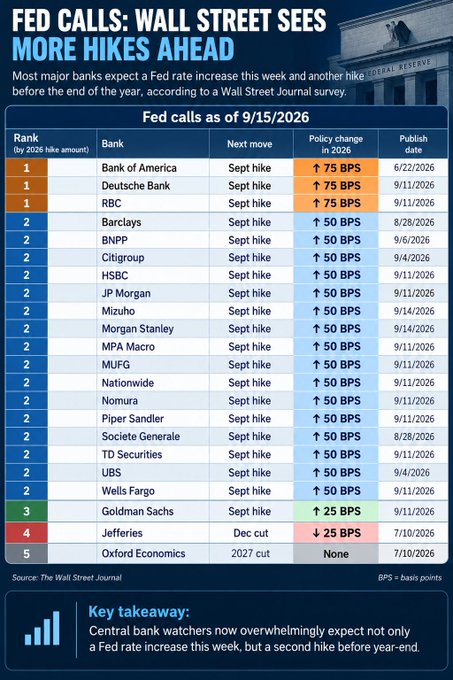
Jason Thomas, Global Head of Research and Investment Strategy at Carlyle, stated that the Federal Reserve is currently under "immense pressure" to raise interest rates by 25 basis points. "The persistent buildup of price increases has placed a heavy burden on American households, with real living standards declining. I believe the Fed must earnestly fulfill its core mandate of maintaining price stability."
In the bond market, as traders brace for the possibility of Fed rate hikes to address inflation concerns, the benchmark 10-year Treasury yield climbed further on Tuesday to its highest level since 2007. Meanwhile, the 2-year Treasury yield also reached its highest point since 2024.
Holding data show that investors generally expect the bond market's downturn to persist, with extremely weak willingness to buy on dips. JPMorgan's latest Treasury client survey indicates that, over the past week, spot-market traders have been building short positions at the fastest pace since early 2025.
Analysts note that if the Federal Reserve fails to raise interest rates as scheduled this week—or if it does raise rates but provides insufficient clarity on the path ahead—traders may demand higher long-term Treasury yields to hedge against inflation risk, while also pushing short-term yields, which are closely tied to the Fed's policy rate, lower.
However, it's worth noting that although a Fed rate hike tonight is all but assured, some traders are still hedging against upside surprises—going so far as to bet on the highly unlikely scenario of no rate increase.
In Tuesday's short-term interest-rate options trading, demand surged for the currently inexpensive October and November call options linked to the Secured Overnight Financing Rate (SOFR) futures, a product that is likewise heavily influenced by the outlook for monetary policy.
Of course, this remains a fringe view at present. The SOFR options market as a whole has priced in a greater risk premium for rate hikes in the near‑month futures contracts over the coming months.
"This week's Federal Reserve decision will be the most critical moment we've faced in quite some time," noted Alex Cohen, a foreign-exchange strategist at Bank of America. "With market expectations for a rate hike already priced in at around 90%, if policymakers choose to hold steady at this juncture, it could trigger unprecedented volatility."
 Stay ahead of the financial news and spot investment opportunities early! Open Futubull > Market > U.S. Stocks >Economic Calendar/Selected Macroeconomic Data, seize the initiative in investment!
Editor/lambor