The Fed's rate hike tonight is all but certain, but the key question is "what it says afterward." Citi has framed this move as a "fine-tuning," suggesting that further hikes are not inevitable, yet warns that without clear forward guidance, Chairman Powell could trigger sharp market volatility. Meanwhile, Goldman Sachs bluntly argues that this rate hike lacks a solid economic foundation, with inflation driven solely by one-off factors, and expects it to be a "signal-free hike."
Wall Street is holding its breath ahead of the Federal Reserve's interest-rate decision on Wednesday. Citi and Goldman Sachs have, in a rare move, converged sharply in their core assessment: a rate hike this time is all but certain, but it will be a "dovish hike"—the hike itself is not the main point; what matters is what the Fed says afterward, or rather, what it fails to say.
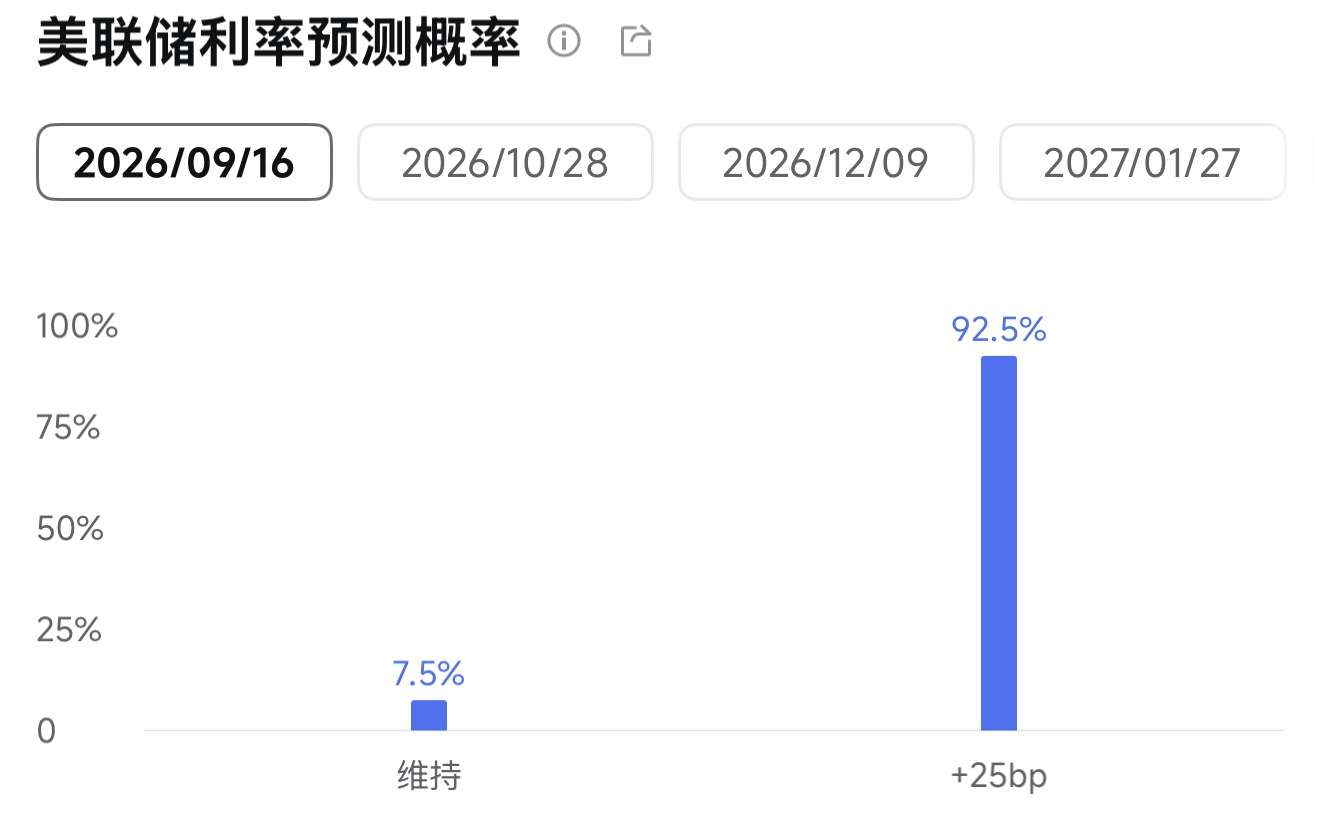
In its latest research report on September 15, Citi noted that its baseline forecast suggests the Federal Reserve will characterize this rate hike as a "calibration" move and signal that no further hikes are inevitable. Meanwhile, in a report issued on September 13, Goldman Sachs stated that tonight's hike will be a "signal-free increase" and explicitly emphasized that it does not believe this rate hike is economically justified; the portion of inflation exceeding the 2% target can be entirely attributed to one-off factors, and the economy is not overheating.
 Both Citi and Goldman Sachs expect the median dot plot to show only one additional rate hike in 2026, with rate cuts resuming in 2027. Core PCE forecasts are expected to be revised downward from the June data due to methodological changes, providing data support for pausing rate hikes.
Although the baseline scenario leans dovish, Chairman Powell's press conference will be the market's biggest suspense.
Citi believes that if Federal Reserve Chair Powell refuses to provide clear forward guidance and merely emphasizes that "there is still work to be done," the market may reprice expectations of consecutive rate hikes in October and December, triggering sharp volatility in asset prices.
Goldman Sachs believes that Wash needs to emphasize at the press conference that the committee will "carefully assess" incoming data, signaling a wait for more information and thereby guiding the market to abandon its overconfidence in a rate hike in October.
Analysts believe that the key tonight is not whether to raise rates, but what will be said afterward. Every word from Mr. Warsh will be scrutinized under a magnifying glass by the markets.
Dove‑ish baseline scenario: Passive rate hikes and a tone of "fine‑tuning" set the stage.
Current market pricing has forced the Federal Reserve to make a choice. Goldman Sachs believes that, following the release of August CPI data, the market's pricing for a rate hike has approached 90%. To avoid a sharp market reaction from inaction, the Fed will be compelled to raise rates by 25 basis points at this meeting.
But this will be a thoroughly dovish move. Citi's baseline forecast suggests that the forward guidance accompanying the rate hike will no longer signal further increases in the policy rate. Fed Chair Powell is likely to downplay the rise in the policy rate as a "slight adjustment" or "calibration," and signal to the market that, should inflation show signs of returning to its target, additional rate hikes may not be necessary.
Goldman Sachs likewise expects the Federal Reserve to make only the bare minimum necessary changes in its statement, refraining from providing forward guidance on the future path—essentially delivering a "no‑signal rate hike."
Notably, Goldman Sachs expects Federal Reserve Governor Waller to vote against the decision. The reason is that, over the past three months, the annualized rate of core PCE inflation—adjusted for anticipated methodological revisions—has fallen to around 2.5%, below the 2.8% "no change" threshold Waller previously set in public remarks.
Goldman Sachs: Does not believe this rate hike is economically justified.
Unlike Citi's strategic analysis perspective, Goldman Sachs' economic research team, starting from fundamentals, explicitly stated that they do not believe there are sufficient economic grounds for this hike in the federal funds rate.
Goldman Sachs's core argument is that all of the overshoot of the 2% inflation target can be attributed to one-off factors whose effects will fade, including tariff impacts, energy/Iran conflict spillovers, software and accessory price dynamics, and portfolio‑management effects. Goldman Sachs believes that the improvement in core PCE inflation to an annualized rate of roughly 2.5% between June and August—taking into account the anticipated methodological revision—is an early sign that these one-off shocks are waning.
On the issue of inflation breadth, Goldman Sachs also disagrees. Although recently more categories have seen prices rise at an annualized rate exceeding 3%, Goldman Sachs points out that once the impact of tariffs is stripped out, the breadth of inflation is broadly comparable to levels observed during periods of 2% inflation—while the tariff shock has likely largely played out.
Moreover, Goldman Sachs's "Bottlenecks Tracker" indicates that at the industry level, capacity constraints are now slightly lower than pre-pandemic levels, and are concentrated primarily in a handful of sectors closely tied to the AI boom. The economy is not overheating—yet overheating is precisely the central rationale for raising interest rates under normal circumstances.
Macroeconomic evidence also suggests that a modest interest-rate hike is unlikely to effectively offset the larger inflationary effects stemming from supply shocks. This implies that, regardless of whether the Federal Reserve raises rates or not, its primary policy rationale remains to wait for the impact of past shocks to dissipate naturally over time.
For this reason, Goldman Sachs believes that some FOMC members are highly aligned with its inflation outlook, and the FOMC as a whole is reluctant to send any further signals of rate hikes at this meeting.
SEP Economic Forecast: The dot plot and the downward revision of the core PCE provide dovish support.
Several components of the Summary of Economic Projections (SEP) will collectively reinforce this dovish outlook.
Citi noted that the median dot plot indicates only one additional rate hike this year, with rate cuts resuming in 2027. This trajectory aligns with the Fed's current internal logic: a policy rate around 4% is already "slightly restrictive," and as inflation returns to its target, such restraint should be gradually unwound.
Goldman Sachs's assessment of the dot plot distribution is equally specific and precise: it expects a narrow majority of 10 to 8 to project only one rate hike by 2026 (with Waller and possibly other members voting for zero hikes). Goldman Sachs justifies this outlook by noting that some committee members hold ambivalent views about this round of rate hikes, while others prefer not to further fuel market expectations of additional increases.
In the June dot plot, Fed officials had still projected one rate cut each next year and the year after; whether this more distant "rate-cut expectation" remains intact is also one of tonight's key points. Goldman Sachs believes that, for the 2027 and 2028 interest-rate projections, the median dot in the dot plot may still indicate one rate cut each, with rates remaining at 3.625% and 3.375%, respectively, though both medians carry a slight upside risk.
However, Goldman Sachs also explicitly highlighted tail risks: if more committee members view this week's rate hike as a normal response to rising oil prices and AI demand, and see it as the start of a series of consecutive hikes, the risk of a majority supporting two rate hikes cannot be ignored.
As for the detailed economic forecasts, Goldman Sachs believes that Fed officials are highly likely to slightly lower both headline and core inflation expectations, primarily because they have factored in the downward impact of the PCE methodology revision scheduled for later this month—Waller's earlier remarks already indicated that the Fed's research team has high hopes for this adjustment. Goldman Sachs expects that, in the September SEP, the median 2026 core PCE inflation forecast will be trimmed modestly from June's 3.3% to 3.2%, providing data support for pausing rate hikes. In addition, GDP and unemployment projections may see only minor adjustments.
Warsh's Press Conference: The Market's Biggest Mystery
Despite a dovish baseline scenario, Citi warns that the most important—and hardest to predict—variable shaping the overall tone is how Chairman Walsh discusses this rate hike. Walsh's personal style tends to offer limited forward guidance, leaving ample room for the market to price in a more hawkish policy stance.
Citi believes that if Powell merely emphasizes "more work to do" without providing near-term rate guidance, this could be interpreted by the market as a red flag. Under such a hawkish scenario, the market might price in rate hikes at both the October and December FOMC meetings, and even extend the risk of further rate increases into 2027.
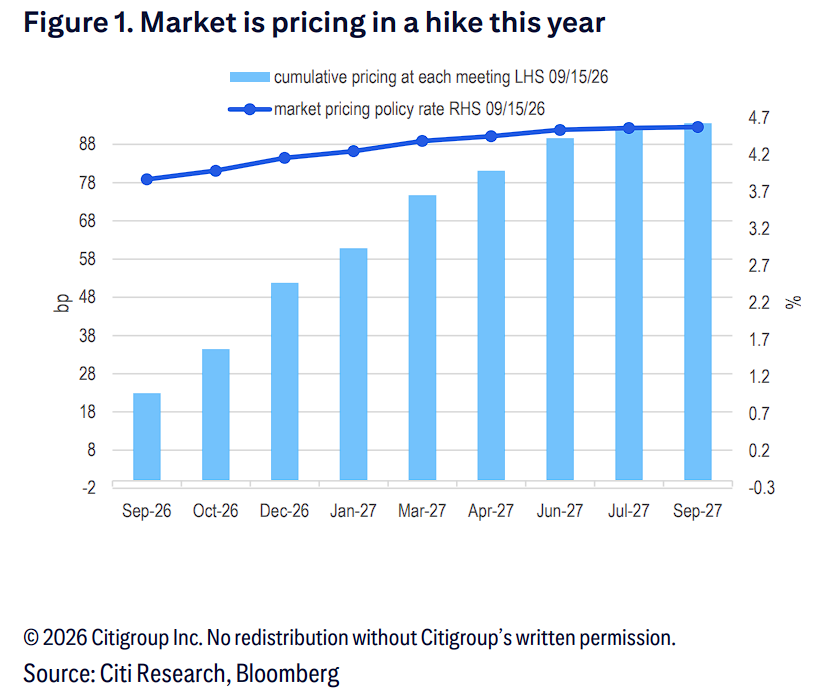
Goldman Sachs' assessment of this scenario is more specific: the FOMC may seek to nudge the market to lower its pricing of a rate hike in October—currently near 50%—but will not state this explicitly in its statement. Instead, at the press conference, Wash might indicate that, before deciding on further action, the FOMC will "carefully assess" the upcoming data, or hope to see multiple forthcoming inflation reports, or monitor how underlying inflation trends evolve—any of these formulations would suggest that the committee prefers to gather more data over a longer period before taking action.
Goldman Sachs also added that, since many investors have already viewed the midterm elections in early November as a political hurdle to a rate hike in October, it would not be difficult to prevent the market from setting an October rate hike as the "default baseline."
Goldman Sachs has outlined three scenarios:
Baseline scenario (50% probability): One rate hike this time, followed by one rate cut in September 2027 and another in December 2027, with the terminal rate at 3.25%–3.5%.
Multiple rate hikes scenario (35% probability): Ultimately, two to three rate hikes will be implemented, with a higher terminal rate.
Recession scenario (15% probability): Economic downturn, with a shift in monetary policy.
Even when fully accounting for the tail risks of multiple rate hikes, Goldman Sachs's probability-weighted federal funds rate forecast remains far more dovish than current market pricing. At the same time, Goldman Sachs has raised its terminal rate forecast from the previous 3%–3.25% to 3.25%–3.5%, and pushed back the timing of the first rate cut in 2027 from June to September.
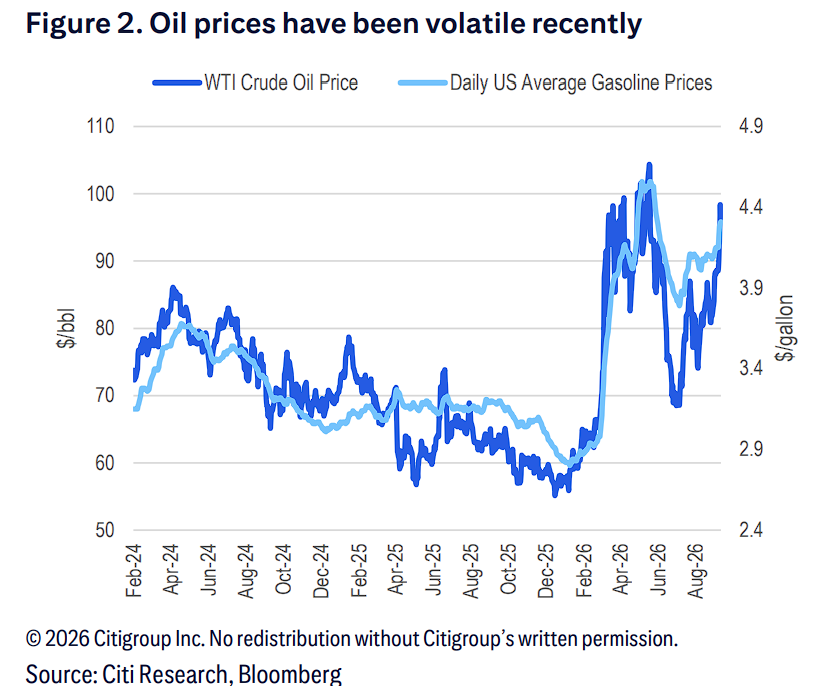
Meanwhile, Citi specifically noted that the recent sharp volatility in WTI crude oil and U.S. average gasoline prices has added further complexity to the inflation outlook and the Federal Reserve's policy trajectory. If energy prices remain persistently high, it could undermine the Fed's assessment that "inflation is on track to reach its target," thereby strengthening the stance of hawkish policymakers.
BMO Capital Markets strategist Vail Hartman said that even if the Federal Reserve raises interest rates tonight, the bond market could still face selling pressure if the dot plot or Chairman Powell's press conference conveys a more dovish stance and greater patience on inflation.
How will financial markets perform tonight?
JPMorgan's market intelligence team noted in its latest research report that, given this week's 25-basis-point rate hike has already been fully priced in, and the market is already aggressively betting on more than three cumulative rate hikes (76 basis points) by the end of the first quarter of 2027, the team and its institutional clients believe that tonight's key debate is centered on four points:
How much guidance and transparency can Walsh actually provide?
Has the market's pricing of a terminal rate hike of 75 basis points gone too far?
Given that Walsh favors a "pre‑emptive tightening" approach, will he opt for a more aggressive path of consecutive rate hikes in September, October, and December, or instead deliver a one‑off 50‑basis‑point surge in either October or December after September?
The policy path with the least resistance—could it simply be to completely erase Powell's "preemptive rate cut" scheduled for the end of 2025?
JPMorgan's baseline forecast is:
On transparency: the "less (said) is more" strategy of negative space is most likely to succeed.
On the magnitude of rate hikes: Two rate increases within the year (totaling 50 basis points) would be more reasonable, as by year-end the oil supply side is likely to reach an agreement that pushes prices lower.
On the pace of rate hikes: If the total increase amounts to only 50 basis points, the FOMC would find it difficult to justify a rapid, aggressive tightening cycle. Consequently, a "September–December" hiking path is more credible than a "September–October" one.
On reversing last year's rate cuts: Walsh firmly believes that the technological breakthrough in AI stands on the cusp of a singularity—one that will unleash productivity and spark a wave of disinflation. Accordingly, he would never regard a straightforward reversal of the earlier precautionary rate cuts as a panacea for today's inflation.
Below is JPMorgan's analysis of five possible scenarios surrounding the Federal Reserve's decision. JPMorgan believes that if the Fed holds rates steady tonight, that would actually be one of the biggest headwinds for U.S. equities. By contrast, a rate hike itself is not all that "terrifying"...
Scenario 1: No Interest Rate Hike
JPMorgan believes that if inflation expectations were to surge under this scenario, pushing 10-year and 30-year U.S. Treasury yields sharply higher, it would constitute a severe headwind for the stock market. Under such conditions, the S&P 500 is expected to decline by 1.25% to 1.75%.
Scenario 2: Interest rates are raised, but no forward guidance is provided.
This appears to be the prevailing market consensus: under these conditions, the yield curve could steepen further, though the upside in long-term yields would likely be constrained. Equity markets will look to bond‑market pricing of interest rates—specifically for December and March 2027—as a guide, which could provide support to equities, with large‑cap stocks expected to outperform. Under this scenario, the S&P 500 is forecast to rise by 0.25%–0.75%.
Scenario 3: Interest rates are raised, and the central bank signals that it will exit its accommodative policy by 2025.
Under this scenario, the stock market would price in a total rate hike of 75 basis points over the current cycle. The key question is whether Powell will opt for hikes in October and December rather than December and March of next year. A more rapid pace of tightening could be viewed more favorably, though this also hinges on Powell providing forward guidance to clarify his intentions. In this case, the S&P 500 is expected to rise by 0.5% to 1%.
Scenario 4: Interest rates are raised, while R* (the neutral interest rate) is also increased.
If the Federal Reserve provides no guidance on the precise level of R*, markets will look to economic theory, which suggests that current interest rates may be roughly 100 to 150 basis points below that neutral rate. The pace of rate hikes will be critical, and attention will also be focused on whether the Fed considers 50-basis-point increases at any meeting through 2026. Rising bond volatility would weigh on equities, with the S&P 500 expected to decline by 0.25% to 1% under this scenario.
Scenario 5: Interest Rate Hike, Pledge to Crush Inflation
JPMorgan views this as another tail-risk scenario, in which the terminal federal funds rate implied by Mr. Walsh would be substantially higher than in other scenarios. Equity markets could react much like they did during the 2022–2023 tightening cycle, potentially bringing an end to the current U.S. stock market bull run. Under this scenario, the S&P 500 is expected to decline by 1%–2%.
Want to pick stocks or analyze them? Looking to understand your portfolio's opportunities and risks? For all your investment questions,Just ask Futubull AI!

Editor/joryn