Author | Yiming Ma, Yao Zeng, Anthony Lee Zhang
Source | RFS
Translated by | Yang Muye
 In September 2026, Yiming Ma, Yao Zeng, and Anthony Lee Zhang published the paper "Stablecoin Runs and the Centralization of Arbitrage." The study examines the trade-off between price stability and run risk in fiat-backed stablecoins. The authors find that arbitrage is highly concentrated, with only a small number of arbitrageurs able to redeem each month on average from the largest issuer; more efficient arbitrage enhances secondary‑market price stability but reduces the impact of sell‑side price shocks, thereby amplifying panic‑driven runs. The policy implication is that price stability and financial stability serve different objectives, necessitating regulatory coordination among redemption mechanisms, reserve management, and profit distribution. The Fintech Institute at Renmin University of China has compiled and summarized the report's key findings.
Research Questions and Core Contributions
Fiat‑backed stablecoins promise to redeem each token at approximately one U.S. dollar, yet their reserve assets are not fully liquid, comprising bank deposits, Treasury securities, commercial paper, corporate bonds, and loans, among others. From early 2020 to early 2022, the combined market capitalization of the six largest dollar‑denominated stablecoins surged from roughly $5.6 billion to over $130 billion. Stablecoins could emerge as a payment alternative competing with fiat currency and bank deposits, making their risks and regulatory implications a subject of intense scrutiny. However, the relationship between stablecoin run risk and price stability remains far from clear. Unlike money market funds (MMFs) or commercial banks, the right to redeem at par is held only by a small cohort of institutional arbitrageurs; most investors can only buy and sell on secondary‑market exchanges, much like trading shares of an exchange‑traded fund (ETF). This paper seeks to answer: When and why do stablecoin investors engage in runs? And what is the link between price deviations and run risk?
The paper's first contribution is to document the high degree of concentration in stablecoin arbitrage. Taking USDT as an example, on average only six arbitrageurs participate in redemptions each month. Arbitrageurs are supposed to hedge against supply‑demand fluctuations: when the price falls below $1, they can buy on the secondary market and redeem at $1 from the issuer, thereby pushing the price back up. The second contribution shows that while constraining arbitrage undermines price stability, it may also reduce the likelihood of panic‑driven runs. Issuers back fixed redemptions with illiquid reserves; if a sufficiently large number of holders begin to sell, the issuer cannot meet redemption demands through fire sales, prompting other holders to sell rationally as well and triggering a self‑fulfilling run. The less effective arbitrage is, the greater the price impact of selling on the secondary market, which in turn discourages others from selling. Consequently, issuers must balance price stability against the risk of runs. The third contribution concerns policy implications: price stability and financial stability are driven by distinct forces and may conflict. Abolishing the two‑tier market structure that allows issuers to determine the level of arbitrage concentration would enhance price stability, but unless asset illiquidity is simultaneously reduced, it could exacerbate run risks.
Institutional Context and Market Structure
Stablecoins are blockchain-based assets that users can self-custody through crypto wallets. The largest issuers seek to maintain stability by pledging that each token is backed by at least one U.S. dollar held off-chain. As of January 2022, USDT and USDC together accounted for over 50% of the market, with a combined value of $76.4 billion. Stablecoins enable low-cost transactions and the holding of U.S. dollar‑denominated assets; for example, in cross‑border remittances, the sender purchases stablecoins on an exchange in Country A, sends them to the recipient in Country B, and the recipient then sells them back into fiat currency.
The stablecoin market is structured in two tiers. In the primary market, arbitrageurs send one U.S. dollar to the issuer, which "mints" the stablecoin; upon redemption, the arbitrageur returns the stablecoin to the issuer, which "burns" it and pays back one dollar—much like a money market fund. In the secondary market, most participants buy and sell existing stablecoins on exchanges, with prices determined by supply and demand—akin to trading ETF shares. Arbitrageurs bridge these two markets: when the secondary-market price falls below one dollar, they purchase and redeem, pushing the price back up; however, this selling pressure eventually spills over into the primary market, forcing the issuer to liquidate its reserves. If those reserves are illiquid, such fire sales can be extremely costly. USDC permits ordinary entities to register as arbitrageurs, whereas USDT imposes lengthy due diligence, restrictions on jurisdiction, a minimum transaction threshold of $100,000, and a redemption fee equal to the greater of 0.1% or $1,000.
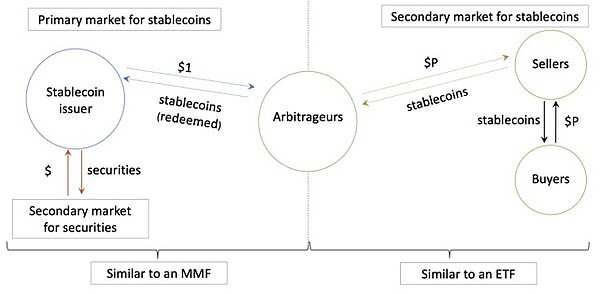
Figure 1: Fiat-Backed Stablecoin Design
Data and Typical Facts
The author constructs transaction-level data on the creation and redemption of six major fiat-backed stablecoins—USDT, USDC, BUSD, USDP, TUSD, and GUSD—covering the Ethereum, Avalanche, and Tron blockchains. The data are sourced from blockchain explorers such as Etherscan, Snowtrace, and Tronscan. The author aggregates wallets that clearly belong to the same entity, so the observed arbitrage concentration should be regarded as a lower bound of the true concentration. Secondary market data are derived from hourly closing prices on exchanges including Binance, Bitfinex, Bitstamp, Gemini, Kraken, and Coinbase, with volume-weighted daily prices calculated. Reserve asset data come from the self-reported balance sheets of USDT and USDC for 2021 and 2022.
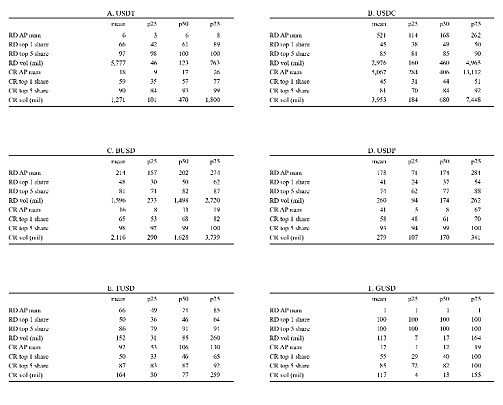
The first fact is that secondary‑market prices frequently deviate from the $1 par value. In our sample, stablecoins trade at a discount 27.2% to 41.6% of the time and at a premium 57.3% to 72.8% of the time. USDT trades at an average discount of 54 basis points, while USDC's discount is just 1 basis point; the median discount for USDT is 11 basis points, compared with less than 1 basis point for USDC. A discount does not equate to an MMF "breaking the buck," nor does it serve as a direct indicator of a run; the "stable value" of a stablecoin refers to the redemption price in the primary market, whereas secondary‑market prices—akin to ETF pricing—can diverge from net asset value due to selling pressure. The second fact is that primary‑market redemptions and creations are carried out by a small number of arbitrageurs. On average, USDT sees only six redemption‑arbitrageurs per month, with the largest accounting for 66%; by contrast, USDC has 521 such participants, with the largest contributing 45%. The average monthly redemption volume stands at $577 million for USDT and $2.976 billion for USDC.
Table 1: Monthly Redemption and Creation Activity in the Primary Market
The third observation is that the more concentrated arbitrageurs are, the more pronounced the secondary‑market price deviations become. When there are fewer arbitrageurs—such as with USDT—the average price deviation is larger; and the greater the share held by the top five arbitrageurs, the larger the price deviation. This raises a key question: if competitive arbitrage can stabilize prices, why not open up market access? The model in this paper identifies a countervailing force: panic runs. The fourth observation is that stablecoins engage in varying degrees of liquidity transformation. Neither USDT nor USDC reserves are fully liquid, with USDT being even less liquid. As of September 2021, USDT reserves consisted of 56.2% deposits and money‑market instruments, whereas USDC reserves were 100% deposits; additionally, USDT held 28.1% in government and corporate bonds, loans, and other assets.
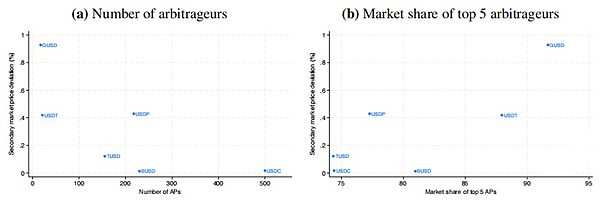
Figure 2: Concentration of Arbitrageurs and Price Deviation
Theoretical Framework: Run Risk and Arbitrage Concentration in a Two-Tier Market
The benchmark model is based on Diamond and Dybvig (1983) and features three time periods, t = 1, 2, 3, with no discounting over time. The risk-neutral agents comprise a continuum of stablecoin investors and n symmetric arbitrageurs. Assets include risk-free, liquid U.S. dollars and illiquid but potentially productive reserve assets. At t = 1, investors collectively hold a stablecoin backed by reserve assets, with its initial value normalized to one U.S. dollar. At t = 2, investors decide whether to redeem early or hold until t = 3 to capture long-term returns. Unlike bank depositors, investors cannot redeem directly from the issuer; instead, they must sell in the secondary market to arbitrageurs, who then redeem from the issuer. Let λ denote the fraction of holdings redeemed at t = 2. Arbitrageurs incur a two‑step transaction cost, χ represents balance-sheet capacity, and they are prohibited from holding net inventories. The issuer satisfies redemption requests by liquidating illiquid reserves at a discount φ. If λ
At time t=2, investors receive private signals about the fundamentals at t=3; following the global games literature, noise vanishes. The fundamental state θ determines long‑term value: with probability π(θ), the economy is in a good state, in which reserve assets yield R(φ) ≥ 1 and remaining investors enjoy a long‑run convenience benefit η; otherwise, reserves are worthless. Competitive bidding by arbitrageurs generates an inverse demand function. If the issuer is solvent, in a symmetric equilibrium each arbitrageur absorbs λ/n, and the price equals the marginal redemption value minus the marginal transaction cost, yielding p2(λ) = 1 − Kλ, where K ≡ 1/(nχ). In the event of default, p2(λ) = (1 − φ)/λ − Kλ. K is referred to as the arbitrage concentration, capturing the slope of secondary‑market demand; larger K implies more concentrated and less efficient arbitrage, while larger n or χ reduces K and mitigates price shocks.
The value v3(λ) that investors hold at time t = 3 depends on the amount of reserve assets the issuer must liquidate. More investor selling and a higher φ lead to more costly liquidation. The sell‑incentive function is h(λ) = v3(λ) − p2(λ). When π(θ) is sufficiently large, h(0) ≥ 0; in the first region, secondary‑price shocks give rise to strategic substitutability—more selling drives prices down, thereby discouraging further sales; in the second region, fire‑sale effects generate strategic complementarity—first‑mover advantages encourage a race to redeem; and in the third region, as reserves are depleted, additional early redemptions reduce each redeemer's payoff, producing a crowding‑out effect. This differs from the standard bank‑run model: in the standard framework, illiquidity invariably induces complementarity, whereas this paper identifies substitutability at low λ due to secondary‑arbitrage opportunities.
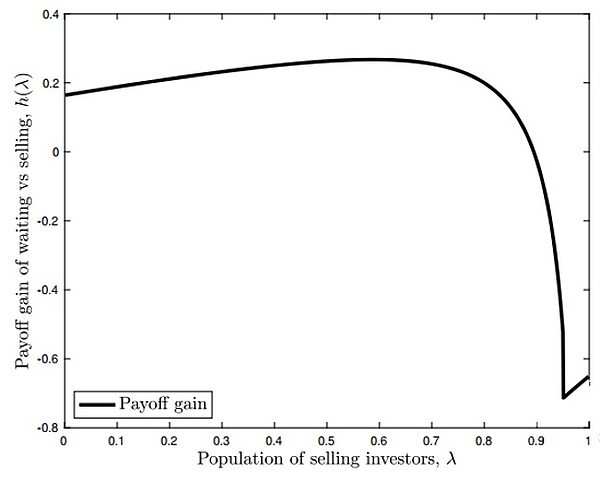
Figure 3: The yield differential between holding and early selling
The global game yields a unique threshold equilibrium: investors sell when the signal falls below θ*, and otherwise refrain from selling. Proposition 2 shows that run risk rises as K declines—that is, it increases with n and χ. More efficient arbitrage reduces the price impact of selling and boosts early‑sale returns, thereby exacerbating runs. The effect of reserve illiquidity φ on run risk is positive when g(φ) > K; however, when φ becomes excessively large, the region in which first‑mover advantage can be exploited shrinks, and further increasing liquidity conversion may, counterintuitively, reduce run risk.
Price Stability and Optimal Stablecoin Design
The extended model incorporates time periods t = 0 and t = 1. At t = 0, the issuer designs the primary market and selects the number of arbitrageurs, n, to maximize expected profits; investors then decide whether to participate, bearing a participation cost. At t = 1, liquidity traders trade stablecoins, generating price volatility. These traders buy or short‑sell, with equal probability, a fraction δ of the total market capitalization, and reverse their positions at period end. The stablecoin price, p₁, fluctuates between 1 − δK and 1 + δK. Investors derive a short‑run price utility of −αVar(p₁), meaning that greater price volatility reduces the asset's value as a medium of exchange. Lemma 2 shows that this price utility equals −αδ²K², which declines with K—i.e., it increases with both n and χ. The less efficient arbitrage is, the lower the secondary‑market elasticity, and the greater the price volatility induced by liquidity trading.
This gives rise to a trade-off: when K is low (arbitrage is effective), price stability is strong, but the risk of bank runs is high; when K is high, price stability is weaker, but the risk of bank runs is lower. Proposition 3 shows that, if the demand function is linear and φ is sufficiently small, the issuer's optimal K increases with φ: the less liquid the reserves, the more the issuer tends to concentrate arbitrage activities. This explains why USDT may hold assets with higher φ than USDC—because it cannot secure the same level of safe, liquid assets—and thereby reduce run risk through more concentrated arbitrage. The degree of arbitrage concentration is not merely a market friction; rather, it reflects the issuer's optimal choice between price stability and run risk.
Policy Implications and Calibration Conclusions
Stablecoins have drawn regulatory attention in many jurisdictions. This paper emphasizes that low run risk and price stability are driven by distinct forces. First, redemption and primary‑market access: the EU proposal mandates unconditional, immediate cash redemptions for all holders, while the UK draft permits a temporary suspension of "next‑business‑day redemption obligations." The analysis suggests that unconditional redemptions—by enhancing arbitrage efficiency and reducing K—lower price variance but increase run risk; imposing redemption fees or thresholds on arbitrageurs, by contrast, resembles concentrated arbitrage, leading to greater price stability but reduced run risk. Second, reserves and liquidity transformation: more liquid reserves mitigate run risk at a given level of arbitrage concentration, yet they incentivize issuers to lower K, partially offsetting this effect; thus, reserve policies must be coordinated with redemption policies. Third, dividend payouts: holding constant arbitrage efficiency, positive dividends strengthen investors' incentives to hold until t = 3, thereby reducing run risk; in equilibrium, issuers optimally choose less concentrated arbitrage sectors, boosting price stability, though the impact on run risk remains uncertain.
The author calibrates USDT and USDC as follows: φ is proxyed by repo haircuts, p(θ) by CDS prices, and η by Aave's lending rates. The calibration reveals that both face economically significant run risks. In September 2021, the probabilities of a run on USDT and USDC were 2.495% and 2.134%, respectively. USDT's vulnerability stems from its higher liquidity‑conversion capacity, whereas USDC's fragility arises from insufficient concentration of arbitrage activity. Policy simulations show that when dividends rise from 0% to 4%, the run probabilities for USDC and USDT decline by 1.34% and 0.80%, respectively; similarly, an increase in redemption fees from 0% to 50 basis points reduces these probabilities by 2.01% and 2.38%, respectively. Regulators can monitor the number of arbitrageurs, the share of the top five arbitrageurs, and the regression coefficients linking price deviations to net redemptions—metrics that are available in real time on public blockchains.
The paper concludes that stablecoin runs stem from liquidity transformation: issuers hold illiquid assets yet offer arbitrageurs a fixed $1 redemption price in the primary market. The arbitrage mechanism serves as a "firewall" between the secondary and primary markets. The more effective the arbitrage, the better price stability becomes, but the higher the run risk; conversely, less effective arbitrage undermines price stability while reducing run risk. From a policy perspective, allowing unrestricted redemptions can enhance arbitrage efficiency and improve price stability, albeit at the cost of elevated run risk; the dampening effect of dividend‑like payouts on run risk should also be considered. A well‑designed and secure stablecoin framework must balance price stability and run risk, coordinating redemption, reserve‑building, and yield‑distribution policies.