
Author: Luke Nolan Source: CoinShares Translation: Shan Oba, Golden Finance
I. Executive Summary
In the second quarter of 2026, the listed mining industry as a whole fell below its cash breakeven point. Bitcoin closed at $58,400 at the end of the quarter, less than half of its October 2025 all-time high. For the first time since China's ban, the network experienced a six-month decline, with hash rate about 50% below its trend level, and the monthly average hash rate price in June hit a record low of $27.7 per PH/s per day.
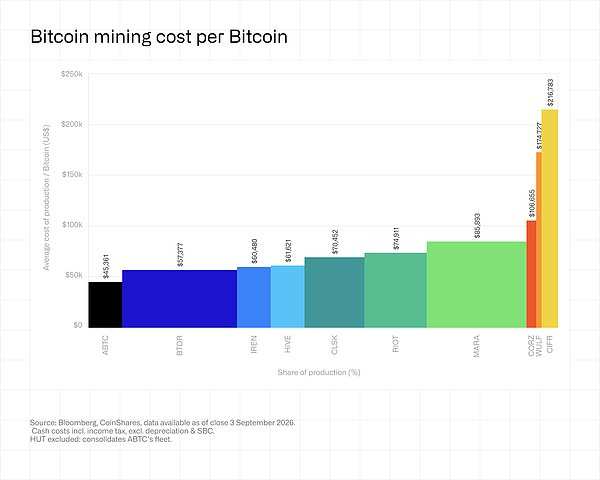
In the second quarter of 2026, the average pre-tax cash cost for listed miners to produce one Bitcoin is approximately $75,500.
 Three key themes emerged this quarter:
To halt mining payments: Core Scientific paid $41.9 million to cancel 15 EH/s of next-generation Proto hardware. Keel ceased mining on June 29 and will report zero mining revenue in the third quarter, while at least 35 EH/s of hash rate will exit the public market once IREN and Cipher complete their delistings. Keel and Cipher have also sold their BTC reserves, redirecting funds toward data center development.
Regulators are turning existing power‑connected sites into scarce assets: at least 225 bans or restrictions on data center construction have been recorded across 30 states, with 151 still in effect, and New York has introduced the first statewide moratorium. The U.S. interconnected grid capacity stands at roughly 2,600 GW, surpassing the nation's total installed capacity, while data centers account for 87% of ERCOT's 410 GW peak load portfolio. A recent transaction valued three fully leased AI data centers at approximately $27 million per MW, whereas some publicly listed miners report unleased but powered capacity at less than $3 million per MW. Existing grid access is becoming increasingly valuable.
The premium has already been priced in, but the revenue remains unrealized: companies with contracted AI or HPC capacity trade at an average EV/NTM sales multiple of 12.9x, compared to 3.7x for miners without contracts. Keel is an exception, trading at 18.3x despite having no contracted tenants. With over $100 billion in disclosed backlog, this currently supports only about $1.1 billion in annualized AI/HPC revenue—of which roughly 550 MW is billable, while more than 4 GW is under contract. Valuations will increasingly hinge on converting contracted capacity into billable revenue.
II. Regulation is turning already‑connected sites into scarce assets.
A new constraint has emerged in the United States, which we believe is fundamentally repricing the asset base of publicly listed miners: building new data centers is becoming increasingly difficult. According to ElectricChoice's tracking, at least 225 bans or restrictions on data center construction have been recorded across 30 states, with 151 of them still in effect.
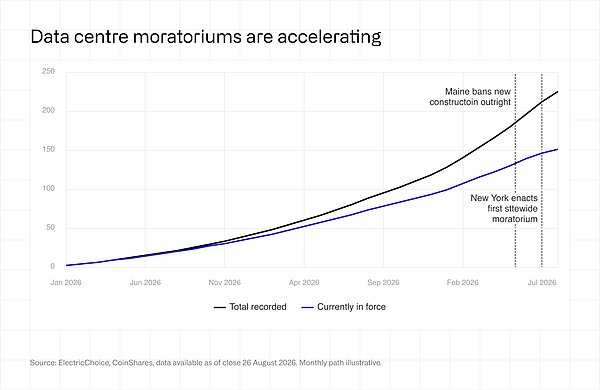
The most significant development occurred on July 14, 2026, when New York became the first state to impose a statewide moratorium, suspending environmental permits for facilities of 50 MW or larger for one year. Maine went even further, enacting a complete ban on new data center construction in April 2026, while restrictions have proliferated at the county level in states such as Ohio, Michigan, Georgia, and Indiana—where more than one-third of counties have already adopted measures to curb development. Crucially, projects that have already completed permit applications are typically grandfathered, meaning existing permits now carry option value that new entrants cannot replicate. Regulatory barriers have exacerbated already severe grid bottlenecks.
According to the Queued Up study by Lawrence Berkeley National Laboratory, the U.S. interconnection queue stands at approximately 2,600 GW—roughly twice the country's total installed capacity—and for projects slated for completion by 2025, the median time from application to operation now exceeds five years.
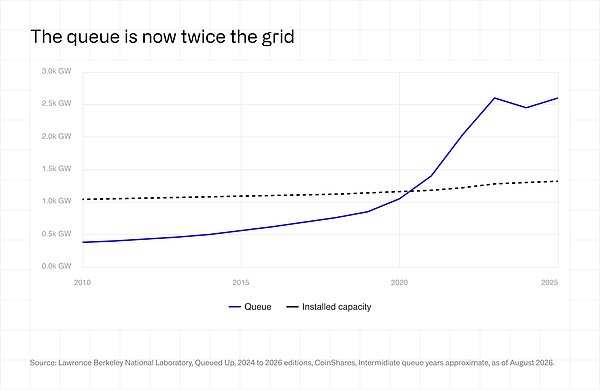
In the PJM region, projects commissioned in 2025 take an average of more than seven years from initial application to operational start-up, while transformer delivery lead times now exceed 160 weeks. ERCOT's own large‑load queue data show that data centers account for 87% of the 410 GW queue. The practical consequence is that, no matter how ample the capital, existing power‑supplying sites cannot be rebuilt within commercially viable timeframes.
The market has responded by assigning substantial premiums to existing space. According to CBRE, despite a 36% year-over-year increase in supply, first‑tier vacancy rates fell to a record low of 1.4% by the end of 2025 and further declined to just 0.3% in Northern Virginia by the first quarter of 2026, while pre‑leasing rates hover around 70%, compared with the historical norm of 40% to 50%.
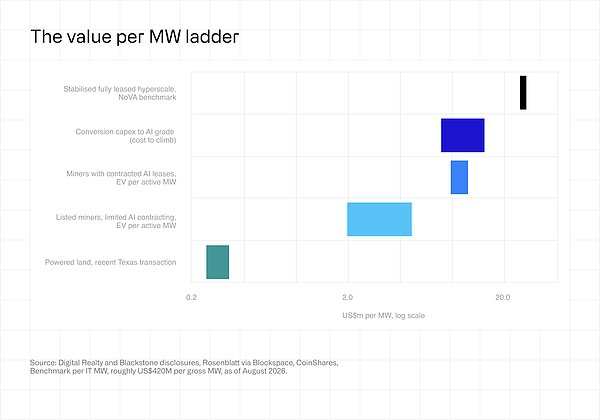
Recently, the acquisition of three leased AI facilities in Northern Virginia for $3.5 billion has established a benchmark of approximately $27 million per MW for stable AI infrastructure. Publicly listed miners with energized but unleased capacity are currently trading at a fraction of this benchmark—sometimes below $3 million per MW—for assets that require only tenants rather than permits.
This repricing is perhaps best illustrated by a publicly listed mining company that, in 2024, turned down an acquisition offer valued at just over $1 billion, only to agree a year later to a $9 billion all‑stock sale—nearly a ninefold increase for essentially the same 1.3 GW footprint. Then, in October 2025, shareholders deemed even that price insufficient and rejected it. More recently, another major operator agreed to pay up to $600 million—roughly $300,000 per MW—to acquire a Texas land site with 2 GW of grid‑connection capacity and no existing infrastructure, sending its stock price up 15% following the announcement.
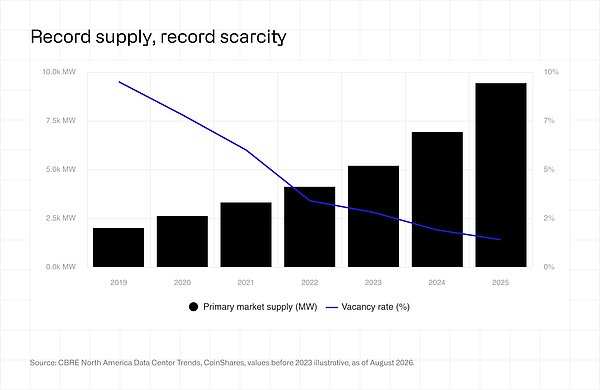
It is important to note that power‑supply capacity is a necessary but not sufficient condition. The cost of converting mining infrastructure into AI‑grade facilities is estimated at $8 million to $15 million per megawatt, compared with $700,000 to $1 million for mining; accordingly, the premium largely accrues to operators with credible upgrade pathways and committed tenants. Nevertheless, the trajectory is clear: regulatory developments and grid congestion have reversed the historical discount applied to mining sites, transforming what was once regarded as idle, low‑value infrastructure into one of the most scarce sources of licensed power capacity in the United States.
III. Stop Mining by Spending Money
In the second quarter, Core Scientific paid $41.9 million to terminate its agreement with Block's Proto division, canceling the delivery of approximately 15 EH/s of next-generation 3-nanometer chips. To date, these chips have been the most energy-efficient mining hardware.
Core Scientific's mining operations are deliberately operating at a loss, with a self-mining gross margin of -56%. Management stated that the remaining miners currently in operation are being used solely to offset contractual power obligations, while the sites are undergoing conversion.
The section title is deliberately bolded, reflecting the culmination of trends over the past two years: many Bitcoin miners are transitioning to hybrid Bitcoin mining and hosted computing services, or to pure hosted computing services, moving away from what they now call their traditional business. Numerous examples illustrated this in the second quarter:
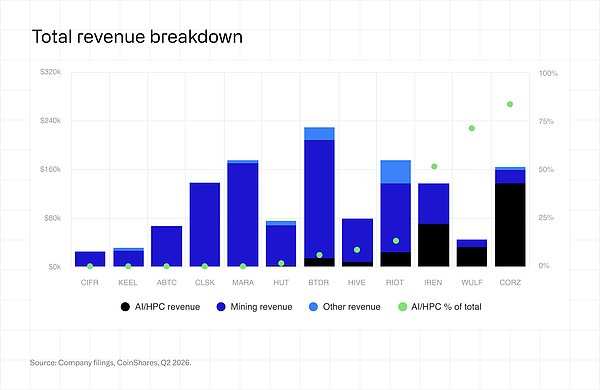
Keel (formerly Bitfarms) has now officially shut down its Bitcoin mining operations. Its Moses Lake facility ceased mining in April, while its Panther Creek, Scrubgrass, and Sharon sites stopped on June 29. This is reflected in its second-quarter gross margin of -285%, as it accelerated depreciation on decommissioned mining equipment to offset costs. Its third-quarter mining revenue will be zero. It is the first publicly listed miner to reach this milestone. Keel also sold 1,085 BTC at an average price of $69,100 ($75 million). As of August 7, it held only 1,861 coins and has indicated its intention to liquidate its entire position by year-end.
Cipher Digital (formerly Cipher Mining) stated that it will no longer incur any capital expenditures for mining and expects mining to become negligible by 2030, likely exiting entirely by the end of 2027. In the second quarter, it mined 346 BTC, entirely from its Odessa site, which benefits from a fixed electricity contract at nearly 2.8 cents per kilowatt-hour. Very much like Keel, Cipher Digital sold $123.4 million worth of Bitcoin in the first half of 2026 at an realized loss of $47.7 million—selling below cost to finance construction for tenants. It now holds 646 BTC.
IREN stated in its 10-K that its transformation from mining to AI will be largely completed by December 31, 2026. Its latest quarterly report showed a $450.4 million impairment charge due to the retirement of mining equipment, as well as a $102.1 million write-down on mining rigs for sale. In addition, IREN recorded a $25.1 million loss on disposals. Fittingly, AI cloud revenue ($70.5 million) surpassed mining revenue ($66.7 million) for the first time. At present, IREN holds no Bitcoin at all (it almost always sells its daily output).
TeraWulf is also deepening its transformation toward AI. In the first half of 2026, two mining facility buildings at Lake Mariner were decommissioned, resulting in a $25.7 million impairment of mining assets and shortening the useful lives of other facilities. HPC leasing now accounts for 71% of TeraWulf's total revenue, and mining disclosures have been downgraded to align with this: the 179 BTC mined in the second quarter did not appear in the press release or the earnings call, but only in the 10-Q filing.
Bitdeer currently holds 150 BTC, a significant drop from 1,502 a year ago, and disposed of $195.5 million worth of assets during the quarter. HIVE sold 918 of the 1,004 coins it mined in the second quarter, with an additional 46 held as equipment deposits—effectively using these coins to fund mining rigs while they are in operation.
Bitcoin mining has not died. We are witnessing a wave of publicly listed miners shifting their business models to capitalize on favorable and seemingly sustained tailwinds. As discussed in the next section of this report, computing power is changing hands, and ultimately, the price of a Bitcoin can—and will—alter the economics underlying these decisions.
IV. Network Computing Power and Hash Price
The Bitcoin mining network has just experienced its most severe period since the halving in April 2024. From a peak of around 1,160 EH/s in early October 2025 to a drop to 850 EH/s by early February 2026, the decline from peak to trough was approximately 27%. Moreover, the first six-month decline in the first half of 2026 was the first since China's ban in 2021. Hash price—the revenue miners earn per unit of computing power—fell to an all-time low, remaining at or below the industry-wide breakeven point for much of the first half of the year. On the surface, these figures appear alarming. However, when compared with historical trends, they reflect a familiar phase in the mining cycle rather than a structural shift.
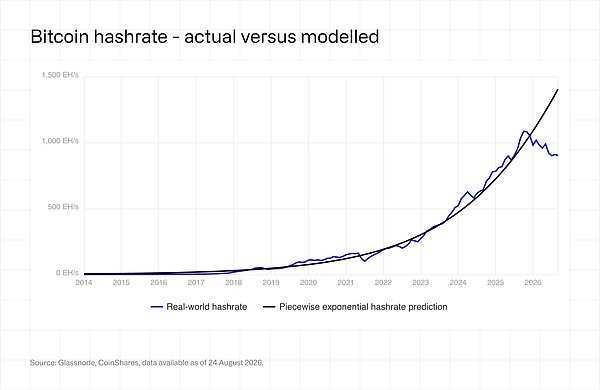
The most effective way to assess the trajectory of Bitcoin hash rate is to analyze historical patterns. Qualitative reasoning suggests that growth is partly driven by Bitcoin's price, as positive expectations encourage miners to expand capacity in anticipation of profits—though this hinges on assumptions about future prices. Given the volatility of hash rate, measuring its deviation from the trend yields more accurate results than relying solely on qualitative judgments; we have previously explored this in our work here. We previously employed out-of-sample trend lines but have since adopted our more recent piecewise modeling approach, which we discuss in detail here, using historical trend lines to identify such deviations.
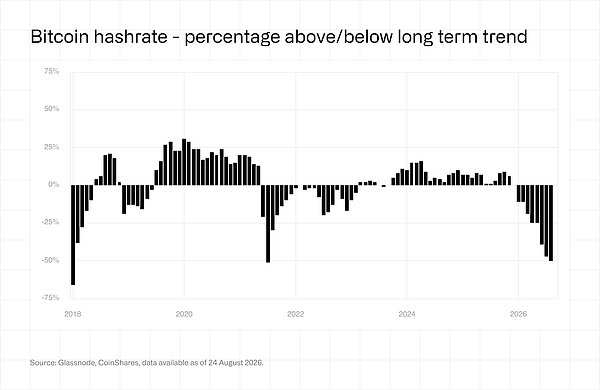
This framework reveals a striking pattern of volatility across halving cycles. During the 2012, 2016, and 2020 halvings, hash rate typically fell about 50% below its trend line within six months after each event. The 2021 Chinese ban was particularly abrupt and severe due to its sudden nature. We note that this figure has been revised from the 42% reported in our January 2024 analysis, reflecting a recalibration of the trend line under our segmented‑index methodology, which has altered the scale of historical deviation measurements. The overall shape remains consistent: an initial decline, a recovery around the midpoint of the cycle, and a surge in activity roughly one year before the next halving. The logic is straightforward: miners ramp up capital expenditures ahead of each halving to stay competitive, pushing hash rate well above trend; the subsequent reduction in block rewards then constrains revenues and, in turn, curtails further investment.
The result has been a shortage of comparable depth to previous cycles, with hash rate now about 50% below the trend line—close to the trough on the recalibrated trend line following China's ban—though the decline has been more gradual. This time, we attribute the cause to the sharp rise in electricity prices in Texas at the start of the year, as well as miners' ongoing shift toward high‑performance AI computing. Whether the decline will continue will depend in part on the price of Bitcoin. At present, AI represents a financially more attractive option for miners: by our estimates, it generates roughly $1.5 million in annualized profit per MW, compared to just $500,000 from mining. However, a sustained increase in the price of Bitcoin could significantly alter this calculus and prompt some miners to reallocate capacity back to mining.
The current cycle follows the same pattern, albeit with a delayed timeline. After the network halved in April 2024, it did not immediately decline; instead, it continued to expand, surpassing 1 ZH/s for the first time at the end of August 2025 and reaching a peak in early October, adding roughly 300 EH/s during 2025. The reversal came in the fourth quarter, when hash rate fell by about 10% from its October peak, dropping to approximately 1,045 EH/s by the end of December. It then rebounded after falling to 850 EH/s in early February, accompanied by three consecutive difficulty reductions—the first such streak since July 2022. This decline mirrored a correction in Bitcoin's price, pushing traditional S19‑era hardware below breakeven. The breakeven electricity price for S19 XP dropped from around $0.12 per kWh in December 2024 to $0.077 per kWh a year later. Adding to this were rising winter energy costs, ERCOT's power rationing in November and December, and renewed regulatory inspections in Xinjiang that restricted operations without permanently curtailing capacity.
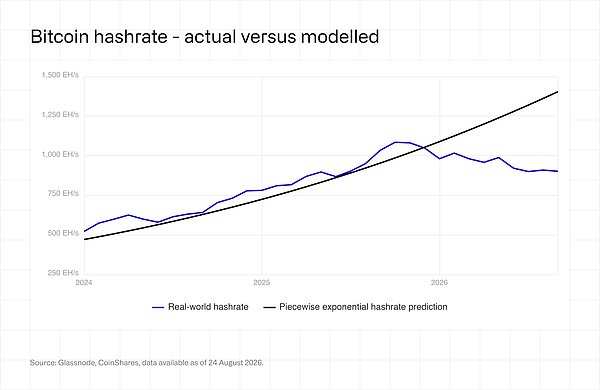
The downturn persisted into 2026. The network's 30-day average hash rate fell 5.8% quarter-over-quarter in the first quarter, marking the sharpest contraction in several quarters, with an estimated 252 EH/s of capacity going offline as machines became unprofitable. By July 13, the hash rate had declined by 17.5%, from 1,066 EH/s on January 1 to 879 EH/s; the closest precedent was the first half of 2021, when China's ban triggered a 25.9% drop. The capitulation has extended to the corporate level, with one of the largest publicly listed operators, TeraWulf, scaling back its mining fleet while repurposing its facilities for high-performance computing. Since then, the network has stabilized, with a seven-day average hash rate of around 920 EH/s by mid-August, and the difficulty reaching 127.48T after a 0.99% increase on August 8—roughly 18% below the record of 155.97T set on October 29, 2025.
Hash price tells the same story in terms of revenue and explains why capacity has gone offline. From a peak of roughly $63 per PH/s/day in July 2025, hash price steadily declined throughout the fourth quarter, reaching a five-year low of $35–$37 by November. It briefly rebounded to $38–$40 near year-end, but this recovery was short-lived, with the metric plunging to new lows in the first quarter. Monthly averages hit record lows in February and March, at $32.31 and $31.27 respectively, before falling further to $27.7 by late June. This compression reflected Bitcoin's price at about half its October 2025 all-time high, transaction fees consistently below 1% of the block reward, and difficulty levels remaining elevated relative to revenue despite recent declines. As Bitcoin rebounded to around $77,000, hash price has recovered to approximately $38 per PH/s/day, bringing most miners back above their cash breakeven point.
Although these price movements may appear concerning, the framework of trend deviations firmly anchors them within historical experience. Along the recalibrated trend line, the current roughly 50% deviation aligns with typical post‑halving troughs and remains shallower than during the Chinese ban, while the peak‑to‑trough decline of about 27% compares to 25.9% in the first half of 2021. On a logarithmic scale, this episode is far less severe than the period surrounding the Chinese ban. The underlying mechanisms differ—economic capitulation rather than a regulatory shock—but the sequence of prolonged above‑trend periods, trend reversals below trend, miner capitulation at the trough, and subsequent recovery is precisely what earlier cycles predicted. The robust rebound from the February low suggests that many operators still view mining as economically viable; if historical patterns hold, the network should enter its next expansion phase as the 2028 halving approaches, with the characteristic pre‑halving surge likely beginning around a year in advance.
Our segmented forecasting model had projected that network hash rate would reach 1.8 ZH/s by the end of 2026 and 2 ZH/s by the end of March 2027. The contraction in the first half of the year has pushed hash rate well below that trajectory, making these milestones now likely to materialize much later than originally anticipated. Meanwhile, the geographic distribution of mining continues to shift: the United States, China, and Russia together account for roughly 68% of global hash power. The U.S. has been gaining about two percentage points of share each quarter, while emerging markets—including Paraguay, Ethiopia, and Oman—have entered the global top ten, driven by operators such as HIVE (with 300 MW in Paraguay) and Bitdeer (with 40 MW in Ethiopia).
V. Mining Cost Analysis
5.1 Overview
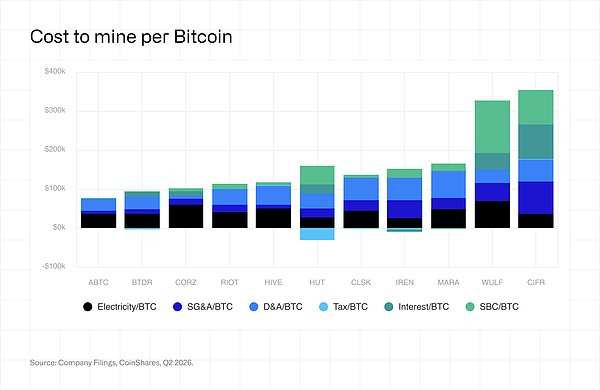
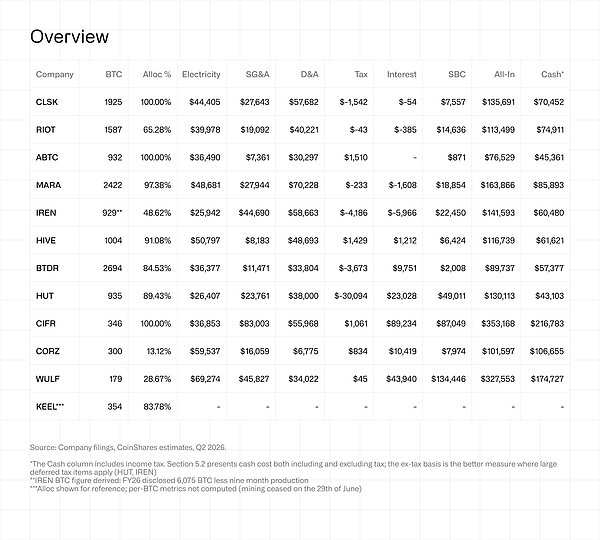
The table below shows the cost-per-Bitcoin breakdown for all covered miners in the second quarter of 2026. All figures are in U.S. dollars per mined Bitcoin, with costs allocated to proprietary mining using the revenue-sharing methodology described in the appendix.
Main observations:
• Cash profitability varies significantly. ABTC, BTDR, HIVE, and IREN mine at prices below the break-even point, while CLSK and RIOT are near breakeven. MARA reported a cash loss of approximately $15,800 per Bitcoin, with the higher costs for those who exited largely reflecting reduced production.
• Self‑operated mining allocations are increasingly impacting overall costs. At IREN, mining accounts for 48.6% of revenue, while at CORZ it stands at 13.1%, indicating that the majority of corporate costs are allocated elsewhere. Electricity typically offers the cleanest operational cost comparison, but this is not the case at WULF, where disclosed line‑item costs actually blend mining and HPC expenses.
• Taxes severely distort HUT's figures. Deferred tax benefits of $28.1 million bring the all-in cash cost to $43,103 per Bitcoin, compared with $73,197 before taxes. The pre-tax figure provides a better measure of mining breakeven.
• SBC remains a major differentiating factor. Ranges from $871 per Bitcoin for ABTC to $134,446 for WULF, exceeding the electricity costs of HUT, CIFR, and WULF. WULF's figure reflects a 28.7% allocation of its $83.9 million prize pool, distributed across just 179 Bitcoins (reflecting the company's shrinking production base as it moves away from Bitcoin mining).
5.2 Breakdown by Company
CLSK CleanSpark Inc
Mining Bitcoin: 1,925
Total cost: $135,691 per Bitcoin
Cash cost: $70,452 per Bitcoin
Cash cost (excluding tax): $71,995 per Bitcoin
*CleanSpark's June quarter is the third quarter of fiscal year 2026, as it has a September fiscal year end.
The company mined 1,925 Bitcoins, with a distribution ratio of 100.00%; its $138 million in mining revenue was its sole income, with no recorded托管 or HPC revenue. This makes CLSK the purest pure-mining stock in the report.
Electricity costs amounted to $44,405 per Bitcoin, while cash costs of $71,995 per Bitcoin nearly matched the realized revenue of $71,691 per Bitcoin. Depreciation and amortization remained the largest cost item, at $57,682 per Bitcoin, followed by selling and administrative expenses of $27,643 per Bitcoin.
SBC remains relatively manageable at $7,557 per Bitcoin, although, according to the company's disclosure, underlying quarterly expenses tripled year over year to $14.5 million. CleanSpark also signed its first HPC lease this quarter—a 20-year agreement in Sandersville valued at $6.6 billion over the base term. HPC contributed $0.0 in revenue in the third quarter of fiscal 2026, but the deal means CleanSpark will no longer be a pure mining company.
RIOT Riot Platforms Inc
Mining Bitcoin: 1,587
Total cost: $113,499 per Bitcoin
Cash cost: $74,911 per Bitcoin
Cash cost (excluding tax): $74,955 per Bitcoin
Riot's $39,978 per Bitcoin electricity cost (net ERCOT demand response credit) makes the $113,499 per Bitcoin all-in cost data competitive.
$74,955 per Bitcoin in cash costs slightly exceeds the $71,667 per Bitcoin in realized revenue, putting the company just above full cash breakeven. Its own direct mining cost of $49,912 per Bitcoin is very close to our calculated direct costs for electricity plus non‑electricity; the additional gap stems from other business operations. Mining contributed 65.28% of total revenue, which amounted to $174.2 million, so roughly one-third of that figure does not apply to the 1,587 Bitcoins produced.
The $28 million impairment charge related to Rockdale's repurposing from mining to a data center has been excluded from the cost analysis. Riot's transformation now encompasses a 191 MW, 20-year state-of-the-art AI lease valued at approximately $9.1 billion, along with targeted deployment capital expenditures ranging from $2.1 billion to $2.3 billion.
ABTC American Bitcoin Corp
Mining Bitcoin: 932
Total cost: $76,529 per Bitcoin
Cash cost: $45,361 per Bitcoin
Cash cost (excluding tax): $43,851 per Bitcoin
ABTC is the lowest-cost producer on the list, with an all-in cost of $76,529 per Bitcoin and a cash cost of $43,851 per Bitcoin, compared to realized revenues of $71,905 per Bitcoin. Its electricity cost is $36,490 per Bitcoin, which reflects the $34 million in custodial fees paid under its fixed arrangement with its 80%-owned parent, Hut 8, rather than the actual underlying costs of operating its mining fleet.
Hut 8's consolidated financial statements show that the direct costs for the same mining rig cluster do not exceed US$24.7 million, including approximately US$22.8 million in ASIC-specific costs, based on the disclosed 66% ASIC computing gross margin. The difference amounts to roughly US$11 million per quarter, or US$12,000 per Bitcoin, and is extracted by the parent company through an associated-party custodial pricing arrangement. This transfer price is fully borne by ABTC's minority shareholders and is eliminated in Hut 8's consolidated financial statements. Selling and administrative expenses of US$7,361 per Bitcoin and equity-based compensation of US$871 per Bitcoin are among the lowest in the table, while reported income tax expenses add US$1,510 per Bitcoin to the total cost.
MARA MARA Holdings Inc
Mining Bitcoin: 2,422
Total cost: $163,866 per Bitcoin
Cash cost: $85,893 per Bitcoin
Cash cost (excluding tax): $86,126 per Bitcoin
MARA mined 2,422 Bitcoins, but its cash cost of $86,126 per Bitcoin exceeded its realized revenue of $70,315 per Bitcoin by approximately $15,800 per Bitcoin. Consequently, the company incurred a full cash loss on its large-scale mining operations. Electricity costs amounted to $48,681 per Bitcoin, with $69.2 million of the $117.9 million electricity bill paid to third-party hosting providers. Additionally, total cost of revenue included $26.9 million, or roughly $11,000 per Bitcoin in non‑electricity direct costs, which were factored into the cash calculation.
Depreciation and amortization of $70,228 per Bitcoin accounted for the largest share of total costs, including $28.1 million in accelerated depreciation. Selling and administrative expenses increased by $27,944 per Bitcoin, while equity-based compensation added another $18,854 per Bitcoin. These costs brought the total cost to $163,866 per Bitcoin.
This quarter also resolved MARA's tax distortion issue. The $587.2 million valuation allowance eliminated the deferred tax benefit arising from fair-value accounting of Bitcoin holdings, leaving only a $233 per Bitcoin tax benefit in the cost calculation. MARA's policy permits it to sell its entire 53,822 Bitcoin reserve, while 64% of Exaion's $174.5 million acquisition cost remains unaccounted for; its Starwood venture capital aims to secure two data-center leases by year-end. Neither generated significant revenue this quarter.
IREN Iren Ltd
Mining Bitcoin: 929
Total cost: $141,593 per Bitcoin
Cash cost: $60,480 per Bitcoin
Cash cost (excluding tax): $64,667 per Bitcoin
*IREN's June quarter is the fourth quarter of fiscal year 2026, as its fiscal year ends in June.
The company's electricity cost of $25,942 per Bitcoin is the lowest among publicly listed miners, and its cash cost of $64,667 per Bitcoin remains below its realized revenue of $71,798 per Bitcoin. The primary cost pressure stems from building an AI platform while Bitcoin production is being scaled back.
AI cloud revenue reached $70.5 million, surpassing mining revenue of $66.7 million for the first time and accounting for 51.4% of total revenue. According to the company's disclosures, in fiscal year 2026, selling and administrative expenses tripled year over year to $128.3 million, headcount roughly tripled, five C-level executives were appointed, and the acquisitions of Mirantis and Nostrum were completed. Even after allocations, selling and administrative expenses contributed $44,690 per Bitcoin, equity-based compensation added $22,450 per Bitcoin, and depreciation and amortization totaled $58,663 per Bitcoin. Net interest income decreased by $5,966 per Bitcoin, thanks to $35.9 million in interest earned on a $7.6 billion cash balance, which offset $24.5 million in financing costs.
The 10-K filing states that the transition from Bitcoin mining will be largely completed by December 31, 2026, making this likely to be IREN's last full quarter as a Bitcoin miner. A $450.4 million impairment of mining hardware, a $102.1 million write-down of mining rigs held for sale, a $25.1 million loss on disposal, and $9.6 million in other operating expenses have been excluded from the cost analysis.
HIVE HIVE Digital Technologies Ltd
Mining Bitcoin: 1,004
Total cost: $116,739 per Bitcoin
Cash cost: $61,621 per Bitcoin
Cash cost (excluding tax): $60,192 per Bitcoin
*HIVE's June quarter is the first quarter of fiscal year 2027, as its fiscal year ends in March.
According to the company's disclosure, production increased by 147% year over year to 1,004 Bitcoins, with its Paraguay site expanding in scale and achieving an average hash rate of 24.0 EH/s. The cash cost of $60,192 per Bitcoin remains below the realized revenue of $71,773 per Bitcoin, and despite electricity costs of $50,797 per Bitcoin, it still maintains a healthy cash margin.
Depreciation and amortization were the largest cost contributors, at $48,693 per Bitcoin, reflecting the company's accelerated ASIC depreciation schedule. Selling and administrative expenses remained low, at $8,183 per Bitcoin, while interest expenses totaled $1,212 per Bitcoin. Hive sold 918 of the 1,004 Bitcoins it mined and transferred an additional 46 Bitcoins to Bitmain's equipment deposit, exercising a repurchase option at a price of $110,000, while holding 190 Bitcoins at quarter-end. It also raised approximately $276 million during the quarter, increasing its cash balance from $23.1 million to $208 million.
US$84.65 million in Swedish VAT provisions (due to an adverse appellate court ruling) has been excluded from the cost analysis. Additionally, US$10.90 million in Boden loans is contingent on a favorable ruling, and the related US$1.80 million receivable has been impaired. These legal and depreciation effects are significant accounting items, but the tax‑free cash figure of US$60,192 per Bitcoin indicates that, compared with quarterly realized revenue, the expanding mining operations remain quite profitable.
BTDR Bitdeer Technologies Group
Mining Bitcoin: 2,694
Total cost: $89,737 per Bitcoin
Cash cost: $57,377 per Bitcoin
Cash cost (excluding tax): $61,051 per Bitcoin
Bitdeer is the largest producer on the list, with a production of 2,694 Bitcoins, up 61% month-over-month, and recorded the second-lowest all-in cost at $89,737 per Bitcoin. Power costs stood at $36,377 per Bitcoin across both self-operated and joint-venture mining, thanks to an efficient 15.8 J/TH miner fleet and an average electricity cost of $44 per MWh. The cash cost of $61,051 per Bitcoin remains significantly lower than the realized revenue of $71,789 per Bitcoin.
This quarter's results support the high costs incurred for its vertically integrated SEALMINER model, but two accounting considerations warrant attention. The company transitioned from IFRS to U.S. GAAP on January 1, 2026, resulting in restatements of prior-period financial statements. It also spent $36.1 million on R&D, primarily for chip development, which has been excluded from cost analysis according to our standard reporting methodology. Allocating this expense would increase costs by approximately $11,300 per Bitcoin.
The interest rate of $9,751 per Bitcoin is the highest among the major miners in the table, reflecting the $1.8 billion in loans used for the construction of Tydal. Bitdeer also raised $463.8 million through its ATMs in the second quarter.
HUT Hut 8 Corp
Mining Bitcoin: 935
Total cost: $130,113 per Bitcoin
Cash cost: $43,103 per Bitcoin
Cash cost (excluding tax): $73,197 per Bitcoin
*Hut 8 provides a consolidated view of the ABTC mining rig cluster.
ABTC paid Hut 8 US$34 million to custody its mining fleet. On Hut 8's own books, that expense has now disappeared, leaving only the actual cost of running the machines: according to its disclosures, this amounts to no more than US$24.7 million. The roughly US$11 million discrepancy represents the profit Hut 8 earned from its subsidiary. ABTC's minority shareholders footed the bill; Hut 8's shareholders technically recouped it through the merger.
In terms of cost, the tax‑free figure is the one that should be used for comparison. The headline cash cost of $43,103 per Bitcoin is offset by $28.1 million in deferred tax liabilities (valued at $30,094 per Bitcoin), which do not represent cash received. Once this amount is excluded, the cash cost stands at $73,197 per Bitcoin, slightly above the realized revenue of $71,674 per Bitcoin.
The $23,028 per Bitcoin in interest comes from a $7.5 billion project note used to build the AI campus, while the $49,011 per Bitcoin in equity incentives stems from $51.2 million in quarterly bonus expenses—both representing substantial portions of the total cost.
CIFR Cipher Digital Inc
Mining Bitcoin: 346
Total cost: $353,168 per Bitcoin
Cash cost: $216,783 per Bitcoin
Cash cost (excluding tax): $215,723 per Bitcoin
Cipher's $353,168 per Bitcoin all-in cost is misleading, as it primarily reflects the company's transition to AI. Although mining accounted for 100.00% of reported revenue in the quarter, the enterprise costs associated with its 5.3 GW infrastructure portfolio were allocated to only 346 Bitcoins. Selling and administrative expenses contributed $83,003 per Bitcoin, interest $89,234 per Bitcoin, and equity-based compensation $87,049 per Bitcoin. Odessa's fixed power agreement at approximately 2.8 cents per kWh, combined with a $2.3 million credit for curtailment and power sales, kept the electricity cost at $36,853 per Bitcoin, providing the sole rationale for keeping the site operational.
In the first half of the year, interest expense of $125.9 million was fully offset by the amortization of the debt discount on the 2031 convertible notes, while $23.2 million in construction interest was capitalized. Cash interest payments for the first half totaled $63.9 million. Overall, it should be clear that the per-Bitcoin figure reflects the operating burden of the broader platform, rather than Odessa's marginal production cost.
CORZ Core Scientific Inc
Mining Bitcoin: 300
Total cost: $101,597 per Bitcoin
Cash cost: $106,655 per Bitcoin
Cash cost (excluding tax): $105,821 per Bitcoin
Core Scientific is the only company whose cash cost ($105,821 per Bitcoin) exceeds its all-in cost. The cash cost includes everything it spends to run its mining operations: electricity, plus approximately $19,800 per Bitcoin in employee and site expenses. The all-in cost starts with electricity and then adds depreciation and amortization as well as equity-based compensation; however, mining now accounts for only 13.12% of total revenue, so virtually none of these costs are allocated to Bitcoin mining.
Core Scientific's own segment disclosure shows $33.7 million in cost of self‑mined Bitcoin revenue, of which $23.8 million was cash (the remainder being depreciation). Spread across 300 mined Bitcoins, this amounts to approximately $79,300 in direct cash costs, with an average realized revenue of $71,783 per Bitcoin, consistent with the disclosed gross margin of -56%. According to the company's disclosure, the number of online miners has decreased by about 30% compared to the end of the first quarter, and the remaining mining fleet is operating solely to absorb contracted power obligations during the transition period.
WULF TeraWulf Inc
Mining Bitcoin: 179
Total cost: $327,553 per Bitcoin
Cash cost: $174,727 per Bitcoin
Cash cost (excluding tax): $174,683 per Bitcoin
TeraWulf disclosed only 179 Bitcoin production in its 10-Q. HPC lease revenue totaled $31.9 million, accounting for 71% of total revenue of $44.8 million, leaving 28.67% allocated to Bitcoin mining. With an all-in cost of $327,553 per Bitcoin and a cash cost of $174,683 per Bitcoin, TeraWulf cannot be compared on a unit‑economy basis: it is shutting down mining, while its AI business has surpassed the cost base.
The $69,274 per Bitcoin electricity cost is also overestimated, because the underlying revenue‑cost line (net $2.8 million in demand‑response credits) mixes mining electricity with HPC tenant‑passed‑through electricity costs. The $134,446 per Bitcoin equity incentive is unusually large: it allocates 28.67% of an $83.9 million group bonus—representing a mining share—to very small coin output, and thus fails to accurately reflect its mining costs. Interest adds another $43,940 per Bitcoin.
KEEL Keel Infrastructure Corp
Mining Bitcoin: 354
Total cost: Not applicable
Cash cost: Not applicable
Cash cost (excluding tax): Not applicable
Mining was discontinued on June 29, 2026.
Keel's line is missing from our table because there is no second-quarter cost-per-Bitcoin figure worth including. It was added to the analysis solely because the company mined 354 Bitcoins, cautiously marking the cessation of its mining operations (as disclosed by the company on June 29). Mining did account for 84% of its quarterly revenue, but it will be 0% in the third quarter. By all definitions of the term, Keel is officially no longer a Bitcoin-mining company.
VI. Performance and Valuation of Mining Stocks
Q2 saw a strong re-rating. Among the 12 companies covered, 10 posted gains ranging from 70% to 195%, with Keel leading at 194.4%, despite the company shutting down its mining operations during the quarter. IREN rose 33.4%, while ABTC was the only one to decline, falling 26.3%. With the exception of ABTC, every company outperformed Bitcoin's year-to-date performance, as BTC is down 10.1%. ABTC remains an outlier, with a year-to-date return of -67.2%, as the premium attached to its end-2025 listing continues to erode.
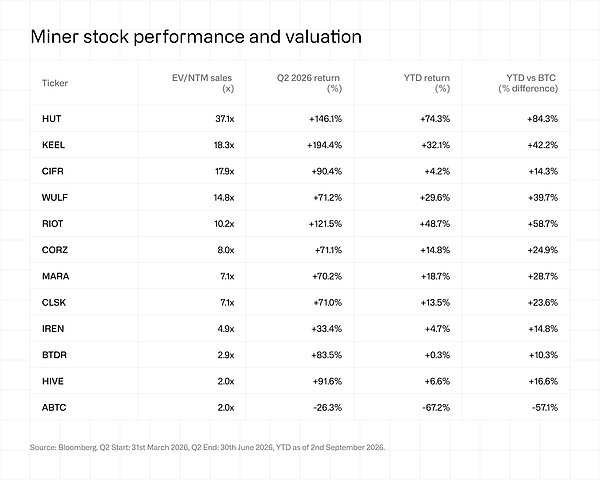
The valuation gap between mining‑oriented companies and AI‑focused firms has widened further. HUT, CIFR, WULF, and CORZ now trade at an average EV/NTM revenue multiple of 19.4x, compared with 6.6x for MARA, CLSK, RIOT, and HIVE. Companies with AI or HPC contracts command an average multiple of 12.9x. Among ongoing‑mining firms without such contracts, MARA, HIVE, and ABTC average 3.7x. Keel stands out as a notable exception, trading at 18.3x despite having no contracted tenants.
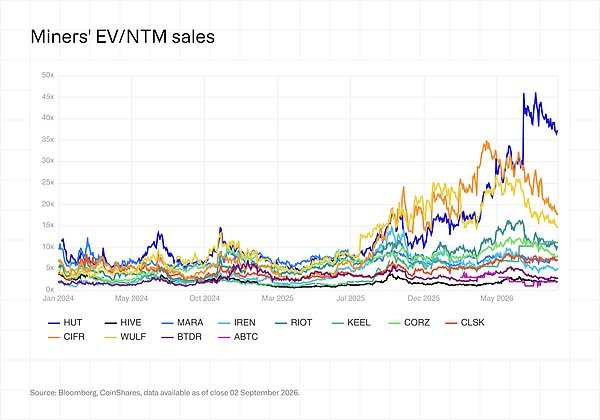
Valuations within the contract‑based group also vary significantly, ranging from 2.9x EV/EBITDA for BTDR to 37.1x for HUT. CORZ boasts one of the largest contract backlogs in the sector, yet it trades at a multiple of 8.0x, below RIOT's 10.2x, despite RIOT's much smaller contract backlog.
The extreme valuation ranges do require some context. HUT's 37.1x multiple—down from nearly 46x at the end of July—partly reflects the inclusion of $7.5 billion in project‑level debt raised in Q2, even though the associated revenue has yet to materialize. IREN trades at just 4.9x, as consensus estimates already factor in a portion of its $4 billion ARR target. CIFR provides perhaps the clearest illustration: despite a 90.4% surge in its share price in Q2, its multiple fell from roughly 35x in mid‑April to 17.9x, as Black Pearl revenues were baked into the forecast. As contracted projects move into revenue projections, multiples can decline even if the stock price rises.
Currently, the company's contracted IT capacity exceeds 4 GW, yet only about 550 MW is billed. With disclosed contract backlog exceeding USD 100 billion, annual colocation revenue remains below USD 800 million.
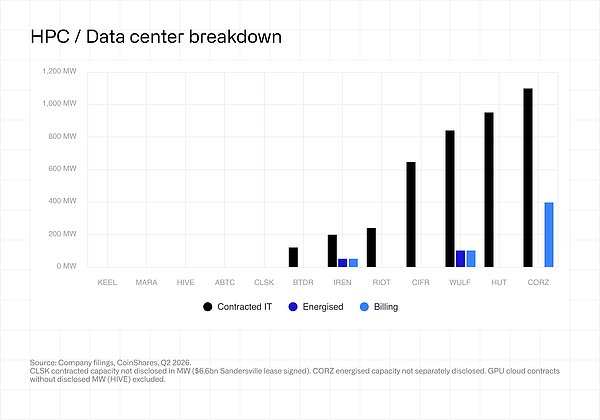
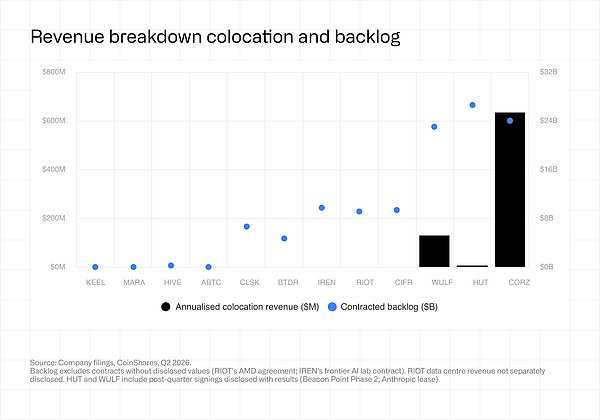
Companies that successfully bring their production capacity online as scheduled will see revenues catch up to their valuation levels; if projects are delayed, the current high‑valuation premium will become increasingly difficult to justify.
VII. Outlook for Q3 2026 and Beyond
At least 35 EH/s of hash power will exit the publicly listed mining sector: Keel has already completed its phase-out; IREN plans to finish exiting by December 31, 2026, with current installed capacity at 23.2 EH/s; Cipher is highly likely to exit by the end of 2027, with 11.6 EH/s at the Odessa site. TeraWulf is also scaling back its remaining 145 MW of mining capacity; the impact on the network's total hash rate will depend on whether the miners are scrapped outright or resold onto the market.
Bitcoin's price has rebounded, but it remains difficult to buck the broader trend toward AI transformation: Core Scientific shelled out $41.9 million just to cancel a 15 EH/s next-generation mining rig order; several companies have already signed 15-year hashpower lease contracts for their facilities. Going forward, additional mining capital expenditures are more likely to come from RIOT, MARA, HIVE, and Bitdeer—companies that still maintain operational flexibility.
Whether hash prices can continue to recover still depends on the Bitcoin price. At the end of Q2, when the price was $58,400, only ABTC, BTDR, HIVE, and IREN had cash costs below their actual output revenues in the sample. As Bitcoin rebounded to around $77,000, hash prices climbed back to $38 per PH/s per day. Key observation for Q3: Can Bitcoin stay above $70,000 for the entire quarter, thereby broadly improving mining profitability across the industry?
Miner hardware prices are likely to decline. Bitmain and Bitdeer's next‑generation miners, with power consumption below 10 J/TH, are slated for mass production in the second half of 2026; meanwhile, the canceled Proto 15 EH/s mining rigs may reenter the market. For companies that remain committed to mining, the economic rationale for upgrading equipment will improve.
In the second half of 2026, AI/HPC revenue will accelerate its realization. With over $100 billion in contracted orders, the current annualized actual revenue is only about $1.1 billion. Core Scientific already has 437 MW under billing; Cipher's Black Pearl began billing in August; IREN aims to achieve $4 billion in annualized operating revenue by December. We expect that, before the next report is released, the industry's overall annualized revenue will more than double.
Financing conditions are becoming an increasingly critical differentiating factor for companies. Hut 8 secured $7.5 billion in non-recourse project debt in Q2, while Cipher and IREN obtained financing at a 6% interest rate. Project-level financing costs are more informative than GAAP-reported net income. Notably, the three companies collectively recorded $1.95 billion in equity‑based revaluation losses this quarter.
Appendix: Methodology
Denominator: Bitcoins mined independently during the quarter.
Allocation: Self‑generated revenue / Total revenue. Applied to selling, general and administrative expenses, depreciation and amortization, stock‑based compensation, interest, and taxes.
Total Bitcoin cost = Electricity (less power restrictions) + Selling, general and administrative expenses (excluding stock-based compensation) + Depreciation and amortization + Net interest + Income tax + Stock-based compensation — all allocated as a share of mining revenue where applicable.
Bitcoin Cash cost = Operating costs (excluding depreciation and amortization) + Selling, general, and administrative expenses (excluding stock-based compensation) + Net interest + Income taxes — all allocated based on the share of mining revenue.
Electricity is the net amount after deducting power‑restriction/demand‑response credits. It excludes impairments, fair‑value revaluations, and non‑operating items (such as gains/losses on Bitcoin revaluations, changes in the fair value of derivative instruments, and debt‑conversion incentive expenses).
Unless otherwise specified, monetary amounts are expressed in thousands of U.S. dollars.