The Dow plunged 1.21%, hitting a new closing low since mid-June. IBM fell more than 4%, and Goldman Sachs dropped nearly 4%, leading the decline in the Dow. Most of the semiconductor sector closed higher, with Intel up 4.03% and AMD gaining 1.65%. The 2-year Treasury yield rose 7 basis points to 4.74%, the highest level since 2024.$U.S. Dollar Index (USDindex.FX)$It rose 0.5%. WTI crude oil closed down 3.6%. Spot gold at one point plunged 3% from its intraday high, hitting its lowest level since early August.
The Federal Reserve raised interest rates for the first time in three years and sent a strong signal that the tightening cycle is far from over. Hawkish rhetoric triggered a ripple effect across markets, putting downward pressure on U.S. stocks and gold, while the dollar surged to a one-month high and the yield curve steepened sharply into inversion.
At the close, the Dow Jones Industrial Average fell 631.33 points, a decline of 1.21%, to 51,461.78.$S&P 500 Index (.SPX.US)$It fell 33.59 points, a decline of 0.44%, to 7,552.14 points;$Nasdaq Composite Index (.IXIC.US)$It fell 3.15 points, a decline of 0.01%, to close at 25,978.43 points.
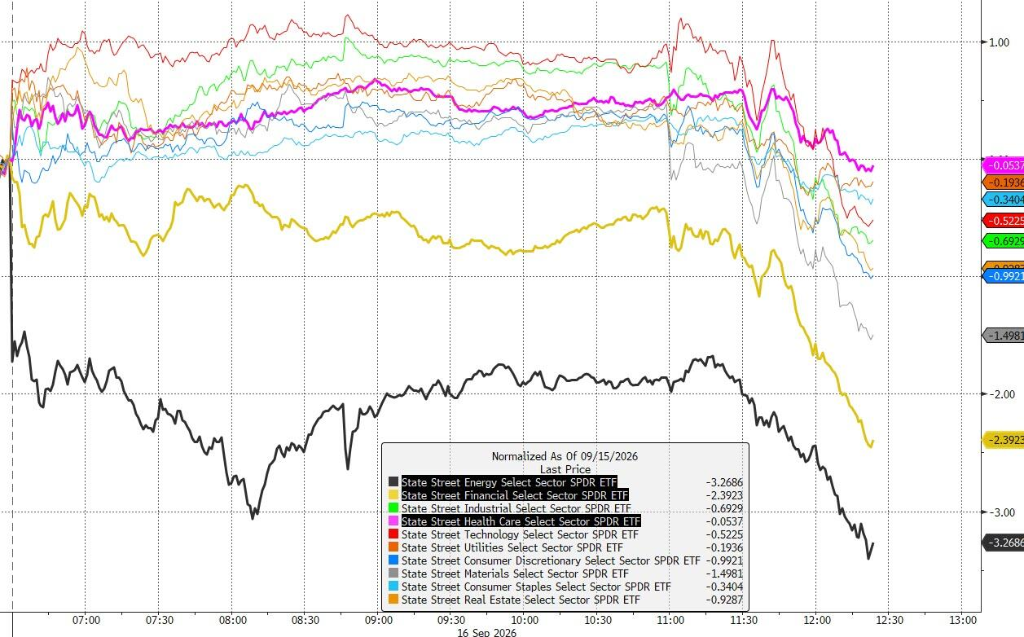
Most U.S. equity sector ETFs closed lower, with the energy sector ETF down 2.88%, and the regional banks, banking, and financial services ETFs each falling by as much as 1.77%. The internet‑stock index ETF dropped 0.43%, while the technology sector ETF gained 0.1%, the global technology stock index ETF rose 0.4%, and the semiconductor ETF advanced 0.64%.
Among the S&P 500's 11 sectors, the energy sector closed down 2.97%, the financials sector fell 1.63%, while the materials, consumer discretionary, and telecommunications sectors each declined by as much as 0.73%. Meanwhile, the utilities, healthcare, and information technology/technology sectors gained up to 0.1%.
Most large-cap tech stocks rose,$NVIDIA (NVDA.US)$Up 0.82%, Meta up 0.46%,$Tesla (TSLA.US)$Up 0.42%, Apple up 0.32%, Google down 0.6%,$Amazon (AMZN.US)$Down 0.99%,$Microsoft (MSFT.US)$Down 1.37%.
Some optical communication and storage chips have risen in price,$Lumentum(LITE.US)$Up over 9%,$Coherent(COHR.US)$Up over 6%,$Marvell Technology (MRVL.US)$, Intel rose more than 3%.
Intel's stock rose 4.0% after reports emerged that South Korea…$SK Hynix (SKHY.US)$It is in talks with Intel about producing memory chips in the United States. Some optical communications concept stocks rose, with Lumentum up over 9% and Coherent up over 6%.
Dragged down by the decline in oil prices,$Chevron (CVX.US)$and$Exxon Mobil (XOM.US)$They fell by 2.9% and 3.5%, respectively,$Devon Energy (DVN.US)$and$ConocoPhillips (COP.US)$All fell by more than 5%.
$Robinhood(HOOD.US)$The stock fell 5.5% after the U.S. Senate failed to advance comprehensive cryptocurrency legislation to the next stage, dealing a major blow to the crypto industry. In addition, on Tuesday, the U.S. Department of Justice charged two former Robinhood engineers with insider trading and misuse of confidential information.
IBM's stock fell 4.4% after the company announced that its chip division, Anderon, has signed a financing agreement with the U.S. government.
Aircraft manufacturer$Boeing (BA.US)$The stock fell 3.7%, as CEO Kelly Ortberg stated that achieving the company's goal of maintaining a monthly production rate of 47 Boeing 737 MAX aircraft "has taken longer than expected."
The Nasdaq Golden Dragon China Index closed down 0.55% at 5,734.17 points. Among the popular Chinese stocks listed in the U.S., Xiaomi fell 2.3%, Tencent dropped 2.4%, Meituan declined 1.8%, and Alibaba slid 1.9%.$Baidu (BIDU.US)$Down 2%,$NetEase (NTES.US)$Down 1.4%,$PDD Holdings (PDD.US)$Up 0.9%.
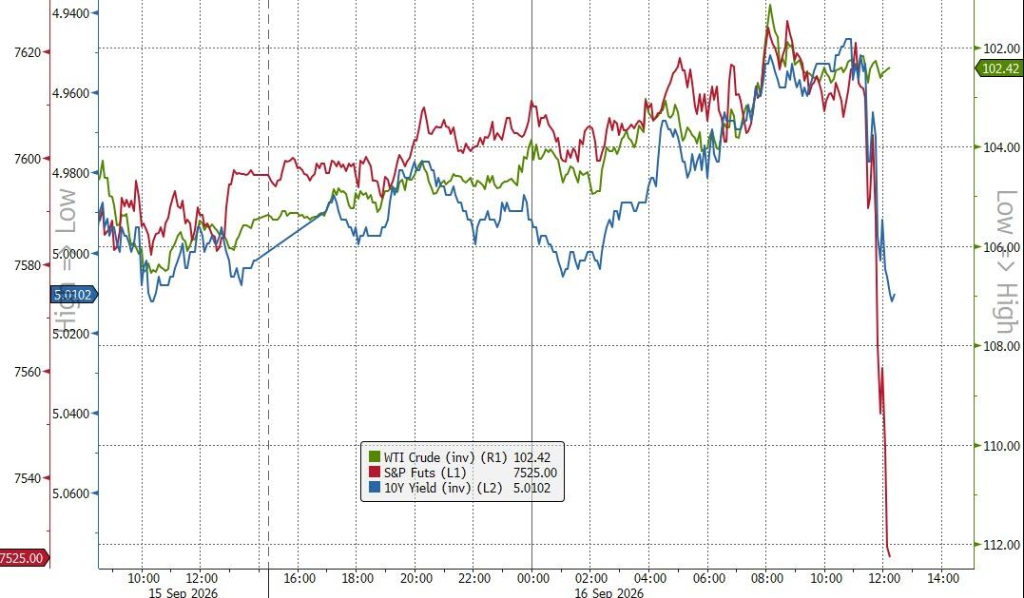
The Federal Open Market Committee voted unanimously to raise the benchmark interest rate by 25 basis points, bringing it into a range of 3.75% to 4.00%. The latest dot plot indicates at least one additional rate hike this year, prompting market expectations for a October rate increase to rise to around 50%, while bets on a December hike have also climbed.
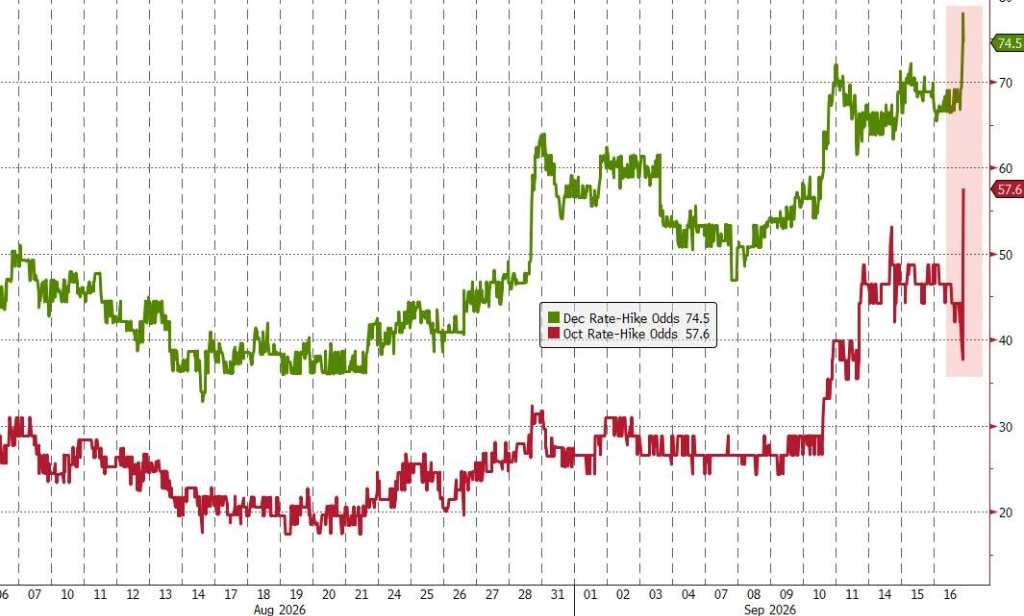
At a press conference, Federal Reserve Chair Jerome Powell stated, "We have removed a degree of accommodation to bring financial and credit conditions more in line with our objectives," a statement widely interpreted by the market as a clear hawkish stance.
U.S. stocks closed lower across the board, with the S&P 500 down 0.45% and the Dow Jones Industrial Average falling 1.2%, hitting a three-month low. Only$Nasdaq 100 Index (.NDX.US)$Nearly flat, with AI-related sectors showing relatively strong resilience.
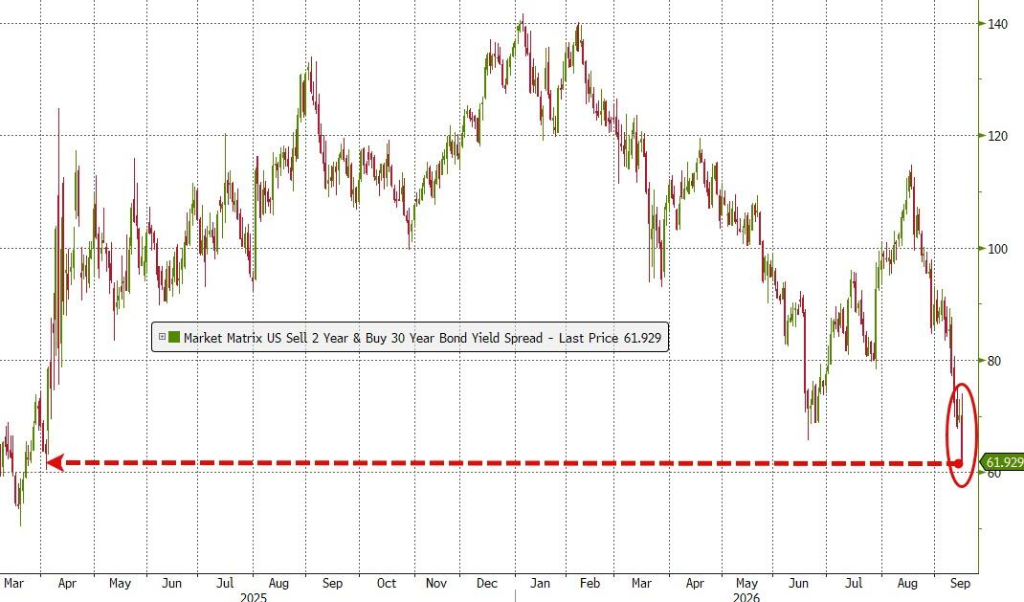
The yield on the 10-year U.S. Treasury note rose to 5.02%, while the two-year yield climbed 7 basis points to 4.74%, the highest level since 2024. Meanwhile, the 30-year yield remained largely unchanged, and the yield spread between the two-year and 30-year notes narrowed by roughly 8 basis points, reaching its flattest level since April 2025.
Meanwhile, the U.S. dollar index extended its gains for a sixth straight day, climbing to a near one-month high, while spot gold fell 0.5% to $4,269.95 per ounce. Crude oil prices retreated about 3.6%, as concerns over Middle East supply disruptions eased somewhat, with WTI crude trading at $102.05 per barrel.
Hawkish signals exceeded expectations, prompting the market to reprice the rate-hike path.
The rate hike decision itself was in line with market expectations, but the dot plot and the signals from the press conference were overall more hawkish than anticipated. The latest dot plot removed the previous median projection for a rate cut next year and instead indicated that a majority of officials support at least one additional rate hike this year.
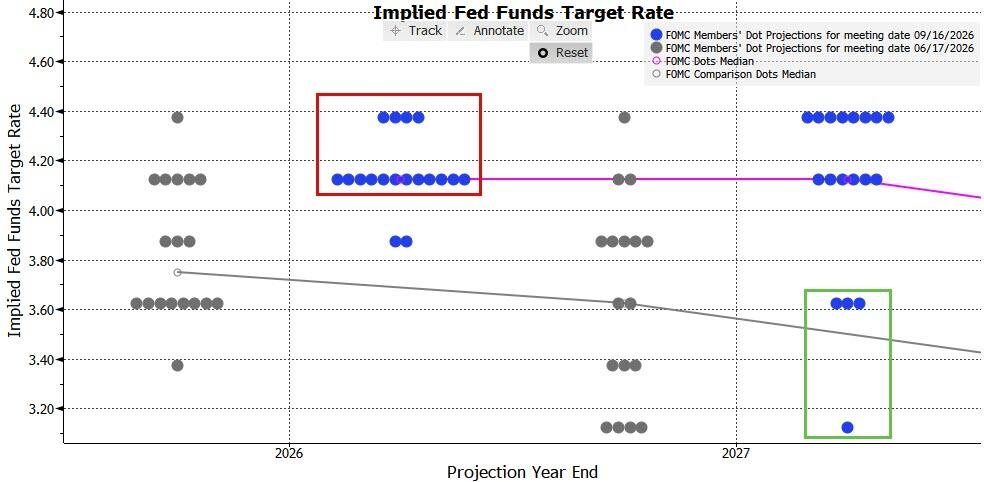
However, there is significant divergence in the projected interest-rate path for 2027. Three officials anticipate two rate cuts by then, while one expects four cuts, suggesting that some policymakers implicitly view the current trajectory as carrying risks of policy missteps.
Luigi Buttiglione, CEO of the consulting firm LB Macro, stated:
By stating that this rate hike will help the economy return to the 2% inflation target "more promptly," the FOMC made clear that further action remains necessary and that at least three additional rate hikes are likely.
Krishna Guha of Evercore noted that Powell characterized this move as removing "a degree of accommodation," a phrasing that could unsettle the bond market—"such comments risk derailing the market's anchor on the Fed chair's view of where interest rates ultimately need to go."
Notably, this press conference concluded roughly 20 minutes earlier than usual—the shortest duration on record—consistent with Chairman Powell's long-standing stance of refraining from providing forward guidance. According to Bloomberg, market volatility on Fed policy days once again stemmed primarily from the press conference, rather than from the FOMC statement itself.
The stock market is volatile, with the AI sector holding up relatively well, while energy and financials are leading the decline.
U.S. stocks remained largely steady ahead of the Federal Reserve's decision, but turned sharply lower during the press conference. After hitting intraday lows, the major indices staged a brief rebound, yet overall they closed broadly lower.
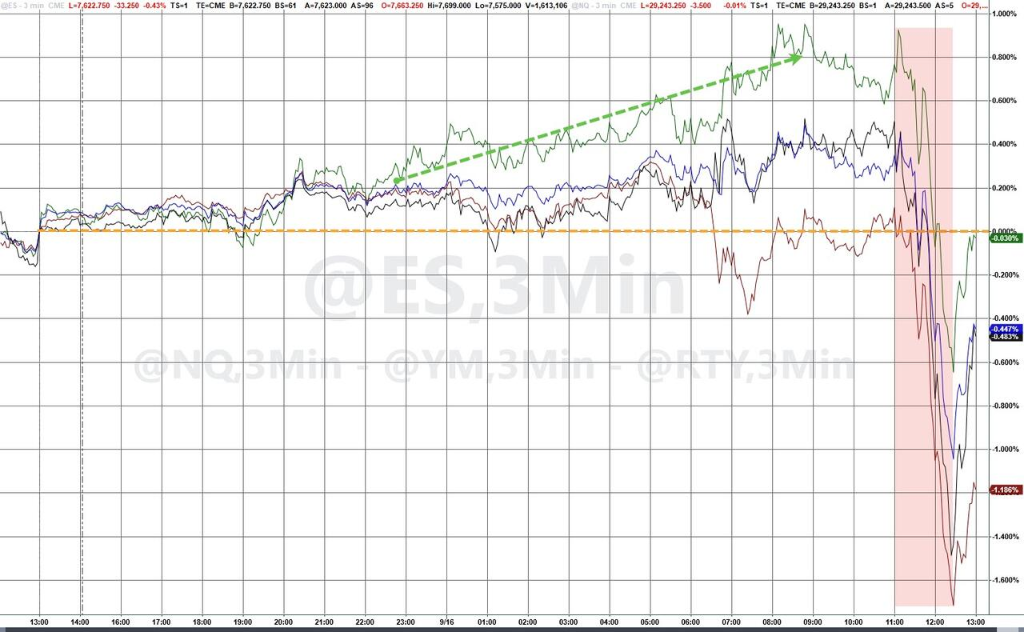
The S&P 500 fell 0.45%, hitting its lowest level since July; the Dow Jones Industrial Average dropped 1.2%; and the Nasdaq 100 was virtually unchanged, largely supported by the relative strength of AI-related stocks.
From a technical perspective, the S&P 500's 7,600-point level serves as a key support. Should this support at 7,550 points give way, it would remove both technical and options‑related support, pushing the market into negative gamma territory. At that point, market makers' hedging activities could further amplify downward momentum.
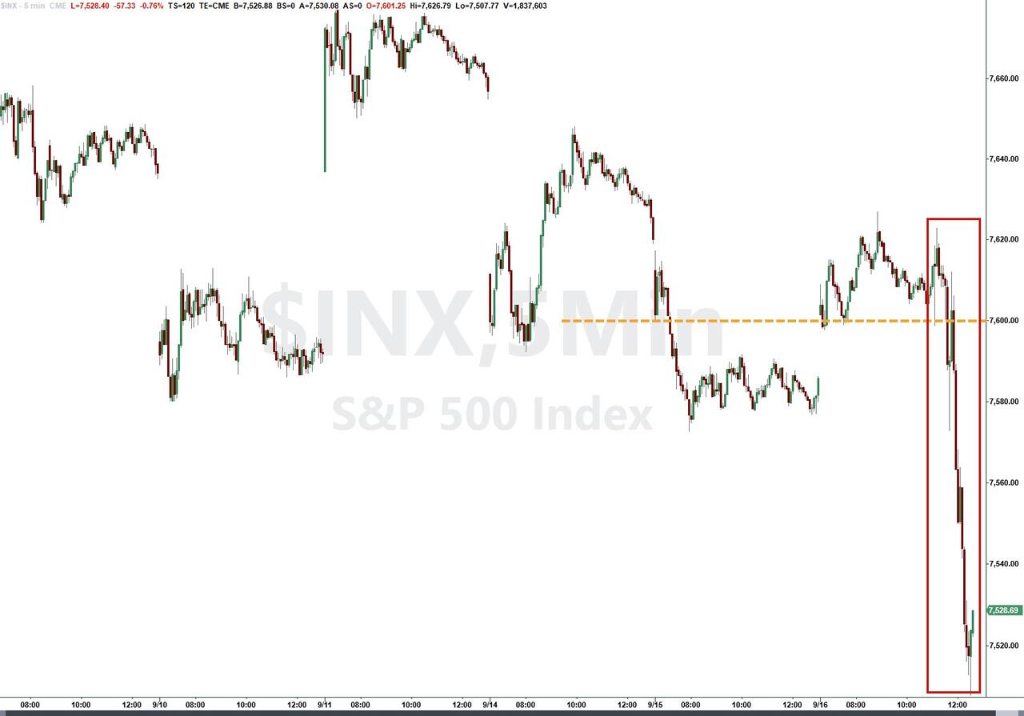
Nomura Securities has warned that the deleveraging threshold for CTA (commodity trading advisor) strategies has become increasingly critical around the 7,500-point level; should prices fall further, the 7,350–7,400 range would constitute the next meaningful support zone.
From a sector‑by‑sector perspective, the energy sector posted the largest decline, falling by roughly 3%, followed closely by the financial sector, while the healthcare sector proved relatively resilient.
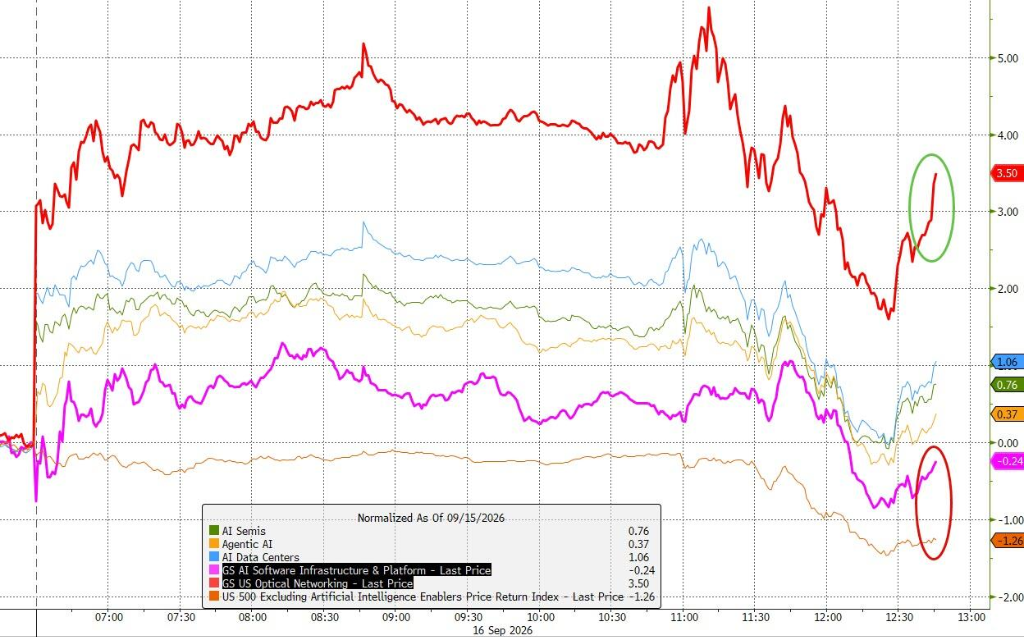
AI-related stocks have outperformed S&P 500 non-AI constituents, with optical networking stocks leading the AI subsector, while software stocks have lagged behind.
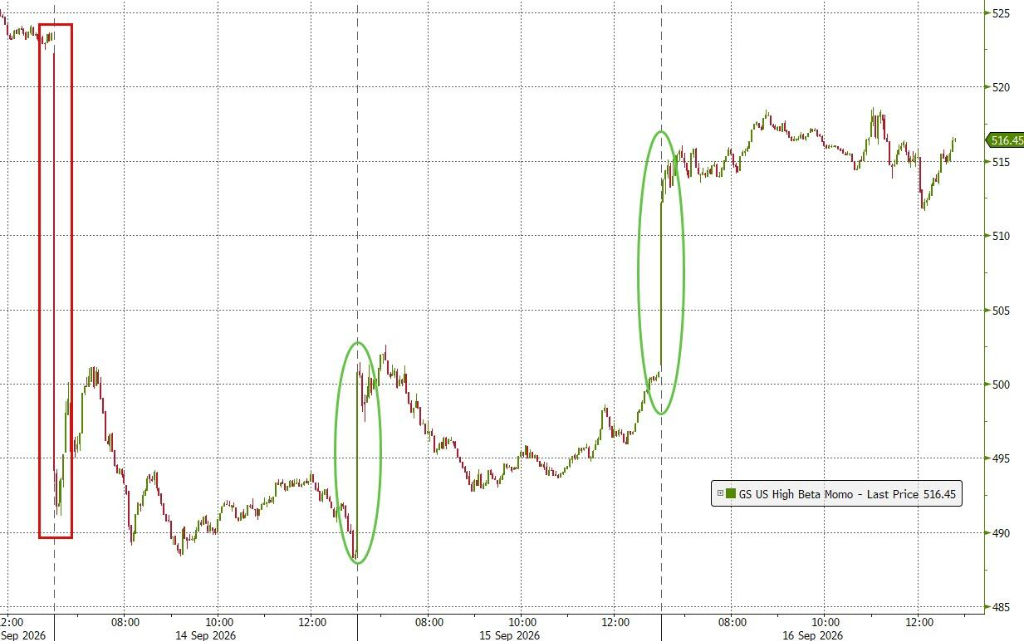
Market momentum extended yesterday's rally, nearly erasing Monday's consolidation.
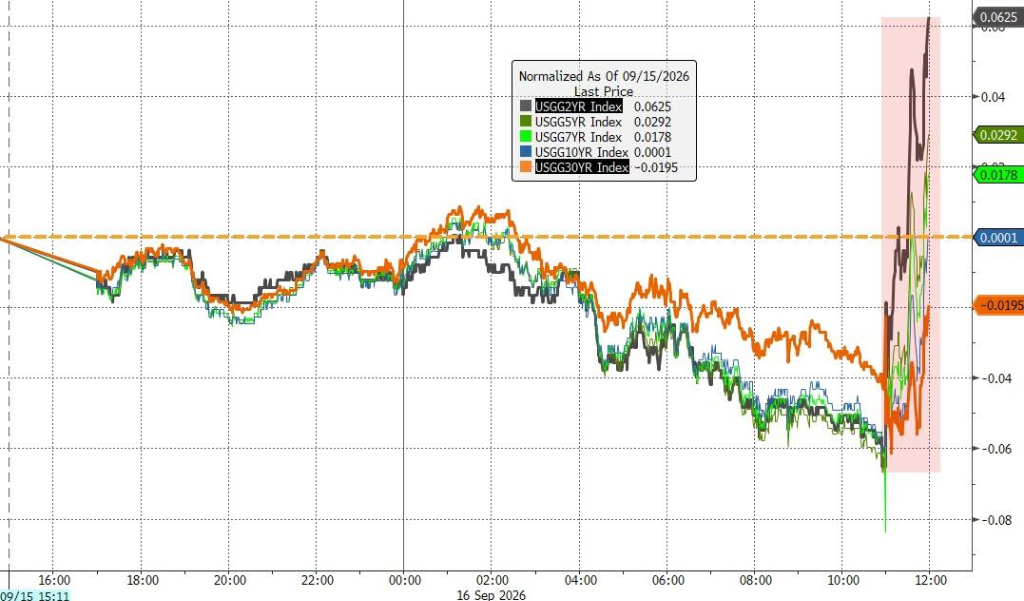
The U.S. Treasury yield curve has steepened sharply, with the two-year yield hitting a two-year high.
In the U.S. Treasury market, the Federal Reserve's decision triggered a pronounced bear‑flattening move.
The 2-year yield posted the largest increase, hitting a more than two-year high during Walsh's remarks, while the 30-year yield edged lower.
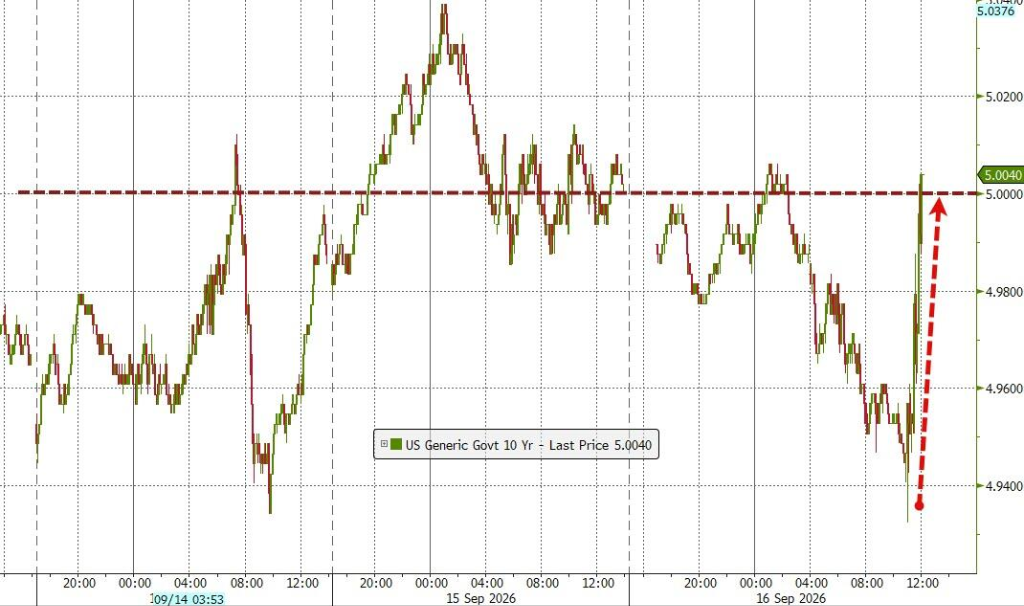
The 10-year yield briefly touched the psychologically significant 5.00% level before stalling, as markets remain highly attentive to the psychological implications of that threshold.
The yield spread between the 2-year and 30-year Treasury notes has narrowed to around 61 basis points, the lowest level since April 2025.
Daniel Siluk, portfolio manager at Janus Henderson Investors, stated:
The Federal Reserve is, in effect, signaling to the market that the economy is stronger, the labor market is tighter, and inflation has proven more persistent than expected, necessitating a more restrictive policy stance for a longer period to restore price stability.
Stephen Brown of Capital Economics expects the Federal Reserve is likely to raise interest rates again in December this year and believes officials are underestimating the likelihood of further declines in the unemployment rate, maintaining his forecast that additional rate hikes will occur in 2027.
The pullback in crude oil prices failed to boost the market, and energy risks remain.
Crude oil prices plunged on Wednesday, but failed to provide support to either the stock or bond markets.
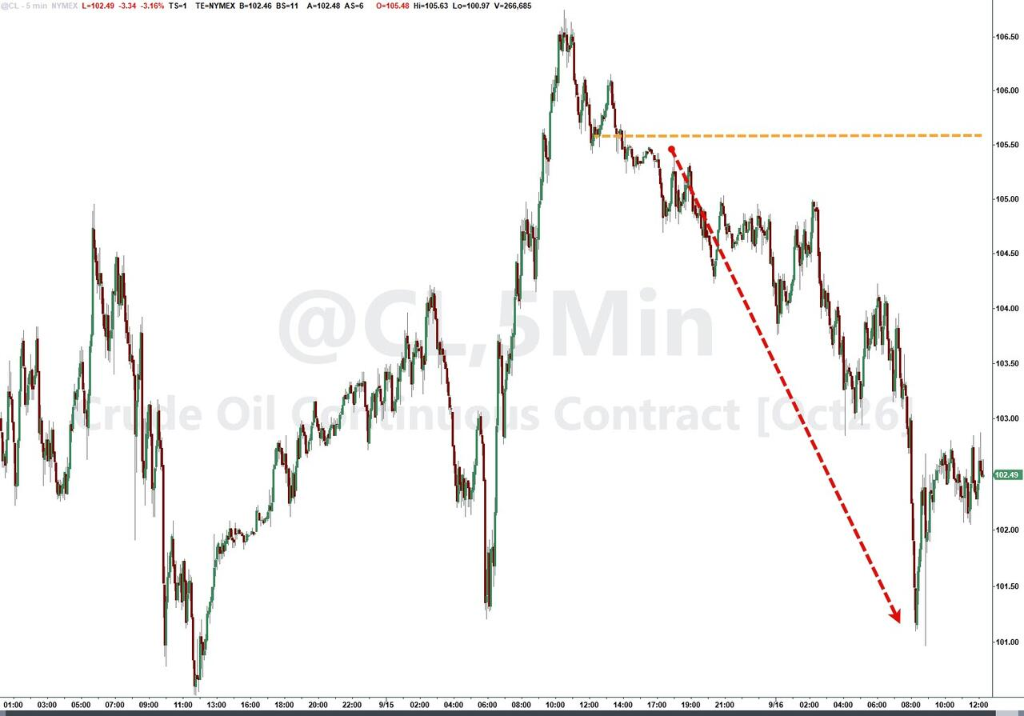
After rising for two consecutive days, WTI crude oil briefly retreated from a high above $106.50 to around $101 before closing down 3.6% at $102.05.
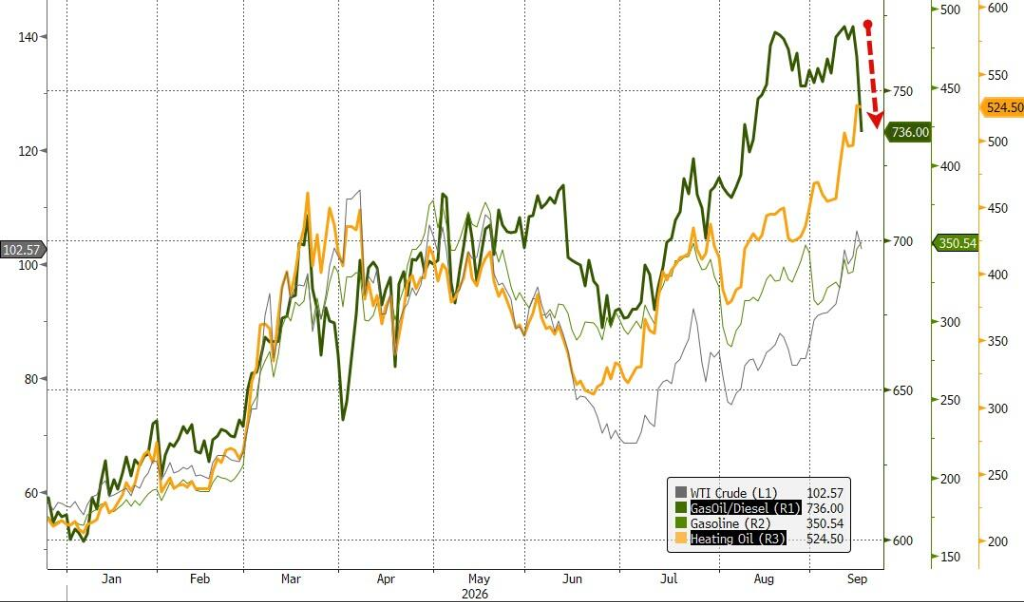
Notably, U.S. refined‑product prices have fallen sharply, with gasoline and diesel posting the largest declines, though heating oil prices remain near their recent highs.
The primary reason is that supply disruptions in parts of the Middle East have eased. Saudi Arabia is working to restore about half of the throughput capacity of its east–west oil pipeline within a matter of days and has increased crude oil sales bypassing the Strait of Hormuz; meanwhile, Libya has also resumed normal production levels.
Charu Chanana, Chief Investment Strategist at Saxo Markets, believes this drop in oil prices should be viewed as a "breather rather than a clear reversal," and warns that any further escalation of the situation or a prolonged disruption could swiftly push oil prices higher again.
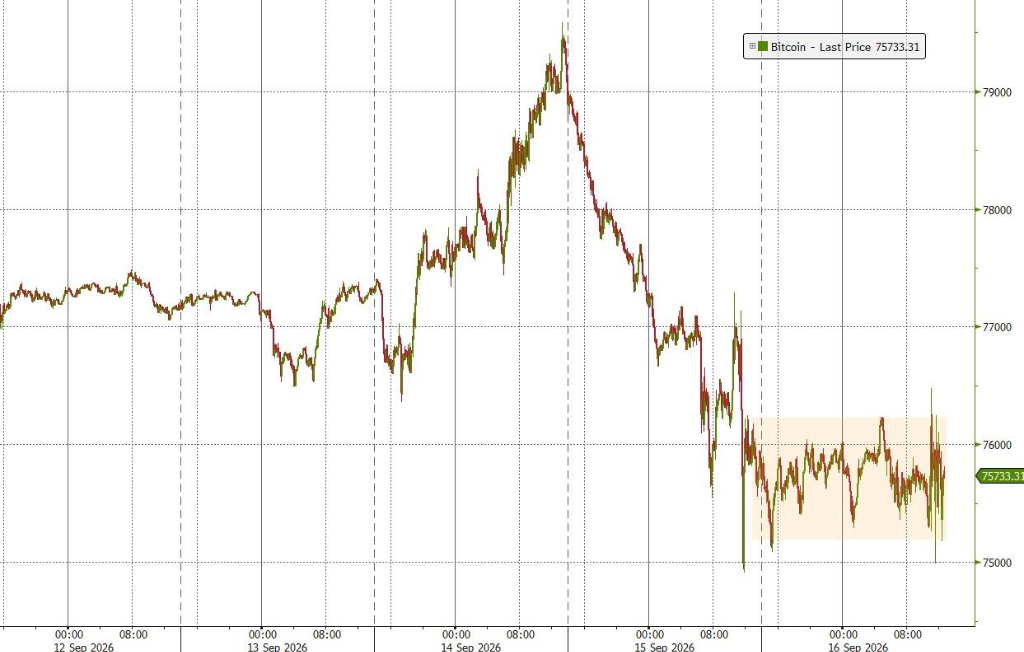
The U.S. dollar surges, while gold plunges,$Bitcoin (BTC.CC)$Standing still
In the foreign-exchange market, the Bloomberg Dollar Spot Index rose 0.5%, while the euro fell 0.6% to 1.1470, the pound dropped 0.7% to 1.3385, and the yen weakened to 156.18 per U.S. dollar.
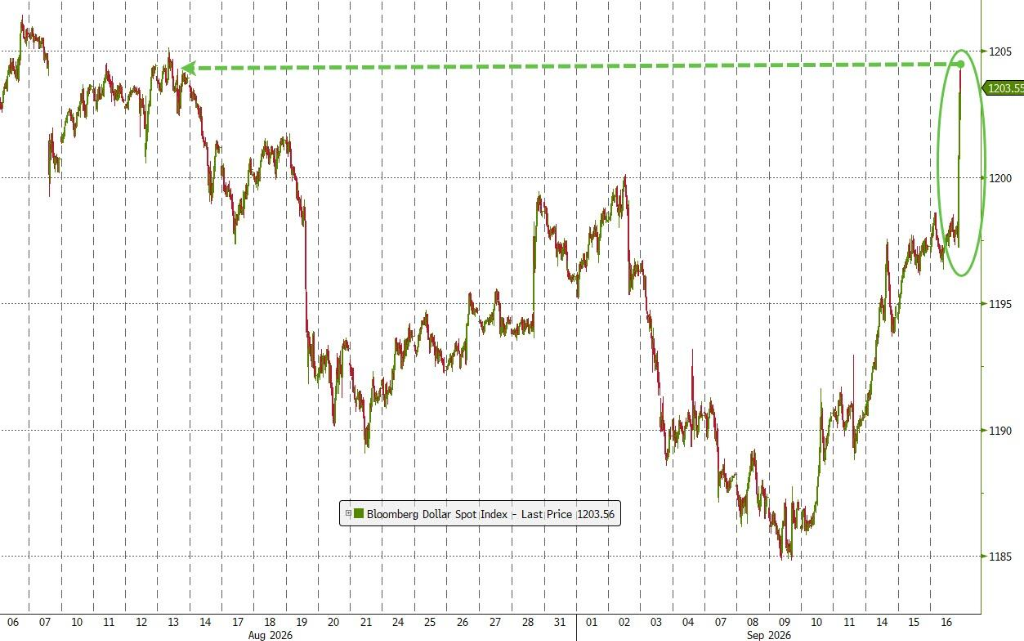
According to the Bloomberg Market Influence Monitor, the U.S. dollar posted its biggest gain in 60 minutes following the Federal Reserve's decision since the December 2024 policy meeting.
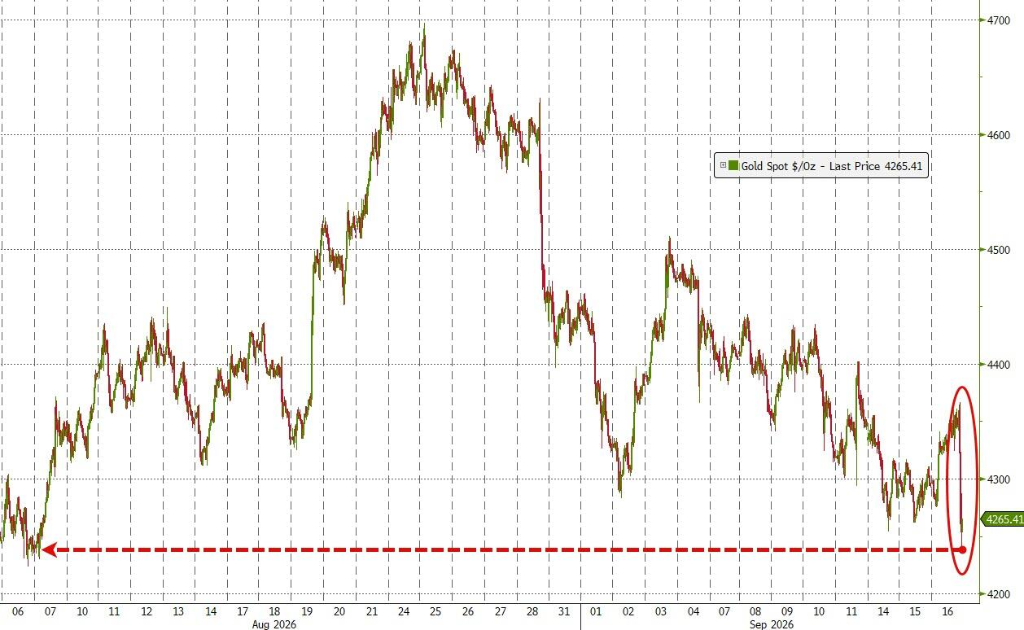
Gold took a severe hit: following the Federal Reserve's interest-rate decision, spot gold prices plunged as much as 3% from their intraday high, falling below $4,240 per ounce—the lowest level since early August.
In contrast, Bitcoin has remained stable amid market volatility, hovering around $76,174.
Company News
[Goldman Sachs CEO Warns Fixed-Income Business Will Perform Weakly; Company-Wide Spending Expected to Rise]
Goldman Sachs CEO David Solomon warned that the firm's fixed-income trading business has underperformed over the past few quarters, and company-wide expenses are also rising. Speaking at a Barclays conference on Wednesday, Solomon said that in the third fiscal quarter, fixed-income trading lagged behind equity trading, which remains "very strong." He added that, given the busy client activity this quarter and the acceleration of certain technology investments, Goldman Sachs expects its cost expenditures to increase.
【$Novo-Nordisk A/S (NVO.US)$Partnering with Anthropic to Accelerate New Drug Development Using Claude
Novo-Nordisk A/S said on Wednesday, local time, that it will use Claude Science, a platform developed by Anthropic for scientific research, to accelerate the discovery and development of new drugs and focus on addressing scientific challenges that both parties believe can deliver the greatest real-world impact. Novo-Nordisk CEO Mike Doustdar stated: "AI can help us improve R&D efficiency and shorten the time from research to product launch. Beyond that, AI tools can also open up entirely new opportunities in scientific research and enable us to better reason about and understand human biology and drug mechanisms."
[Apple is reportedly set to return to the server market, considering NVIDIA's interconnect technology]
Apple may return to the enterprise server market after many years. Reports indicate that Apple is currently developing an enterprise‑grade AI server equipped with the M8 Ultra chip and is considering adopting NVIDIA's NVLink Fusion technology. According to sources cited by media on September 16 local time, Apple is working on an AI inference server powered by its in‑house chip, targeting AI developers, enterprises, and government customers, with potential versions featuring either two or four M8 Ultra chips. Media reports further state that the M8 Ultra is the most powerful chip in Apple's roadmap; it has not yet been officially released and remains in the development phase.
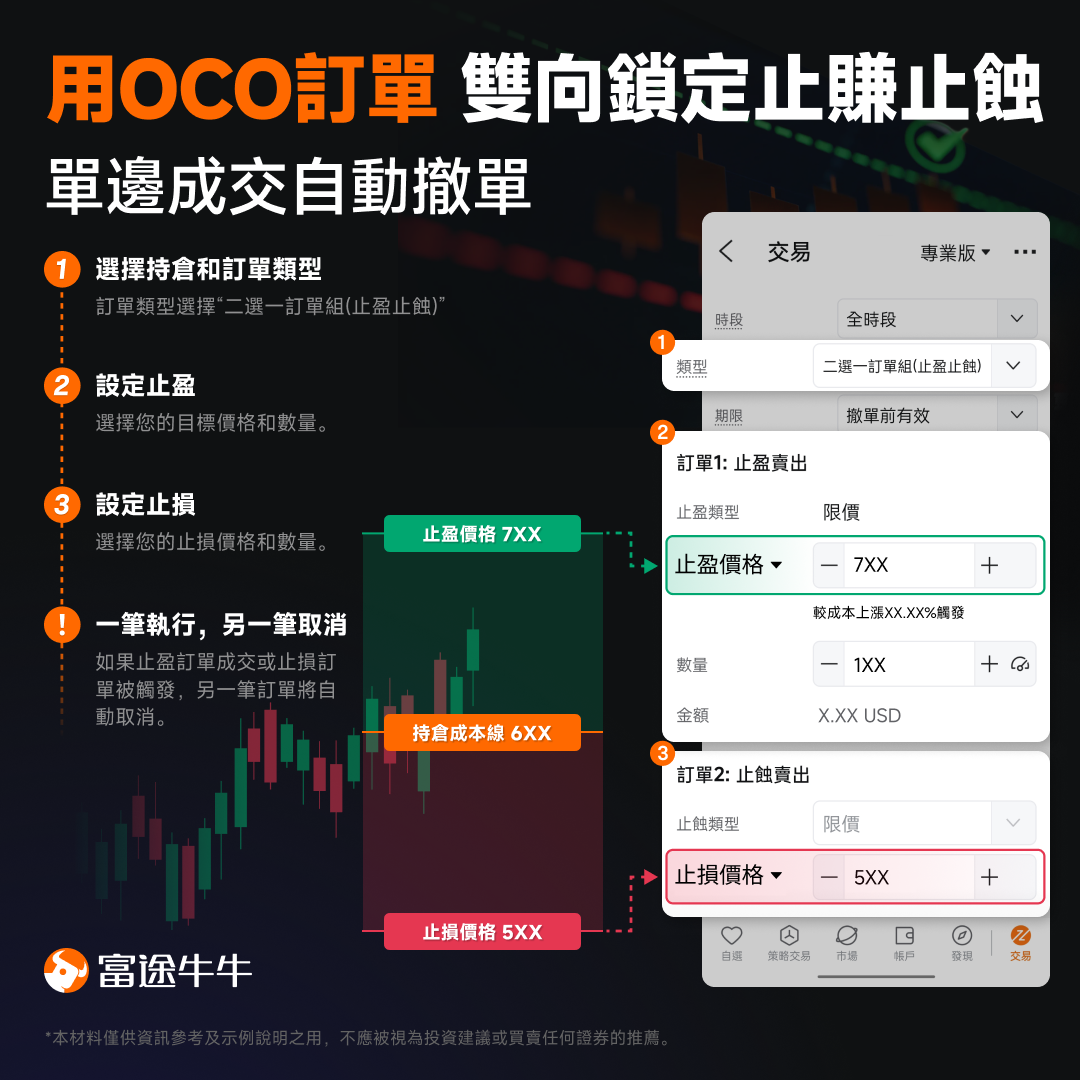
Market conditions can be highly volatile. Rather than rushing to sell once the trend becomes clear, it's better to prepare for both scenarios in advance. OCO (One Cancels the Other) orders let you place two linked orders simultaneously: when one is executed, the other is automatically canceled, giving you the flexibility to adapt to a wide range of market movements.
Editor/Liam