
(Source: Wu Shuo)
Author | TheEnergyMag
Compiled by | Wu Shuo Blockchain
 Original article link:
https://theenergymag.com/news/2026-09-03/bitcoin-miner-unplug-ai-revenue-surge
TL;DR:
· In the first half of 2026, listed mining companies saw their actual hash rate decline by approximately 56 EH/s, with some electricity redirected to AI and HPC; related revenue in the second quarter increased by 52% quarter over quarter.
· The median revenue per megawatt-hour for HPC hosting is about $175, similar to that of the latest-generation Bitcoin miners; in contrast, AI cloud services generate approximately $941, with significantly higher revenue.
· Zcash mining generates roughly $586 per megawatt-hour, having exceeded $700 just over a week ago, but its volatility is far higher than that of long-term contracted HPC hosting services.
· The revenue potential of mining companies' shift to AI is substantial, but capital expenditures are hefty; 14 firms invested a combined $18.6 billion in a single quarter, yet only a subset of them have managed to achieve satisfactory returns.
Bitcoin mining companies shut down on a large scale in the second quarter, which may seem like surrender, but that's not the case.
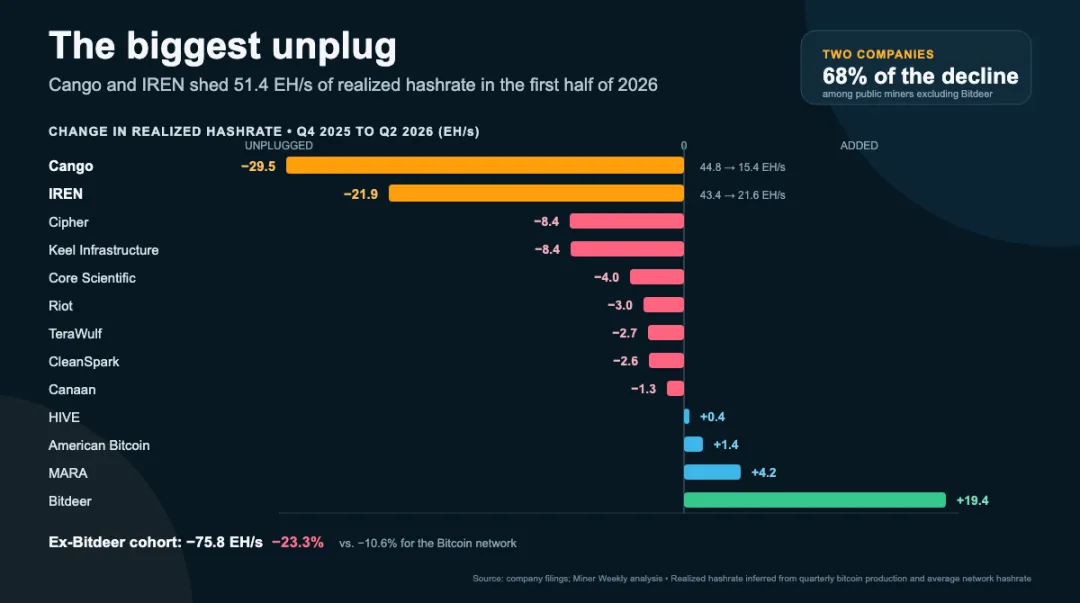
According to TheEnergyMag's analysis of publicly listed mining companies, in the first half of 2026, their actual hash rate is expected to decline by 56 EH/s, a drop of 15%, exceeding the 10% reduction across the entire Bitcoin network. A significant portion of this electricity has not completely exited the mining sector but has instead been redirected toward upgrading AI infrastructure.
This shift has already been reflected in the financial statements. Among comparable mining companies, directly disclosed HPC and AI business revenues increased by 52% compared to the first quarter. For the companies that have made the fastest progress in their transformation, the second quarter also marked the first time that HPC hosting or AI cloud business revenues surpassed their shrinking Bitcoin mining revenues.
The cost of transformation is substantial. Earlier, an analysis by Miner Weekly tracked approximately $30 billion in capital expenditures among publicly listed mining companies and their AI‑related peers. PwC now estimates that, by 2050, the broader deployment of AI data centers could require as much as $31.6 trillion in investment.
In the latest comparison by TheEnergyMag, 14 companies collectively spent $18.6 billion in a single quarter. Among the six infrastructure providers that have consistently disclosed their HPC revenues, total capital expenditures nearly equaled 15 times their combined revenue for the same period.
The substantial gap between capital expenditures and revenues raises the central question of this article:
How much revenue can AI‑driven electricity generation actually generate per megawatt-hour? And how does it compare to the current computing power used in digital asset mining?
TheEnergyMag estimates that, among six comparable AI-powered infrastructure providers, their recurring HPC revenue ranges from approximately $86 to $300 per megawatt-hour, with a median of about $180.
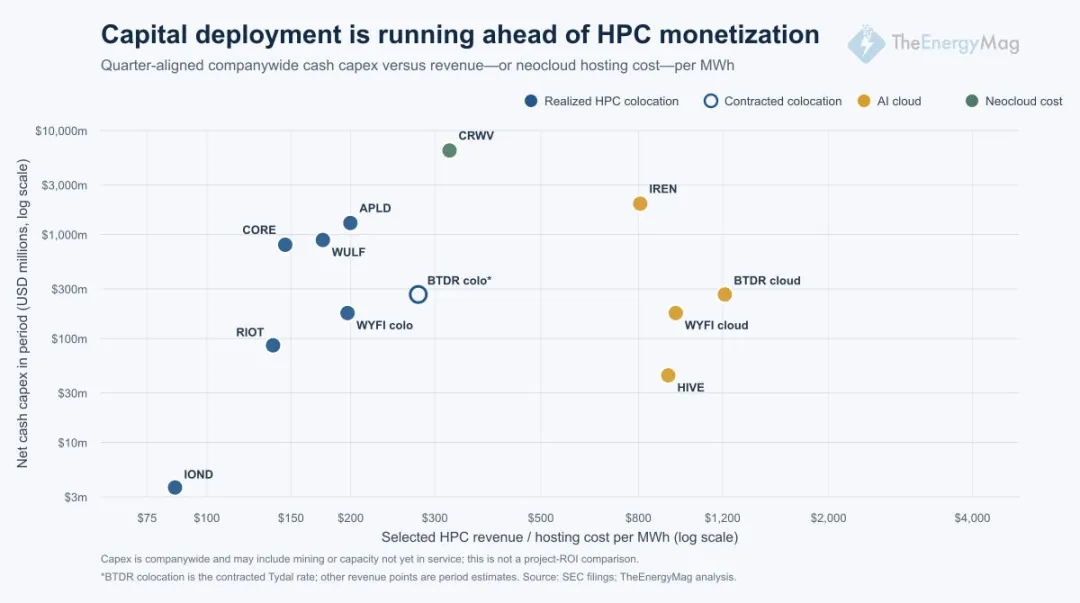
The foregoing data are derived by dividing recurring HPC,托管, or base rental income by estimated billable electricity consumption. Where separable, both fit-out allowances and construction‑related revenues have been excluded.
These estimates are highly sensitive to the timing of commissioning. A facility commissioned midway through a quarter cannot be deemed to have been in continuous operation over the entire 91-day period. Furthermore, straight-line lease accounting may recognize revenue before actual cash is received.
Even with these limitations, companies adopting a landlord‑like model still see their revenues clustered within a relatively narrow range of roughly $140 to $200 per megawatt-hour.
When a company sells not just space for hosting equipment but rather computing power as a service, its business model undergoes a transformation.
CoreWeave (NASDAQ: CRWV) invested $6.42 billion in the quarter. Based on its data center cost of revenue and estimated actual operating power, we estimate its hosting cost at approximately $322 per megawatt-hour; depending on different assumptions about the pace of capacity ramp-up, this cost range spans from $268 to $403 per megawatt-hour.
This cost encompasses far more than just the rent charged by data center owners. It also explains why emerging cloud service providers can spend over $300 per megawatt-hour on infrastructure, whereas mining companies that transition into data center operators initially recognize only $150 to $200 per megawatt-hour in revenue.
Revenue disclosed by full-stack operators is even higher. IREN's AI cloud‑related revenue is estimated at approximately $807 per megawatt-hour, HIVE at about $924, WhiteFiber at $958, and Bitdeer (NASDAQ: BTDR) at roughly $1,213.
These figures cannot be directly compared with rental revenues, as they also incorporate the value of GPUs, networking, software, and computing‑power‑scheduling services. Moreover, operators bear the risks associated with computing‑power utilization rates and hardware obsolescence. Bitdeer vividly illustrates this distinction: its AI‑cloud business generates the highest per‑unit electricity revenue in the group, yet the costs disclosed for this segment exceed its revenue.
How does it compare to Bitcoin mining?
Even so, the revenue generated by AI cloud services remains significantly higher—by an order of magnitude. The median estimated revenue is $940.74 per megawatt-hour, more than five times the $179.13 per MWh produced by Bitmain's latest-generation Antminer S23 Hyd., and over eight times the $113.45 per MWh achieved by the S21 Pro.
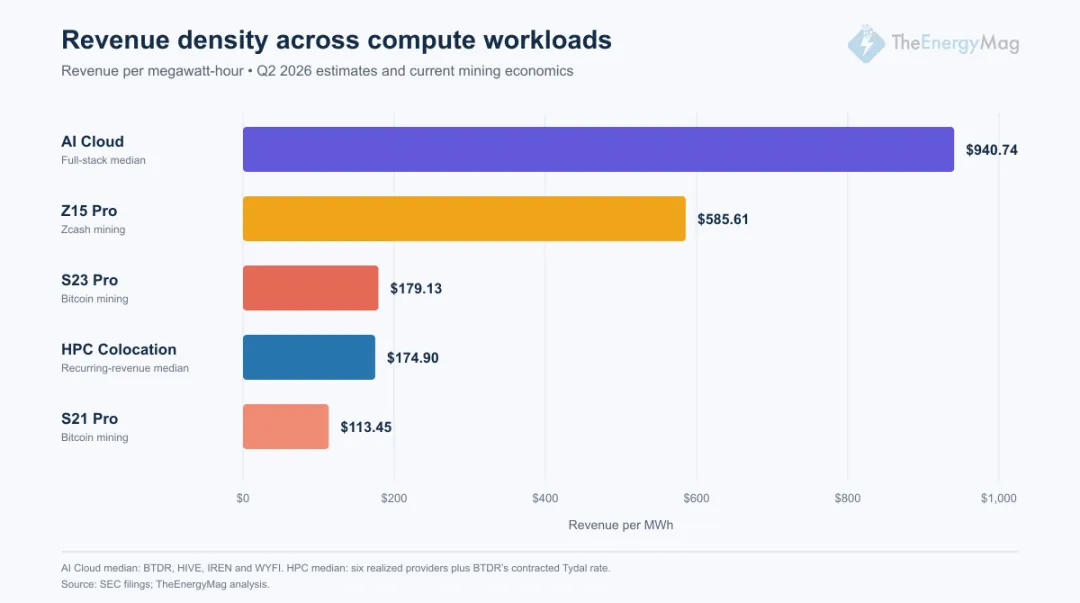
More noteworthy is the comparison between Bitcoin mining and HPC hosting. TheEnergyMag estimates that the median revenue per megawatt-hour for HPC hosting is $174.90, nearly identical to S23 Hyd.'s current mining revenue. However, the underlying economic models of the two are fundamentally different: hosting revenue is typically locked in through multi-year contracts, and electricity costs may also be passed on to customers; by contrast, Bitcoin mining revenue fluctuates continuously with the price of Bitcoin, the network's difficulty, and transaction fees.
Zcash mining revenue falls somewhere in between the two. The Z15 Pro, with a rated hash rate of 840 KSol/s and a power consumption of 2.78 kW, currently generates an estimated $585.61 per megawatt-hour—about three times the electricity‑related earnings of the S23 Hyd., though its volatility is significantly higher. Just over a week ago, Zcash mining revenue still exceeded $700 per MWh.
This means that the per-unit electricity revenue from Zcash mining is about 3.3 times that of HPC, and 4.5 times that of the latest-generation Bitcoin miners.
— — TheEnergyMag, August 24, 2026
This makes the per-unit electricity revenue from Zcash mining temporarily higher than that of most HPC hosting agreements, and comparable to the lower‑tier GPU cloud‑computing revenue.
However, the word "temporary" here is crucial. Mining companies can rapidly deploy ASIC miners and sell their mining output on highly liquid markets, yet their revenues may plummet overnight. By contrast, an HPC campus may require years of sustained capital investment and construction, but once it secures tenants with strong creditworthiness, it can lock in contract revenues for a decade or even longer.
Revenue per megawatt-hour explains why mining companies seek to onboard AI‑driven tenants, while capital expenditures determine why only some miners can achieve meaningful returns.