
Starting October 1, Nebius is raising prices across its GPU cloud services by approximately 20%, with price hikes applied to a wide range of chips from the H100 to the B300. This marks the second round of price increases within just a few months, bringing the cumulative rise for the B300 to as much as 56%. With demand visibility extending beyond 24 months, customers are rushing to secure Blackwell‑based compute power, even willing to bid at premium prices. The growing imbalance between AI compute supply and demand is reshaping the industry's bargaining dynamics, quietly shifting negotiating leverage toward the supply side.
Nebius announced that, effective October 1, it will implement across-the-board price increases for its GPU cloud services, with an average hike of approximately 20%. Coupled with NVIDIA's strong quarterly earnings report, this drove the stock to surge nearly 7% in after-hours trading, further validating market expectations of a persistently tight supply-and-demand balance in AI computing power.
This round of price hikes covers multiple chip models, including the H100, H200, B200, and B300, marking Nebius's second price increase since May this year. The market interprets this as a strong signal that AI computing demand remains overheated while supply remains tight. Boosted by this, Coreweave's stock subsequently rose nearly 4%, and the optical communications sector also strengthened across the board, with AAOI and Credo Technology gaining nearly 3%, Marvell Technology and Astera Labs surging more than 2%, and Coherent climbing nearly 2%.
 The news of price hikes closely coincides with NVIDIA's strong earnings guidance, further bolstering market confidence in the continued expansion of AI data center construction and sparking a broad-based rally across the cloud computing and computing‑power infrastructure sectors. Meanwhile, data center operators' bargaining power is on the rise, with contract terms shifting in favor of the supply side, signaling a quiet but significant shift in the industry landscape.
Price hike details: Prices for multiple GPU models have been significantly increased.
According to pricing screenshots circulating among X platform users, this round of price adjustments is substantial. The price per GPU-hour for the H100 has been raised from $3.85 to $4.50, an increase of approximately 16.9%; the H200 has risen from $4.50 to $5.40, a 20% hike; the B200 has gone up from $7.15 to $8.50, a roughly 18.9% increase; and the B300 has climbed from $7.85 to $9.50, representing an approximate 21% rise.
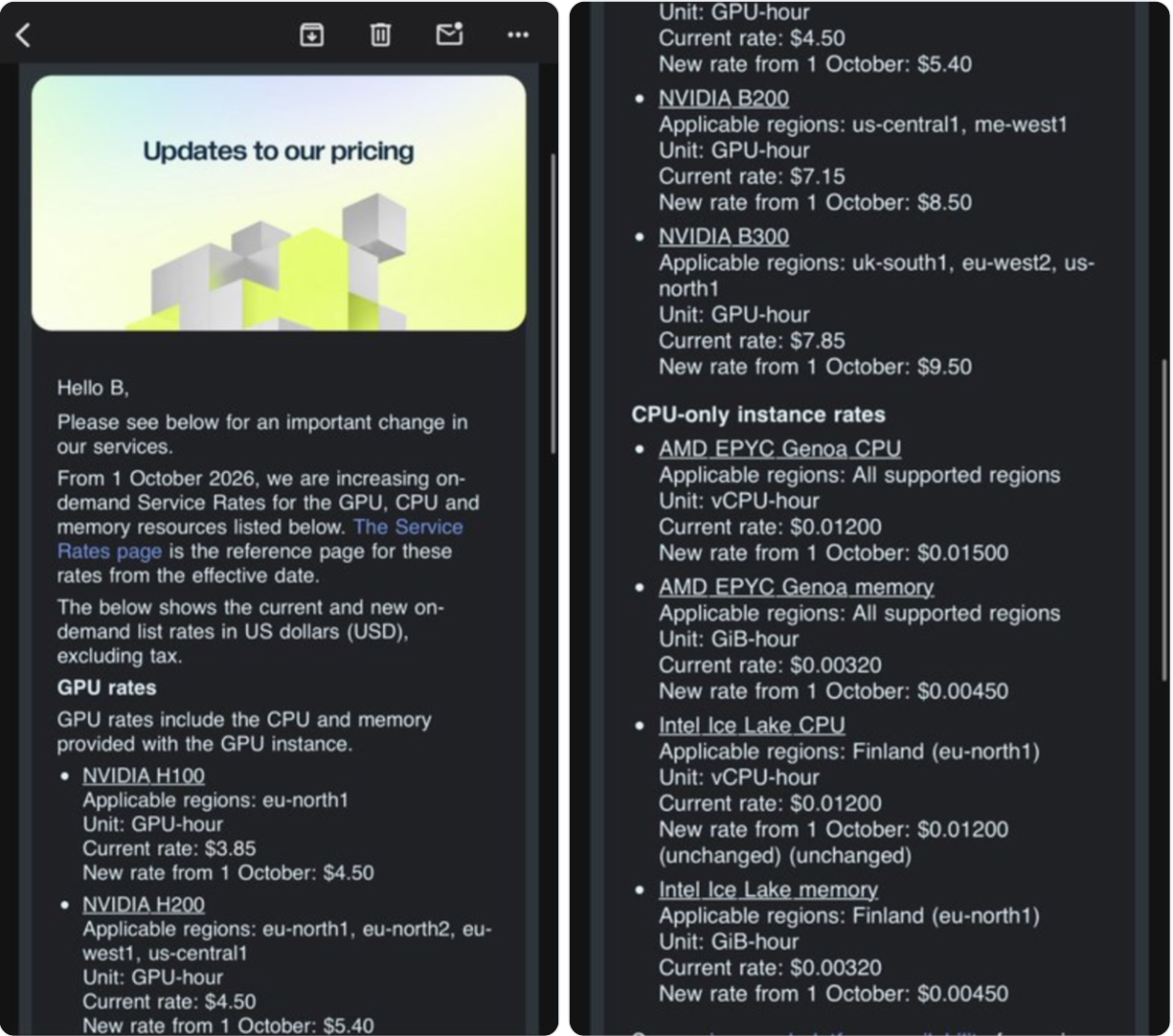
This marks Nebius's second price hike within just a few months. In May of this year, the company announced an average 29% increase for on-demand capacity and a 51% increase for spot capacity. Taking the B300 instance as an example, its price has risen by roughly 56% since before May, when it stood at about $6.10 per hour.
In an email sent to customers in May, Nebius stated that the price adjustment "reflects the continued strong demand for high-end GPU computing power, and even after the updated pricing, Nebius still offers one of the most competitive GPU infrastructure prices on the market." According to Stocktwits, as of press time, Nebius has not yet issued a public response to the latest rumors of a price hike.
Supply-and-demand dynamics: Demand visibility exceeds 24 months, while capacity remains persistently tight.
Market analysts note that this round of price hikes reflects deeper supply-and-demand dynamics. According to X-platform user @MelvinInvests, Nebius had previously attempted manual price adjustments, but management concluded that demand was so robust that even those changes fell short of balancing supply and demand. Subsequently, the company conducted an auction for its scarce Blackwell computing power, with customers paying prices 15% to 20% above the previous peak rate in order to secure access.
The analyst also noted that Nebius management disclosed that some customers have already placed orders for computing power in the first and second quarters of 2028, with certain contracts covering tens of thousands of GPUs. The company's current order visibility now extends beyond 24 months, a significant increase from roughly 18 months previously.
Notably, this price hike applies to both the older Hopper‑architecture GPUs and the newer Blackwell series, indicating that market demand is not confined to a single generation of chips but is instead spread across a broad range of AI computing architectures.
"Nebius is simultaneously benefiting from two forces: on the one hand, it continues to expand its computing capacity, and on the other, it is raising prices for its existing capacity," @MelvinInvests wrote. This means that, with utilization remaining high, the revenue generated per available GPU hour will increase significantly, helping to improve profit margins and accelerate the payback of infrastructure investments.
Fundamental Support: With substantial orders in hand, expansion continues to accelerate.
Nebius's recent fundamentals have also supported market sentiment. According to Stocktwits, since securing a major contract with Microsoft last September, the company has continued to accelerate its expansion, successively acquiring Staryps, Eigen AI, and Tavily. In March this year, Nebius announced a $27 billion contract with Meta Platforms and secured a $2 billion strategic investment from NVIDIA.
NVIDIA's quarterly earnings report released on Wednesday further confirmed the view that upstream demand remains robust, reinforcing the market rationale that the boom in AI data center construction among major tech companies will continue to drive demand across the computing power supply chain.
Jonah Lupton, a user on Platform X, commented that Nebius's average price hike of roughly 20% indicates a persistent and significant bottleneck in computing‑power supply within the AI ecosystem. Based on this, he estimates that Nebius's current short‑term customer contract rates may already exceed $60 million per megawatt, with future contracts for Vera Rubin‑architecture products potentially surpassing $80 million per megawatt.
Nebius has posted a year-to-date share-price gain of roughly 150%, making it one of the standout performers among AI‑related stocks. According to Stocktwits, discussions about NBIS have surged by more than 120% over the past 30 days, while follower counts have risen 7.3%. As of Thursday morning, retail investor sentiment remained bullish, with overall message volume at a "high" level.
Shift in Bargaining Power: Data Center Operator Contract Terms Are Starting to Reverse
The supply-demand imbalance reflected in Nebius's price hikes is reshaping the landscape of contract negotiations across the entire data center industry.
Previously, major cloud providers held a dominant position in negotiations, often imposing extremely stringent requirements: each server rack was expected to operate at nearly 100% uptime, and data center temperature and humidity were subject to rigorously strict standards. According to a senior data center executive, he once encountered contract terms stipulating that if even a single rack went offline due to a power outage, overheating, or a switch failure, the cloud provider could suspend six months' worth of rent; moreover, should SLA violations accumulate to a certain threshold, the provider could outright terminate the lease.
The executive noted that negotiating an SLA essentially involves balancing "best‑in‑class pricing" against "contractual durability"—the stricter the terms, the higher the price, but the greater the risk. "Securing an SLA with more lenient penalties is worthwhile, even if it comes at a slightly higher cost."
However, as carriers' bargaining power has increased, these extreme contractual provisions are gradually being relaxed. There are also signs of a shift in payment terms. According to reports citing a credit executive, he has encountered cases where a customer rents only a small portion of a large data center, yet the contract stipulates that if the customer fails to make timely payments, they must cover the full rent for the entire facility over a specified period. Even the data center owner was candid about this requirement, saying, "He said, 'Look, we know this is outrageous… but we can pull it off.'"
As cloud providers like Microsoft are eager to get NVIDIA server racks up and running as soon as possible, the bargaining power of data center operators such as CoreWeave is on the rise, and the supply side of computing power is gaining increasing leverage in contract negotiations.