①According to OpenAI's latest research, employees are increasingly relying on AI to perform tasks beyond their traditional responsibilities, and these expanded duties may eventually become part of their day-to-day work; ②The report suggests that AI could redefine occupational boundaries by "borrowing professional capabilities," such that even if the job title remains unchanged, the mix of tasks within a role may continue to expand.
Cailian Press, September 17 (Editor: Shi Zhengcheng) — A report released Wednesday by OpenAI's Economic Research Team further demonstrates how AI tools are reshaping the professional trajectories of today's workers.
Even today, when discussing the use of AI in the workplace, most people's first concern is whether AI will take their jobs. However, OpenAI's latest research paints a different picture: jobs are still secure for now, while the boundaries between roles are becoming increasingly blurred.
 More precisely, tasks you previously weren't responsible for have started to feel second nature—and some of them may even become part of your day-to-day routine as you keep at them.
In this report, titled "The Future of Work: How Workers Are Unlocking New Ways of Working," researchers analyzed more than 1.5 million work‑related ChatGPT messages from U.S. users between April and July 2026. They identified users' occupations based on the job titles or departments they provided during the ChatGPT Business sign‑up process.
Researchers have distinguished two categories of AI‑related work in the workplace: first, tasks that are integral to one's primary job—such as a programmer asking ChatGPT to help write code, or a marketer instructing AI to draft social‑media posts.
Another approach is to take on cross‑functional tasks—work that traditionally falls outside one's own professional role.
OpenAI found that when workers ask AI to perform tasks outside their own expertise, their phrasing changes significantly. For instance, prompts involving cross‑functional tasks are, on average, 20 characters shorter than those for roles within the user's own field, and they more frequently include examples and contextual background. At the same time, users tend to make slightly more requests for AI to conduct checks and validations.
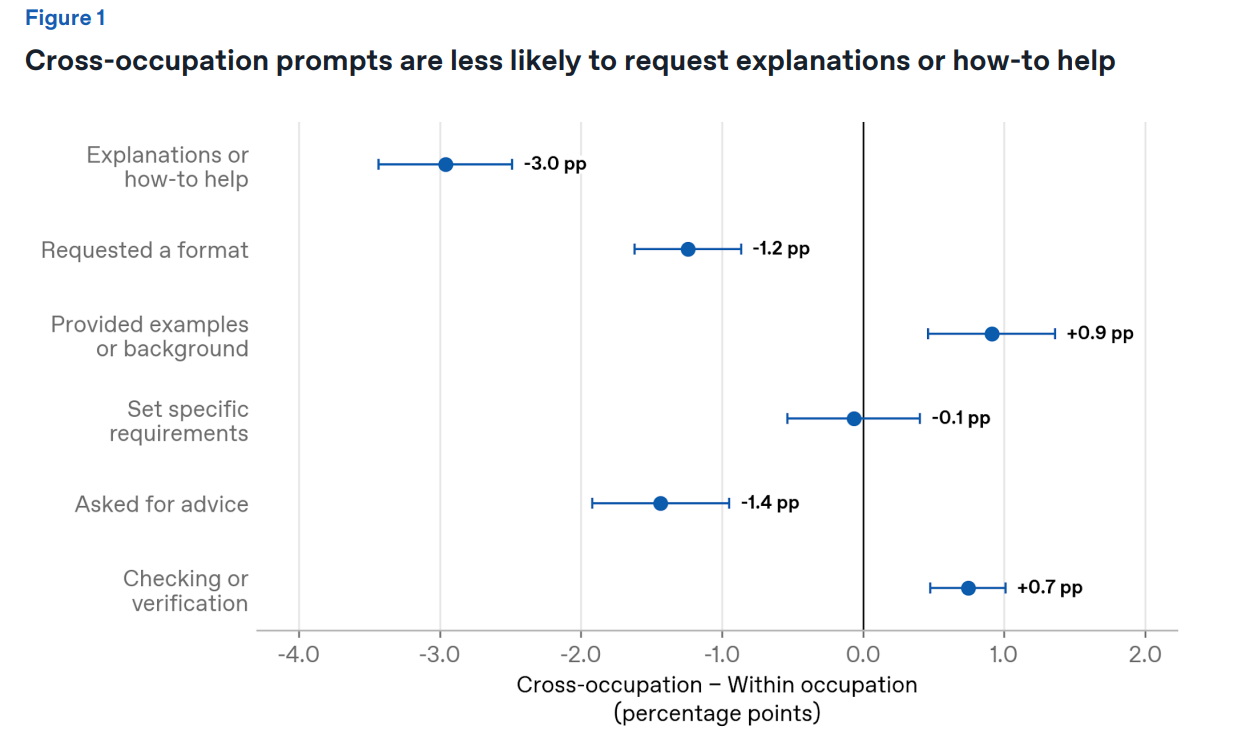
Researchers explain that if someone genuinely wants to learn a new skill, the typical approach would be to ask AI how to go about it. However, these users seem more inclined to say, "That's roughly the situation—just help me get it done."
The report even coined a specific term: "borrow expertise"—the professional capabilities borrowed from AI.
OpenAI's report also indicates that as workers leverage AI to perform cross‑functional tasks, activities that were once outside their job descriptions will increasingly become routine, repetitive tasks in their subsequent use of AI.
To this end, OpenAI continuously tracked approximately 6,200 employees. The results showed that cross‑functional tasks—previously tried by the company—accounted for the following shares of its AI‑related work activities: 13.1% in April, rising to 20.5% in May, 24.0% in June, and further increasing to 25.9% in July.
Four months, nearly doubled.
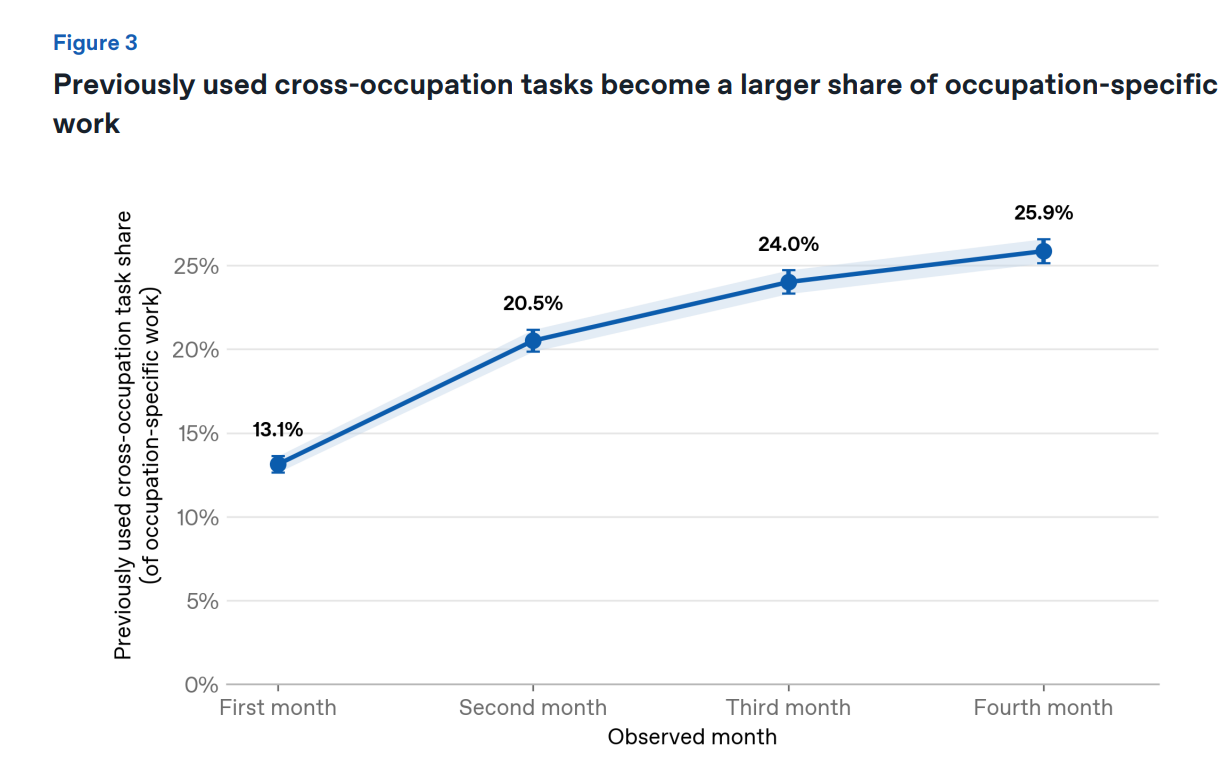
From the perspective of work practices, this indicates that cross‑functional AI tasks are evolving from one‑off experiments into recurring workflows.
OpenAI also drew a more intriguing comparison.
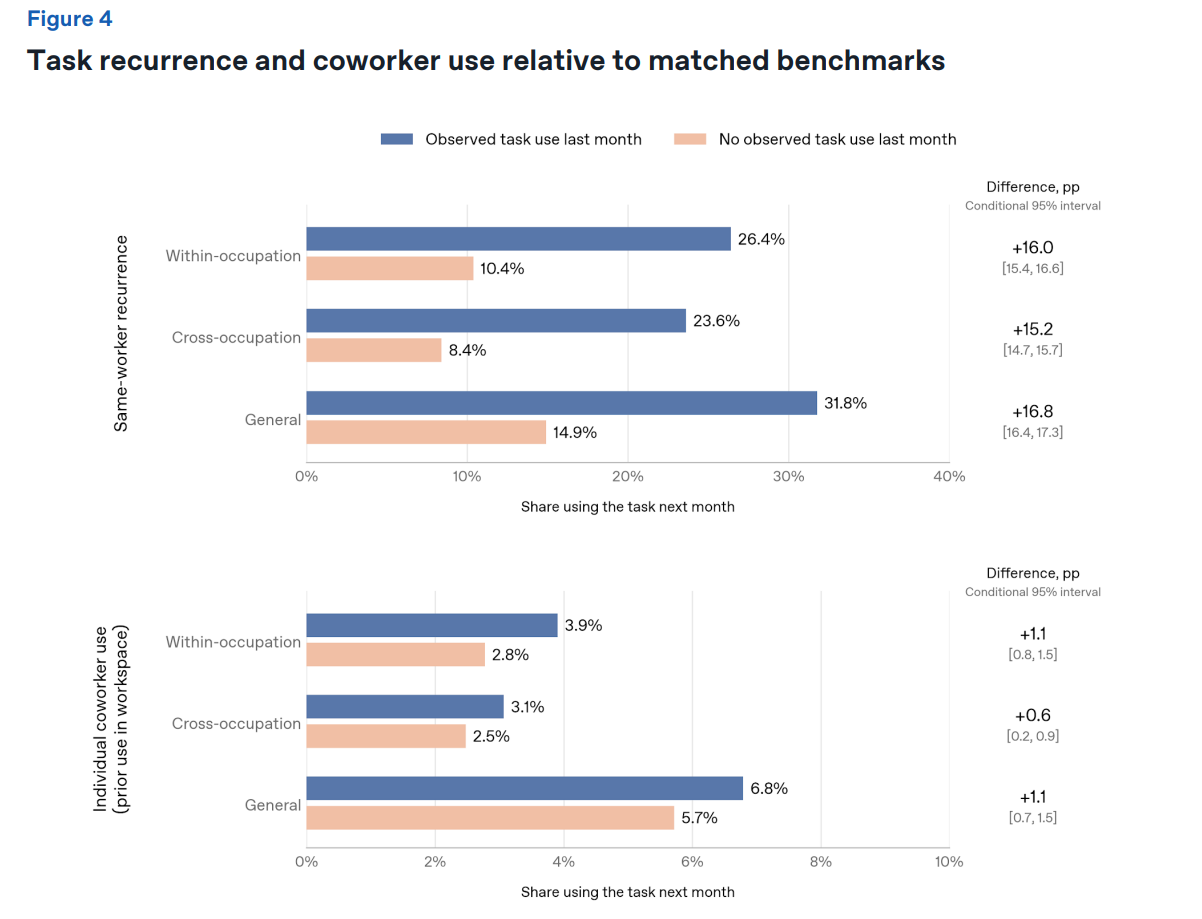
If an employee has already used AI to perform a cross‑functional task this month, the probability that they will use that same task again next month is 23.6%. By contrast, for similar employees who did not use that task in the previous month, the observed probability of using it again next month is only 8.4%.
More subtly, this usage also carries a certain "office‑wide diffusion" quality.
If someone in a workplace is already using AI to perform a cross‑functional task, the likelihood that other colleagues will take on that same task next month is 3.1%; in workplaces where no one else is doing so, the corresponding figure is only 2.5%.
Which tasks are most easily picked up on the fly?
The report also indicates that not all professional tasks are equally easy to cross‑disciplinary.
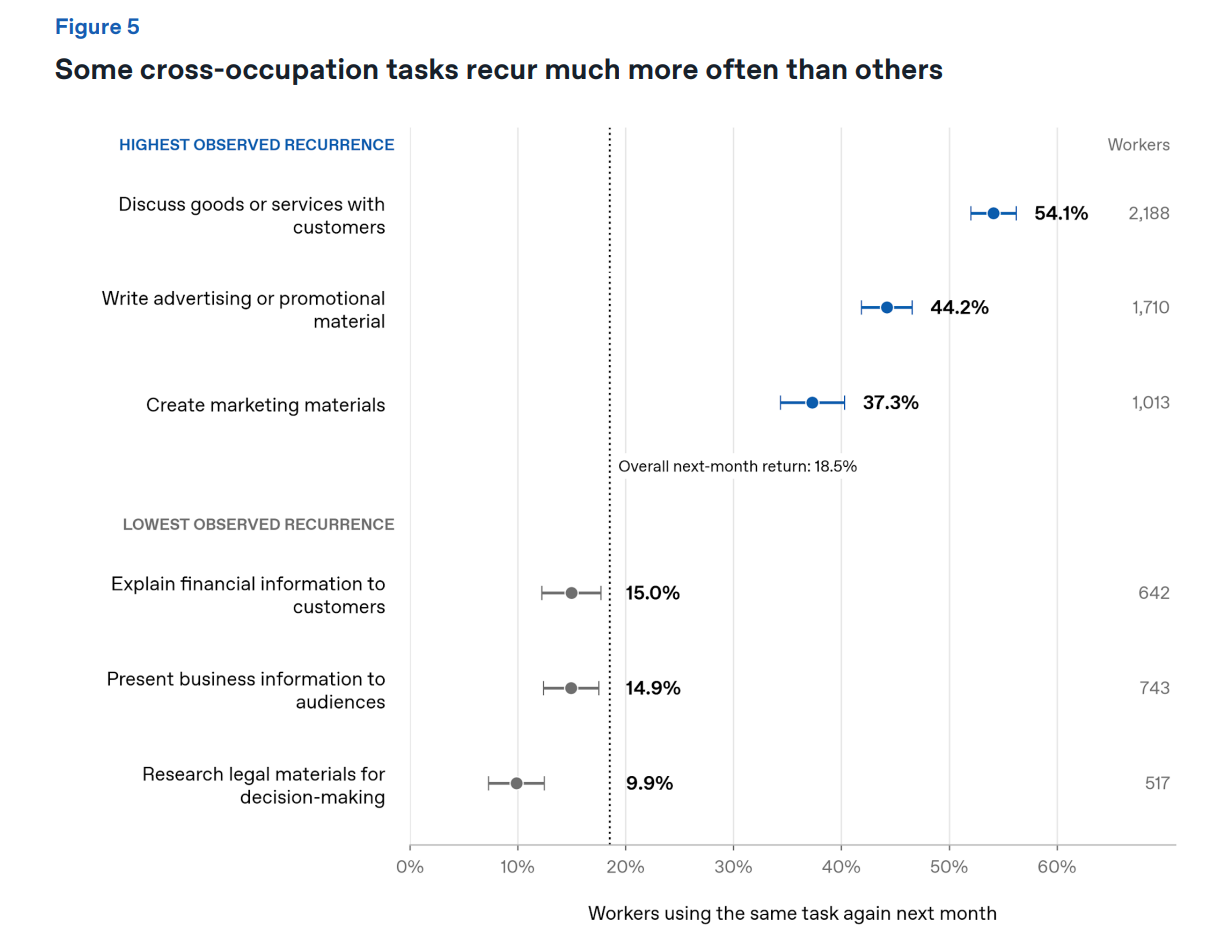
OpenAI calculated the probability that employees would use a particular cross‑functional task again the following month after trying it for the first time. The highest probability was for customer communication, at 54.1%. In other words, more than half of those who used AI to handle customer communication once were likely to do so again the next month.
Other popular areas include advertising or promotional copywriting (44.2%) and the creation of marketing materials (37.3%), among others.
At the other end of the spectrum, the figures are considerably lower—for example, explaining financial information to clients (15.0%), presenting business information (14.9%), and conducting legal research (9.9%).
This also aligns with common workplace intuition, as certain tasks are relatively low‑risk when handled by AI—for example, drafting a marketing email or compiling client‑communication materials. However, when it comes to legal or financial decision‑making, any misstep can have vastly different consequences. That's why AI doesn't uniformly erode the boundaries of every profession.
The OpenAI research team notes that, overall, AI is enabling employees to increasingly work across traditional occupational boundaries and, by "borrowing" expertise from other fields, gradually integrate tasks that were once outside their core roles into everyday workflows. For businesses, this means that an AI strategy goes beyond merely adopting tools; it also requires rethinking task allocation, job design, and which functions still demand the judgment of human professionals.